Introduction to the Seat Ibiza IV ST 1.4 (85 Hp)
The Seat Ibiza IV ST 1.4 (85 Hp) represents a significant offering within the European B-segment (subcompact) market, produced by the Spanish automaker SEAT, a subsidiary of the Volkswagen Group. Launched in 2010 as part of the fourth-generation Ibiza lineup, the “ST” designation signifies its station wagon (or estate) body style, a practical and popular choice for European families and individuals seeking versatility in a compact footprint. This particular variant, powered by a modest yet efficient 1.4-liter gasoline engine delivering 85 horsepower, was designed to cater to the core needs of urban and suburban drivers who prioritized fuel economy, maneuverability, and cargo capacity without sacrificing the engaging driving dynamics SEAT vehicles are known for.
Unlike many of its larger, more performance-oriented siblings or luxury marques from the Volkswagen Group, the Seat Ibiza IV ST was never officially sold in the United States market. Its design and engineering were specifically tailored for the highly competitive European landscape, where smaller, fuel-efficient vehicles with flexible interiors are highly valued. The Ibiza ST, therefore, played a crucial role in SEAT’s portfolio, expanding the appeal of the popular Ibiza hatchback to those requiring more utility, directly competing with other subcompact wagons and hatchbacks across the continent. This article delves into the technical specifications, design philosophy, and market impact of this distinctive European model, using American English terminology for clarity.
Engine & Performance: The Heart of the Seat Ibiza IV ST 1.4 (85 Hp)
At the core of the Seat Ibiza IV ST 1.4 (85 Hp) lies a naturally aspirated 1.4-liter (1390 cm3 or 84.82 cu. in.) inline four-cylinder gasoline engine. This powertrain, code-named BXW or CGGB, is a familiar and robust unit within the Volkswagen Group’s small car architecture, engineered for reliability and economical operation. It features a Double Overhead Camshaft (DOHC) valvetrain with four valves per cylinder, optimizing airflow for combustion efficiency. Fuel is delivered via a multi-port manifold injection system, a proven technology that balances performance with fuel economy.
The engine produces a respectable 85 horsepower at 5000 RPM, translating to a power-per-liter output of 61.2 horsepower per liter. Peak torque stands at 132 Nm (97.36 lb.-ft.) available at 3800 RPM. These figures, while not indicative of a performance car, are perfectly adequate for the Ibiza ST’s intended purpose: urban commuting and comfortable highway cruising within European speed limits. Power is sent to the front wheels via a five-speed manual transmission, a common and efficient setup for vehicles in this class, offering the driver direct control and contributing to the car’s overall light weight.
In terms of straight-line performance, the Ibiza IV ST 1.4 (85 Hp) accelerates from 0 to 60 mph in a calculated 11.8 seconds (0-100 km/h in 12.4 seconds) and reaches a top speed of 109.98 mph (177 km/h). These numbers align with its classification as an economical, practical subcompact. Fuel efficiency was a key selling point in its primary market, with a combined NEDC cycle rating of 39.9 US mpg (5.9 l/100 km). Urban consumption was rated at 29.4 US mpg (8 l/100 km) and extra-urban at an impressive 50 US mpg (4.7 l/100 km). With CO2 emissions of 139 g/km, the vehicle met the Euro 5 emission standard, reflecting its environmental consciousness for the era. The engine’s modest 10.5:1 compression ratio and 3.2-liter oil capacity (3.38 US quarts) further underscore its design for everyday usability and ease of maintenance.
Design & Features: Practicality Meets Spanish Flair
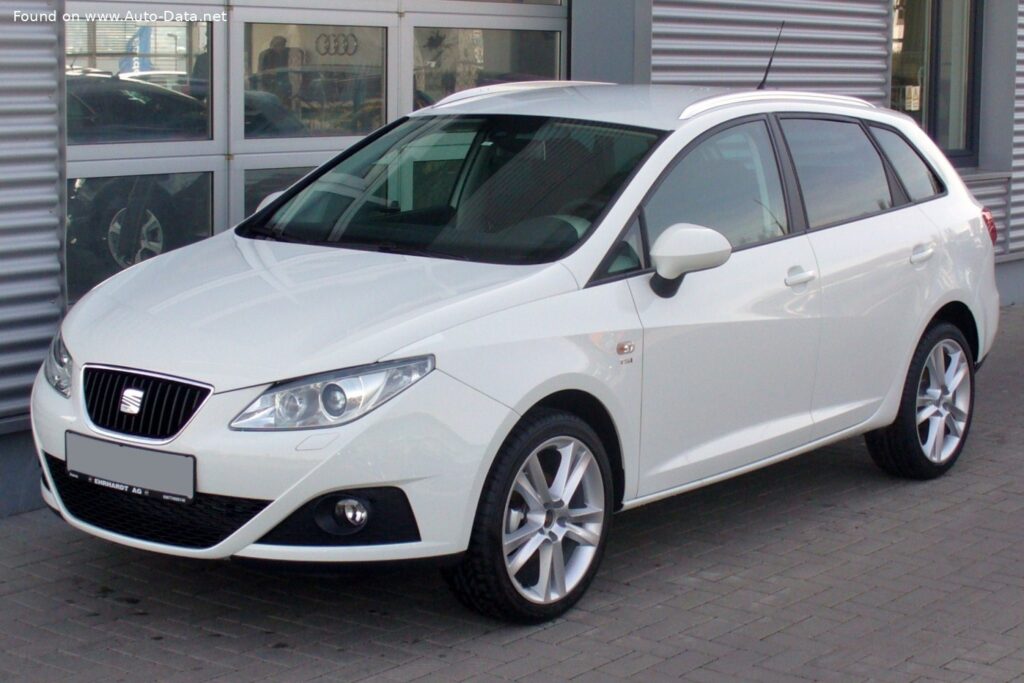
The Seat Ibiza IV ST 1.4 (85 Hp) adopts a five-door station wagon (estate) body type, a design choice that significantly enhances its practicality over the standard Ibiza hatchback. Measuring 166.42 inches (4227 mm) in length, 66.65 inches (1693 mm) in width, and 56.89 inches (1445 mm) in height, the ST variant is noticeably longer than its hatchback counterpart, primarily to accommodate an expanded cargo area. The wheelbase of 97.2 inches (2469 mm) provides a stable ride and contributes to interior space for its five occupants.
Visually, the Ibiza ST retains SEAT’s characteristic dynamic styling, often described as having a “Spanish flair” compared to its more conservative Volkswagen Group siblings. Sharp lines, a distinctive grille, and angular headlights give it a youthful and sporty appearance, even in its utilitarian station wagon form. The extended roofline flows smoothly into a practical tailgate, offering excellent access to the cargo bay. Inside, the focus is on ergonomic design and functionality. The cabin provides seating for five, with a particular emphasis on maximizing usable space. The minimum trunk (boot) space of 15.19 cu. ft. (430 liters) is highly competitive for its segment, making it a viable option for small families or those needing extra luggage capacity for trips.
Underneath its stylish exterior, the Ibiza ST is built on the Volkswagen Group’s PQ25 platform, shared with other successful subcompacts like the Volkswagen Polo and Skoda Fabia. This robust architecture provides a solid foundation for its driving dynamics. The suspension setup features an independent McPherson type with coil springs and an anti-roll bar at the front, while the rear utilizes a semi-dependent beam with a stabilizer for lateral stability. This combination ensures a comfortable ride while maintaining agile handling, crucial for navigating European city streets. Braking is handled by ventilated discs at the front (256×22 mm) and solid discs at the rear (232×9 mm), complemented by an Anti-lock Braking System (ABS) for enhanced safety. The electric power steering system, with its rack and pinion setup, offers light and precise control, aiding maneuverability with a minimum turning circle of 34.38 feet (10.48 m). Tire options included 185/60 R15 or 215/45 R16, mounted on 6J x 15 or 7J x 16 wheel rims, respectively, allowing for a balance between ride comfort and grip.
Technical Specifications: Seat Ibiza IV ST 1.4 (85 Hp)
| General Information | |
|---|---|
| Brand | Seat |
| Model | Ibiza |
| Generation | Ibiza IV ST |
| Type (Engine) | 1.4 (85 Hp) |
| Start of Production | 2010 year |
| End of Production | 2012 year |
| Powertrain Architecture | Internal Combustion engine |
| Body Type | Station wagon (estate) |
| Seats | 5 |
| Doors | 5 |
| Performance Specifications | |
| Fuel Consumption (Economy) – Urban (NEDC) | 8 l/100 km (29.4 US mpg) |
| Fuel Consumption (Economy) – Extra Urban (NEDC) | 4.7 l/100 km (50 US mpg) |
| Fuel Consumption (Economy) – Combined (NEDC) | 5.9 l/100 km (39.9 US mpg) |
| CO2 Emissions (NEDC) | 139 g/km |
| Fuel Type | Petrol (Gasoline) |
| Acceleration 0 – 60 mph | 11.8 sec |
| Acceleration 0 – 100 km/h | 12.4 sec |
| Maximum Speed | 177 km/h (109.98 mph) |
| Emission Standard | Euro 5 |
| Weight-to-Power Ratio | 12.4 kg/Hp (27.34 lbs/Hp) |
| Weight-to-Torque Ratio | 8 kg/Nm |
| Engine Specifications | |
| Power | 85 Hp @ 5000 rpm |
| Power per Liter | 61.2 Hp/l |
| Torque | 132 Nm @ 3800 rpm (97.36 lb.-ft. @ 3800 rpm) |
| Engine Layout | Front, Transverse |
| Engine Model/Code | BXW, CGGB |
| Engine Displacement | 1390 cm3 (84.82 cu. in.) |
| Number of Cylinders | 4 |
| Engine Configuration | Inline |
| Cylinder Bore | 76.5 mm (3.01 in.) |
| Piston Stroke | 75.6 mm (2.98 in.) |
| Compression Ratio | 10.5:1 |
| Number of Valves per Cylinder | 4 |
| Fuel Injection System | Multi-port manifold injection |
| Engine Aspiration | Naturally aspirated engine |
| Valvetrain | DOHC |
| Engine Oil Capacity | 3.2 l (3.38 US qt) |
| Coolant Capacity | 5.6 l (5.92 US qt) |
| Space, Volume and Weights | |
| Kerb Weight | 1055 kg (2325.88 lbs) |
| Max. Weight | 1570 kg (3461.26 lbs) |
| Max Load | 515 kg (1135.38 lbs) |
| Trunk (boot) Space – Minimum | 430 l (15.19 cu. ft.) |
| Fuel Tank Capacity | 45 l (11.89 US gal) |
| Permitted Trailer Load with Brakes (12%) | 1000 kg (2204.62 lbs) |
| Dimensions | |
| Length | 4227 mm (166.42 in.) |
| Width | 1693 mm (66.65 in.) |
| Height | 1445 mm (56.89 in.) |
| Wheelbase | 2469 mm (97.2 in.) |
| Front Track | 1465 mm (57.68 in.) |
| Rear (Back) Track | 1457 mm (57.36 in.) |
| Minimum Turning Circle (Turning Diameter) | 10.48 m (34.38 ft.) |
| Drivetrain, Brakes and Suspension Specifications | |
| Drivetrain Architecture | Internal combustion engine (ICE) drives the front wheels. |
| Drive Wheel | Front wheel drive |
| Number of Gears and Type of Gearbox | 5 gears, manual transmission |
| Front Suspension | Independent, type McPherson with coil spring and anti-roll bar |
| Rear Suspension | Semi-dependent beam with stabilizer lateral stability |
| Front Brakes | Ventilated discs, 256×22 mm |
| Rear Brakes | Disc, 232×9 mm |
| Assisting Systems | ABS (Anti-lock braking system) |
| Steering Type | Steering rack and pinion |
| Power Steering | Electric Steering |
| Tires Size | 185/60 R15; 215/45 R16 |
| Wheel Rims Size | 6J x 15; 7J x 16 |
Legacy & Market Impact of the Seat Ibiza IV ST
The Seat Ibiza IV ST, particularly the 1.4 (85 Hp) variant, carved out a significant niche in the highly competitive European subcompact segment from its production start in 2010 to its conclusion in 2012. While it never graced American showrooms, its impact across Europe was substantial, reinforcing SEAT’s reputation as a brand offering stylish, practical, and dynamically engaging vehicles derived from proven Volkswagen Group engineering.
In its primary market, the Ibiza ST was a compelling alternative to more conventional hatchbacks, providing minivan-like practicality in a more car-like package. Its main competitors included other B-segment wagons and highly versatile hatchbacks such as the Skoda Fabia Combi (sharing its platform), the Renault Clio Estate, the Peugeot 207 SW, and later, the Kia Cee’d SW. The Ibiza ST distinguished itself with its distinctive “Arrow Design” aesthetic, which injected a youthful and sporty character into the often-staid station wagon segment. This design appeal, combined with SEAT’s emphasis on driving enjoyment, helped it stand out.
The 1.4 (85 Hp) engine variant, though not a powerhouse, was perfectly suited for the demands of European driving. Its excellent fuel economy (nearly 40 US mpg combined) and Euro 5 emissions compliance made it an attractive option for budget-conscious buyers and those facing stricter urban emission regulations. The engine’s reliability and low running costs, inherited from Volkswagen Group’s extensive parts bin, further enhanced its appeal. For many European families, the Ibiza ST offered a pragmatic solution: enough space for groceries, luggage, or even a small pet, without the bulk or higher running costs of a larger vehicle. Its compact dimensions and tight turning circle (34.38 ft) also made it ideal for navigating crowded city streets and tight parking spaces, a common challenge in European urban environments.
The Ibiza IV ST’s legacy is rooted in its successful blend of form and function. It demonstrated that a subcompact car could be both stylish and highly practical, challenging the perception that station wagons were solely utilitarian. It contributed to SEAT’s brand identity as a purveyor of “auto emoción”—cars that evoke emotion through design and driving dynamics. Although the station wagon variant of the Ibiza was eventually discontinued in subsequent generations as market trends shifted towards SUVs and crossovers, the Ibiza IV ST remains a testament to a period when compact wagons were a sensible and popular choice, embodying the efficient, versatile, and spirited spirit of European motoring. Its engineering prowess and thoughtful design ensured it was a valued and respected player in its segment during its production run, leaving a lasting impression on the SEAT brand’s development.