The Skoda Octavia III Combi RS 2.0 TSI (220 Hp) DSG: A European Performance Wagon
The Skoda Octavia, a cornerstone of the Czech automaker’s lineup, has long been revered in Europe for its pragmatic blend of space, value, and robust engineering, largely thanks to its Volkswagen Group parentage. Introduced for the third generation (Type 5E) in 2013, the Octavia Combi (station wagon) further cemented its reputation, offering expansive cargo capacity alongside a comfortable ride. However, it was the RS variant, specifically the Skoda Octavia III Combi RS 2.0 TSI (220 Hp) DSG, that truly captured the imagination of driving enthusiasts seeking a practical family vehicle with a significant punch. This model, produced from 2013 to 2017, represented a compelling proposition in its primary European market: a “hot wagon” that seamlessly integrated everyday usability with genuine sporting prowess, a formula less common in the United States but highly prized across the Atlantic.
The Octavia III Combi RS shared its underpinnings with other celebrated performance vehicles within the VW Group, notably the Volkswagen Golf GTI and Audi A3. This common platform allowed Skoda to leverage proven technology, including a potent turbocharged gasoline engine and a sophisticated dual-clutch automatic transmission, while offering it in a more capacious and often more value-oriented package. The RS designation has always signified Skoda’s commitment to performance, and this generation was no exception, delivering a driving experience that belied its family-friendly appearance.
Engine & Performance: The Heart of the Skoda Octavia III Combi RS 2.0 TSI (220 Hp) DSG
At the core of the Skoda Octavia III Combi RS 2.0 TSI (220 Hp) DSG lies a powerplant renowned across the Volkswagen Group: the EA888 series 2.0-liter turbocharged inline-four engine, specifically identified by the CHHB code for this application. This sophisticated engine, featuring both direct and multi-port manifold fuel injection, a turbocharger, and an intercooler, delivered a healthy 220 horsepower at a broad range of 4500-6200 rpm. More impressively for daily driving and spirited acceleration, it produced a robust 258.15 lb.-ft. of torque, available from a remarkably low 1500 rpm and sustained up to 4400 rpm. This wide torque band ensured responsive acceleration across virtually the entire rev range.
Power was efficiently channeled to the front wheels via a 6-speed automatic DSG (Direct Shift Gearbox) transmission. This dual-clutch unit was celebrated for its lightning-fast shifts and seamless power delivery, contributing significantly to the car’s dynamic character. The combination of the potent engine and quick-shifting DSG allowed the Octavia RS Combi to accelerate from 0 to 60 mph in a swift 6.7 seconds (calculated by Auto-Data.net) and reach a top speed of 150.37 mph. These figures placed it firmly in the realm of genuine performance cars, while its station wagon body provided unparalleled practicality.
Despite its performance capabilities, the 2.0 TSI engine also demonstrated commendable efficiency for its class. The combined fuel economy was rated at 36.8 US mpg, an impressive figure for a vehicle offering this level of power and space. This was aided by features like the Start & Stop System, which automatically shut off the engine when stationary to conserve fuel and reduce emissions. The vehicle met the stringent Euro 6 emission standard, reflecting its contemporary environmental considerations for the European market.
Design & Features: Practicality Meets Sportiness
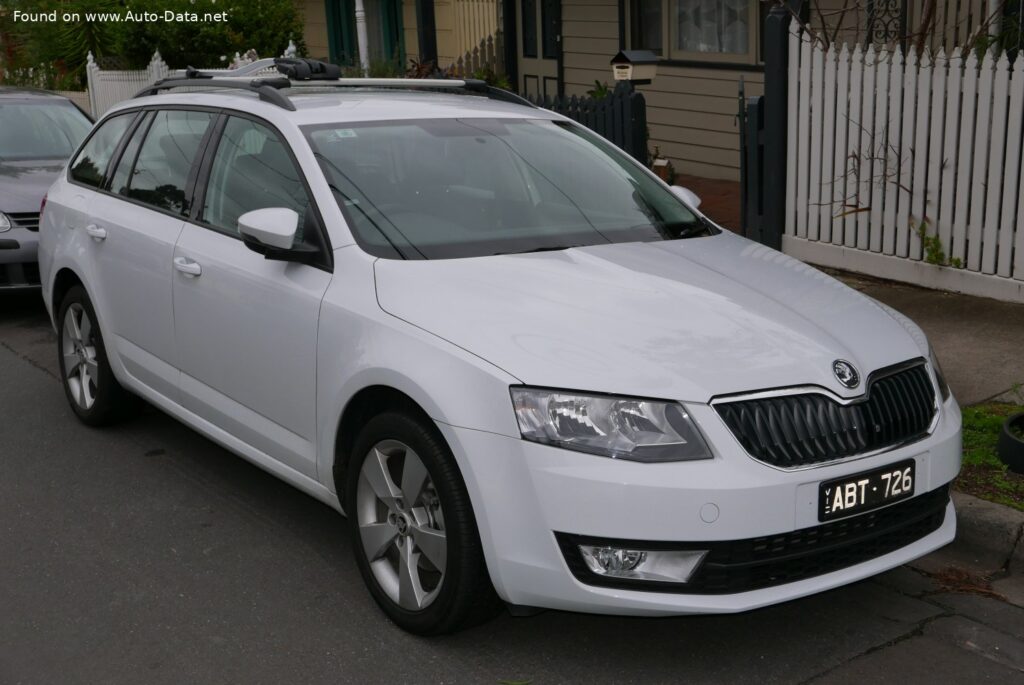
The Skoda Octavia III Combi RS presented a compelling aesthetic that subtly hinted at its performance capabilities without resorting to overt aggression. The station wagon (Combi) body type inherently offered immense practicality, making it an ideal choice for families or individuals requiring significant cargo space. With a minimum trunk volume of 21.54 cubic feet (610 liters) and a cavernous 61.45 cubic feet (1740 liters) with the rear seats folded, the Octavia RS Combi could swallow vast amounts of luggage, sports equipment, or groceries with ease.
Distinguishing the RS from standard Octavia models were several key design elements. These included more aggressive front and rear bumpers, a unique grille with RS badging, larger alloy wheels (available in 17-inch or 19-inch sizes), and often red brake calipers. Inside, the RS treatment continued with sport seats offering enhanced bolstering, a flat-bottom steering wheel, distinctive trim accents, and RS-specific instrumentation. The overall cabin design was functional and ergonomic, typical of Volkswagen Group vehicles, with a focus on high-quality materials and intuitive controls.
Underneath, the Octavia RS featured a sophisticated chassis setup designed to handle its increased power. It utilized an independent McPherson strut front suspension with a coil spring and anti-roll bar, paired with an independent multi-link spring suspension with a stabilizer at the rear. This configuration provided a balanced ride, combining comfort for long journeys with agile handling for spirited driving. Braking performance was ensured by ventilated discs at the front and disc brakes at the rear, complemented by ABS (Anti-lock Braking System) for enhanced safety. Electric power steering provided precise feedback and ease of maneuverability, contributing to a confident driving experience.
Technical Specifications
| Category | Specification |
|---|---|
| Brand | Skoda |
| Model | Octavia |
| Generation | Octavia III Combi |
| Type (Engine) | RS 2.0 TSI (220 Hp) DSG |
| Production Start | 2013 |
| Production End | 2017 |
| Powertrain Architecture | Internal Combustion Engine |
| Body Type | Station wagon (estate), 5 Doors, 5 Seats |
| Performance Specs | |
| Fuel Consumption (Urban) | 8.1 l/100 km (29 US mpg) |
| Fuel Consumption (Extra Urban) | 5.4 l/100 km (43.6 US mpg) |
| Fuel Consumption (Combined) | 6.4 l/100 km (36.8 US mpg) |
| CO2 Emissions | 149 g/km |
| Fuel Type | Petrol (Gasoline) |
| Acceleration 0-60 mph | 6.7 seconds |
| Acceleration 0-62 mph (0-100 km/h) | 7.1 seconds |
| Maximum Speed | 150.37 mph (242 km/h) |
| Emission Standard | Euro 6 |
| Weight-to-Power Ratio | 6.3 kg/Hp (158.6 Hp/tonne) |
| Weight-to-Torque Ratio | 4 kg/Nm (252.3 Nm/tonne) |
| Engine Specs | |
| Power | 220 Hp @ 4500-6200 rpm |
| Power per liter | 110.9 Hp/l |
| Torque | 258.15 lb.-ft. (350 Nm) @ 1500-4400 rpm |
| Engine Layout | Front, Transverse |
| Engine Model/Code | EA888 / CHHB |
| Engine Displacement | 121.07 cu. in. (1984 cm³) |
| Number of Cylinders | 4, Inline |
| Cylinder Bore | 3.25 in. (82.5 mm) |
| Piston Stroke | 3.65 in. (92.8 mm) |
| Compression Ratio | 9.6:1 |
| Valves per Cylinder | 4 |
| Fuel Injection System | Direct injection and Multi-port manifold injection |
| Engine Aspiration | Turbocharger, Intercooler |
| Valvetrain | DOHC |
| Engine Oil Capacity | 6.02 US qt (5.7 l) |
| Coolant Capacity | 9.09 US qt (8.6 l) |
| Engine Systems | Start & Stop System |
| Space, Volume and Weights | |
| Kerb Weight | 3057.81 lbs. (1387 kg) |
| Max. Weight | 4305.63 lbs. (1953 kg) |
| Max Load | 1247.82 lbs. (566 kg) |
| Trunk Space (minimum) | 21.54 cu. ft. (610 l) |
| Trunk Space (maximum) | 61.45 cu. ft. (1740 l) |
| Fuel Tank Capacity | 13.21 US gal (50 l) |
| Permitted Trailer Load with Brakes (12%) | 3527.4 lbs. (1600 kg) |
| Permitted Trailer Load without Brakes | 1609.37 lbs. (730 kg) |
| Dimensions | |
| Length | 184.45 in. (4685 mm) |
| Width | 71.42 in. (1814 mm) |
| Width including mirrors | 79.41 in. (2017 mm) |
| Height | 57.17 in. (1452 mm) |
| Wheelbase | 105.51 in. (2680 mm) |
| Front Track | 60.43 in. (1535 mm) |
| Rear Track | 59.29 in. (1506 mm) |
| Front Overhang | 35.39 in. (899 mm) |
| Rear Overhang | 43.54 in. (1106 mm) |
| Ride Height (Ground Clearance) | 5 in. (127 mm) |
| Minimum Turning Circle | 36.52 ft. (11.13 m) |
| Approach Angle | 12.8° |
| Departure Angle | 12.3° |
| Drivetrain, Brakes and Suspension Specs | |
| Drivetrain Architecture | Internal combustion engine drives the front wheels. |
| Drive Wheel | Front-wheel drive |
| Gearbox | 6 gears, automatic transmission DSG |
| Front Suspension | Independent, McPherson with coil spring and anti-roll bar |
| Rear Suspension | Independent multi-link spring suspension with stabilizer |
| Front Brakes | Ventilated discs |
| Rear Brakes | Disc |
| Assisting Systems | ABS (Anti-lock braking system) |
| Steering Type | Steering rack and pinion |
| Power Steering | Electric Steering |
| Tires Size | 225/45 R17; 225/35 R19 |
| Wheel Rims Size | 7.5J x 17; 7.5J x 19 |
Legacy & Market Impact
The Skoda Octavia III Combi RS, particularly the 2.0 TSI (220 Hp) DSG variant, carved out a significant niche for itself in the European automotive landscape. It was widely regarded as a “sleeper” or a “performance bargain,” offering a compelling mix of practicality, performance, and value that few rivals could match. Its primary competitors in its segment included other hot wagons or performance-oriented family cars such as the Ford Focus ST Estate (Combi), the SEAT Leon ST Cupra, and, to some extent, the Volkswagen Golf R Variant, though the latter often commanded a higher price point and offered all-wheel drive.
What set the Octavia RS apart was its ability to blend these attributes so seamlessly. Families could appreciate the vast trunk space, comfortable seating for five, and reasonable fuel economy for daily commutes. Enthusiasts, on the other hand, found joy in the potent 2.0-liter turbocharged engine, the crisp shifts of the DSG transmission, and the surprisingly engaging handling dynamics. It was a car that could effortlessly transition from school runs and grocery hauls to exhilarating weekend drives on winding roads.
The Octavia RS played a crucial role in elevating Skoda’s brand image from a manufacturer of purely utilitarian vehicles to one capable of producing genuinely desirable cars with a sporting edge. It demonstrated that Skoda, under the Volkswagen Group’s stewardship, could deliver not just reliability and value, but also excitement and advanced technology. Its historical significance lies in its contribution to popularizing the “hot wagon” concept in Europe, proving that performance doesn’t have to come at the expense of everyday utility.
Even after its production run ended in 2017, the Skoda Octavia III Combi RS 2.0 TSI (220 Hp) DSG remains a sought-after used vehicle in Europe, a testament to its enduring appeal and the well-executed balance of its design and engineering. It stands as a prime example of Skoda’s maturation and its successful strategy of offering compelling vehicles that punch above their weight class, providing a unique blend of German engineering with a distinctive Czech character.