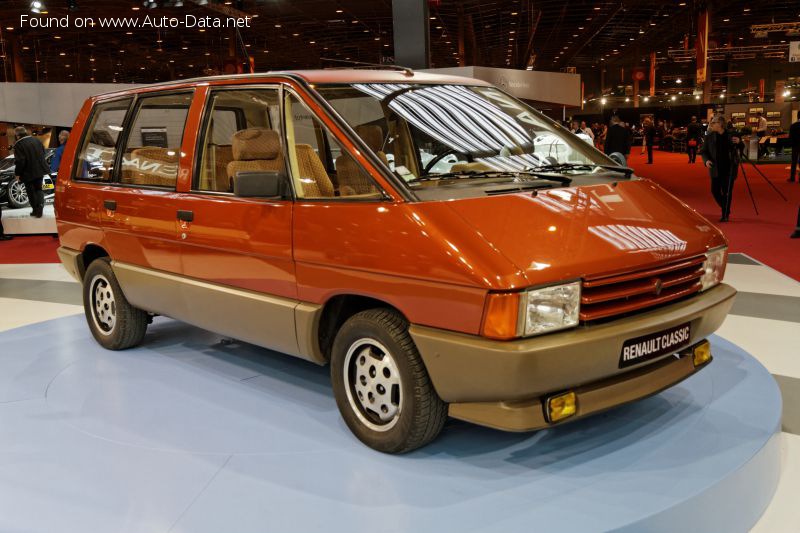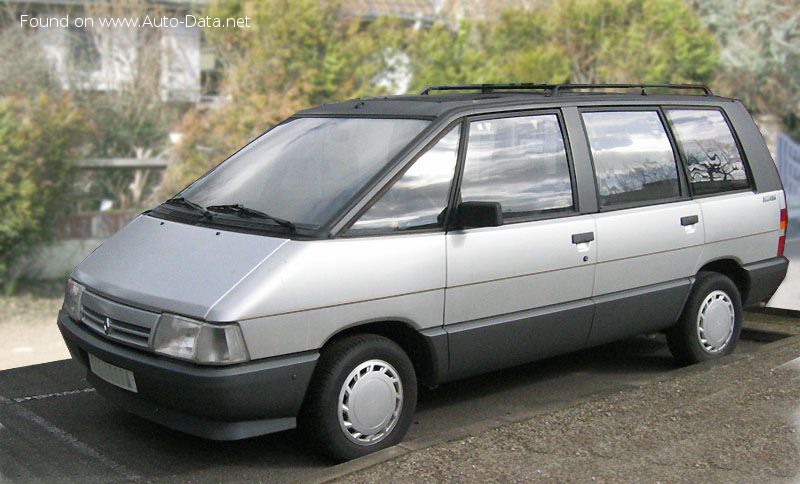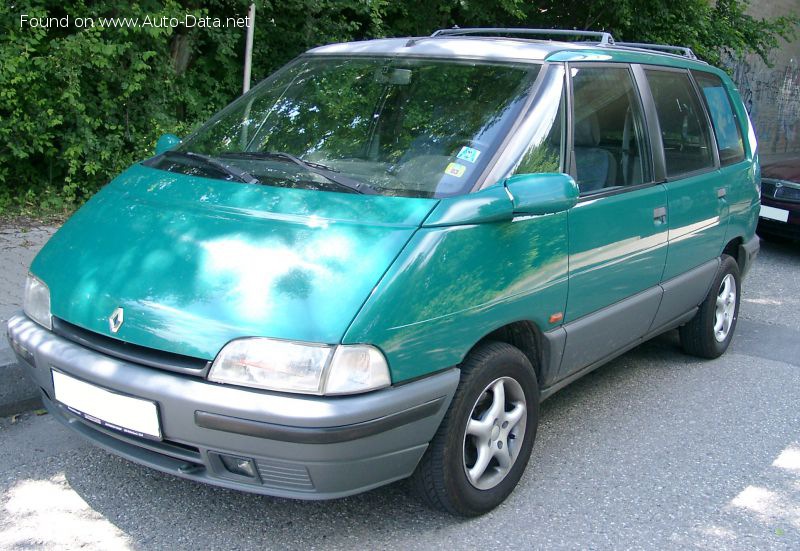
The Renault Espace II (J63) 2.2i (107 Hp) Quadra: A European Family Innovator
The Renault Espace II (J63) 2.2i (107 Hp) Quadra represents the second generation of Renault’s pioneering multi-purpose vehicle (MPV), a segment that the original Espace largely helped to define and popularize in Europe. Produced from 1991 to 1996, the Espace II built upon the revolutionary “monobox” design and modular interior concept of its predecessor, refining its styling, improving its ergonomics, and enhancing its overall driving dynamics. While the Renault Espace was never officially sold in the United States, it played a crucial role in shaping the family vehicle landscape across Europe and other international markets, offering a compelling alternative to traditional station wagons and sedans for larger families or those requiring exceptional cargo versatility. The specific 2.2i (107 Hp) Quadra variant was particularly notable for integrating an all-wheel-drive (AWD) system, a relatively uncommon feature for an MPV of its era, providing enhanced traction and stability, especially in adverse weather conditions or on less-than-perfect roads. This blend of practicality, innovative design, and added capability made the Espace II Quadra a distinctive offering in the early 1990s European automotive market.
Powertrain and Performance Characteristics
Underpinning the Espace II (J63) 2.2i (107 Hp) Quadra was a robust and proven powertrain designed for reliability and adequate performance for its intended family-hauling duties. The vehicle was equipped with a 2.2-liter (2165 cm³ or 132.12 cu. in.) inline-four gasoline engine, internally designated as the J7T. This naturally aspirated unit featured a single overhead camshaft (OHC) and a multi-port manifold fuel injection system, a common and efficient setup for the period. It produced a respectable 107 horsepower (Hp) at 5000 revolutions per minute (rpm) and delivered 125.39 lb.-ft. (170 Nm) of torque at a relatively low 3500 rpm. This torque delivery profile was well-suited for a vehicle of its type, providing sufficient pulling power for city driving and highway cruising, even when fully loaded.
A key differentiator for the Quadra model was its all-wheel-drive system, which provided improved grip and confidence compared to the standard front-wheel-drive variants. Power was channeled through a 5-speed manual transmission, offering direct engagement and control for the driver. In terms of acceleration, the Espace II 2.2i Quadra could achieve 0 to 60 mph in approximately 13.2 seconds, with a top speed of 105.63 mph (170 km/h). While these figures might not suggest a performance-oriented vehicle, they were entirely competitive for a minivan in the early 1990s, especially one equipped with an AWD system and a curb weight of 3152.61 lbs. (1430 kg). Fuel economy for the combined cycle was rated at 22.8 US mpg (10.3 liters per 100 km), which was a reasonable figure considering the vehicle’s size, weight, and drivetrain complexity for its time. The engine’s longitudinal layout was also somewhat unusual for a front-engined, front-wheel-drive-based platform, but it facilitated the integration of the Quadra all-wheel-drive system.
Design Philosophy and Interior Versatility
The design of the Renault Espace II (J63) continued the distinctive “monobox” silhouette that had made its predecessor so recognizable. Its exterior dimensions, measuring 174.37 inches (4429 mm) in length, 70.67 inches (1795 mm) in width (81.1 inches or 2060 mm including mirrors), and 67.05 inches (1703 mm) in height, created a spacious and airy cabin. The wheelbase of 101.57 inches (2580 mm) contributed to a stable ride and maximized interior volume. The Espace II featured a more rounded and aerodynamic design compared to the first generation, aligning with contemporary automotive trends of the early 1990s.
However, the true brilliance of the Espace II, and indeed the Espace line, lay in its interior versatility. As a 5-door MPV/minivan, it was designed to accommodate up to seven occupants. The seating arrangement was highly flexible, allowing the rear seats to be individually removed, folded, or reconfigured to prioritize either passenger comfort or cargo capacity. This modularity was a revolutionary concept for family vehicles and offered unparalleled practicality. With all seats in place, the trunk space was a modest 8.83 cu. ft. (250 liters), but with the rear seats removed, it could expand to an enormous 105.94 cu. ft. (3000 liters), transforming the Espace into a highly capable cargo hauler.
The vehicle’s chassis featured a double wishbone front suspension and a semi-independent, coil spring rear suspension, providing a comfortable ride quality suitable for long family journeys. Braking was handled by ventilated discs at the front and solid discs at the rear, ensuring adequate stopping power. A hydraulic power steering system with a rack and pinion setup made maneuvering the Espace relatively easy despite its size, with a minimum turning circle of 38.06 ft. (11.60 m). Standard tire size was 195/65 R15 on 15-inch wheel rims, a common specification for family vehicles of the era, balancing comfort, grip, and cost. Practical features like a 20.34 US gallon (77 liter) fuel tank, a maximum roof load of 132.28 lbs. (60 kg), and a permitted trailer load with brakes of 3505.35 lbs. (1590 kg) further underscored its utility as a versatile family and utility vehicle.
Technical Specifications Overview
| Category | Specification | Value |
|---|---|---|
| General Information | ||
| Brand | Renault | |
| Model | Espace | |
| Generation | Espace II (J63) | |
| Type (Engine) | 2.2i (107 Hp) Quadra | |
| Production Start | 1991 year | |
| Production End | 1996 year | |
| Powertrain Architecture | Internal Combustion engine | |
| Body type | Minivan, MPV | |
| Seats | 7 | |
| Doors | 5 | |
| Performance Specs | ||
| Fuel Consumption (Urban) | 12.5 l/100 km | 18.8 US mpg |
| Fuel Consumption (Extra Urban) | 8.2 l/100 km | 28.7 US mpg |
| Fuel Consumption (Combined) | 10.3 l/100 km | 22.8 US mpg |
| Fuel Type | Petrol (Gasoline) | |
| Acceleration 0 – 60 mph | 13.2 sec | |
| Maximum Speed | 170 km/h | 105.63 mph |
| Weight-to-Power Ratio | 13.4 kg/Hp | 74.8 Hp/tonne |
| Weight-to-Torque Ratio | 8.4 kg/Nm | 118.9 Nm/tonne |
| Engine Specs | ||
| Power | 107 Hp @ 5000 rpm | |
| Power per liter | 49.4 Hp/l | |
| Torque | 170 Nm @ 3500 rpm | 125.39 lb.-ft. @ 3500 rpm |
| Engine Layout | Front, Longitudinal | |
| Engine Model/Code | J7T | |
| Engine Displacement | 2165 cm³ | 132.12 cu. in. |
| Number of Cylinders | 4 | |
| Engine Configuration | Inline | |
| Cylinder Bore | 88 mm | 3.46 in. |
| Piston Stroke | 89 mm | 3.5 in. |
| Compression Ratio | 9.5:1 | |
| Number of Valves per Cylinder | 2 | |
| Fuel Injection System | Multi-port manifold injection | |
| Engine Aspiration | Naturally aspirated engine | |
| Valvetrain | OHC | |
| Engine Oil Capacity | 6 l | 6.34 US qt |
| Coolant Capacity | 8.4 l | 8.88 US qt |
| Space, Volume and Weights | ||
| Kerb Weight | 1430 kg | 3152.61 lbs. |
| Max. Weight | 2170 kg | 4784.03 lbs. |
| Max Load | 740 kg | 1631.42 lbs. |
| Trunk (boot) space – minimum | 250 l | 8.83 cu. ft. |
| Trunk (boot) space – maximum | 3000 l | 105.94 cu. ft. |
| Fuel Tank Capacity | 77 l | 20.34 US gal |
| Max. Roof Load | 60 kg | 132.28 lbs. |
| Permitted Trailer Load with Brakes (12%) | 1590 kg | 3505.35 lbs. |
| Permitted Trailer Load without Brakes | 600 kg | 1322.77 lbs. |
| Dimensions | ||
| Length | 4429 mm | 174.37 in. |
| Width | 1795 mm | 70.67 in. |
| Width including mirrors | 2060 mm | 81.1 in. |
| Height | 1703 mm | 67.05 in. |
| Wheelbase | 2580 mm | 101.57 in. |
| Front Track | 1494 mm | 58.82 in. |
| Rear (Back) Track | 1505 mm | 59.25 in. |
| Front Overhang | 974 mm | 38.35 in. |
| Rear Overhang | 875 mm | 34.45 in. |
| Ride Height (ground clearance) | 165 mm | 6.5 in. |
| Minimum Turning Circle (turning diameter) | 11.60 m | 38.06 ft. |
| Drivetrain, Brakes and Suspension Specs | ||
| Drive Wheel | All wheel drive (4×4) | |
| Number of gears and type of gearbox | 5 gears, manual transmission | |
| Front Suspension | Double wishbone | |
| Rear Suspension | Semi-independent, coil spring | |
| Front Brakes | Ventilated discs | |
| Rear Brakes | Disc | |
| Steering Type | Steering rack and pinion | |
| Power Steering | Hydraulic Steering | |
| Tires Size | 195/65 R15 | |
| Wheel Rims Size | 15 | |
Legacy and Market Influence of the Espace II
The Renault Espace II (J63) continued the legacy of its groundbreaking predecessor, solidifying Renault’s position as a leader in the European MPV segment. The first Espace had essentially created the modern minivan concept for Europe, and the second generation refined this formula, making it more appealing to a broader audience. The Espace II was lauded for its exceptional interior space, innovative modular seating, and comfortable ride, making it a highly desirable family vehicle. It successfully balanced the practicality of a van with the driving dynamics and comfort expected of a passenger car.
The introduction of the Quadra all-wheel-drive variant further enhanced the Espace’s appeal, offering a unique selling proposition in a market where AWD was typically reserved for SUVs or off-road vehicles. This made the Renault Espace II (J63) 2.2i (107 Hp) Quadra a particularly attractive option for families in regions with challenging winter conditions or those who frequently ventured off paved roads, without sacrificing the interior flexibility and comfort of an MPV. While direct competitors in the early 1990s were relatively few in the same segment, the Espace faced indirect competition from larger station wagons and emerging SUV models. The Chrysler Voyager, which was also marketed in Europe, offered a similar proposition but often without the same level of interior modularity or the AWD option found in the Quadra. Later in the decade, joint ventures like the Ford Galaxy/VW Sharan/SEAT Alhambra would emerge, but the Espace had already established a strong foothold.
The Espace II’s success contributed significantly to the mainstream acceptance of the MPV body style in Europe, demonstrating that a family car could be both practical and stylish. Its blend of innovative design, thoughtful engineering, and genuine utility earned it a strong reputation for versatility and comfort. Today, the Espace II is remembered as a pivotal model in the evolution of the MPV, a classic example of Renault’s willingness to innovate, and a testament to the enduring appeal of a well-executed, family-oriented vehicle. Its influence can still be seen in the design and functionality of many contemporary family vehicles, even as the market has largely shifted towards crossovers and SUVs.