The Renault Megane II RS 2.0 16V (224 Hp): A European Hot Hatch Icon
The Renault Megane II RS 2.0 16V (224 Hp), specifically the Phase II model produced from 2006 to 2008, stands as a formidable entry in the highly competitive European hot hatchback segment. Developed by Renault Sport, the performance division of the French automaker, this vehicle was engineered to deliver an exhilarating driving experience, combining everyday usability with track-ready capabilities. While never officially sold in the United States, the Megane RS carved out a significant niche in its primary markets, particularly across Europe, earning a reputation for its sharp handling, potent turbocharged engine, and distinctive styling. It represented a pinnacle of front-wheel-drive performance for its era, challenging established rivals and setting new benchmarks for driver engagement. This particular variant, with its 224 horsepower output, was a refinement of the original Megane II RS, offering enhanced performance and updated aesthetics.
Engine and Performance of the Renault Megane II RS 2.0 16V (224 Hp)
At the heart of the 2006 Renault Megane II RS 2.0 16V (224 Hp) lies a turbocharged 2.0-liter (1998 cm³) inline-four engine, designated as the F4R Turbo. This powerplant was a marvel of engineering for its time, featuring a DOHC (Double Overhead Camshaft) valvetrain with four valves per cylinder, ensuring efficient airflow and combustion. The engine’s aspiration system utilized a turbocharger paired with an intercooler, which significantly boosted power output and torque delivery across a wide RPM range.
The F4R Turbo engine produced a robust 224 horsepower at 5500 rpm, delivering an impressive power-per-liter ratio of 112.1 Hp/l. Torque figures were equally compelling, with 300 Nm (221.27 lb.-ft.) available at a relatively low 3000 rpm. This broad torque band contributed to the car’s remarkable responsiveness and strong in-gear acceleration. Power was sent to the front wheels through a precise 6-speed manual transmission, a choice that underscored its enthusiast-oriented nature and provided drivers with direct control over the engine’s output.
Performance metrics for the Megane II RS were impressive, even by today’s standards. It could sprint from 0 to 60 mph in a swift 6.2 seconds (0-100 km/h in 6.5 seconds), making it one of the quickest front-wheel-drive cars of its generation. The maximum speed was rated at 146.64 mph (236 km/h), demonstrating its capability to sustain high speeds on unrestricted European highways. Despite its performance focus, Renault also paid attention to efficiency for its class, with a combined fuel economy of approximately 28 US mpg (8.4 l/100 km) and CO2 emissions of 199 g/km, adhering to the Euro 4 emission standard. The car’s weight-to-power ratio of 6.1 kg/Hp (162.9 Hp/tonne) further highlighted its athletic prowess.
Design and Features
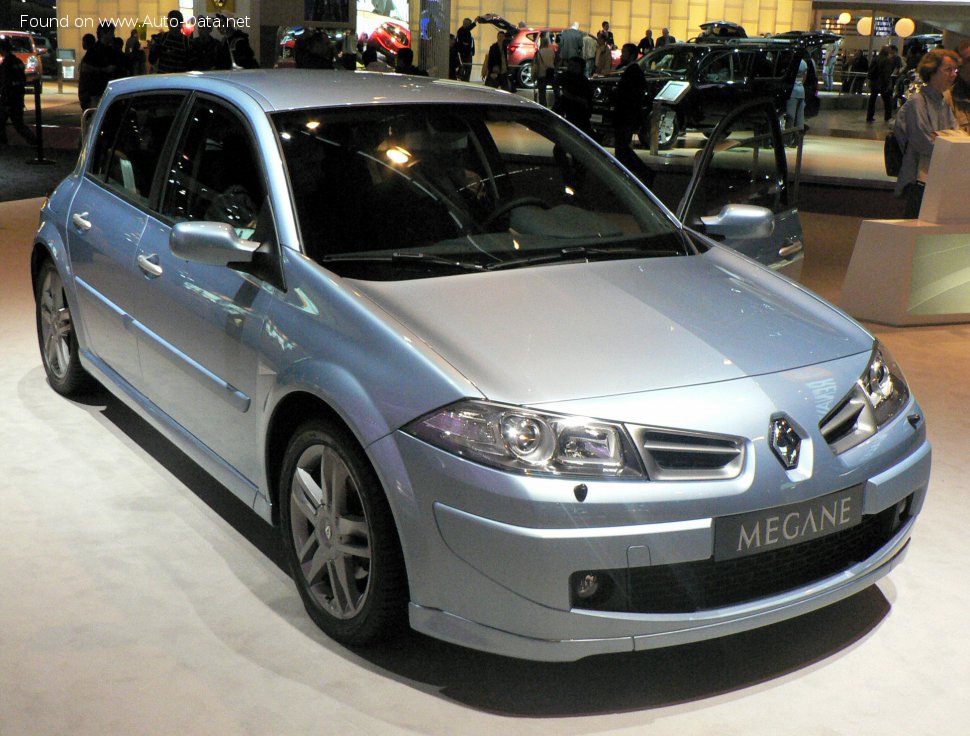
The Renault Megane II RS 2.0 16V (224 Hp) adopted a distinctive 5-door hatchback body style, blending practicality with an aggressive, sporty aesthetic. The Phase II refresh, launched in 2006, brought subtle yet impactful changes to its exterior, including revised headlamps, taillamps, and bumpers, giving it a more modern and assertive presence. The overall design was characterized by its muscular fenders, which housed large 18-inch alloy wheels wrapped in 225/40 R18 tires, and a lower stance compared to standard Megane models. The RS treatment also included unique aerodynamic elements, such as a prominent front spoiler, side skirts, and a rear diffuser, all designed to enhance stability at high speeds and improve airflow.
Inside, the Megane II RS offered a driver-focused cockpit with supportive sports seats, often upholstered in a combination of fabric and leather, providing excellent lateral support during spirited driving. The cabin maintained a functional layout, with clear instrumentation and ergonomic controls. Despite its performance credentials, the car did not compromise on everyday usability, offering seating for five occupants and a versatile cargo area. The trunk space ranged from a practical 11.65 cu. ft. (330 liters) with the rear seats up, expanding to a generous 42.02 cu. ft. (1190 liters) when the rear seats were folded down, making it suitable for a variety of tasks from grocery runs to weekend trips.
Safety features for the era included an Anti-lock Braking System (ABS) as standard, complementing the ventilated disc brakes at the front and disc brakes at the rear. The suspension setup, featuring an independent McPherson type at the front and a torsion beam at the rear, was specifically tuned by Renault Sport for optimal handling and cornering prowess. Electric power steering provided precise feedback, contributing to the car’s agile and engaging feel.
Technical Specifications
| Category | Specification |
|---|---|
| Brand | Renault |
| Model | Megane |
| Generation | Megane II (Phase II, 2006) |
| Type (Engine) | RS 2.0 16V (224 Hp) |
| Production Start | 2006 year |
| Production End | 2008 year |
| Powertrain Architecture | Internal Combustion engine |
| Body type | Hatchback |
| Seats | 5 |
| Doors | 5 |
| Performance Specs | |
| Fuel consumption (economy) – urban | 11.4 l/100 km (20.6 US mpg) |
| Fuel consumption (economy) – extra urban | 6.6 l/100 km (35.6 US mpg) |
| Fuel consumption (economy) – combined | 8.4 l/100 km (28 US mpg) |
| CO2 emissions | 199 g/km |
| Fuel Type | Petrol (Gasoline) |
| Acceleration 0 – 60 mph | 6.2 sec |
| Acceleration 0 – 100 km/h | 6.5 sec |
| Maximum speed | 236 km/h (146.64 mph) |
| Emission standard | Euro 4 |
| Weight-to-power ratio | 6.1 kg/Hp (162.9 Hp/tonne) |
| Weight-to-torque ratio | 4.6 kg/Nm (218.2 Nm/tonne) |
| Engine Specs | |
| Power | 224 Hp @ 5500 rpm |
| Power per liter | 112.1 Hp/l |
| Torque | 300 Nm @ 3000 rpm (221.27 lb.-ft. @ 3000 rpm) |
| Engine layout | Front, Transverse |
| Engine Model/Code | F4R Turbo |
| Engine displacement | 1998 cm³ (121.93 cu. in.) |
| Number of cylinders | 4 |
| Engine configuration | Inline |
| Cylinder Bore | 82.7 mm (3.26 in.) |
| Piston Stroke | 93 mm (3.66 in.) |
| Compression ratio | 9:1 |
| Number of valves per cylinder | 4 |
| Fuel injection system | Multi-port manifold injection |
| Engine aspiration | Turbocharger, Intercooler |
| Valvetrain | DOHC |
| Engine oil capacity | 5.35 l (5.65 US qt) |
| Engine oil specification | Not specified |
| Coolant capacity | 7 l (7.4 US qt) |
| Space, Volume and Weights | |
| Kerb Weight | 1375 kg (3031.36 lbs.) |
| Max. weight | 1820 kg (4012.41 lbs.) |
| Max load | 445 kg (981.06 lbs.) |
| Trunk (boot) space – minimum | 330 l (11.65 cu. ft.) |
| Trunk (boot) space – maximum | 1190 l (42.02 cu. ft.) |
| Fuel tank capacity | 60 l (15.85 US gal) |
| Max. roof load | 80 kg (176.37 lbs.) |
| Permitted trailer load with brakes (12%) | 1000 kg (2204.62 lbs.) |
| Permitted trailer load without brakes | 650 kg (1433 lbs.) |
| Permitted towbar download | 75 kg (165.35 lbs.) |
| Dimensions | |
| Length | 4228 mm (166.46 in.) |
| Width | 1777 mm (69.96 in.) |
| Width including mirrors | 2026 mm (79.76 in.) |
| Height | 1436 mm (56.54 in.) |
| Wheelbase | 2617 mm (103.03 in.) |
| Front track | 1517 mm (59.72 in.) |
| Rear (Back) track | 1521 mm (59.88 in.) |
| Front overhang | 857 mm (33.74 in.) |
| Rear overhang | 754 mm (29.69 in.) |
| Drivetrain, Brakes and Suspension Specs | |
| Drivetrain Architecture | The Internal combustion engine (ICE) drives the front wheels of the vehicle. |
| Drive wheel | Front wheel drive |
| Number of gears and type of gearbox | 6 gears, manual transmission |
| Front suspension | Independent type McPherson |
| Rear suspension | Torsion |
| Front brakes | Ventilated discs |
| Rear brakes | Disc |
| Assisting systems | ABS (Anti-lock braking system) |
| Steering type | Steering rack and pinion |
| Power steering | Electric Steering |
| Tires size | 225/40 R18 |
| Wheel rims size | 18 |
Legacy and Market Impact
The Renault Megane II RS 2.0 16V (224 Hp) cemented Renault Sport’s reputation as a purveyor of some of the finest front-wheel-drive performance cars in the world. Its legacy is deeply rooted in its ability to blend raw performance with exceptional chassis dynamics, making it a favorite among automotive journalists and driving enthusiasts across Europe. In a segment dominated by fierce competition, the Megane RS stood out for its highly communicative steering, finely tuned suspension, and robust turbocharged engine.
Its primary competitors in the European market included formidable hot hatches like the Volkswagen Golf GTI, Ford Focus ST, Honda Civic Type R, and the Opel Astra OPC (Vauxhall Astra VXR in the UK). While each offered their own strengths, the Megane RS was often praised for its superior chassis balance and driver involvement, particularly when equipped with the optional Cup chassis, which featured stiffer springs, dampers, and a limited-slip differential. This made it a formidable weapon on twisty roads and track days, often setting lap records for front-wheel-drive cars at circuits like the Nürburgring Nordschleife.
The Megane II RS’s impact extended beyond just sales figures; it helped to define what a modern hot hatch could be, showcasing that high performance could be achieved without resorting to all-wheel drive or overly complex electronic aids. Its success paved the way for subsequent, even more extreme, iterations of the Megane RS, which continued to push the boundaries of front-wheel-drive performance. Although never sold in the United States, its reputation transcended borders, making it a coveted import for American enthusiasts aware of its capabilities. Today, the Megane II RS is regarded as a modern classic, celebrated for its engaging driving experience, distinctive design, and its significant contribution to the hot hatch genre. It remains a testament to Renault Sport’s engineering prowess and commitment to delivering pure driving exhilaration.