The Opel Senator B 2.6i (150 Hp) Automatic: A European Executive Sedan Legacy
The Opel Senator B 2.6i (150 Hp) Automatic represents the second and final generation of Opel’s flagship executive sedan, a vehicle that held a significant position in the European automotive landscape during its production run from August 1990 to June 1993. As a full-size, rear-wheel-drive sedan, the Senator B was designed to offer a blend of comfort, refinement, and robust engineering, competing in a segment dominated by established players like the Mercedes-Benz E-Class and BMW 5 Series, albeit often at a more accessible price point. Primarily sold in mainland Europe under the Opel badge and in the United Kingdom as the Vauxhall Senator, this model was a testament to GM Europe’s capabilities in producing a sophisticated cruiser tailored for business executives and discerning families. It succeeded the original Senator A and was based on the larger Omega A platform, sharing many mechanical components but distinguishing itself with more upscale styling and a higher level of standard equipment. The 2.6i variant, equipped with a 150 horsepower engine and an automatic transmission, provided a smooth and competent driving experience, prioritizing effortless long-distance travel over outright sportiness.
Engine and Performance of the Opel Senator B 2.6i (150 Hp) Automatic
At the heart of the Opel Senator B 2.6i (150 Hp) Automatic lay the C26NE engine, a naturally aspirated, 2.6-liter (2594 cm3 or 158.3 cu. in.) inline six-cylinder powerplant. This engine featured a Single Overhead Camshaft (SOHC) valvetrain with two valves per cylinder, a common and reliable configuration for its era, known for its longevity and smooth operation. Fuel delivery was managed by a multi-port manifold injection system, ensuring efficient combustion and responsive throttle input. The engine produced a respectable 150 horsepower at 5600 rpm, providing ample power for comfortable highway cruising and confident overtaking maneuvers. Torque output stood at 162.26 lb.-ft. (220 Nm) at a relatively low 3600 rpm, contributing to the car’s relaxed character and strong pulling power from lower engine speeds, characteristic of a large executive sedan.
Power was delivered to the rear wheels via a 4-speed automatic transmission, emphasizing smooth shifts and a refined driving experience. While not designed for aggressive acceleration, the Senator B 2.6i could reach 60 mph from a standstill in a computed 10.7 seconds (11.3 seconds for 0-62 mph or 0-100 km/h) and achieve a top speed of 129.25 mph (208 km/h). These figures were competitive for a car of its size and class at the time, especially considering its focus on comfort rather than outright performance. The car’s powertrain architecture, with its front-longitudinal engine layout and rear-wheel drive, contributed to a balanced chassis and predictable handling, a hallmark of traditional executive sedans.
Fuel efficiency for the 2.6i automatic variant was rated at 25 US mpg combined (9.4 l/100 km). Urban driving saw consumption figures of 16.2 US mpg (14.5 l/100 km), while extra-urban (highway) driving improved significantly to 30.5 US mpg (7.7 l/100 km), showcasing the engine’s efficiency during sustained cruising. With a 19.81 US gallon (75-liter) fuel tank, the Senator B offered a substantial cruising range, further cementing its role as an ideal long-distance tourer.
Design and Features
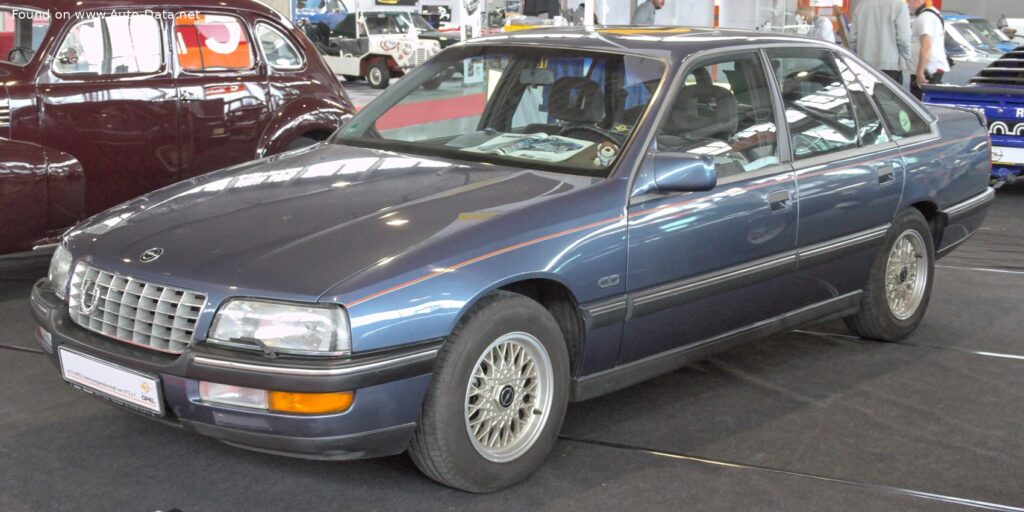
The design of the Opel Senator B was a sophisticated evolution of its predecessor, characterized by clean lines, a sleek profile, and a substantial road presence. As a 4-door sedan with seating for five, it exuded an understated elegance that was typical of European executive cars of the early 1990s. Its dimensions were generous, measuring 190.75 inches (4845 mm) in length, 68.62 inches (1743 mm) in width, and 57.09 inches (1450 mm) in height, with a wheelbase of 107.48 inches (2730 mm). These proportions contributed to a spacious and comfortable cabin, a key selling point for its target audience. The design also benefited from a commendable drag coefficient (Cd) of 0.31, which was quite good for a large sedan of its time, aiding both fuel efficiency and reducing wind noise at higher speeds.
Inside, the Senator B was equipped with features aimed at enhancing passenger comfort and convenience. While specific trim levels varied by market, standard amenities typically included power steering, power windows, central locking, and a well-appointed interior with quality materials. The large trunk offered impressive cargo capacity, ranging from 18.72 cu. ft. (530 liters) with the rear seats up to a cavernous 30.72 cu. ft. (870 liters) when the rear seats were folded, providing excellent versatility for luggage and larger items.
In terms of driving dynamics, the Senator B utilized an independent suspension system with coil springs at both the front and rear, tuned to provide a smooth and composed ride characteristic of a luxury cruiser. The hydraulic power steering system ensured effortless maneuverability, particularly at lower speeds, despite the car’s considerable size. Safety features for the era included disc brakes on all four wheels, augmented by an Anti-lock Braking System (ABS), which was a significant safety advancement for the early 1990s, providing improved control during emergency braking. The car rode on 205/65 R15 tires, mounted on 15-inch wheel rims, a common setup for ensuring a comfortable ride and good grip. With a curb weight of 3251.82 lbs. (1475 kg), the Senator B felt substantial and secure on the road, further enhancing its appeal as a safe and reliable executive vehicle.
Technical Specifications: Opel Senator B 2.6i (150 Hp) Automatic
| Category | Specification | US Equivalent / Notes |
|---|---|---|
General Information |
||
| Brand | Opel | |
| Model | Senator | |
| Generation | Senator B | |
| Type (Engine) | 2.6i (150 Hp) Automatic | |
| Start of production | August, 1990 year | |
| End of production | June, 1993 year | |
| Powertrain Architecture | Internal Combustion engine | |
| Body type | Sedan | |
| Seats | 5 | |
| Doors | 4 | |
Performance Specs |
||
| Fuel consumption (economy) – urban | 14.5 l/100 km | 16.2 US mpg |
| Fuel consumption (economy) – extra urban | 7.7 l/100 km | 30.5 US mpg |
| Fuel consumption (economy) – combined | 9.4 l/100 km | 25 US mpg |
| Fuel Type | Petrol (Gasoline) | |
| Acceleration 0 – 100 km/h | 11.3 sec | |
| Acceleration 0 – 62 mph | 11.3 sec | |
| Acceleration 0 – 60 mph (Calculated) | 10.7 sec | |
| Maximum speed | 208 km/h | 129.25 mph |
| Weight-to-power ratio | 9.8 kg/Hp | 21.6 lbs/Hp |
| Weight-to-torque ratio | 6.7 kg/Nm | 4.56 lbs/lb.-ft. |
Engine Specs |
||
| Power | 150 Hp @ 5600 rpm | |
| Power per liter | 57.8 Hp/l | |
| Torque | 220 Nm @ 3600 rpm | 162.26 lb.-ft. @ 3600 rpm |
| Maximum engine speed | 6250 rpm | |
| Engine layout | Front, Longitudinal | |
| Engine Model/Code | C26NE | |
| Engine displacement | 2594 cm3 | 2.6 Liters / 158.3 cu. in. |
| Number of cylinders | 6 | Inline configuration |
| Cylinder Bore | 88.8 mm | 3.5 in. |
| Piston Stroke | 69.8 mm | 2.75 in. |
| Compression ratio | 9.2:1 | |
| Number of valves per cylinder | 2 | |
| Fuel injection system | Multi-port manifold injection | |
| Engine aspiration | Naturally aspirated engine | |
| Valvetrain | SOHC | Single Overhead Camshaft |
| Engine oil capacity | 5.5 l | 5.81 US qt / 4.84 UK qt |
| Engine oil specification | Not specified in data | |
| Coolant | 10.5 l | 11.1 US qt / 9.24 UK qt |
Space, Volume and Weights |
||
| Kerb Weight | 1475 kg | 3251.82 lbs. |
| Max. weight | 2005 kg | 4420.27 lbs. |
| Max load | 530 kg | 1168.45 lbs. |
| Trunk (boot) space – minimum | 530 l | 18.72 cu. ft. |
| Trunk (boot) space – maximum | 870 l | 30.72 cu. ft. |
| Fuel tank capacity | 75 l | 19.81 US gal / 16.5 UK gal |
Dimensions |
||
| Length | 4845 mm | 190.75 in. |
| Width | 1743 mm | 68.62 in. |
| Height | 1450 mm | 57.09 in. |
| Wheelbase | 2730 mm | 107.48 in. |
| Front track | 1462 mm | 57.56 in. |
| Rear (Back) track | 1480 mm | 58.27 in. |
| Ride height (ground clearance) | 140 mm | 5.51 in. |
| Drag coefficient (Cd) | 0.31 | |
| Minimum turning circle (turning diameter) | 10.95 m | 35.93 ft. |
Drivetrain, Brakes and Suspension Specs |
||
| Drivetrain Architecture | The Internal combustion engine (ICE) drives the rear wheels of the vehicle. | Rear-wheel drive |
| Drive wheel | Rear wheel drive | |
| Number of gears and type of gearbox | 4 gears, automatic transmission | |
| Front suspension | Coil spring | Independent |
| Rear suspension | Coil spring | Independent |
| Front brakes | Disc | |
| Rear brakes | Disc | |
| Assisting systems | ABS (Anti-lock braking system) | |
| Power steering | Hydraulic Steering | |
| Tires size | 205/65 R15 | |
| Wheel rims size | 15 | Inches |
Legacy and Market Impact of the Opel Senator B
The Opel Senator B 2.6i (150 Hp) Automatic played a crucial role in Opel’s strategy to compete in the demanding European executive car market. While it never achieved the same premium status or sales volumes as its German luxury counterparts from BMW and Mercedes-Benz, the Senator B carved out a niche for itself as a highly competent, comfortable, and often more affordable alternative. Its reputation was built on its robust mechanicals, spacious interior, smooth ride, and understated styling, making it a popular choice among business professionals, government fleets, and taxi operators in various European countries.
In its segment, the Senator B faced competition from a range of European rivals. Key competitors included the Ford Scorpio (especially in its Ghia trims), the Volvo 740 and later 940, and the Saab 9000. These vehicles all offered varying degrees of luxury, practicality, and performance, but the Senator B often stood out for its traditional rear-wheel-drive architecture and the inherent balance it offered. It was perceived as a “poor man’s luxury car” by some, offering many of the attributes of more expensive sedans without the associated price tag or maintenance costs.
Historically, the Senator B represents the end of an era for Opel. Its discontinuation in 1993 marked Opel’s departure from the full-size, rear-wheel-drive executive sedan market, a segment that General Motors Europe would increasingly cede to its premium brands like Cadillac or focus on smaller, front-wheel-drive platforms. This shift reflected broader changes in the automotive industry, where badge prestige and advanced technology became increasingly important. Despite its relatively short production run for the B generation, the Senator maintained a loyal following due to its reliability and comfortable cruising abilities.
Today, the Opel Senator B is remembered as a classic example of early 1990s European automotive engineering. It embodies the characteristics of a traditional executive sedan, offering a blend of comfort, space, and a dignified driving experience. While it may not command the same collector attention as some of its more exotic contemporaries, it remains a testament to Opel’s ability to produce a capable and well-engineered large car that served its purpose admirably in its primary market. Its legacy is one of quiet competence and dependable luxury, providing a comfortable and reliable ride for those who appreciated substance over flashy prestige.