Introduction to the Suzuki Ignis II 1.2 DualJet (90 Hp) ALLGRIP + SHVS
The Suzuki Ignis II 1.2 DualJet (90 Hp) ALLGRIP + SHVS represents the second generation of Suzuki’s distinctive subcompact crossover, a vehicle that carved out a unique niche in the global automotive landscape. Produced from 2016 to December 2019, this particular variant stands out for its combination of a fuel-efficient mild-hybrid powertrain, an advanced all-wheel-drive system, and a remarkably compact footprint. Primarily designed for markets outside the United States, such as Europe, Japan, and India, the Ignis II was lauded for its blend of urban maneuverability, surprising practicality, and a rugged, yet charming, design aesthetic.
Positioned as a micro-SUV or a compact city crossover, the Ignis II offered a compelling package for consumers seeking an economical vehicle capable of handling diverse driving conditions. Its ALLGRIP all-wheel-drive system provided enhanced traction and stability, making it suitable for light off-road excursions or challenging weather, while the SHVS (Smart Hybrid Vehicle by Suzuki) mild-hybrid technology contributed significantly to its impressive fuel economy and reduced emissions. This generation of the Ignis upheld Suzuki’s reputation for producing reliable, efficient, and surprisingly capable small vehicles, appealing to a demographic that valued functionality and affordability without sacrificing a touch of adventurous spirit.
Engine and Performance of the Suzuki Ignis II 1.2 DualJet (90 Hp) ALLGRIP + SHVS
Powertrain Technology: DualJet and SHVS
At the heart of the Suzuki Ignis II 1.2 DualJet (90 Hp) ALLGRIP + SHVS lies a sophisticated and efficient powertrain. The vehicle is equipped with Suzuki’s K12C engine, a 1.2-liter (1242 cm3 or 75.79 cu. in.) naturally aspirated inline-four gasoline unit. This engine features DualJet technology, which utilizes two injectors per cylinder, positioned closer to the intake valves. This precise fuel delivery system optimizes fuel atomization and combustion, leading to enhanced thermal efficiency and lower fuel consumption.
Further elevating its efficiency, this variant incorporates Suzuki’s SHVS mild-hybrid system. This innovative architecture integrates an Integrated Starter Generator (ISG) with a compact lithium-ion battery. The ISG assists the engine during acceleration, providing a modest power boost to improve responsiveness and reduce the load on the gasoline engine. It also acts as a generator during deceleration, recovering kinetic energy through regenerative braking to recharge the battery. This stored energy is then used to power the vehicle’s electrical components and assist the engine, contributing to the Ignis’s excellent fuel economy ratings and lower CO2 emissions. The engine produces a respectable 90 horsepower at 6000 rpm and 88.51 lb.-ft. of torque at 4400 rpm, providing adequate power for its lightweight body.
ALLGRIP All-Wheel Drive System
A key differentiator for the Suzuki Ignis II 1.2 DualJet (90 Hp) ALLGRIP + SHVS is its ALLGRIP all-wheel-drive system. Unlike many conventional full-time AWD systems, Suzuki’s ALLGRIP is designed for efficiency and adaptability. In normal driving conditions, the engine primarily drives the front wheels, optimizing fuel economy. However, when the system detects a loss of traction at the front wheels—due to slippery surfaces, rough terrain, or aggressive acceleration—an electrically or mechanically operated clutch quickly engages to send power to the rear wheels. This on-demand system provides enhanced grip and stability without the continuous parasitic losses associated with always-on AWD, making the Ignis surprisingly capable in challenging conditions for a vehicle of its size.
Driving Dynamics and Fuel Efficiency
Paired with a crisp 5-speed manual transmission, the Ignis II offers an engaging driving experience. Its lightweight construction, with a curb weight ranging from 1951.09 to 2028.25 pounds, contributes to its agile handling and spirited performance. The vehicle can accelerate from 0 to 60 mph in a respectable 10.9 seconds and reach a maximum speed of 102.53 mph. These figures, combined with its compact dimensions, make it a nimble performer in urban environments.
Fuel efficiency is a strong suit for this Ignis variant. The combined effect of the DualJet engine, SHVS mild-hybrid system, and the efficient ALLGRIP setup results in an impressive combined fuel economy of 50 US mpg (4.7 liters per 100 km). Urban driving yields 45.2 US mpg, while extra-urban driving achieves 53.5 US mpg. CO2 emissions are kept low at 106 g/km, meeting stringent Euro 6 emission standards, underscoring its environmental consciousness.
Design and Features
Distinctive Exterior and Compact Dimensions
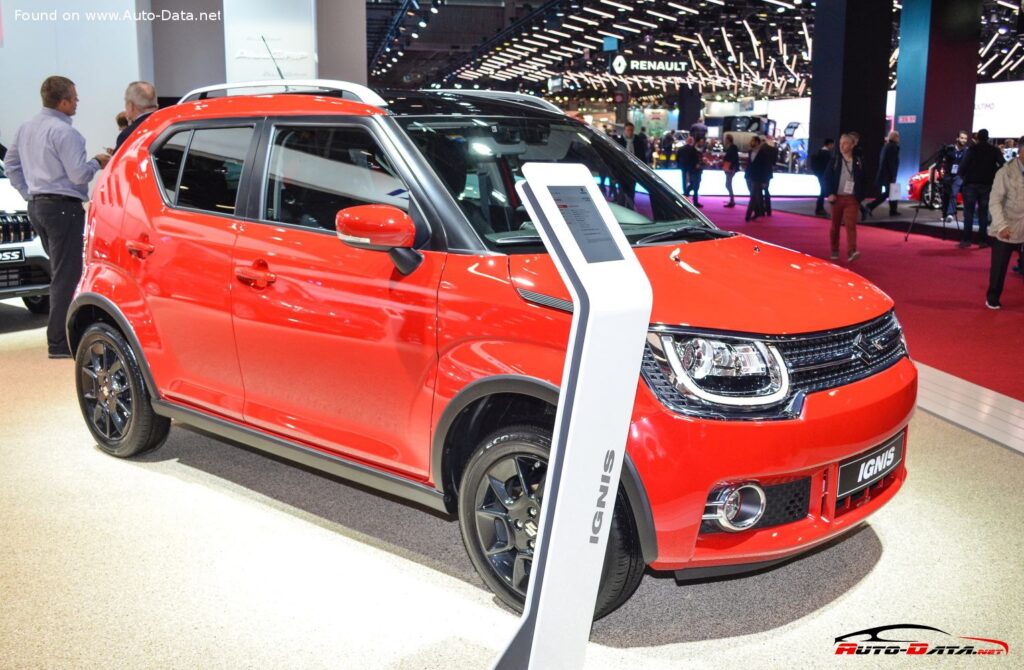
The Suzuki Ignis II boasts a truly unique and polarizing design, often described as “retro-modern” or “funky.” Its compact SUV body type, measuring just 145.67 inches in length, 66.54 inches in width, and 62.8 inches in height, belies a surprisingly spacious interior. The design incorporates several Suzuki heritage cues, such as the distinctive three-slat C-pillar design, reminiscent of classic Suzuki models. Its high ground clearance of 7.09 inches, coupled with short overhangs, gives it a robust, go-anywhere stance, further emphasized by approach and departure angles of 20° and 38.3°, respectively. The 16-inch wheels, shod with 175/60 R16 tires, fill the wheel wells nicely, contributing to its confident road presence.
Interior Practicality and Modern Amenities
Despite its diminutive exterior, the Ignis II offers a cleverly packaged interior designed for maximum practicality. With seating for four occupants, the cabin feels airy thanks to its tall roofline. The rear seats are often individually sliding and reclining, allowing for flexible configuration of passenger and cargo space. Trunk space is a respectable 7.2 cubic feet with all seats in place, expanding to a generous 38.35 cubic feet when the rear seats are folded down. This adaptability makes the Ignis surprisingly versatile for hauling luggage or groceries.
While not laden with luxury, the interior focuses on functionality and user-friendliness. Key features include an electric power steering system, making urban maneuvers effortless with a minimum turning circle of just 30.84 feet. The vehicle incorporates essential safety features like ABS (Anti-lock Braking System) as standard. The overall design aesthetic within the cabin often mirrored the playful exterior, with contrasting color accents and a minimalist dashboard layout.
Safety and Chassis Engineering
Underneath its charismatic exterior, the Ignis II is built on a lightweight yet rigid platform. The chassis features an independent McPherson strut front suspension and a semi-independent, coil spring rear suspension, a common and effective setup for compact vehicles, providing a comfortable ride and predictable handling. Braking is handled by ventilated discs at the front and drum brakes at the rear, complemented by the ABS system for controlled stopping power. The robust body structure and carefully engineered suspension contribute to a secure and stable driving experience, whether navigating city streets or venturing onto less-traveled paths.
Technical Specifications
| Category | Specification |
|---|---|
| General Information | |
| Brand | Suzuki |
| Model | Ignis |
| Generation | Ignis II |
| Type (Engine) | 1.2 DualJet (90 Hp) ALLGRIP + SHVS |
| Production Start | 2016 year |
| Production End | December, 2019 year |
| Powertrain Architecture | Internal Combustion engine + Mild-Hybrid (SHVS) |
| Body Type | SUV |
| Seats | 4 |
| Doors | 5 |
| Performance Specifications | |
| Fuel Consumption (Urban) | 45.2 US mpg (5.2 l/100 km) |
| Fuel Consumption (Extra Urban) | 53.5 US mpg (4.4 l/100 km) |
| Fuel Consumption (Combined) | 50 US mpg (4.7 l/100 km) |
| CO2 Emissions | 106 g/km |
| Fuel Type | Petrol (Gasoline) |
| Acceleration 0-60 mph | 10.9 seconds |
| Acceleration 0-100 km/h | 11.5 seconds |
| Maximum Speed | 102.53 mph (165 km/h) |
| Emission Standard | Euro 6 |
| Weight-to-Power Ratio | 9.8 kg/Hp (101.7 Hp/tonne) |
| Weight-to-Torque Ratio | 7.4 kg/Nm (135.6 Nm/tonne) |
| Engine Specifications | |
| Power | 90 Hp @ 6000 rpm |
| Power per liter | 72.5 Hp/l |
| Torque | 88.51 lb.-ft. @ 4400 rpm (120 Nm) |
| Engine Layout | Front, Transverse |
| Engine Model/Code | K12C |
| Engine Displacement | 1.2 liters (1242 cm3 / 75.79 cu. in.) |
| Number of Cylinders | 4 |
| Engine Configuration | Inline |
| Cylinder Bore | 2.87 inches (73 mm) |
| Piston Stroke | 2.92 inches (74.2 mm) |
| Compression Ratio | 12.5:1 |
| Valves per Cylinder | 4 |
| Fuel Injection System | Multi-port manifold injection |
| Engine Aspiration | Naturally aspirated |
| Engine Oil Capacity | 3.49 US quarts (3.3 l) |
| Coolant Capacity | 4.23 US quarts (4 l) |
| Space, Volume, and Weights | |
| Kerb Weight | 1951.09 – 2028.25 lbs. (885-920 kg) |
| Max. Weight (GVWR) | 2932.15 lbs. (1330 kg) |
| Max Load | 903.9 – 981.06 lbs. (410-445 kg) |
| Trunk (Boot) Space – Minimum | 7.2 cu. ft. (204 l) |
| Trunk (Boot) Space – Maximum | 38.35 cu. ft. (1086 l) |
| Fuel Tank Capacity | 7.93 US gallons (30 l) |
| Permitted Trailer Load (with brakes) | 2204.62 lbs. (1000 kg) |
| Permitted Trailer Load (without brakes) | 881.85 lbs. (400 kg) |
| Permitted Towbar Download | 110.23 lbs. (50 kg) |
| Dimensions | |
| Length | 145.67 inches (3700 mm) |
| Width | 66.54 inches (1690 mm) |
| Height | 62.8 inches (1595 mm) |
| Wheelbase | 95.87 inches (2435 mm) |
| Front Track | 57.48 inches (1460 mm) |
| Rear Track | 57.48 inches (1460 mm) |
| Ride Height (Ground Clearance) | 7.09 inches (180 mm) |
| Minimum Turning Circle | 30.84 feet (9.4 m) |
| Approach Angle | 20° |
| Departure Angle | 38.3° |
| Ramp-over (Brakeover) Angle | 19.2° |
| Drivetrain, Brakes, and Suspension | |
| Drivetrain Architecture | Internal Combustion engine drives front wheels permanently, rear wheels driven through clutch if necessary. |
| Drive Wheel | All-wheel drive (4×4) |
| Gearbox Type | 5 gears, manual transmission |
| Front Suspension | Independent type McPherson |
| Rear Suspension | Semi-independent, coil spring |
| Front Brakes | Ventilated discs |
| Rear Brakes | Drum |
| Assisting Systems | ABS (Anti-lock braking system) |
| Steering Type | Steering rack and pinion |
| Power Steering | Electric Steering |
| Tires Size | 175/60 R16 |
| Wheel Rims Size | 16 inches |
Legacy and Market Impact
Positioning in the Global Market
The Suzuki Ignis II 1.2 DualJet (90 Hp) ALLGRIP + SHVS, while not sold in the American market, played a significant role in Suzuki’s global strategy, particularly in regions where compact, efficient, and versatile vehicles are highly valued. In Europe, Japan, and emerging Asian markets like India, the Ignis II carved out a distinctive niche. It wasn’t just another subcompact car; it was marketed as a “micro-SUV,” appealing to buyers who desired the elevated driving position and rugged aesthetics of an SUV but needed the urban agility and fuel economy of a city car. Its unique styling helped it stand out in a crowded segment, making it a recognizable and often beloved vehicle.
Competitors and Unique Selling Propositions
In its primary markets, the Ignis II faced competition from a variety of compact hatchbacks and entry-level crossovers. Direct rivals in the micro-SUV space included vehicles like the Dacia Sandero Stepway and, to some extent, the Fiat Panda 4×4. However, the Ignis often distinguished itself with a combination of unique selling propositions. Its ALLGRIP all-wheel-drive system offered genuine light off-road capability that many competitors lacked, while its SHVS mild-hybrid technology provided class-leading fuel efficiency and lower emissions. The Ignis’s ultra-compact dimensions and tight turning radius also made it exceptionally well-suited for congested urban environments, offering a blend of practicality and fun that was hard to match.
Enduring Reputation and Future Outlook
The Suzuki Ignis II 1.2 DualJet (90 Hp) ALLGRIP + SHVS earned a reputation for reliability, exceptional fuel economy, and surprising capability for its size. Its robust build quality, combined with Suzuki’s engineering prowess in small vehicles, contributed to strong owner satisfaction. The mild-hybrid system was an early adoption in this specific segment, showcasing Suzuki’s commitment to efficiency and environmental responsibility without significantly increasing the vehicle’s cost or complexity. Although this particular generation concluded production in 2019, the Ignis nameplate continues in various forms in different markets, demonstrating the enduring appeal of its concept. The Ignis II’s legacy is one of a cleverly designed, highly functional, and characterful vehicle that punched above its weight, proving that a small footprint doesn’t have to mean limited capability or compromised efficiency. It remains a testament to Suzuki’s expertise in crafting compact, versatile, and capable automobiles for global audiences.