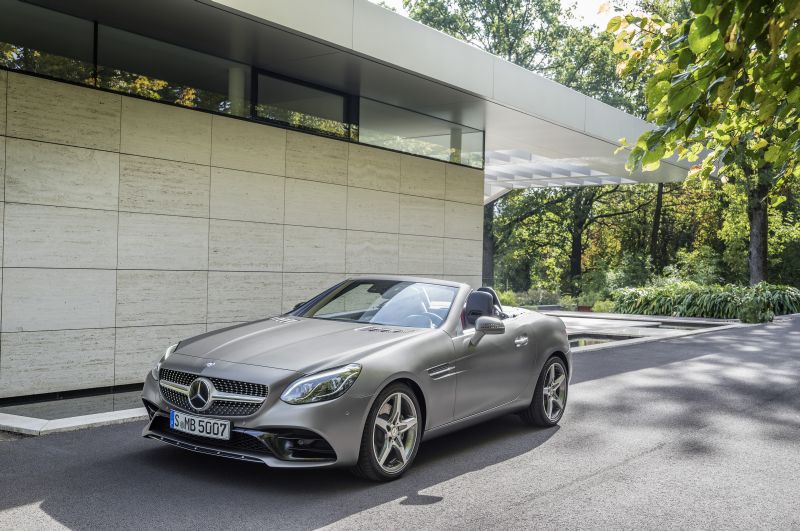
The Mercedes-Benz SLC (R172 facelift 2016) SLC 200 (184 Hp): A Refined European Roadster
The Mercedes-Benz SLC (R172 facelift 2016) SLC 200 (184 Hp) represents a significant refresh and rebranding of the popular R172 generation compact luxury roadster. Launched in April 2016, this iteration marked a pivotal moment for Mercedes-Benz’s two-seater convertible, moving from the iconic SLK nomenclature to SLC – a nod to its close familial ties with the C-Class sedan, aligning it with the brand’s updated naming strategy. Primarily aimed at the European and Asian markets where compact, premium roadsters hold strong appeal, the SLC 200 offered a compelling blend of sophisticated styling, engaging performance, and everyday usability. It was positioned as an accessible entry point into the Mercedes-Benz open-top driving experience, combining elegant design with modern technology and efficient powertrain options, catering to drivers seeking a blend of sportiness and comfort.
Evolution of the Mercedes-Benz SLC (R172 facelift 2016)
The R172 generation, initially introduced as the SLK in 2011, built upon a legacy of successful compact roadsters from Mercedes-Benz. The 2016 facelift brought more than just a name change; it introduced updated styling cues, enhanced interior features, and revised powertrain options to keep the model competitive in its segment. The transition to SLC aimed to clarify its position within the Mercedes-Benz lineup, emphasizing its relationship with the C-Class sedan (C for compact, L for lightweight, C for coupe/cabriolet). The SLC 200, specifically, was engineered to deliver a balanced driving experience, providing ample power for spirited cruising without sacrificing fuel efficiency, making it a popular choice for daily driving and weekend getaways across its primary markets.
Engine & Performance of the Mercedes-Benz SLC (R172 facelift 2016) SLC 200
At the heart of the Mercedes-Benz SLC 200 lies a highly capable and efficient M 274.920 inline-four engine. This 2.0-liter (1991 cm³, or 121.5 cu. in.) gasoline powerplant is longitudinally mounted at the front and employs an advanced powertrain architecture that drives the rear wheels, adhering to classic sports car principles. The engine features direct fuel injection and is equipped with a turbocharger and intercooler, ensuring robust performance across the rev range. This sophisticated setup allows the SLC 200 to produce a healthy 184 horsepower at 5500 rpm. More impressively, it generates a substantial 221.27 lb-ft of torque, available across a broad and usable band from just 1200 rpm up to 4000 rpm, which significantly contributes to its responsive feel and effortless acceleration.
Power is channeled through a precise 6-speed manual transmission, offering an engaging and direct driving experience for enthusiasts. This combination enables the SLC 200 to accelerate from 0 to 60 mph in a brisk 6.7 seconds (0-100 km/h in 7 seconds) and reach a top speed of 149.13 mph (240 km/h). Despite its spirited performance, the engine is also designed for efficiency, boasting a combined fuel consumption rating of 35.6 – 38.6 US mpg (6.6-6.1 l/100 km). With CO2 emissions ranging from 142-154 g/km, it met the stringent Euro 6 emission standards, showcasing Mercedes-Benz’s commitment to environmental responsibility even in its performance-oriented models. The engine’s compression ratio of 9.8:1 further optimizes its power delivery and fuel economy, making the SLC 200 a compelling package for those who desire performance without excessive running costs.
Design & Features
The Mercedes-Benz SLC (R172 facelift 2016) SLC 200 maintains the classic proportions of a compact roadster, characterized by its long hood, short rear deck, and a cabin positioned close to the rear axle. Its body type is described as a Coupe-Cabriolet or Roadster, thanks to its signature retractable hardtop, famously known as the “Vario-roof.” This ingenious design allows the car to transform from a sleek, weather-protected coupe to an exhilarating open-top roadster in a matter of seconds, offering the best of both worlds. With two doors and seating for two occupants, the SLC 200 is unequivocally driver-focused.
The facelift introduced subtle but effective design enhancements. The front fascia received a revised diamond radiator grille, sportier bumpers, and updated LED headlights, giving the car a more aggressive and contemporary look. At the rear, new LED taillights and a restyled bumper with integrated exhaust finishers contributed to a wider, more athletic stance. Dimensionally, the SLC 200 measures 162.72 inches (4133 mm) in length, 71.26 inches (1810 mm) in width (78.98 inches or 2006 mm including mirrors), and 51.22 inches (1301 mm) in height, with a wheelbase of 95.67 inches (2430 mm). These compact dimensions, combined with a minimum turning circle of 34.51 feet (10.52 m), ensure agile handling and ease of maneuverability in urban environments.
Underneath, the SLC 200 features an independent multi-link suspension system at both the front and rear, tuned to provide a blend of sporting agility and Mercedes-Benz’s renowned ride comfort. Braking is handled by ventilated discs at the front and solid discs at the rear, complemented by an Anti-lock Braking System (ABS) for enhanced safety. The electric power steering system, with its rack and pinion setup, offers precise control and feedback, enhancing the driving experience. The car comes standard with 205/55 R16 tires on 16-inch wheel rims, providing a good balance of grip and ride quality. The trunk space is practical for a roadster, offering 7.95 cu. ft. (225 liters) with the top down and expanding to 11.83 cu. ft. (335 liters) with the top up, making it suitable for weekend trips.
Technical Specifications
| Category | Specification | US Equivalent |
|---|---|---|
| Brand | Mercedes-Benz | Mercedes-Benz |
| Model | SLC | SLC |
| Generation | SLC (R172 facelift 2016) | SLC (R172 facelift 2016) |
| Type (Engine) | SLC 200 (184 Hp) | SLC 200 (184 Hp) |
| Production Start | April, 2016 | April, 2016 |
| Production End | July, 2020 | July, 2020 |
| Powertrain Architecture | Internal Combustion Engine | Internal Combustion Engine |
| Body Type | Coupe-Cabriolet, Roadster | Coupe-Cabriolet, Roadster |
| Seats | 2 | 2 |
| Doors | 2 | 2 |
| Performance Specs | ||
| Fuel Consumption (Urban) | 8.8-8.1 l/100 km | 26.7 – 29 US mpg |
| Fuel Consumption (Extra Urban) | 5.4-4.9 l/100 km | 43.6 – 48 US mpg |
| Fuel Consumption (Combined) | 6.6-6.1 l/100 km | 35.6 – 38.6 US mpg |
| CO2 Emissions | 154-142 g/km | 154-142 g/km |
| Fuel Type | Petrol (Gasoline) | Gasoline |
| Acceleration 0-60 mph | 6.7 sec | 6.7 sec |
| Acceleration 0-100 km/h | 7 sec | 7 sec |
| Maximum Speed | 240 km/h | 149.13 mph |
| Emission Standard | Euro 6 | Euro 6 |
| Weight-to-Power Ratio | 7.5 kg/Hp | 133.3 Hp/tonne |
| Weight-to-Torque Ratio | 4.6 kg/Nm | 217.4 Nm/tonne |
| Engine Specs | ||
| Power | 184 Hp @ 5500 rpm | 184 Hp @ 5500 rpm |
| Power per liter | 92.4 Hp/l | 92.4 Hp/l |
| Torque | 300 Nm @ 1200-4000 rpm | 221.27 lb-ft @ 1200-4000 rpm |
| Engine Layout | Front, Longitudinal | Front, Longitudinal |
| Engine Model/Code | M 274.920 | M 274.920 |
| Engine Displacement | 1991 cm³ | 2.0 Liters (121.5 cu. in.) |
| Number of Cylinders | 4 | 4 |
| Engine Configuration | Inline | Inline |
| Compression Ratio | 9.8:1 | 9.8:1 |
| Fuel Injection System | Direct injection | Direct injection |
| Engine Aspiration | Turbocharger, Intercooler | Turbocharger, Intercooler |
| Engine Oil Capacity | 6.3 l | 6.66 US qt |
| Space, Volume and Weights | ||
| Curb Weight | 1380 kg | 3042.38 lbs |
| Max. Weight | 1770 kg | 3902.18 lbs |
| Max Load | 390 kg | 859.8 lbs |
| Trunk Space (Minimum) | 225 l | 7.95 cu. ft. |
| Trunk Space (Maximum) | 335 l | 11.83 cu. ft. |
| Fuel Tank Capacity | 60 l | 15.85 US gal |
| Dimensions | ||
| Length | 4133 mm | 162.72 in. |
| Width | 1810 mm | 71.26 in. |
| Width (incl. mirrors) | 2006 mm | 78.98 in. |
| Height | 1301 mm | 51.22 in. |
| Wheelbase | 2430 mm | 95.67 in. |
| Front Track | 1559 mm | 61.38 in. |
| Rear Track | 1565 mm | 61.61 in. |
| Drag Coefficient (Cd) | 0.30 | 0.30 |
| Minimum Turning Circle | 10.52 m | 34.51 ft. |
| Drivetrain, Brakes and Suspension Specs | ||
| Drivetrain Architecture | Internal Combustion engine (ICE) drives the rear wheels. | |
| Drive Wheel | Rear wheel drive | Rear wheel drive |
| Number of Gears & Type | 6 gears, manual transmission | 6 gears, manual transmission |
| Front Suspension | Independent multi-link suspension | Independent multi-link suspension |
| Rear Suspension | Independent multi-link suspension | Independent multi-link suspension |
| Front Brakes | Ventilated discs | Ventilated discs |
| Rear Brakes | Disc | Disc |
| Assisting Systems | ABS (Anti-lock braking system) | ABS (Anti-lock braking system) |
| Steering Type | Steering rack and pinion | Steering rack and pinion |
| Power Steering | Electric Steering | Electric Steering |
| Tire Size | 205/55 R16 | 205/55 R16 |
| Wheel Rims Size | 16 | 16 inches |
Legacy & Market Impact of the Mercedes-Benz SLC
The Mercedes-Benz SLC (R172 facelift 2016) SLC 200 occupied an important niche in the premium compact roadster segment, primarily within the European and Asian markets. In these regions, it faced competition from established rivals such as the Audi TT Roadster and the BMW Z4. Unlike some of its more aggressively sporting competitors, the SLC 200 carved out a reputation as a sophisticated and comfortable open-top cruiser, prioritizing refinement and style over raw, track-focused performance. Its retractable hardtop, a feature that distinguished it from many soft-top rivals, offered enhanced security, improved cabin insulation, and the versatility of a coupe, making it a highly desirable option for year-round usability.
The name change from SLK to SLC was more than just a marketing exercise; it solidified the model’s position within Mercedes-Benz’s evolving nomenclature, linking it directly to the C-Class family and emphasizing its accessible luxury appeal. While not sold in significant numbers in the USA, its role in its primary markets was to offer a quintessential Mercedes-Benz experience in a smaller, more agile package. It appealed to a demographic that appreciated the brand’s prestige, quality, and comfort, combined with the joy of open-air driving, without the higher cost or larger footprint of the flagship SL-Class.
The SLC 200, with its efficient yet capable 2.0-liter turbocharged engine and manual transmission option, resonated with drivers who valued engagement and fuel economy. Its Euro 6 compliance further underscored its modern engineering and environmental consciousness. The production run from 2016 to 2020 marked the final chapter for Mercedes-Benz’s hardtop roadster concept in this segment. As market trends shifted towards SUVs and, within the convertible segment, back to traditional soft-tops for weight and packaging benefits, the SLC was eventually discontinued. Nevertheless, its legacy endures as a beautifully styled, well-engineered, and highly practical premium roadster that offered a unique blend of coupe-like refinement and exhilarating open-top freedom, embodying Mercedes-Benz’s commitment to diverse and engaging driving experiences.