The Rover 75 (facelift 2004): A Swan Song of British Motoring
The
Rover 75 (facelift 2004)
represents a significant, albeit late-stage, chapter in the storied history of the Rover Group, a British automobile manufacturer. Introduced in 1999, the Rover 75 was Rover’s entry into the competitive executive car segment, designed to blend traditional British luxury with modern engineering. The facelifted model, launched in 2004, sought to modernize its aesthetics and refine its offerings for its primary European markets, just a year before the company’s eventual collapse. This particular variant, the 2.0 CDT with 116 horsepower, was a popular choice, especially in the UK and continental Europe, prized for its diesel efficiency, comfortable ride, and distinctive styling, offering a unique alternative to its German and French rivals.
Engine and Performance of the Rover 75 (facelift 2004) 2.0 CDT
Under the hood of the
Rover 75 (facelift 2004)
2.0 CDT lies a robust and efficient powertrain, a testament to the engineering partnerships of its era. This model is equipped with a 1,951 cm3 (119.06 cu. in.) inline-four diesel engine, internally designated as the M47R / 204D2. This unit, famously derived from BMW’s M47 engine, delivered a respectable 116 horsepower at 4000 rpm, paired with a substantial 260 Nm (191.77 lb.-ft.) of torque available from a low 2000 rpm. This ample torque, characteristic of turbo-diesel engines, provided excellent drivability and effortless cruising, particularly on European highways.
The engine’s configuration features a DOHC (Double Overhead Camshaft) valvetrain with four valves per cylinder, ensuring efficient combustion. A common rail direct fuel injection system, combined with a turbocharger and intercooler, optimized fuel delivery and air intake for both power and efficiency. With a compression ratio of 18:1, the diesel unit was designed for durability and fuel economy.
Performance figures for the 2.0 CDT were solid for its class and intended purpose. The sedan could accelerate from 0 to 60 mph in 11 seconds, reaching a maximum speed of 119.92 mph (193 km/h). While not a sports sedan, these figures highlight its capability as a comfortable long-distance cruiser. Fuel economy was a strong suit, with a combined rating of 40.6 US mpg (5.8 l/100 km), an urban rating of 30.5 US mpg (7.7 l/100 km), and an impressive extra-urban figure of 50 US mpg (4.7 l/100 km). These numbers, along with CO2 emissions of 163 g/km, placed it competitively within the Euro 3 emission standard, making it an attractive option for economy-conscious buyers in Europe. Power was sent to the front wheels via a smooth-shifting 5-speed manual transmission.
Design and Features
The
Rover 75 (facelift 2004)
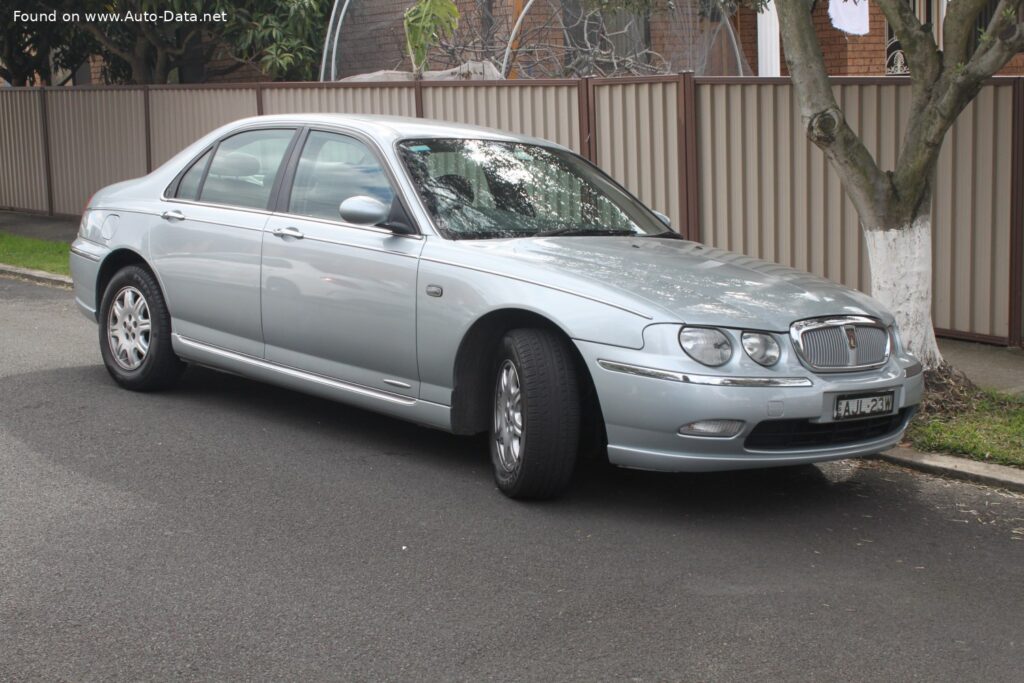
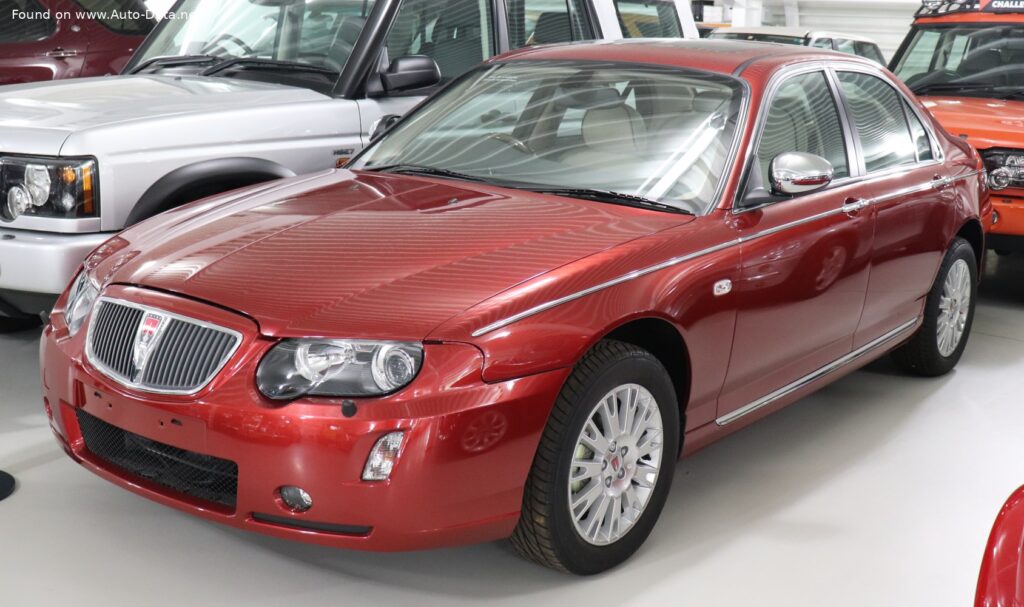
maintained the distinctive “retro-modern” styling that characterized the original model, albeit with subtle enhancements. The facelift aimed to give the car a slightly more contemporary edge without sacrificing its inherent British charm. The changes included a revised front grille, updated headlights, and subtle alterations to the bumpers, which gave the car a slightly less rounded, more assertive look. Despite these updates, the car retained its classic proportions, with a length of 186.97 inches (4749 mm), a width of 70 inches (1778 mm), and a height of 54.84 inches (1393 mm). Its long wheelbase of 108.11 inches (2746 mm) contributed significantly to its renowned ride comfort.
Inside, the Rover 75 continued to offer a luxurious and comfortable cabin designed for five occupants. The interior was celebrated for its high-quality materials, traditional wood and chrome accents, and ergonomic layout. Features often included plush seating, automatic climate control, and a sophisticated audio system, creating an environment that felt distinctly British and upscale. Safety features for the era included standard ABS (Anti-lock Braking System), enhancing braking performance.
The vehicle’s suspension system was engineered for comfort and refinement. The front utilized an independent McPherson strut setup with coil springs and an anti-roll bar, while the rear featured an independent multi-link spring suspension with a stabilizer. This combination provided a supple ride, effectively absorbing road imperfections, a characteristic highly valued in its market segment. Braking was handled by ventilated discs at the front and solid discs at the rear. Steering was a hydraulic rack and pinion system, offering a classic, communicative feel to the driver. The trunk space was practical, ranging from 15.26 cu. ft. (432 liters) to a maximum of 23.8 cu. ft. (674 liters) with the rear seats folded, catering to family and travel needs.
Technical Specifications: Rover 75 (facelift 2004) 2.0 CDT (116 Hp)
| Category | Specification |
|---|---|
| General Information | |
| Brand | Rover |
| Model | 75 |
| Generation | 75 (facelift 2004) |
| Type (Engine) | 2.0 CDT (116 Hp) |
| Start of Production | 2004 year |
| End of Production | 2005 year |
| Powertrain Architecture | Internal Combustion engine |
| Body type | Sedan |
| Seats | 5 |
| Doors | 4 |
| Performance Specs | |
| Fuel consumption (economy) – urban | 7.7 l/100 km (30.5 US mpg) |
| Fuel consumption (economy) – extra urban | 4.7 l/100 km (50 US mpg) |
| Fuel consumption (economy) – combined | 5.8 l/100 km (40.6 US mpg) |
| CO2 emissions | 163 g/km |
| Fuel Type | Diesel |
| Acceleration 0 – 60 mph | 11 sec |
| Maximum speed | 193 km/h (119.92 mph) |
| Emission standard | Euro 3 |
| Weight-to-power ratio | 13 kg/Hp (76.8 Hp/tonne) |
| Weight-to-torque ratio | 5.8 kg/Nm (172.2 Nm/tonne) |
| Engine Specs | |
| Power | 116 Hp @ 4000 rpm |
| Power per liter | 59.5 Hp/l |
| Torque | 260 Nm @ 2000 rpm (191.77 lb.-ft. @ 2000 rpm) |
| Engine layout | Front, Transverse |
| Engine Model/Code | M47R / 204D2 |
| Engine displacement | 1951 cm3 (119.06 cu. in.) |
| Number of cylinders | 4 |
| Engine configuration | Inline |
| Cylinder Bore | 84 mm (3.31 in.) |
| Piston Stroke | 88 mm (3.46 in.) |
| Compression ratio | 18:1 |
| Number of valves per cylinder | 4 |
| Fuel injection system | Diesel Commonrail |
| Engine aspiration | Turbocharger, Intercooler |
| Valvetrain | DOHC |
| Engine oil capacity | 6.8 l (7.19 US qt) |
| Coolant | 8.2 l (8.66 US qt) |
| Space, Volume and Weights | |
| Kerb Weight | 1510-1635 kg (3328.98 – 3604.56 lbs.) |
| Max. weight | 2030 kg (4475.38 lbs.) |
| Max load | 395-520 kg (870.83 – 1146.4 lbs.) |
| Trunk (boot) space – minimum | 432 l (15.26 cu. ft.) |
| Trunk (boot) space – maximum | 674 l (23.8 cu. ft.) |
| Fuel tank capacity | 65 l (17.17 US gal) |
| Max. roof load | 80 kg (176.37 lbs.) |
| Permitted trailer load with brakes (12%) | 1600 kg (3527.4 lbs.) |
| Permitted trailer load without brakes | 750 kg (1653.47 lbs.) |
| Permitted towbar download | 100 kg (220.46 lbs.) |
| Dimensions | |
| Length | 4749 mm (186.97 in.) |
| Width | 1778 mm (70 in.) |
| Width including mirrors | 1970 mm (77.56 in.) |
| Height | 1393 mm (54.84 in.) |
| Wheelbase | 2746 mm (108.11 in.) |
| Front track | 1511 mm (59.49 in.) |
| Rear (Back) track | 1504 mm (59.21 in.) |
| Front overhang | 915 mm (36.02 in.) |
| Rear overhang | 1087 mm (42.8 in.) |
| Minimum turning circle (turning diameter) | 11.33 m (37.17 ft.) |
| Drivetrain, Brakes and Suspension Specs | |
| Drivetrain Architecture | Internal combustion engine (ICE) drives the front wheels |
| Drive wheel | Front wheel drive |
| Number of gears and type of gearbox | 5 gears, manual transmission |
| Front suspension | Independent, type McPherson with coil spring and anti-roll bar |
| Rear suspension | Independent multi-link spring suspension with stabilizer |
| Front brakes | Ventilated discs |
| Rear brakes | Disc |
| Assisting systems | ABS (Anti-lock braking system) |
| Steering type | Steering rack and pinion |
| Power steering | Hydraulic Steering |
| Tires size | 195/65 R15; 205/60 R15; 215/55 R16 |
| Wheel rims size | 6J x 15; 6.5J x 16 |
Legacy and Market Impact of the Rover 75 (facelift 2004)
The
Rover 75 (facelift 2004)
, particularly in its 2.0 CDT guise, carved out a unique niche in the European executive sedan market. It stood apart from its more dynamically focused German rivals like the BMW 3 Series, Audi A4, and Mercedes-Benz C-Class by emphasizing comfort, refinement, and a distinctly traditional British luxury ambiance. While it may not have offered the razor-sharp handling of a BMW, its compliant ride and well-appointed interior appealed to buyers looking for a more relaxed and stately driving experience. It also competed with mainstream European offerings such as the Ford Mondeo, Vauxhall Vectra (Opel Vectra), and Peugeot 406/407, often offering a more premium feel at a comparable price point.
Despite its many virtues, the Rover 75 arrived at a challenging time for the Rover brand. The facelift in 2004 was an attempt to inject new life into the model and the company, but it proved to be a final, valiant effort. Rover Group faced significant financial difficulties, culminating in its collapse in 2005. This timing meant that the facelifted 75 had a very short production run, making it a poignant symbol of the end of an era for British mass-market car manufacturing under its traditional guise.
However, its legacy endures. The Rover 75 is remembered for its elegant design, comfortable ride, and the quality of its BMW-derived diesel engine. It garnered a reputation for reliability, particularly in its diesel variants, and continues to be appreciated by enthusiasts for its distinctive character and value. It was a car that, despite its company’s fate, demonstrated that Rover still possessed the capability to produce a competitive and desirable vehicle. Today, the Rover 75 is often seen as a modern classic, cherished for its unique blend of heritage and practicality, and a reminder of what could have been for the iconic British marque. Its impact lies not just in its specifications but in its role as the last true Rover, a comfortable and dignified farewell.