The Renault Espace III (JE) 1.9 dTi (98 Hp): A Pillar of European Versatility
The Renault Espace, a name synonymous with the Multi-Purpose Vehicle (MPV) segment in Europe, represented a paradigm shift in family transportation. The third generation, known internally as the JE series, built upon the pioneering legacy of its predecessors, offering enhanced comfort, improved driving dynamics, and a continued focus on modular interior space. Introduced in 1999, the Renault Espace III (JE) 1.9 dTi (98 Hp) variant was a particularly significant offering, catering to the strong European demand for fuel-efficient diesel powertrains within a spacious, family-oriented package. While never officially sold in the United States, the Espace played a crucial role in defining the minivan segment across the Atlantic, influencing design and functionality in a market where versatility was paramount.
Positioned as a sophisticated and practical family hauler, the Espace III aimed to provide a car-like driving experience despite its generous dimensions. The 1.9 dTi engine variant, produced for a brief but impactful period between 1999 and 2000, showcased Renault’s commitment to direct-injection diesel technology, offering a blend of economical operation and adequate performance for daily European driving conditions. This particular model stood out for its blend of utility, comfort for up to seven passengers, and a design that was both functional and aesthetically pleasing for its time.
Engineering and Performance of the Renault Espace III (JE) 1.9 dTi (98 Hp)
Powertrain and Driving Dynamics
At the heart of the Renault Espace III (JE) 1.9 dTi (98 Hp) was its robust 1.9-liter (1870 cm3 or 114.11 cu. in.) F9QT inline-four diesel engine. This unit, featuring direct injection and a turbocharger, was engineered to deliver a balance of power and efficiency crucial for a family-oriented MPV. It produced a respectable 98 horsepower at 4000 revolutions per minute (rpm) and a healthy 147.51 lb.-ft. of torque at a low 2000 rpm. This torque output was particularly beneficial for an MPV, providing ample pulling power for a fully loaded vehicle or when navigating city traffic, minimizing the need for constant gear changes.
Power was sent to the front wheels via a five-speed manual transmission, a common and reliable setup for European vehicles of this era. This drivetrain architecture, combined with a kerb weight of 3351.03 pounds, resulted in a weight-to-power ratio of 15.5 kg/Hp, or 64.5 Hp per tonne. While not designed for outright speed, the Espace III 1.9 dTi could accelerate from 0 to 60 miles per hour in a calculated 14.3 seconds, reaching a maximum speed of 103.77 mph. These figures were perfectly adequate for its intended use as a family transporter on European highways and urban environments.
Fuel efficiency was a key selling point for this diesel variant. The Espace III 1.9 dTi boasted impressive consumption figures, with an urban economy of 28.7 US mpg, an extra-urban economy of 41.3 US mpg, and a combined average of 35.6 US mpg. These numbers made it an attractive option for families seeking to minimize running costs, especially given the higher fuel prices in Europe. The vehicle also met the Euro 2 emission standard, reflecting the environmental considerations of its production period.
Chassis and Suspension
The Espace III was designed to offer a comfortable and stable ride. It featured an independent McPherson strut setup with coil springs and an anti-roll bar at the front, a configuration known for its balance of comfort and handling. The rear suspension utilized a semi-independent design with coil springs, providing a good compromise between load-carrying capability and ride quality. Braking performance was handled by ventilated discs at the front for effective heat dissipation and drum brakes at the rear, supplemented by an Anti-lock Braking System (ABS) for enhanced safety during emergency stops. The hydraulic power steering system, a rack and pinion type, offered responsive and manageable control, crucial for maneuvering a vehicle of its size in tight European streets.
Design and Features
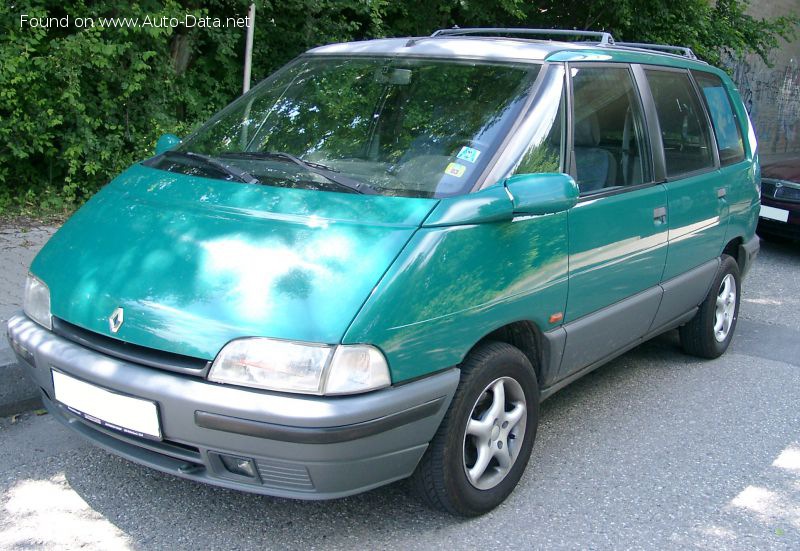
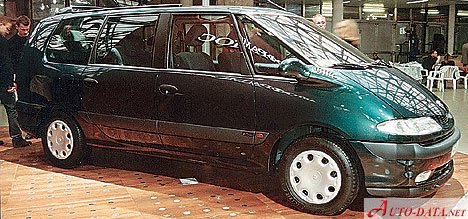
The Renault Espace III (JE) retained the fundamental MPV body type, prioritizing interior space and versatility. It featured five doors, including a large rear tailgate, and could comfortably accommodate seven passengers. Its exterior dimensions – a length of 177.83 inches, a width of 71.26 inches, and a height of 69.8 inches – made it a substantial vehicle, yet its design was thoughtfully proportioned to navigate urban landscapes. The 106.38-inch wheelbase contributed to a stable ride and maximized interior volume.
Inside, the Espace III was a masterclass in modularity, a hallmark of the Espace lineage. While specific features like removable seats are implied by its MPV nature and maximum cargo volume, the data confirms a minimum trunk space of 9.71 cubic feet, which could expand dramatically to an cavernous 100.65 cubic feet with the rear seats reconfigured or removed. This flexibility allowed owners to tailor the interior for various needs, from carrying a full complement of passengers to transforming into a cargo hauler for large items. Standard safety features for the era included ABS, enhancing driver control during braking events. The vehicle rode on 195/65 R15 tires mounted on 15-inch wheel rims, a common size that offered a good balance of comfort and cost-effectiveness.
Technical Specifications
| Category | Specification |
|---|---|
| General Information | |
| Brand | Renault |
| Model | Espace |
| Generation | Espace III (JE) |
| Type (Engine) | 1.9 dTi (98 Hp) |
| Production Start | 1999 |
| Production End | 2000 |
| Powertrain Architecture | Internal Combustion engine |
| Body type | Minivan, MPV |
| Seats | 7 |
| Doors | 5 |
| Performance Specs | |
| Fuel Consumption (Urban) | 8.2 l/100 km (28.7 US mpg) |
| Fuel Consumption (Extra Urban) | 5.7 l/100 km (41.3 US mpg) |
| Fuel Consumption (Combined) | 6.6 l/100 km (35.6 US mpg) |
| CO2 Emissions | 175 g/km |
| Fuel Type | Diesel |
| Acceleration 0-60 mph | 14.3 seconds |
| Maximum Speed | 167 km/h (103.77 mph) |
| Emission Standard | Euro 2 |
| Weight-to-power ratio | 15.5 kg/Hp (64.5 Hp/tonne) |
| Weight-to-torque ratio | 7.6 kg/Nm (131.6 Nm/tonne) |
| Engine Specs | |
| Power | 98 Hp @ 4000 rpm |
| Power per liter | 52.4 Hp/l |
| Torque | 200 Nm (147.51 lb.-ft.) @ 2000 rpm |
| Engine Layout | Front, Transverse |
| Engine Model/Code | F9QT |
| Engine Displacement | 1870 cm3 (114.11 cu. in.) |
| Number of Cylinders | 4 |
| Engine Configuration | Inline |
| Cylinder Bore | 80 mm (3.15 in.) |
| Piston Stroke | 93 mm (3.66 in.) |
| Compression Ratio | 18.3:1 |
| Valves per Cylinder | 2 |
| Fuel Injection System | Direct injection |
| Engine Aspiration | Turbocharger |
| Valvetrain | OHC |
| Engine Oil Capacity | 4.6 l (4.86 US qt) |
| Coolant Capacity | 7.5 l (7.93 US qt) |
| Space, Volume and Weights | |
| Kerb Weight | 1520 kg (3351.03 lbs.) |
| Max. Weight | 2270 kg (5004.49 lbs.) |
| Max Load | 750 kg (1653.47 lbs.) |
| Trunk Space (Minimum) | 275 l (9.71 cu. ft.) |
| Trunk Space (Maximum) | 2850 l (100.65 cu. ft.) |
| Fuel Tank Capacity | 78 l (20.61 US gal) |
| Max. Roof Load | 80 kg (176.37 lbs.) |
| Permitted Trailer Load with Brakes (12%) | 1560 kg (3439.21 lbs.) |
| Permitted Trailer Load without Brakes | 750 kg (1653.47 lbs.) |
| Dimensions | |
| Length | 4517 mm (177.83 in.) |
| Width | 1810 mm (71.26 in.) |
| Height | 1773 mm (69.8 in.) |
| Wheelbase | 2702 mm (106.38 in.) |
| Front Track | 1534 mm (60.39 in.) |
| Rear Track | 1540 mm (60.63 in.) |
| Front Overhang | 929 mm (36.57 in.) |
| Rear Overhang | 886 mm (34.88 in.) |
| Ride Height (Ground Clearance) | 110 mm (4.33 in.) |
| Minimum Turning Circle | 11.4 m (37.4 ft.) |
| Drivetrain, Brakes and Suspension | |
| Drivetrain Architecture | Front-wheel drive, Internal Combustion Engine |
| Drive Wheel | Front wheel drive |
| Number of Gears and Gearbox Type | 5 gears, manual transmission |
| Front Suspension | Independent, McPherson with coil spring and anti-roll bar |
| Rear Suspension | Semi-independent, coil spring |
| Front Brakes | Ventilated discs |
| Rear Brakes | Drum |
| Assisting Systems | ABS (Anti-lock braking system) |
| Steering Type | Steering rack and pinion |
| Power Steering | Hydraulic Steering |
| Tires Size | 195/65 R15 |
| Wheel Rims Size | 15 inches |
Legacy and Market Impact of the Renault Espace III (JE)
The Renault Espace holds a revered place in automotive history, particularly in Europe, as one of the original and most influential MPVs. The third generation, the Espace III (JE), continued this legacy by refining the formula of space, comfort, and versatility. It arrived at a time when the MPV segment was booming across Europe, with families increasingly seeking alternatives to traditional sedans and station wagons for their practicality and flexible interiors. The 1.9 dTi (98 Hp) variant, with its emphasis on diesel economy, perfectly tapped into the European market’s preference for diesel powertrains, which offered superior fuel efficiency and lower running costs compared to gasoline counterparts.
The Espace III’s reputation was built on its ability to comfortably transport seven people and their luggage, or transform into a vast cargo carrier, making it ideal for everything from school runs to extended family vacations. Its design, while more conventional than the groundbreaking first generation, still exuded a sense of modern practicality. The large glass areas provided excellent visibility, contributing to a feeling of spaciousness for all occupants.
In its primary market, the Renault Espace III faced stiff competition from a growing number of rivals. Key competitors included the Ford Galaxy, Volkswagen Sharan, and SEAT Alhambra – a trio of jointly developed MPVs that offered similar seven-seat configurations. Other contenders included the Opel Zafira, which pioneered a clever “Flex7” seating system, and PSA Group’s offerings like the Citroën Xsara Picasso and Peugeot 806. Despite this intense competition, the Espace maintained its strong market position, thanks to its established brand recognition, reputation for comfort, and innovative interior solutions.
The historical significance of the Renault Espace III (JE) 1.9 dTi (98 Hp) lies in its contribution to the mainstream adoption of the MPV concept and its demonstration of how diesel technology could power large family vehicles efficiently. While the MPV segment has since seen a decline in popularity in favor of SUVs, the Espace’s influence on vehicle design, particularly in terms of modular interiors and passenger comfort, remains undeniable. It solidified Renault’s position as a leader in family transportation solutions in Europe and showcased the brand’s ability to innovate and adapt to evolving consumer needs.