Ford Mustang VI GT 5.0 V8 (426 Hp): A Global Icon’s Evolution
The Ford Mustang, an undisputed icon of American automotive culture, entered a new era with its sixth generation, internally designated S550. Launched for the 2015 model year, this iteration represented a monumental shift for the legendary pony car. For the first time in its storied history, the Mustang was engineered from the ground up to be a truly global product, available in right-hand-drive configurations and sold in markets across Europe, Asia, and Australia. Central to its appeal, particularly for enthusiasts seeking raw power and traditional muscle car exhilaration, was the Ford Mustang VI GT 5.0 V8 (426 Hp) fastback variant. This model combined the Mustang’s classic swagger with modern engineering and a sophisticated chassis, marking a significant departure from its predecessors while retaining its quintessential American spirit.
Produced from 2015 to 2017 in this specific output configuration, the Mustang VI GT 5.0 V8 (426 Hp) was a pivotal model, showcasing Ford’s commitment to evolving the Mustang without sacrificing its performance heritage. It bridged the gap between traditional muscle car appeal and contemporary sports coupe dynamics, all while making its presence known on a global stage. This generation brought independent rear suspension across the lineup, a long-awaited upgrade that transformed the Mustang’s handling characteristics, making it a more refined and capable performer on diverse road conditions.
Engine and Performance: The Heart of the Ford Mustang VI GT 5.0 V8 (426 Hp)
At the core of the Ford Mustang VI GT 5.0 V8 (426 Hp) lies the revered “Coyote” V8 engine, a powerplant synonymous with modern Mustang performance. This naturally aspirated 4.95-liter (302.13 cubic inches) unit is a testament to Ford’s engineering prowess, delivering an impressive 426 horsepower at 6500 rpm. The engine’s DOHC (Double Overhead Camshaft) valvetrain with four valves per cylinder ensures efficient breathing and a broad powerband, characteristic of high-revving performance engines.
Torque delivery is equally robust, with 390.17 lb.-ft. (529 Nm) available at 4250 rpm, providing that quintessential V8 shove that propels the Mustang forward with authority. The front, longitudinal engine layout, combined with a rear-wheel-drive architecture, maintains the classic muscle car drivetrain configuration, offering a balanced and engaging driving experience. Power is channeled through a precise 6-speed manual transmission, putting the driver firmly in control of the V8’s potent output. This combination allows for a weight-to-power ratio of 3.9 kg/Hp, or approximately 253.4 Hp per tonne, underscoring its performance credentials.
Fueling the Coyote V8 is a multi-port manifold injection system, ensuring optimal fuel delivery for both power and efficiency. While a muscle car is rarely lauded for its fuel economy, the Mustang VI GT 5.0 V8 (426 Hp) manages respectable figures for its class: an estimated 19 US mpg combined (12.4 l/100 km), with 15 US mpg in urban driving and 25 US mpg on the extra-urban cycle. With an 11:1 compression ratio and a healthy 7.6-liter (8.03 US qt) engine oil capacity, the Coyote V8 is built for both spirited driving and long-term durability.
Design and Features: Modern Muscle with Global Appeal
Exterior Design
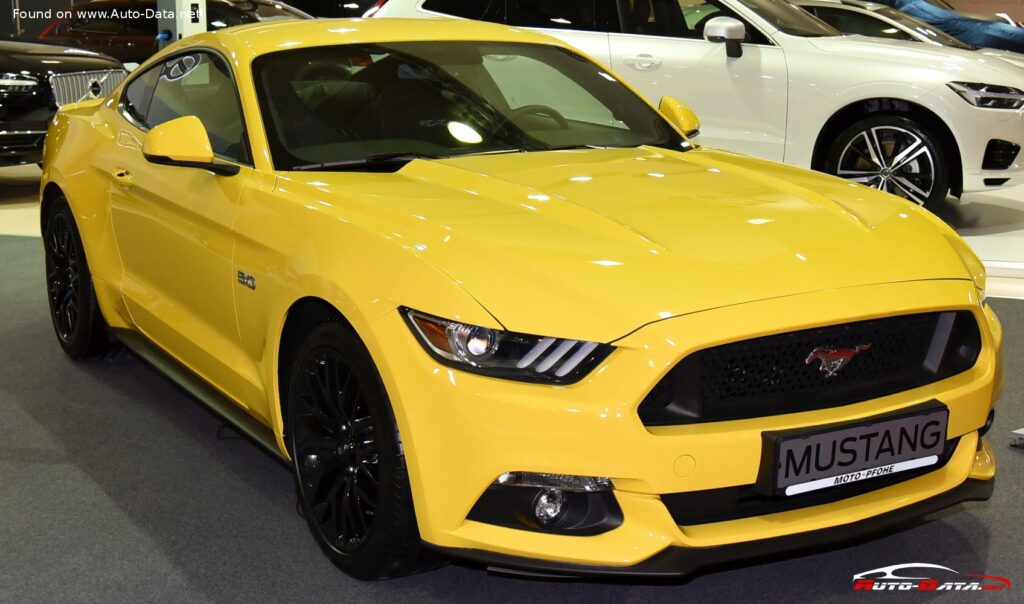
The Ford Mustang VI GT 5.0 V8 (426 Hp) proudly wears its fastback body type, a silhouette deeply ingrained in the Mustang’s heritage. However, this generation brought a more contemporary and athletic stance. Measuring 188.31 inches (4783 mm) in length, 75.39 inches (1915 mm) in width, and 54.41 inches (1382 mm) in height, the S550 Mustang possesses a broad and aggressive road presence. Its long hood, short deck, and muscular haunches pay homage to its predecessors, while sharper lines, a more pronounced grille, and modern lighting elements bring it firmly into the 21st century. The drag coefficient of 0.32 is a testament to its aerodynamic refinement, contributing to both stability at speed and fuel efficiency.
The 18-inch wheels, wrapped in 235/50 R18 tires, fill the wheel arches purposefully, hinting at the performance capabilities beneath. The wide tracks—62.28 inches (1582 mm) at the front and 64.88 inches (1648 mm) at the rear—contribute to its planted feel and aggressive stance.
Interior and Chassis Innovations
Inside, the Mustang VI GT 5.0 V8 (426 Hp) offers a 2-door, 4-seat configuration, blending classic Mustang cues with modern ergonomics and technology. While the rear seats are more suited for occasional use or extra storage, the front cabin provides a driver-focused environment. The most significant chassis innovation for the S550 generation was the adoption of an independent rear suspension (IRS) system across all models. This was a radical departure from the live rear axle that had been a Mustang staple for decades, fundamentally transforming the car’s handling dynamics. The IRS dramatically improved ride comfort, cornering stability, and overall refinement, especially on uneven surfaces, making the Mustang a more formidable competitor against European and Japanese sports coupes.
Braking performance is handled by ventilated discs at both the front and rear, complemented by an Anti-lock Braking System (ABS) for enhanced safety and control during aggressive stops. Steering is managed by an electric power steering rack and pinion system, offering adjustable steering modes to suit different driving preferences, from light and easy for city maneuvering to firm and responsive for track use. With a minimum turning circle of 37.8 feet (11.52 meters), the Mustang remains surprisingly agile for its size.
Technical Specifications: Ford Mustang VI GT 5.0 V8 (426 Hp) (2015-2017)
| General Information | |
|---|---|
| Brand | Ford |
| Model | Mustang |
| Generation | Mustang VI (S550) |
| Type (Engine) | GT 5.0 V8 (426 Hp) |
| Start of Production | 2015 year |
| End of Production | 2017 year |
| Powertrain Architecture | Internal Combustion Engine |
| Body type | Fastback |
| Seats | 4 |
| Doors | 2 |
| Performance Specs | |
| Fuel Consumption (Economy) – Urban | 15.7 l/100 km (15 US mpg) |
| Fuel Consumption (Economy) – Extra Urban | 9.4 l/100 km (25 US mpg) |
| Fuel Consumption (Economy) – Combined | 12.4 l/100 km (19 US mpg) |
| Fuel Type | Petrol (Gasoline) |
| Weight-to-Power Ratio | 3.9 kg/Hp (253.4 Hp/tonne) |
| Weight-to-Torque Ratio | 3.2 kg/Nm (314.7 Nm/tonne) |
| Engine Specs | |
| Power | 426 Hp @ 6500 rpm |
| Power per Liter | 86 Hp/l |
| Torque | 529 Nm @ 4250 rpm (390.17 lb.-ft. @ 4250 rpm) |
| Engine Layout | Front, Longitudinal |
| Engine Model/Code | Coyote |
| Engine Displacement | 4951 cm3 (302.13 cu. in.) |
| Number of Cylinders | 8 |
| Engine Configuration | V-engine |
| Cylinder Bore | 92.2 mm (3.63 in.) |
| Piston Stroke | 92.7 mm (3.65 in.) |
| Compression Ratio | 11:1 |
| Number of Valves per Cylinder | 4 |
| Fuel Injection System | Multi-port manifold injection |
| Engine Aspiration | Naturally aspirated engine |
| Valvetrain | DOHC |
| Engine Oil Capacity | 7.6 l (8.03 US qt) |
| Coolant Capacity | 12.88 l (13.61 US qt) |
| Space, Volume and Weights | |
| Kerb Weight | 1681 kg (3705.97 lbs) |
| Fuel Tank Capacity | 60 l (15.85 US gal) |
| Dimensions | |
| Length | 4783 mm (188.31 in.) |
| Width | 1915 mm (75.39 in.) |
| Width with mirrors folded | 2080 mm (81.89 in.) |
| Height | 1382 mm (54.41 in.) |
| Wheelbase | 2720 mm (107.09 in.) |
| Front Track | 1582 mm (62.28 in.) |
| Rear (Back) Track | 1648 mm (64.88 in.) |
| Drag Coefficient (Cd) | 0.32 |
| Minimum Turning Circle (Turning Diameter) | 11.52 m (37.8 ft.) |
| Drivetrain, Brakes and Suspension Specs | |
| Drivetrain Architecture | The Internal combustion engine (ICE) drives the rear wheels of the vehicle. |
| Drive Wheel | Rear wheel drive |
| Number of Gears and Type of Gearbox | 6 gears, manual transmission |
| Front Brakes | Ventilated discs |
| Rear Brakes | Ventilated discs |
| Assisting Systems | ABS (Anti-lock braking system) |
| Steering Type | Steering rack and pinion |
| Power Steering | Electric Steering |
| Tires Size | 235/50 R18 |
| Wheel Rims Size | 18 |
Legacy and Market Impact
The Ford Mustang VI GT 5.0 V8 (426 Hp) (2015-2017) represents a watershed moment in the Mustang’s illustrious history. By embracing a global design philosophy and incorporating sophisticated engineering like the independent rear suspension, Ford successfully transformed the Mustang from a regional icon into a universally respected performance car. This generation proved that the Mustang could deliver both traditional American muscle car thrills and contemporary sports car refinement, appealing to a much broader audience than ever before.
In its primary market, the United States, the Mustang VI GT 5.0 V8 (426 Hp) fiercely competed with its traditional rivals: the Chevrolet Camaro SS and the Dodge Challenger R/T Scat Pack. While the Camaro often offered sharper handling and the Challenger boasted brute force, the Mustang GT carved out its niche by offering a compelling blend of both, wrapped in an undeniably iconic package. Its aggressive styling, powerful Coyote V8, and the newfound handling prowess made it a formidable contender, frequently winning comparison tests and enthusiast acclaim.
Globally, the S550 Mustang opened up new markets and introduced the pony car phenomenon to millions. Its success in Europe, where it was often praised for its value proposition against more expensive German and Japanese sports coupes, underscored its universal appeal. The availability of a powerful V8, coupled with the choice of a manual transmission, resonated deeply with enthusiasts worldwide who had long admired the Mustang from afar. This global expansion not only boosted sales but also cemented the Mustang’s status as one of the most recognizable and desirable performance cars on the planet.
The 2015-2017 Ford Mustang VI GT 5.0 V8 (426 Hp) will be remembered as the generation that modernized the legend without losing its soul. It successfully balanced heritage with innovation, delivering a vehicle that was both a fantastic driver’s car and a cultural phenomenon. Its impact on Ford’s brand image and the global performance car market is undeniable, solidifying the Mustang’s position as a true automotive legend for generations to come.