Introduction to the Opel Senator B 3.0i (177 Hp) Automatic
The Opel Senator B 3.0i (177 Hp) Automatic represents a significant chapter in the history of German automotive engineering, serving as Opel’s flagship executive sedan during its production run from September 1987 to August 1990. Positioned at the pinnacle of Opel’s model lineup, the Senator B was designed to offer a compelling blend of luxury, performance, and sophisticated comfort, challenging established rivals in the competitive European executive car segment.
As the second generation of the Senator nameplate, the Senator B (also known as the Vauxhall Carlton/Omega-based Senator in the UK) built upon the foundation of its predecessor, sharing its platform with the Opel Omega A. However, the Senator distinguished itself with a more upscale interior, refined styling, and a focus on premium features. This particular variant, equipped with the robust 3.0-liter inline-six engine and an automatic transmission, was a quintessential grand tourer, emphasizing smooth power delivery and a serene driving experience tailored for long-distance cruising on European autobahns. While never officially sold in the United States under the Opel brand, the Senator B’s engineering and design philosophies reflect General Motors’ global strategies of the era, leveraging shared platforms and powertrains across its diverse marques. Its heritage lies firmly in the European market, where it was appreciated for its understated elegance and mechanical resilience.
Engine and Performance of the Opel Senator B
At the heart of the Opel Senator B 3.0i (177 Hp) Automatic lies a formidable 3.0-liter (2969 cm³) naturally aspirated inline-six engine, designated with the code 30NE. This powerplant was a hallmark of Opel’s engineering prowess, known for its smooth operation, durability, and linear power delivery. It produced a respectable 177 horsepower at 5600 revolutions per minute (rpm), making it a competitive offering in its class. Torque was equally impressive for the era, peaking at 177.01 lb.-ft. at 4400 rpm, which contributed to the car’s effortless acceleration and flexible cruising capabilities.
The engine featured a multi-port manifold injection system, ensuring precise fuel delivery and efficiency. Its valvetrain utilized Opel’s CIH (Cam-in-head) design, a testament to the brand’s long-standing engineering traditions, allowing for a relatively compact cylinder head design and good power characteristics. The inline-six configuration, with a bore of 3.74 inches and a piston stroke of 2.75 inches, along with a compression ratio of 9.4:1, provided a balanced and refined driving experience.
Power was transmitted to the rear wheels via a 4-speed automatic transmission, a common choice for luxury sedans of the period, prioritizing comfort and ease of driving over outright sportiness. This combination allowed the Senator B to accelerate from 0 to 60 miles per hour in a brisk 9.8 seconds, with a top speed of 137.94 mph. Despite its size and performance, the vehicle achieved a combined fuel economy of 23.8 US mpg, a respectable figure for a large-engined executive car in the late 1980s. The Senator B’s powertrain architecture, with its front-longitudinal engine layout and rear-wheel drive, provided excellent weight distribution and a traditional, engaging driving feel that appealed to discerning buyers.
Design and Features of the Opel Senator B
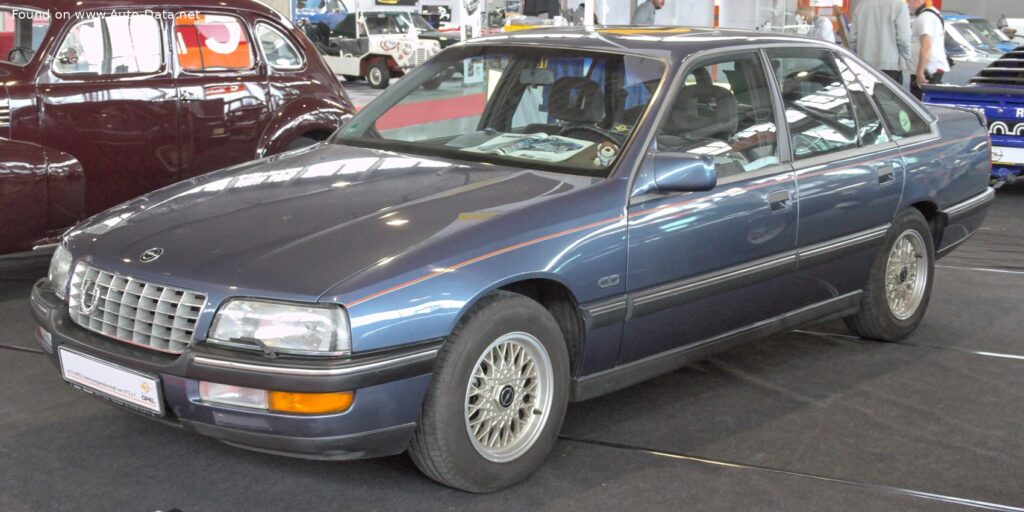
The design of the Opel Senator B was characterized by a clean, aerodynamic, and understated aesthetic that was typical of German luxury cars of the late 1980s. As a 4-door, 5-seat sedan, it exuded a sense of conservative elegance rather than overt flashiness. Its dimensions were substantial for the time, measuring 190.75 inches in length, 69.41 inches in width, and 57.09 inches in height, providing ample interior space for five occupants and a commanding road presence. The long wheelbase of 107.48 inches contributed to a smooth ride and stable handling characteristics.
One notable aspect of the Senator B’s design was its impressive drag coefficient (Cd) of 0.30. This was a highly competitive figure for a sedan of its size in the late 1980s, contributing to improved fuel efficiency and reduced wind noise at higher speeds, enhancing the car’s grand touring credentials.
Inside, the Senator B was appointed with features aimed at maximizing comfort and convenience. While specific trim levels varied, typical amenities for an executive car of this era included power windows, central locking, an advanced audio system, and comfortable, supportive seating. The trunk space was generous, offering a minimum of 18.72 cubic feet, which could expand to a substantial 32.84 cubic feet with the rear seats folded (if applicable for the model, though often executive sedans had fixed rear seats, this data indicates potential for enhanced cargo flexibility).
In terms of chassis and safety, the Senator B featured an independent suspension setup both front and rear. The front utilized a McPherson strut design with coil springs and an anti-roll bar, while the rear employed an independent coil spring system with a transverse stabilizer and trailing arms, providing a compliant ride and predictable handling. Braking duties were handled by ventilated discs at the front and solid discs at the rear, augmented by an Anti-lock Braking System (ABS), which was a significant safety feature for the period. The hydraulic power steering, utilizing a cone worm with recirculation balls system, offered precise control and good road feel, befitting a vehicle of its stature. The car rode on 205/65 R15 tires mounted on 6J x 15-inch wheel rims, providing a good balance of grip and ride comfort.
Technical Specifications
| Category | Specification |
|---|---|
| General Information | |
| Brand | Opel |
| Model | Senator B |
| Type | 3.0i (177 Hp) Automatic |
| Production Start | September, 1987 |
| Production End | August, 1990 |
| Body Type | Sedan |
| Seats | 5 |
| Doors | 4 |
| Performance Specs | |
| Fuel Consumption (Combined) | 23.8 US mpg |
| Fuel Type | Petrol (Gasoline) |
| Acceleration 0-60 mph | 9.8 sec |
| Maximum Speed | 137.94 mph |
| Weight-to-Power Ratio | 8.2 kg/Hp |
| Engine Specs | |
| Power | 177 Hp @ 5600 rpm |
| Torque | 177.01 lb.-ft. @ 4400 rpm |
| Engine Displacement | 3.0 Liters (181.18 cu. in.) |
| Number of Cylinders | 6 |
| Engine Configuration | Inline |
| Engine Layout | Front, Longitudinal |
| Valvetrain | CIH (Cam-in-head) |
| Fuel Injection System | Multi-port manifold injection |
| Aspiration | Naturally aspirated |
| Compression Ratio | 9.4:1 |
| Engine Oil Capacity | 5.81 US qt |
| Coolant Capacity | 10.67 US qt |
| Dimensions, Weight & Volume | |
| Length | 190.75 in. |
| Width | 69.41 in. |
| Height | 57.09 in. |
| Wheelbase | 107.48 in. |
| Curb Weight | 3207.73 lbs. |
| Maximum Weight | 4420.27 lbs. |
| Trunk Space (Min/Max) | 18.72 – 32.84 cu. ft. |
| Fuel Tank Capacity | 19.81 US gal |
| Drag Coefficient (Cd) | 0.30 |
| Minimum Turning Circle | 35.93 ft. |
| Drivetrain, Brakes & Suspension | |
| Drive Wheel | Rear-wheel drive |
| Transmission | 4 gears, automatic transmission |
| Front Suspension | Independent, McPherson with coil spring and anti-roll bar |
| Rear Suspension | Independent coil spring, Transverse stabilizer, Trailing arm |
| Front Brakes | Ventilated discs |
| Rear Brakes | Disc |
| Assisting Systems | ABS (Anti-lock braking system) |
| Steering Type | Cone worm with recirculation balls, Hydraulic Power Steering |
| Tire Size | 205/65 R15 |
| Wheel Rim Size | 6J x 15 |
Legacy and Market Impact
The Opel Senator B 3.0i (177 Hp) Automatic carved out a distinct niche for itself in the European executive car market during its relatively short production run. As Opel’s flagship, it represented the brand’s aspiration to compete with more prestigious German marques like BMW and Mercedes-Benz, albeit with a focus on value, understated luxury, and robust engineering. The Senator B was often considered a more discreet and less ostentatious choice compared to its Bavarian rivals, appealing to buyers who prioritized comfort, space, and reliable performance without the higher price tag or overt brand prestige.
Its primary competitors included the BMW 5 Series (E28 and later the E34 generation during the Senator B’s tenure), the Mercedes-Benz E-Class (W124), and Ford’s own executive offering, the Scorpio/Granada. While it may not have matched the dynamic sportiness of a BMW or the ultimate luxury perception of a Mercedes-Benz, the Senator B offered a compelling package of smooth inline-six power, a comfortable ride, and a spacious, well-appointed interior. Its excellent drag coefficient and sophisticated independent suspension contributed to its reputation as a capable and refined long-distance cruiser.
The Senator B’s legacy is that of a solid, dependable, and often overlooked executive sedan. It showcased Opel’s ability to produce a competitive product in the premium segment, leveraging General Motors’ extensive engineering resources. Though production ceased in 1990, the Senator B’s influence can be seen in subsequent Opel/Vauxhall executive models, particularly the Omega, which continued to offer a blend of comfort and performance in the large car segment. Today, the Opel Senator B is remembered by enthusiasts as a classic example of late 1980s German executive motoring, a car that offered substantial luxury and performance for its price point, and a testament to Opel’s ambition in the fiercely competitive European market. Its robust build quality and straightforward mechanics ensure that well-maintained examples continue to be appreciated by collectors and classic car enthusiasts alike.