The Suzuki Ignis II 1.2 DualJet (90 Hp) + SHVS: A Compact Urban Crossover for Global Markets
The Suzuki Ignis II 1.2 DualJet (90 Hp) + SHVS represents the second generation of Suzuki’s distinctive subcompact crossover, produced from 2016 to December 2019. Positioned as a versatile and economical vehicle, this iteration of the Ignis carved out a unique niche in various international markets, particularly in Europe, Asia, and Oceania, where its blend of compact dimensions, SUV-inspired styling, and efficient mild-hybrid powertrain made it a compelling choice for urban dwellers and those seeking a practical, go-anywhere attitude in a small package. While not officially sold in the United States, the Ignis II is a prime example of Suzuki’s global strategy, focusing on lightweight construction, fuel efficiency, and a robust, utilitarian design philosophy.
This generation of the Ignis, characterized by its bold design and innovative powertrain, was a testament to Suzuki’s expertise in developing small, capable vehicles. It offered a refreshing alternative in the increasingly crowded compact SUV segment, emphasizing maneuverability, low running costs, and a surprisingly spacious interior for its diminutive footprint. The inclusion of the Smart Hybrid Vehicle by Suzuki (SHVS) system, paired with the efficient DualJet engine, underscored its commitment to modern environmental standards and economical operation.
Engine and Performance: The Efficient 1.2 DualJet (90 Hp) + SHVS Powertrain
At the heart of the Suzuki Ignis II 1.2 DualJet (90 Hp) + SHVS is a sophisticated and highly efficient powertrain designed for optimum performance and fuel economy. The vehicle is powered by a 1.2-liter (1242 cm³, 75.79 cu. in.) K12C inline four-cylinder engine, featuring Suzuki’s “DualJet” technology. This innovative engine design incorporates two fuel injectors per cylinder, positioned close to the intake valves, which allows for finer atomization of fuel and more precise fuel delivery. This results in enhanced combustion efficiency, leading to improved fuel economy and reduced emissions.
The naturally aspirated engine delivers a respectable 90 horsepower at 6000 rpm and 88.51 lb.-ft. of torque at 4400 rpm. For a vehicle of its size and weight, this output provides ample power for city driving and sufficient capability for highway cruising. A key differentiator for this specific Ignis variant is the integration of Suzuki’s Smart Hybrid Vehicle by Suzuki (SHVS) system. This mild-hybrid setup utilizes an Integrated Starter Generator (ISG) that assists the engine during acceleration, recovers energy during braking, and enables a smooth engine auto start-stop function. While not a full hybrid, the SHVS system significantly contributes to the Ignis’s impressive fuel efficiency and lower CO2 emissions.
Power is sent to the front wheels via a precise 5-speed manual transmission, offering engaging driving dynamics and further contributing to the vehicle’s efficiency. The Ignis II 1.2 DualJet + SHVS boasts an acceleration time from 0 to 60 mph in a swift 11.2 seconds, with a top speed of 105.63 mph (170 km/h). Its fuel economy figures are particularly noteworthy: 48 US mpg in urban settings, 58.8 US mpg on extra-urban cycles, and a combined 54.7 US mpg (4.3 l/100 km). With CO2 emissions of just 97 g/km, the Ignis II meets stringent Euro 6 emission standards, making it an environmentally conscious choice in its segment.
Design and Features: Compact SUV Aesthetics and Practicality
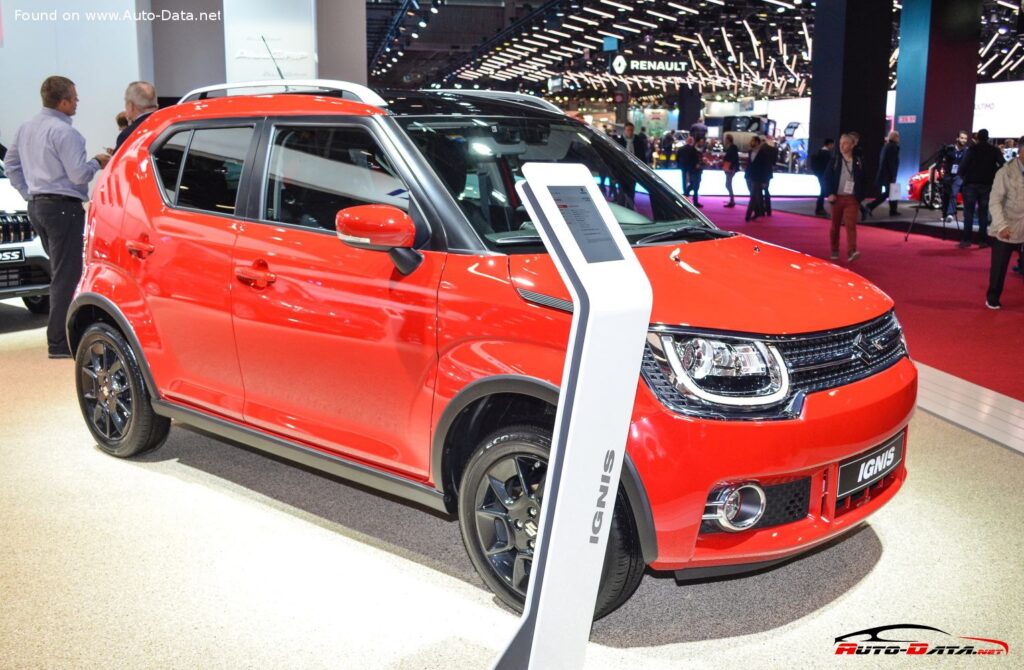
The Suzuki Ignis II adopted a distinctive and somewhat polarizing design that blended elements of a compact SUV with the practicality of a city car. Its “micro-SUV” or “subcompact crossover” body type, characterized by a tall stance, prominent wheel arches, and a relatively short wheelbase, gave it a robust and adventurous appearance despite its compact dimensions. Measuring 145.67 inches (3700 mm) in length, 66.54 inches (1690 mm) in width, and 62.8 inches (1595 mm) in height, the Ignis was designed for urban maneuverability and easy parking.
The five-door body provided practical access to its four-seat interior. Despite its compact exterior, Suzuki engineers maximized interior space, offering a surprising amount of headroom and legroom for its class. The rear seats often featured a sliding function, allowing owners to prioritize either passenger comfort or cargo volume. With a minimum trunk space of 9.18 cu. ft. (260 liters), which expands to an impressive 38.85 cu. ft. (1100 liters) with the rear seats folded, the Ignis offered commendable versatility for a vehicle of its size.
Key design elements included a unique front fascia with integrated LED daytime running lights (on higher trims), a clamshell hood, and a distinctive C-pillar design with three slashes, a nod to Suzuki’s heritage. The vehicle’s high ground clearance of 7.09 inches (180 mm) further enhanced its SUV credentials, providing confidence over uneven terrain and through light snow. Standard features typically included power steering (electric), a rack and pinion steering type, and ABS (Anti-lock Braking System) for enhanced safety. The suspension system featured an independent McPherson setup at the front and a semi-independent coil spring design at the rear, tuned for a comfortable ride and agile handling. Ventilated disc brakes up front and drum brakes at the rear provided reliable stopping power, complemented by 175/60 R16 tires on 16-inch wheel rims.
Technical Specifications
| Category | Specification | US/Imperial Equivalent |
|---|---|---|
General Information |
||
| Brand | Suzuki | |
| Model | Ignis | |
| Generation | Ignis II | |
| Type (Engine) | 1.2 DualJet (90 Hp) + SHVS | |
| Start of production | 2016 year | |
| End of production | December, 2019 year | |
| Powertrain Architecture | Internal Combustion engine | |
| Body type | SUV | |
| Seats | 4 | |
| Doors | 5 | |
Performance Specifications |
||
| Fuel consumption (economy) – urban | 4.9 l/100 km | 48 US mpg |
| Fuel consumption (economy) – extra urban | 4 l/100 km | 58.8 US mpg |
| Fuel consumption (economy) – combined | 4.3 l/100 km | 54.7 US mpg |
| CO2 emissions | 97 g/km | |
| Fuel Type | Petrol (Gasoline) | |
| Acceleration 0 – 60 mph | 11.2 sec | |
| Maximum speed | 170 km/h | 105.63 mph |
| Emission standard | Euro 6 | |
| Weight-to-power ratio | 9.3 kg/Hp | 20.5 lbs/Hp |
| Weight-to-torque ratio | 7 kg/Nm | 15.4 lbs/lb.-ft. |
Engine Specifications |
||
| Power | 90 Hp @ 6000 rpm | |
| Power per liter | 72.5 Hp/l | |
| Torque | 120 Nm @ 4400 rpm | 88.51 lb.-ft. @ 4400 rpm |
| Engine layout | Front, Transverse | |
| Engine Model/Code | K12C | |
| Engine displacement | 1242 cm3 | 75.79 cu. in. |
| Number of cylinders | 4 | |
| Engine configuration | Inline | |
| Cylinder Bore | 73 mm | 2.87 in. |
| Piston Stroke | 74.2 mm | 2.92 in. |
| Compression ratio | 12.5:1 | |
| Number of valves per cylinder | 4 | |
| Fuel injection system | Multi-port manifold injection | |
| Engine aspiration | Naturally aspirated engine | |
| Engine oil capacity | 3.3 l | 3.49 US qt |
| Coolant | 4 l | 4.23 US qt |
Space, Volume and Weights |
||
| Kerb Weight | 835-870 kg | 1840.86 – 1918.02 lbs. |
| Max. weight | 1330 kg | 2932.15 lbs. |
| Max load | 460-495 kg | 1014.13 – 1091.29 lbs. |
| Trunk (boot) space – minimum | 260 l | 9.18 cu. ft. |
| Trunk (boot) space – maximum | 1100 l | 38.85 cu. ft. |
| Fuel tank capacity | 32 l | 8.45 US gal |
| Permitted trailer load with brakes (12%) | 1000 kg | 2204.62 lbs. |
| Permitted trailer load without brakes | 400 kg | 881.85 lbs. |
| Permitted towbar download | 50 kg | 110.23 lbs. |
Dimensions |
||
| Length | 3700 mm | 145.67 in. |
| Width | 1690 mm | 66.54 in. |
| Height | 1595 mm | 62.8 in. |
| Wheelbase | 2435 mm | 95.87 in. |
| Front track | 1460 mm | 57.48 in. |
| Rear (Back) track | 1470 mm | 57.87 in. |
| Ride height (ground clearance) | 180 mm | 7.09 in. |
| Minimum turning circle (turning diameter) | 9.4 m | 30.84 ft. |
| Approach angle | 20° | |
| Departure angle | 38.8° | |
| Ramp-over (brakeover) angle | 18° | |
Drivetrain, Brakes and Suspension Specifications |
||
| Drivetrain Architecture | Internal combustion engine (ICE) drives the front wheels. | |
| Drive wheel | Front wheel drive | |
| Number of gears and type of gearbox | 5 gears, manual transmission | |
| Front suspension | Independent type McPherson | |
| Rear suspension | Semi-independent, coil spring | |
| Front brakes | Ventilated discs | |
| Rear brakes | Drum | |
| Assisting systems | ABS (Anti-lock braking system) | |
| Steering type | Steering rack and pinion | |
| Power steering | Electric Steering | |
| Tires size | 175/60 R16 | |
| Wheel rims size | 16 | |
Legacy and Market Impact of the Suzuki Ignis II
The Suzuki Ignis II 1.2 DualJet (90 Hp) + SHVS carved out a distinctive legacy in the compact car segments of its target markets. Its primary impact stemmed from its ability to offer the perceived benefits of an SUV – higher driving position, increased ground clearance, and rugged styling – in a footprint barely larger than a city car. This made it particularly appealing in urban environments across Europe, Japan, India, and Australia, where space is at a premium and fuel efficiency is a major purchasing factor. Its compact dimensions, coupled with a tight turning circle of 30.84 feet (9.4 meters), made it exceptionally nimble and easy to park.
In its segment, the Ignis competed with a diverse range of vehicles, from traditional A-segment hatchbacks like the Toyota Aygo, Fiat Panda, and Kia Picanto, to other burgeoning micro-crossovers such as the Dacia Sandero Stepway or even smaller variants of the Renault Captur. What set the Ignis apart was its unique styling, which some found quirky and charming, combined with Suzuki’s reputation for reliability and value. The SHVS mild-hybrid system further enhanced its competitiveness, offering a tangible advantage in terms of fuel economy and lower emissions compared to many non-hybrid rivals, making it attractive to environmentally conscious buyers and those seeking reduced running costs.
The Ignis played a crucial role in Suzuki’s global lineup, reinforcing the brand’s image as a specialist in small, efficient, and often all-wheel-drive (though this specific variant is FWD) vehicles. It demonstrated Suzuki’s commitment to innovation in powertrain technology with the DualJet engine and SHVS system, proving that even a small, affordable car could incorporate advanced features for efficiency. Its relatively light curb weight, ranging from 1840.86 to 1918.02 lbs. (835-870 kg), also contributed significantly to its performance and efficiency, a hallmark of Suzuki engineering.
While its production run concluded in December 2019, the Ignis II continued to be a popular choice in the used car market, testament to its enduring appeal as a practical, economical, and characterful urban crossover. Its distinctive design and robust mechanicals ensured it maintained a loyal following, cementing its place as an important, albeit niche, model in Suzuki’s modern history.