The Renault Megane III 1.5 dCi (110 Hp) FAP EDC: A European Compact Stalwart
The Renault Megane III 1.5 dCi (110 Hp) FAP EDC represents a significant iteration of Renault’s popular compact family car, the Megane. Launched in 2010 as part of the third generation (Megane III), this particular variant, produced until 2012, was a quintessential European offering, emphasizing fuel efficiency, practicality, and a comfortable driving experience. Positioned in the highly competitive C-segment, a category dominated by hatchbacks and sedans in Europe, the Megane III aimed to build on its predecessors’ success by offering a more conventional yet stylish design, coupled with advanced powertrain technologies tailored for the European market’s stringent emissions and fuel economy demands. While never officially sold in the United States, the Megane III played a crucial role in Renault’s global portfolio, showcasing the brand’s expertise in developing sophisticated diesel engines and efficient automatic transmissions for a broad consumer base.
This specific model, featuring the 1.5-liter dCi diesel engine paired with an Efficient Dual Clutch (EDC) automatic transmission and a Diesel Particulate Filter (FAP), was engineered to provide an optimal balance of performance for daily commuting and impressive long-distance fuel economy. Its design and engineering reflected Renault’s commitment to innovation in powertrain technology and passenger comfort, making it a strong contender against rivals like the Volkswagen Golf, Ford Focus, and Opel Astra in its primary markets.
Engine and Performance of the Renault Megane III
At the heart of the Renault Megane III 1.5 dCi (110 Hp) FAP EDC lies Renault’s acclaimed K9K 837 diesel engine, a 1.5-liter (1461 cm3 or 89.16 cu. in.) inline four-cylinder unit. This powerplant is a testament to Renault’s prowess in diesel engine development, known for its robustness, efficiency, and smooth operation. Equipped with a common rail fuel injection system, a turbocharger, and an intercooler, the engine delivers a respectable 110 horsepower at 4000 rpm. More significantly for real-world driving, it produces a robust 240 Nm (177.01 lb.-ft.) of torque at a low 1750 rpm, providing excellent pulling power and responsiveness from low engine speeds.
The engine’s power is channeled to the front wheels through Renault’s advanced EDC (Efficient Dual Clutch) automatic transmission. This six-speed dual-clutch unit was a key technological highlight for the Megane III, offering the convenience of an automatic with the efficiency and direct feel typically associated with a manual gearbox. The EDC transmission contributes significantly to the vehicle’s impressive fuel economy figures: an estimated 46.1 US mpg in urban driving, 63.6 US mpg on the highway, and a combined average of 56 US mpg. These figures, combined with CO2 emissions of just 110 g/km and compliance with Euro 5 emission standards, underscore the Megane III 1.5 dCi’s eco-friendly credentials for its time.
Performance-wise, the Megane III 1.5 dCi (110 Hp) FAP EDC is adequately swift for its segment. It accelerates from 0 to 60 mph in a calculated 11.1 seconds and can reach a top speed of 118.06 mph (190 km/h). While not a performance-oriented vehicle, its ample torque and smooth transmission make it a comfortable and capable cruiser, particularly on European highways, where its fuel economy benefits are most pronounced. The engine’s low compression ratio of 15.2:1 and two valves per cylinder are optimized for efficiency and low emissions, further enhanced by the standard Particulate Filter (FAP) system.
Design and Features
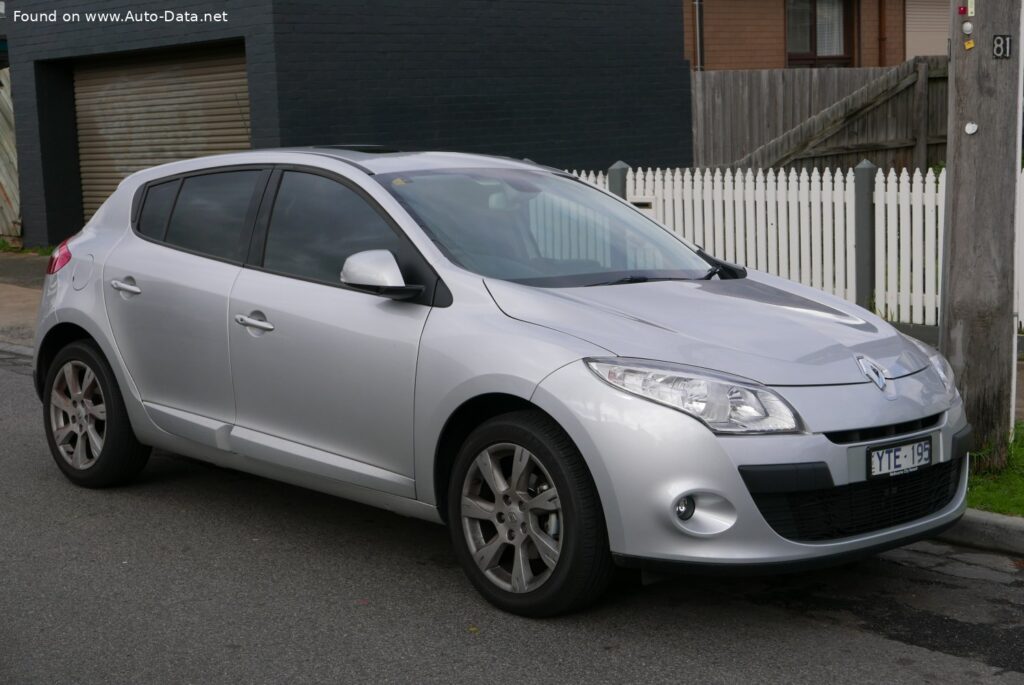
The Renault Megane III, in its 5-door hatchback configuration, presented a more conservative and universally appealing design compared to the polarizing “bustle-back” design of its predecessor. Its lines were fluid and modern, aiming for a broader market appeal. The exterior dimensions of 169.09 inches (4295 mm) in length, 71.18 inches (1808 mm) in width (80.2 inches or 2037 mm including mirrors), and 58.7 inches (1491 mm) in height, coupled with a 103.98-inch (2641 mm) wheelbase, provided a spacious and practical cabin for five occupants.
Inside, the Megane III emphasized comfort and functionality. The hatchback body style offered considerable versatility, with a minimum trunk space of 14.3 cu. ft. (405 liters) that could expand to a substantial 41.04 cu. ft. (1162 liters) with the rear seats folded down. This made it a highly practical choice for families and individuals requiring flexible cargo capacity. Key features for the era included an electric power steering system, offering light and precise control for urban driving and highway cruising. The suspension setup, with independent MacPherson struts at the front and a torsion beam axle at the rear, provided a comfortable ride quality, balancing compliance with competent handling.
Safety was a priority, as is typical for European family cars. The Megane III came standard with an Anti-lock Braking System (ABS), and its braking system comprised ventilated discs at the front and solid discs at the rear, ensuring effective stopping power. The vehicle typically rode on 205/60 R16 or 205/55 R17 tires, mounted on 6.5J x 16 or 6.5J x 17 wheel rims, contributing to its stable road manners and aesthetic appeal.
Technical Specifications
| General Information | |
| Brand | Renault |
| Model | Megane |
| Generation | Megane III |
| Type (Engine) | 1.5 dCi (110 Hp) FAP EDC |
| Start of Production | 2010 year |
| End of Production | 2012 year |
| Powertrain Architecture | Internal Combustion engine |
| Body Type | Hatchback |
| Seats | 5 |
| Doors | 5 |
| Performance Specs | |
| Fuel consumption (economy) – urban | 5.1 l/100 km (46.1 US mpg) |
| Fuel consumption (economy) – extra urban | 3.7 l/100 km (63.6 US mpg) |
| Fuel consumption (economy) – combined | 4.2 l/100 km (56 US mpg) |
| CO2 emissions | 110 g/km |
| Fuel Type | Diesel |
| Acceleration 0 – 60 mph | 11.1 sec |
| Maximum speed | 118.06 mph (190 km/h) |
| Emission standard | Euro 5 |
| Weight-to-power ratio | 11.7 kg/Hp (85.3 Hp/tonne) |
| Weight-to-torque ratio | 5.4 kg/Nm (186 Nm/tonne) |
| Engine Specs | |
| Power | 110 Hp @ 4000 rpm |
| Power per liter | 75.3 Hp/l |
| Torque | 240 Nm (177.01 lb.-ft.) @ 1750 rpm |
| Engine layout | Front, Transverse |
| Engine Model/Code | K9K 837 |
| Engine displacement | 1.5 Liters (1461 cm3, 89.16 cu. in.) |
| Number of cylinders | 4 |
| Engine configuration | Inline |
| Cylinder Bore | 2.99 in. (76 mm) |
| Piston Stroke | 3.17 in. (80.5 mm) |
| Compression ratio | 15.2:1 |
| Number of valves per cylinder | 2 |
| Fuel injection system | Diesel Commonrail |
| Engine aspiration | Turbocharger, Intercooler |
| Engine oil capacity | 4.5 l (4.76 US qt) |
| Coolant | 6.5 l (6.87 US qt) |
| Engine systems | Particulate filter |
| Space, Volume and Weights | |
| Kerb Weight | 2843.96 lbs. (1290 kg) |
| Max. weight | 4067.53 lbs. (1845 kg) |
| Max load | 1223.57 lbs. (555 kg) |
| Trunk (boot) space – minimum | 14.3 cu. ft. (405 l) |
| Trunk (boot) space – maximum | 41.04 cu. ft. (1162 l) |
| Fuel tank capacity | 15.85 US gal (60 l) |
| Permitted trailer load with brakes (12%) | 2866.01 lbs. (1300 kg) |
| Permitted trailer load without brakes | 1499.14 lbs. (680 kg) |
| Dimensions | |
| Length | 169.09 in. (4295 mm) |
| Width | 71.18 in. (1808 mm) |
| Width including mirrors | 80.2 in. (2037 mm) |
| Height | 58.7 in. (1491 mm) |
| Wheelbase | 103.98 in. (2641 mm) |
| Front track | 60.87 in. (1546 mm) |
| Rear (Back) track | 60.91 in. (1547 mm) |
| Front overhang | 33.94 in. (862 mm) |
| Rear overhang | 31.18 in. (792 mm) |
| Ride height (ground clearance) | 4.72 in. (120 mm) |
| Minimum turning circle (turning diameter) | 35.93 ft. (10.95 m) |
| Drivetrain, Brakes and Suspension Specs | |
| Drivetrain Architecture | The Internal combustion engine (ICE) drives the front wheels of the vehicle. |
| Drive wheel | Front wheel drive |
| Number of gears and type of gearbox | automatic transmission EDC |
| Front suspension | Independent type McPherson |
| Rear suspension | Torsion |
| Front brakes | Ventilated discs |
| Rear brakes | Disc |
| Assisting systems | ABS (Anti-lock braking system) |
| Steering type | Steering rack and pinion |
| Power steering | Electric Steering |
| Tires size | 205/60 R16 92H; 205/55 R17 91H |
| Wheel rims size | 6.5J x 16; 6.5J x 17 |
Legacy and Market Impact
The Renault Megane III, and particularly its efficient diesel variants like the 1.5 dCi (110 Hp) FAP EDC, solidified Renault’s position as a key player in the European compact car market. Its reputation was built on a blend of comfortable ride quality, practical interior space, strong safety credentials, and, crucially, exceptional fuel economy. The 1.5 dCi engine, in particular, was widely praised across various Renault and Nissan models for its reliability and efficiency, making it a popular choice for both private buyers and large corporate fleets across Europe.
In its primary markets, the Megane III faced stiff competition from segment leaders such as the Volkswagen Golf, renowned for its build quality and resale value; the Ford Focus, celebrated for its driving dynamics; and other European contenders like the Opel Astra, Peugeot 308, and Citroën C4. Despite this fierce rivalry, the Megane III carved out a significant market share by offering compelling value, distinctive French styling (albeit more subdued than its predecessor), and a strong emphasis on comfort and technology, especially with the introduction of the EDC transmission.
The historical significance of the Megane III 1.5 dCi FAP EDC lies in its embodiment of the evolving European automotive landscape during the early 2010s. It represented a period where diesel engines, especially smaller, highly efficient units, were at their peak popularity, offering a compelling alternative to gasoline engines due to their superior fuel economy and torque. The integration of advanced features like dual-clutch transmissions and particulate filters also highlighted the industry’s push towards greater refinement and environmental responsibility.
For the American market, the Megane III, like most Renault models, remained an exotic curiosity. Renault had withdrawn from the U.S. market in the late 1980s, and the preferences of American consumers for larger vehicles, SUVs, and gasoline engines further ensured that compact diesel hatchbacks like the Megane III never made the transatlantic journey. However, its success in Europe underscores a different automotive philosophy, prioritizing compact dimensions, fuel efficiency, and a refined driving experience for its specific market needs.