Renault Espace III (JE) 2.0 (114 Hp): A European Minivan Icon
The Renault Espace III (JE) 2.0 (114 Hp) represents the third generation of Renault’s groundbreaking multi-purpose vehicle (MPV), a segment it largely pioneered in Europe. Produced from 1996 to 2000, this particular variant, equipped with a 2.0-liter gasoline engine, was a cornerstone of family transportation across the European continent. While never officially imported to the United States, the Espace series played a pivotal role in defining the modern minivan concept in its primary markets, offering unparalleled interior versatility, comfort, and a distinctive design that set it apart from traditional station wagons and sedans. The Espace III built upon its predecessors’ success by refining its design, enhancing safety features, and improving overall driving dynamics, cementing its reputation as a benchmark in the burgeoning European MPV segment.
Engine & Performance: The Heart of the Renault Espace III (JE)
Under the hood, the Renault Espace III (JE) 2.0 (114 Hp) featured Renault’s F3R engine, a naturally aspirated 2.0-liter (1998 cm3 or 121.93 cubic inches) inline-four gasoline unit. This engine was designed for reliable, everyday performance, perfectly suited to the Espace’s role as a family hauler. It utilized a Single Overhead Camshaft (OHC) valvetrain with two valves per cylinder and a multi-port manifold injection system, providing a balance of power delivery and fuel efficiency for its time.
The F3R engine produced a respectable 114 horsepower (HP) at 5400 revolutions per minute (rpm), making it capable of comfortably moving a fully loaded Espace. Torque output stood at 123.91 lb.-ft. (168 Nm) at 3500 rpm, ensuring adequate pulling power for city driving and highway cruising. Power was delivered to the front wheels via a smooth-shifting 5-speed manual transmission, a common and robust setup for vehicles of this class during the late 1990s. The drivetrain architecture was front-wheel drive, contributing to stable handling and efficient packaging.
In terms of performance, the Espace III 2.0 (114 Hp) was not built for speed but offered competent acceleration for its segment. It could accelerate from 0 to 60 miles per hour (mph) in approximately 13 seconds, with a top speed reaching 108.74 mph (175 km/h). Fuel economy, a crucial factor for family vehicles, was rated at an estimated 24.2 US mpg (9.7 l/100 km) on a combined cycle, with urban consumption at 18.4 US mpg (12.8 l/100 km) and extra-urban at 29.8 US mpg (7.9 l/100 km). With CO2 emissions of 227 g/km, it met the Euro 2 emission standard, reflecting the environmental regulations of its production era.
Design & Features: Practicality Meets Innovation
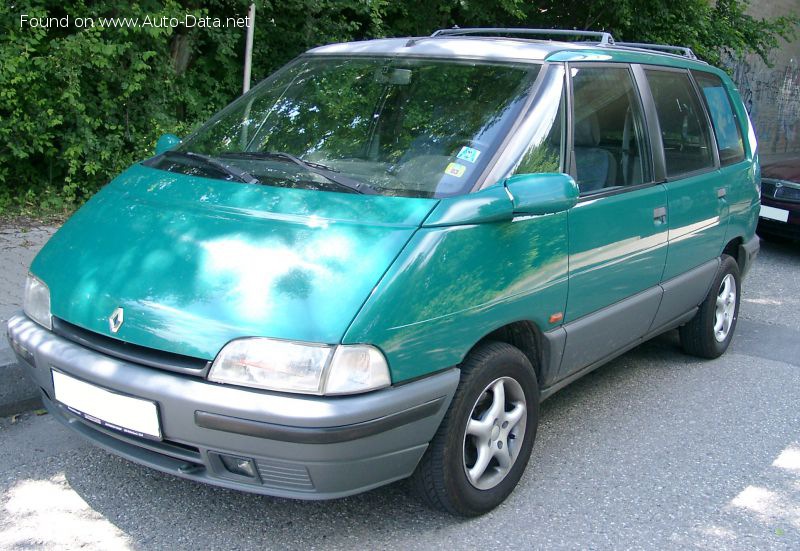
The design of the Renault Espace III (JE) continued the “monobox” philosophy established by its predecessors, characterized by a single, continuous volume from front to rear that maximized interior space. Its body type was classified as a Minivan or MPV, offering five doors and a versatile 7-seat configuration. This flexible seating arrangement allowed owners to easily reconfigure the interior for passenger transport or cargo hauling, a key selling point for the Espace. The rear seats could often be removed or folded to create an expansive cargo area, boasting a maximum trunk space of 100.65 cubic feet (2850 liters), significantly more than many SUVs or station wagons of the period.
Measuring 177.83 inches (4517 mm) in length, 71.26 inches (1810 mm) in width, and 69.8 inches (1773 mm) in height, the Espace III struck a balance between maneuverability and interior spaciousness. Its 106.38-inch (2702 mm) wheelbase contributed to a stable ride, while a minimum turning circle of 37.4 feet (11.4 meters) aided in urban navigation. The kerb weight for this variant was 3284.89 lbs (1490 kg), contributing to a weight-to-power ratio of 13.1 kg/Hp.
Chassis components included an independent McPherson strut front suspension with coil springs and an anti-roll bar, paired with a semi-independent rear suspension with coil springs. This setup provided a comfortable ride quality, essential for long family journeys. Braking was handled by ventilated discs at the front and traditional drum brakes at the rear, offering reliable stopping power. The steering system was a hydraulic rack and pinion setup, providing direct and assisted steering feel. The vehicle rode on 195/65 R15 tires mounted on 15-inch wheel rims, a common size for family vehicles of that era.
Technical Specifications: Renault Espace III (JE) 2.0 (114 Hp)
| Category | Specification |
|---|---|
| General Information | |
| Brand | Renault |
| Model | Espace |
| Generation | Espace III (JE) |
| Engine Type | 2.0 (114 Hp) |
| Production Start | 1996 |
| Production End | 2000 |
| Powertrain Architecture | Internal Combustion Engine |
| Body Type | Minivan, MPV |
| Seats | 7 |
| Doors | 5 |
| Performance Specifications | |
| Fuel Consumption (Urban) | 18.4 US mpg (12.8 l/100 km) |
| Fuel Consumption (Extra Urban) | 29.8 US mpg (7.9 l/100 km) |
| Fuel Consumption (Combined) | 24.2 US mpg (9.7 l/100 km) |
| CO2 Emissions | 227 g/km |
| Fuel Type | Petrol (Gasoline) |
| Acceleration 0-60 mph | 13 seconds |
| Acceleration 0-62 mph (0-100 km/h) | 13.7 seconds |
| Maximum Speed | 108.74 mph (175 km/h) |
| Emission Standard | Euro 2 |
| Weight-to-Power Ratio | 13.1 kg/Hp (76.5 Hp/tonne) |
| Weight-to-Torque Ratio | 8.9 kg/Nm (112.8 Nm/tonne) |
| Engine Specifications | |
| Power | 114 Hp @ 5400 rpm |
| Power per Liter | 57.1 Hp/l |
| Torque | 123.91 lb.-ft. (168 Nm) @ 3500 rpm |
| Engine Layout | Front, Transverse |
| Engine Model/Code | F3R |
| Engine Displacement | 2.0 liters (1998 cm3 / 121.93 cu. in.) |
| Number of Cylinders | 4 |
| Engine Configuration | Inline |
| Cylinder Bore | 3.26 in. (82.7 mm) |
| Piston Stroke | 3.66 in. (93 mm) |
| Compression Ratio | 9.7:1 |
| Valves per Cylinder | 2 |
| Fuel Injection System | Multi-port manifold injection |
| Engine Aspiration | Naturally aspirated |
| Valvetrain | OHC |
| Engine Oil Capacity | 5.81 US qt (5.5 l) |
| Coolant Capacity | 7.4 US qt (7 l) |
| Space, Volume, and Weights | |
| Kerb Weight | 3284.89 lbs (1490 kg) |
| Maximum Weight | 4960.4 lbs (2250 kg) |
| Maximum Load | 1675.51 lbs (760 kg) |
| Trunk (Boot) Space – Minimum | 9.71 cu. ft. (275 l) |
| Trunk (Boot) Space – Maximum | 100.65 cu. ft. (2850 l) |
| Fuel Tank Capacity | 20.61 US gal (78 l) |
| Max. Roof Load | 176.37 lbs (80 kg) |
| Permitted Trailer Load (with brakes) | 3417.17 lbs (1550 kg) |
| Permitted Trailer Load (without brakes) | 1653.47 lbs (750 kg) |
| Dimensions | |
| Length | 177.83 in. (4517 mm) |
| Width | 71.26 in. (1810 mm) |
| Height | 69.8 in. (1773 mm) |
| Wheelbase | 106.38 in. (2702 mm) |
| Front Track | 60.39 in. (1534 mm) |
| Rear (Back) Track | 60.63 in. (1540 mm) |
| Front Overhang | 36.57 in. (929 mm) |
| Rear Overhang | 34.88 in. (886 mm) |
| Ride Height (Ground Clearance) | 4.33 in. (110 mm) |
| Minimum Turning Circle | 37.4 ft. (11.4 m) |
| Drivetrain, Brakes, and Suspension | |
| Drivetrain Architecture | Front-wheel drive, Internal Combustion Engine |
| Drive Wheel | Front-wheel drive |
| Number of Gears & Gearbox Type | 5 gears, manual transmission |
| Front Suspension | Independent, McPherson with coil spring and anti-roll bar |
| Rear Suspension | Semi-independent, coil spring |
| Front Brakes | Ventilated discs |
| Rear Brakes | Drum |
| Steering Type | Steering rack and pinion |
| Power Steering | Hydraulic Steering |
| Tires Size | 195/65 R15 |
| Wheel Rims Size | 15 inches |
Legacy & Market Impact of the Renault Espace III (JE)
The Renault Espace III (JE) continued the model’s strong legacy as a pioneering and highly influential MPV in the European market. Although it never crossed the Atlantic to compete with American minivans like the Chrysler Voyager (which was incidentally sold as a badge-engineered model by Chrysler’s European partners, including Renault, for a time), the Espace carved out its own niche by emphasizing innovative design, flexible interiors, and a distinctly European driving experience. Its impact on family transportation in Europe was profound, offering a viable and stylish alternative to sedans and station wagons for those needing more space and versatility.
In its segment, the Espace III faced robust competition from a growing number of rivals. These included the Ford Galaxy, Volkswagen Sharan, and SEAT Alhambra (often referred to as the “Eurovans” due to their joint development), as well as French competitors like the Citroën Evasion and Peugeot 806. Despite this increasing competition, the Espace maintained its strong reputation for comfort, modularity, and a relatively refined ride. Its innovative use of composite body panels (though not explicitly detailed in the provided data, a known Espace characteristic) contributed to its lightweight structure and resistance to minor dents, enhancing its practicality for family use.
The 2.0 (114 Hp) variant, while not the most powerful in the Espace III lineup, was a popular choice due to its balance of cost, fuel economy, and sufficient performance for typical family duties. It exemplified the Espace’s core values: a spacious, comfortable, and practical vehicle designed to make family life easier. Its success helped solidify the MPV as a mainstream vehicle type in Europe and demonstrated Renault’s commitment to innovation in vehicle packaging and design. The Espace III remains a significant chapter in the history of the European minivan, remembered for its distinctive style, thoughtful engineering, and enduring appeal to families seeking a versatile and enjoyable mode of transport.