Introduction to the Ford Mustang VI GT 5.0 V8 (426 Hp) Automatic
The Ford Mustang, an enduring icon of American automotive culture, entered its sixth generation (codenamed S550) in 2015, marking a significant milestone in its illustrious history. This generation was particularly notable as it represented the first truly global Mustang, designed from the outset to be sold in markets worldwide, including Europe and Asia, alongside its traditional North American stronghold. Among its most compelling variants was the Ford Mustang VI GT 5.0 V8 (426 Hp) Automatic, a potent blend of classic muscle car ethos and modern engineering sophistication. Produced between 2015 and 2017, this specific model year range for the GT Fastback with the 426 horsepower V8 and automatic transmission quickly established itself as a benchmark for performance and value in the sports coupe segment.
The S550 generation brought about a fundamental shift in the Mustang’s architecture, most notably the adoption of an independent rear suspension (IRS) system across the entire lineup. This was a radical departure from the live rear axle that had defined the Mustang’s handling dynamics for decades and signaled Ford’s commitment to transforming the pony car into a truly world-class sports car capable of competing on a global stage. The GT 5.0 V8 (426 Hp) Automatic Fastback embodied this evolution, offering exhilarating performance, improved ride comfort, and refined handling without sacrificing the raw power and distinctive rumble that Mustang enthusiasts cherished.
The S550 Generation and the Ford Mustang VI GT 5.0 V8 (426 Hp) Automatic
The sixth-generation Ford Mustang, often referred to by its internal code S550, represented a monumental leap forward for the storied nameplate. Launched for the 2015 model year, it was engineered to be a global product, breaking from the Mustang’s long-standing tradition as a vehicle primarily focused on the North American market. This global ambition necessitated a more sophisticated chassis and a design that resonated with a broader international audience, while still retaining its quintessential American identity. The inclusion of the Ford Mustang VI GT 5.0 V8 (426 Hp) Automatic Fastback variant was central to this strategy, offering a compelling blend of power, style, and modern amenities.
A cornerstone of the S550’s engineering was the complete redesign of its suspension system. For the first time in the Mustang’s mainstream production, an independent rear suspension was standard across all models. This move dramatically improved ride quality, handling precision, and high-speed stability, addressing a long-standing critique of previous generations. The front suspension also saw significant revisions, featuring a new perimeter subframe that enhanced rigidity and steering response. These chassis improvements allowed the Mustang GT to fully exploit its formidable V8 power, making it a more capable and confidence-inspiring machine on both twisty backroads and long highway cruises.
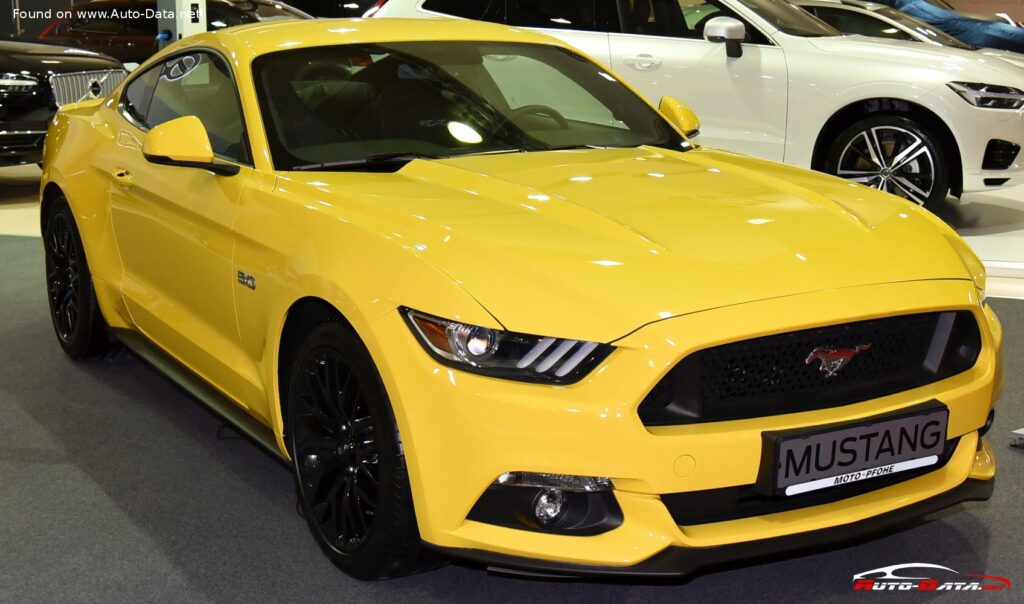
Visually, the S550 generation blended classic Mustang cues with contemporary design language. It retained the iconic long hood, short deck proportions, and aggressive stance, but with a more sleek and aerodynamic profile. The Fastback body style, as featured in the GT 5.0 V8 (426 Hp) Automatic, accentuated its sporty character, paying homage to the original 1960s Mustangs while incorporating modern elements like LED lighting and a more sculpted body. The interior was also significantly upgraded, offering a more premium feel, improved ergonomics, and a host of new technologies, elevating the Mustang’s cabin experience to a level commensurate with its global aspirations.
Engine and Performance
At the heart of the Ford Mustang VI GT 5.0 V8 (426 Hp) Automatic lies the revered “Coyote” 5.0-liter V8 engine. This naturally aspirated powerhouse, known for its robust construction and free-revving nature, delivers a potent 426 horsepower at 6500 rpm and a substantial 390.17 lb.-ft. of torque at 4250 rpm. The engine’s architecture features a V-engine configuration with eight cylinders, each equipped with four valves, totaling 32 valves. Its advanced DOHC (Double Overhead Camshaft) valvetrain ensures optimal airflow and combustion efficiency across the rev range. Fuel is delivered via a multi-port manifold injection system, contributing to its responsive throttle feel and impressive power delivery.
With a displacement of 4951 cm³ (302.13 cu. in.) and a compression ratio of 11:1, the Coyote V8 offers a classic large-displacement, high-horsepower experience. The engine’s bore of 3.63 inches and stroke of 3.65 inches indicate a slightly oversquare design, favoring higher revs and horsepower. This power is expertly managed by a 6-speed automatic transmission, which provides smooth, rapid shifts, enhancing both performance and daily drivability. The automatic gearbox allows for seamless power transfer to the rear wheels, making the GT 5.0 V8 an engaging car for spirited driving while also offering comfortable cruising capabilities.
The drivetrain architecture is classic American muscle: a front, longitudinally mounted engine driving the rear wheels. This setup provides excellent weight distribution for a performance car. With a curb weight of 3728.02 lbs. and 426 horsepower, the Mustang GT boasts a respectable weight-to-power ratio of approximately 4 kg/Hp (or 251.9 Hp/tonne). This translates to strong acceleration and a thrilling driving experience. Despite its performance credentials, the Mustang GT 5.0 V8 (426 Hp) Automatic manages a combined fuel economy of 19 US mpg, a commendable figure for a naturally aspirated V8 of its size and output. Urban consumption is rated at 16 US mpg, while extra-urban driving yields 25 US mpg.
Design and Features
The design of the Ford Mustang VI GT 5.0 V8 (426 Hp) Automatic Fastback is a masterful blend of heritage and modernity. Its iconic Fastback silhouette, stretching 188.31 inches in length, 75.39 inches in width, and 54.41 inches in height, instantly communicates its sporting intent. The aggressive front fascia, characterized by its “shark-bite” grille and distinctive headlights, projects a powerful and assertive presence. At the rear, the signature tri-bar LED taillights pay homage to past Mustangs while integrating seamlessly into the contemporary design. The vehicle’s wide stance, with a front track of 62.28 inches and a rear track of 64.88 inches, contributes to its commanding road presence and improved stability.
Aerodynamics played a more crucial role in the S550 generation, reflected in its drag coefficient (Cd) of 0.32, which helps reduce wind resistance at higher speeds and contributes to better fuel efficiency. The car rides on 18-inch wheels, shod with 235/50 R18 tires, providing a balance of grip, ride comfort, and visual appeal.
Inside, the Mustang GT offers a driver-focused cockpit with seating for four. The interior design strikes a balance between retro-inspired elements and contemporary ergonomics. For its production years (2015-2017), key features included modern infotainment options, a well-appointed dashboard, and comfortable seating designed to support spirited driving. Safety is paramount, and the GT 5.0 V8 comes equipped with robust ventilated disc brakes on both the front and rear axles, complemented by an Anti-lock Braking System (ABS) for enhanced stopping power and control. The electric power steering system, a rack and pinion setup, offers precise feedback and variable assist, making the car nimble around corners and easy to maneuver in tight spaces, as evidenced by its minimum turning circle of 37.8 feet.
Technical Specifications
| General Information | |
|---|---|
| Brand | Ford |
| Model | Mustang |
| Generation | Mustang VI (S550) |
| Type (Engine) | GT 5.0 V8 (426 Hp) Automatic |
| Start of production | 2015 year |
| End of production | 2017 year |
| Powertrain Architecture | Internal Combustion engine |
| Body type | Fastback |
| Seats | 4 |
| Doors | 2 |
| Performance Specs | |
| Fuel consumption (economy) – urban | 16 US mpg |
| Fuel consumption (economy) – extra urban | 25 US mpg |
| Fuel consumption (economy) – combined | 19 US mpg |
| Fuel Type | Petrol (Gasoline) |
| Weight-to-power ratio | 4 kg/Hp (251.9 Hp/tonne) |
| Weight-to-torque ratio | 3.2 kg/Nm (312.8 Nm/tonne) |
| Engine Specs | |
| Power | 426 Hp @ 6500 rpm |
| Power per liter | 86 Hp/l |
| Torque | 390.17 lb.-ft. @ 4250 rpm |
| Engine layout | Front, Longitudinal |
| Engine Model/Code | Coyote |
| Engine displacement | 302.13 cu. in. (4951 cm³) |
| Number of cylinders | 8 |
| Engine configuration | V-engine |
| Cylinder Bore | 3.63 in. (92.2 mm) |
| Piston Stroke | 3.65 in. (92.7 mm) |
| Compression ratio | 11:1 |
| Number of valves per cylinder | 4 |
| Fuel injection system | Multi-port manifold injection |
| Engine aspiration | Naturally aspirated engine |
| Valvetrain | DOHC |
| Engine oil capacity | 8.03 US qt (7.6 l) |
| Coolant | 13.61 US qt (12.88 l) |
| Space, Volume and Weights | |
| Kerb Weight | 3728.02 lbs. (1691 kg) |
| Fuel tank capacity | 15.85 US gal (60 l) |
| Dimensions | |
| Length | 188.31 in. (4783 mm) |
| Width | 75.39 in. (1915 mm) |
| Width with mirrors folded | 81.89 in. (2080 mm) |
| Height | 54.41 in. (1382 mm) |
| Wheelbase | 107.09 in. (2720 mm) |
| Front track | 62.28 in. (1582 mm) |
| Rear (Back) track | 64.88 in. (1648 mm) |
| Drag coefficient (Cd) | 0.32 |
| Minimum turning circle (turning diameter) | 37.8 ft. (11.52 m) |
| Drivetrain, Brakes and Suspension Specs | |
| Drivetrain Architecture | Internal combustion engine drives the rear wheels. |
| Drive wheel | Rear wheel drive |
| Number of gears and type of gearbox | 6 gears, automatic transmission |
| Front brakes | Ventilated discs |
| Rear brakes | Ventilated discs |
| Assisting systems | ABS (Anti-lock braking system) |
| Steering type | Steering rack and pinion |
| Power steering | Electric Steering |
| Tires size | 235/50 R18 |
| Wheel rims size | 18 inches |
Legacy and Market Impact
The Ford Mustang VI GT 5.0 V8 (426 Hp) Automatic, as part of the S550 generation, carved out a significant legacy in the automotive world, particularly from 2015 to 2017. Its introduction marked a pivotal moment for the Mustang, transforming it from a regionally focused performance car into a global player. The decision to engineer the S550 with an independent rear suspension was arguably the most impactful change, fundamentally altering the Mustang’s handling dynamics. This move allowed the GT to compete more effectively with European sports coupes and sophisticated Japanese performance cars, while still retaining its quintessential American muscle car identity.
In its primary North American market, the Mustang GT continued its fierce rivalry with the Chevrolet Camaro and Dodge Challenger, forming the “pony car” triumvirate. The S550 GT distinguished itself by offering a compelling balance of modern technology, refined road manners, and raw V8 power, often at a price point that undercut its rivals when comparing similar performance levels. Its blend of classic styling cues with contemporary engineering resonated strongly with both long-time Mustang enthusiasts and a new generation of buyers seeking a high-performance vehicle with daily usability.
Globally, the S550 Mustang, including the GT 5.0 V8, achieved unprecedented success. It became a best-seller in numerous international markets, demonstrating the universal appeal of its design and performance. For many, it was their first opportunity to own a brand-new Mustang, and the GT variant, with its powerful Coyote engine, was often the halo model. This international exposure not only boosted Ford’s brand image but also solidified the Mustang’s status as a truly iconic vehicle on a worldwide scale.
The 2015-2017 Mustang VI GT 5.0 V8 (426 Hp) Automatic set a new benchmark for what a Mustang could be. It demonstrated that a muscle car could evolve, embrace modern technology, and excel in performance and refinement without losing its soul. Its reputation for offering immense bang for the buck, combined with its improved handling and global appeal, cemented its place as one of the most significant iterations in the Mustang’s storied history, paving the way for future performance enhancements and special editions. The S550 generation, and particularly the GT 5.0 V8, will be remembered as the era when the Mustang truly went global, captivating enthusiasts around the world.