The Opel Senator B 3.0i 24V: A European Executive Contender
The Opel Senator B 3.0i 24V represents a significant chapter in the history of Opel, General Motors’ primary European brand. Introduced in October 1989 as the second and final generation of the Senator line, this full-size, executive sedan was Opel’s flagship offering, designed to compete in the highly competitive E-segment of the European market. While never officially sold in the United States under the Opel badge, the Senator B carved out a niche for itself across Europe, offering a blend of robust engineering, sophisticated comfort, and impressive performance for its era. This particular variant, the 3.0i 24V, stood as the pinnacle of the Senator B lineup, showcasing Opel’s engineering prowess with its advanced multi-valve inline-six engine and rear-wheel-drive architecture. Produced until May 1993, the Senator B was a testament to traditional European executive car values, prioritizing smooth power delivery, a composed ride, and spacious accommodations.
Engine & Performance of the Opel Senator B 3.0i 24V
At the heart of the most potent Opel Senator B 3.0i 24V lay a formidable powertrain that defined its executive aspirations. The vehicle was equipped with Opel’s renowned C30SE engine, a 3.0-liter (2969 cm³, or 181.18 cu. in.) naturally aspirated inline-six gasoline engine. This unit was a technological highlight for its time, featuring a Double Overhead Camshaft (DOHC) valvetrain with four valves per cylinder, totaling 24 valves. This multi-valve design allowed for superior airflow and combustion efficiency compared to its two-valve counterparts, contributing significantly to its power output and refinement.
The C30SE engine generated a robust 204 horsepower at 6000 rpm, translating to a specific output of 68.7 horsepower per liter. Torque figures were equally impressive for a naturally aspirated engine of this period, peaking at 199.14 lb.-ft. (270 Nm) at a relatively accessible 3600 rpm. This broad powerband ensured strong, linear acceleration and effortless cruising. Power was delivered to the rear wheels via a smooth-shifting 5-speed manual transmission, a choice favored by enthusiasts for its direct engagement.
Performance metrics underscored the Senator B 3.0i 24V’s capabilities. It could sprint from 0 to 60 mph in a brisk 7.4 seconds, with the 0-100 km/h acceleration rated at 7.8 seconds. Its top speed was an impressive 149.13 mph (240 km/h), making it one of the faster sedans in its class. These figures were achieved despite a curb weight of 3251.82 lbs. (1475 kg), highlighting the efficiency of the engine and drivetrain. The weight-to-power ratio stood at 7.2 kg/Hp (138.3 Hp/tonne), demonstrating a well-balanced power-to-weight characteristic for an executive sedan. Fuel efficiency, while not its primary focus, was respectable for a large-displacement inline-six of its era: 25.6 US mpg combined (9.2 l/100 km), with highway figures reaching 30.9 US mpg (7.6 l/100 km).
Design & Features
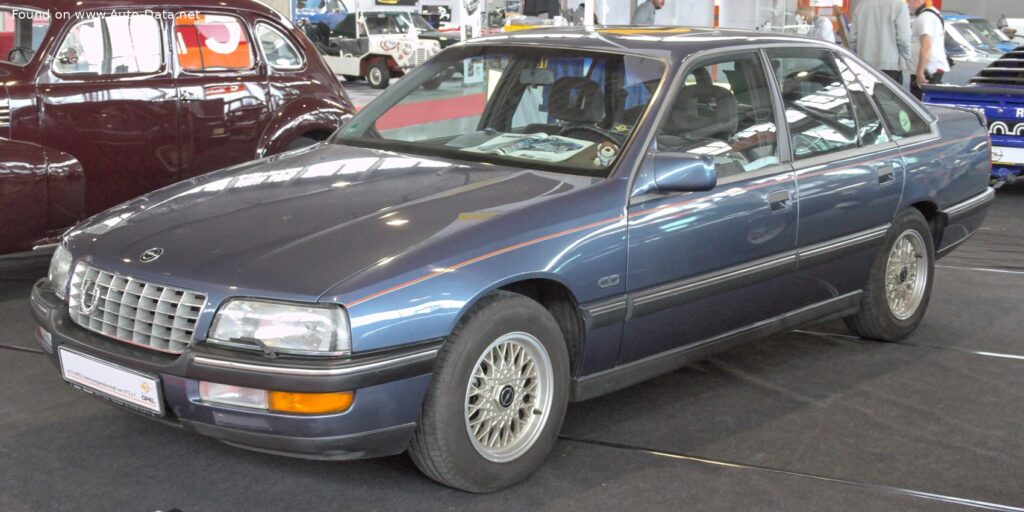
The Opel Senator B adopted a classic, understated executive sedan design, characteristic of European cars from the late 1980s and early 1990s. Its four-door, five-seat body exuded a sense of understated elegance rather than overt flashiness. Measuring 190.75 inches (4845 mm) in length, 69.41 inches (1763 mm) in width, and 57.09 inches (1450 mm) in height, the Senator B presented a substantial and commanding presence on the road. The 107.48-inch (2730 mm) wheelbase contributed to both its stable ride and generous interior space.
Aerodynamics played a role in its design, with a commendable drag coefficient (Cd) of 0.31, which was competitive for a large sedan of its time and contributed to both fuel efficiency and reduced wind noise at higher speeds. The interior was designed for comfort and practicality, offering a spacious cabin with ample legroom and headroom for five occupants. The trunk capacity was particularly impressive, ranging from 18.72 cu. ft. (530 liters) to a maximum of 32.84 cu. ft. (930 liters) with the rear seats folded, providing significant cargo versatility for an executive sedan.
Underneath its composed exterior, the Senator B featured a sophisticated chassis designed for ride comfort and handling precision. It employed an independent McPherson strut front suspension with coil springs and an anti-roll bar, paired with an independent coil spring rear suspension featuring a transverse stabilizer and trailing arms. This setup provided a compliant ride while maintaining good body control. Braking duties were handled by ventilated discs at the front and solid discs at the rear, augmented by a standard Anti-lock Braking System (ABS), a crucial safety feature for its time. Steering was a hydraulic power-assisted cone worm with recirculation balls system, offering precise feedback and ease of maneuverability, especially given its minimum turning circle of 35.93 feet (10.95 meters). The car rode on 205/65 R15 tires mounted on 6J x 15-inch wheel rims.
Technical Specifications
| General Information | |
|---|---|
| Brand | Opel |
| Model | Senator |
| Generation | Senator B |
| Type (Engine) | 3.0i 24V (204 Hp) |
| Start of production | October, 1989 year |
| End of production | May, 1993 year |
| Powertrain Architecture | Internal Combustion engine |
| Body type | Sedan |
| Seats | 5 |
| Doors | 4 |
| Performance Specs | |
| Fuel consumption (economy) – urban | 14.3 l/100 km (16.4 US mpg) |
| Fuel consumption (economy) – extra urban | 7.6 l/100 km (30.9 US mpg) |
| Fuel consumption (economy) – combined | 9.2 l/100 km (25.6 US mpg) |
| Fuel Type | Petrol (Gasoline) |
| Acceleration 0 – 60 mph | 7.4 sec |
| Acceleration 0 – 100 km/h | 7.8 sec |
| Maximum speed | 240 km/h (149.13 mph) |
| Weight-to-power ratio | 7.2 kg/Hp (138.3 Hp/tonne) |
| Weight-to-torque ratio | 5.5 kg/Nm (183.1 Nm/tonne) |
| Engine Specs | |
| Power | 204 Hp @ 6000 rpm. |
| Power per liter | 68.7 Hp/l |
| Torque | 270 Nm @ 3600 rpm. (199.14 lb.-ft.) |
| Maximum engine speed | 6600 rpm. |
| Engine layout | Front, Longitudinal |
| Engine Model/Code | C30SE |
| Engine displacement | 2969 cm³ (181.18 cu. in.) |
| Number of cylinders | 6 |
| Engine configuration | Inline |
| Cylinder Bore | 95 mm (3.74 in.) |
| Piston Stroke | 69.8 mm (2.75 in.) |
| Compression ratio | 10:1 |
| Number of valves per cylinder | 4 |
| Fuel injection system | Multi-port manifold injection |
| Engine aspiration | Naturally aspirated engine |
| Valvetrain | DOHC |
| Engine oil capacity | 5.5 l (5.81 US qt) |
| Coolant | 9.8 l (10.36 US qt) |
| Space, Volume and Weights | |
| Kerb Weight | 1475 kg (3251.82 lbs.) |
| Max. weight | 2035 kg (4486.41 lbs.) |
| Max load | 560 kg (1234.59 lbs.) |
| Trunk (boot) space – minimum | 530 l (18.72 cu. ft.) |
| Trunk (boot) space – maximum | 930 l (32.84 cu. ft.) |
| Fuel tank capacity | 75 l (19.81 US gal) |
| Max. roof load | 100 kg (220.46 lbs.) |
| Permitted trailer load with brakes (12%) | 1700 kg (3747.86 lbs.) |
| Permitted towbar download | 75 kg (165.35 lbs.) |
| Dimensions | |
| Length | 4845 mm (190.75 in.) |
| Width | 1763 mm (69.41 in.) |
| Height | 1450 mm (57.09 in.) |
| Wheelbase | 2730 mm (107.48 in.) |
| Front track | 1450 mm (57.09 in.) |
| Rear (Back) track | 1468 mm (57.8 in.) |
| Ride height (ground clearance) | 140 mm (5.51 in.) |
| Drag coefficient (Cd) | 0.31 |
| Minimum turning circle (turning diameter) | 10.95 m (35.93 ft.) |
| Drivetrain, Brakes and Suspension Specs | |
| Drivetrain Architecture | The Internal combustion engine (ICE) drives the rear wheels of the vehicle. |
| Drive wheel | Rear wheel drive |
| Number of gears and type of gearbox | 5 gears, manual transmission |
| Front suspension | Independent, type McPherson with coil spring and anti-roll bar |
| Rear suspension | Independent coil spring, Transverse stabilizer, Trailing arm |
| Front brakes | Ventilated discs |
| Rear brakes | Disc |
| Assisting systems | ABS (Anti-lock braking system) |
| Steering type | Cone worm with recirculation balls |
| Power steering | Hydraulic Steering |
| Tires size | 205/65 R15 |
| Wheel rims size | 6J x 15 |
Legacy & Market Impact of the Opel Senator B
The Opel Senator B 3.0i 24V held a unique position in the European automotive landscape during its production run from 1989 to 1993. As Opel’s largest and most luxurious sedan, it was designed to offer a compelling alternative to established premium executive cars such as the BMW 5-Series (E34 generation), the Mercedes-Benz E-Class (W124 generation), and the Ford Scorpio/Granada. While it may not have carried the same prestige as its German luxury rivals, the Senator B distinguished itself by offering a comparable level of comfort, space, and performance at a more accessible price point.
Its robust C30SE inline-six engine, with its DOHC 24-valve configuration, earned a reputation for smoothness, durability, and strong performance. This engine was a particular highlight, providing the Senator B with the grunt needed to keep pace with its more expensive competitors on the Autobahn. The rear-wheel-drive platform, combined with a well-tuned independent suspension system, ensured a driving experience that was both comfortable for long journeys and engaging when pushed. The standard inclusion of ABS was also a significant selling point, underscoring Opel’s commitment to safety in its top-tier models.
Despite its merits, the Senator B faced an uphill battle. The executive car segment was (and remains) fiercely competitive, heavily influenced by brand image and perceived luxury. Opel, as a more mainstream brand, struggled to capture a larger share of the truly premium market against the likes of BMW and Mercedes-Benz. Nevertheless, the Senator B cultivated a loyal following among those who appreciated its blend of solid engineering, understated elegance, and value. It was particularly popular as a comfortable and reliable long-distance cruiser and a favored choice for company car fleets.
The end of the Senator B’s production in 1993 marked the close of an era for Opel. It was one of the last large, rear-wheel-drive sedans produced by a mainstream European manufacturer before the industry shifted towards more front-wheel-drive platforms and, eventually, SUVs. Its discontinuation also reflected a broader trend where traditional executive sedans from non-premium brands found it increasingly difficult to compete with dedicated luxury marques. Today, the Opel Senator B, especially the potent 3.0i 24V variant, is remembered as a well-engineered, powerful, and comfortable European executive car that offered a distinctive alternative to the dominant luxury brands, representing a significant piece of Opel’s heritage and engineering ambition. It remains a cherished classic for enthusiasts who appreciate its robust mechanicals and classic European styling.