<!DOCTYPE html>
<html lang=”en”>
<head>
<meta charset=”UTF-8″>
<meta name=”viewport” content=”width=device-width, initial-scale=1.0″>
<title>Suzuki Ignis II 1.2 DualJet (90 Hp) + SHVS 5 Seat</title>
</head>
<body>
<h2>Suzuki Ignis II 1.2 DualJet (90 Hp) + SHVS 5 Seat</h2>
<p>
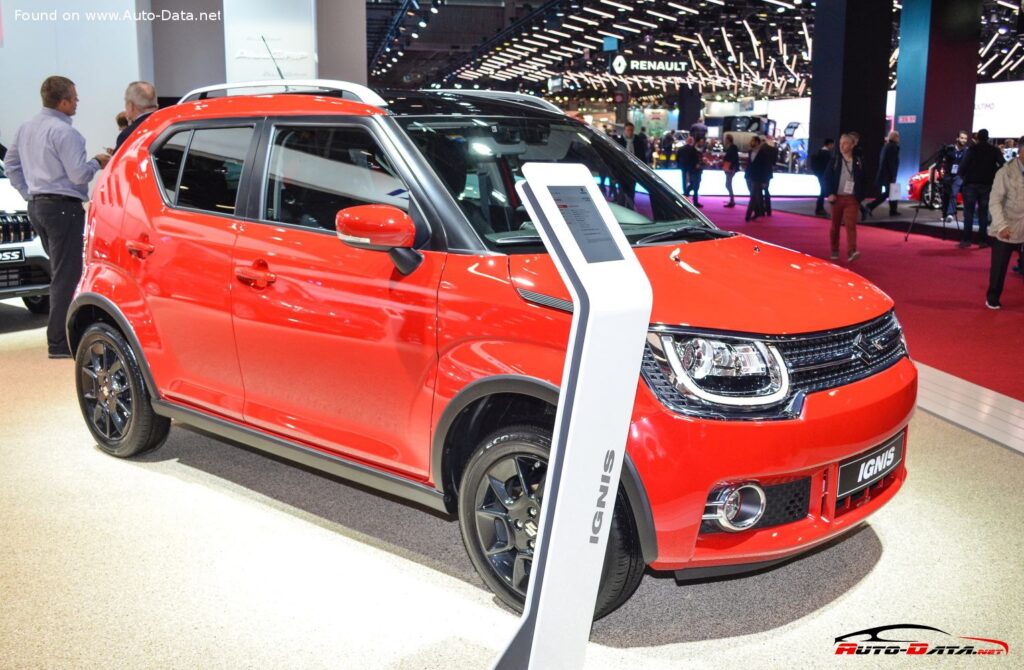
The <strong>Suzuki Ignis II 1.2 DualJet (90 Hp) + SHVS 5 Seat</strong> represents the second generation of Suzuki’s distinctive compact crossover, a model celebrated for its unique blend of city car maneuverability and SUV-inspired styling. Produced from 2016 to December 2019, this iteration of the Ignis carved out a niche in the global automotive landscape, particularly in European, Japanese, and Indian markets, where its compact dimensions, fuel efficiency, and practical design resonated with urban dwellers and those seeking a versatile, economical vehicle. Positioned as a micro-SUV or an A-segment crossover, the Ignis II was lauded for its ability to combine a surprisingly spacious interior with a minimal footprint, making it an ideal choice for navigating crowded city streets while offering a commanding driving position. Its powertrain, featuring the efficient 1.2-liter DualJet gasoline engine paired with Suzuki’s Smart Hybrid Vehicle by Suzuki (SHVS) mild-hybrid system, underscored its commitment to modern automotive trends focusing on reduced emissions and enhanced fuel economy.
</p>
<h2>Engine and Performance of the Suzuki Ignis II 1.2 DualJet (90 Hp) + SHVS 5 Seat</h2>
<p>
At the heart of the <strong>Suzuki Ignis II 1.2 DualJet (90 Hp) + SHVS 5 Seat</strong> lies the K12C 1.2-liter DualJet engine, a sophisticated naturally aspirated inline-four cylinder gasoline unit designed for optimal efficiency and responsive performance. This engine benefits from Suzuki’s DualJet technology, which employs twin injectors positioned close to the intake valves for each cylinder. This precise fuel delivery system optimizes fuel atomization and combustion efficiency, contributing significantly to the engine’s impressive fuel economy and lower emissions output.
</p>
<p>
The engine produces a respectable 90 horsepower at 6000 rpm and 88.51 lb.-ft. of torque at 4400 rpm. While these figures might seem modest on paper, the Ignis II’s remarkably low curb weight, ranging from 1,840 to 1,918 pounds, ensures a sprightly performance. This lightweight construction results in an excellent weight-to-power ratio of 9.3 kg/Hp (approximately 20.5 lbs/Hp), allowing the vehicle to accelerate from 0 to 60 mph in a brisk 11.2 seconds. The top speed is rated at 105.63 mph, more than adequate for its intended urban and suburban usage.
</p>
<p>
A key differentiator for this specific Ignis variant is the integration of the Smart Hybrid Vehicle by Suzuki (SHVS) system. This mild-hybrid technology utilizes an Integrated Starter Generator (ISG) to provide torque assist during acceleration and to recover kinetic energy during deceleration and braking. The recovered energy is stored in a compact lithium-ion battery, which then powers the ISG to support the engine, reducing the load on the gasoline engine and improving overall efficiency. The SHVS system also facilitates a smooth and quick engine start/stop function, further contributing to fuel savings, especially in stop-and-go traffic.
</p>
<p>
The combination of the DualJet engine and SHVS technology yields exceptional fuel economy figures. The Ignis II achieves an impressive 48 US mpg in urban driving, 58.8 US mpg on the extra-urban cycle, and a combined average of 54.7 US mpg. These figures, coupled with CO2 emissions of just 97 g/km, make the Ignis II an environmentally conscious choice, meeting stringent Euro 6 emission standards. Power is delivered to the front wheels via a smooth-shifting 5-speed manual transmission, emphasizing driver engagement and control.
</p>
<h2>Design Philosophy and Features</h2>
<p>
The design of the <strong>Suzuki Ignis II 1.2 DualJet (90 Hp) + SHVS 5 Seat</strong> is undoubtedly one of its most defining characteristics. Suzuki intentionally crafted a vehicle that stands out from the crowd with its distinctive and somewhat quirky styling. With a body type classified as an SUV, albeit a very compact one, the Ignis II features a robust, upright stance, a high beltline, and unique design cues like the clamshell hood, prominent C-pillar slits (a nod to Suzuki’s classic models like the Cervo and Vitara), and a floating roof effect. Its compact dimensions – a length of 145.67 inches, a width of 66.54 inches, and a height of 62.8 inches – belie an interior that is surprisingly spacious and versatile for up to five occupants.
</p>
<p>
Despite its small footprint, the Ignis boasts a significant ground clearance of 7.09 inches, which, combined with short overhangs (indicated by generous approach and departure angles of 20° and 38.8° respectively), contributes to its light-SUV appeal and ability to tackle uneven urban terrain or light off-road paths with confidence. The interior prioritizes practicality and user-friendliness. The 5-seat configuration ensures ample room for passengers, and the trunk space is adaptable, offering a minimum of 9.43 cubic feet, which expands to a generous 38.74 cubic feet with the rear seats folded down, accommodating varying cargo needs.
</p>
<p>
Underneath its distinctive skin, the Ignis II employs a lightweight platform, contributing to its agile handling and remarkable fuel efficiency. The suspension system comprises independent MacPherson struts at the front and a semi-independent setup with coil springs at the rear, providing a comfortable ride quality that is well-suited for city driving. Braking is handled by ventilated discs at the front and drum brakes at the rear, augmented by an Anti-lock Braking System (ABS) for enhanced safety. The steering is an electric power-assisted rack and pinion system, offering light effort and a tight turning circle of just 30.84 feet, making parking and maneuvering in confined spaces exceptionally easy. The vehicle rides on 16-inch wheels shod with 175/60 R16 tires, balancing ride comfort with responsive handling.
</p>
<h2>Technical Specifications</h2>
<table border=”1″ style=”width:100%; border-collapse: collapse;”>
<tr><th colspan=”2″ style=”padding: 8px; text-align: left; background-color: #f2f2f2;”>General Information</th></tr>
<tr><td style=”padding: 8px; border: 1px solid #ddd;”>Brand</td><td style=”padding: 8px; border: 1px solid #ddd;”>Suzuki</td></tr>
<tr><td style=”padding: 8px; border: 1px solid #ddd;”>Model</td><td style=”padding: 8px; border: 1px solid #ddd;”>Ignis</td></tr>
<tr><td style=”padding: 8px; border: 1px solid #ddd;”>Generation</td><td style=”padding: 8px; border: 1px solid #ddd;”>Ignis II</td></tr>
<tr><td style=”padding: 8px; border: 1px solid #ddd;”>Type (Engine)</td><td style=”padding: 8px; border: 1px solid #ddd;”>1.2 DualJet (90 Hp) + SHVS 5 Seat</td></tr>
<tr><td style=”padding: 8px; border: 1px solid #ddd;”>Production Start</td><td style=”padding: 8px; border: 1px solid #ddd;”>2016</td></tr>
<tr><td style=”padding: 8px; border: 1px solid #ddd;”>Production End</td><td style=”padding: 8px; border: 1px solid #ddd;”>December, 2019</td></tr>
<tr><td style=”padding: 8px; border: 1px solid #ddd;”>Powertrain Architecture</td><td style=”padding: 8px; border: 1px solid #ddd;”>Internal Combustion Engine with Mild Hybrid</td></tr>
<tr><td style=”padding: 8px; border: 1px solid #ddd;”>Body Type</td><td style=”padding: 8px; border: 1px solid #ddd;”>SUV</td></tr>
<tr><td style=”padding: 8px; border: 1px solid #ddd;”>Seats</td><td style=”padding: 8px; border: 1px solid #ddd;”>5</td></tr>
<tr><td style=”padding: 8px; border: 1px solid #ddd;”>Doors</td><td style=”padding: 8px; border: 1px solid #ddd;”>5</td></tr>
<tr><th colspan=”2″ style=”padding: 8px; text-align: left; background-color: #f2f2f2;”>Performance Specifications</th></tr>
<tr><td style=”padding: 8px; border: 1px solid #ddd;”>Fuel Consumption (Urban)</td><td style=”padding: 8px; border: 1px solid #ddd;”>48 US mpg</td></tr>
<tr><td style=”padding: 8px; border: 1px solid #ddd;”>Fuel Consumption (Extra Urban)</td><td style=”padding: 8px; border: 1px solid #ddd;”>58.8 US mpg</td></tr>
<tr><td style=”padding: 8px; border: 1px solid #ddd;”>Fuel Consumption (Combined)</td><td style=”padding: 8px; border: 1px solid #ddd;”>54.7 US mpg</td></tr>
<tr><td style=”padding: 8px; border: 1px solid #ddd;”>CO2 Emissions</td><td style=”padding: 8px; border: 1px solid #ddd;”>97 g/km</td></tr>
<tr><td style=”padding: 8px; border: 1px solid #ddd;”>Fuel Type</td><td style=”padding: 8px; border: 1px solid #ddd;”>Petrol (Gasoline)</td></tr>
<tr><td style=”padding: 8px; border: 1px solid #ddd;”>Acceleration 0-60 mph</td><td style=”padding: 8px; border: 1px solid #ddd;”>11.2 sec</td></tr>
<tr><td style=”padding: 8px; border: 1px solid #ddd;”>Maximum Speed</td><td style=”padding: 8px; border: 1px solid #ddd;”>105.63 mph</td></tr>
<tr><td style=”padding: 8px; border: 1px solid #ddd;”>Emission Standard</td><td style=”padding: 8px; border: 1px solid #ddd;”>Euro 6</td></tr>
<tr><td style=”padding: 8px; border: 1px solid #ddd;”>Weight-to-Power Ratio</td><td style=”padding: 8px; border: 1px solid #ddd;”>20.5 lbs/Hp</td></tr>
<tr><th colspan=”2″ style=”padding: 8px; text-align: left; background-color: #f2f2f2;”>Engine Specifications</th></tr>
<tr><td style=”padding: 8px; border: 1px solid #ddd;”>Power</td><td style=”padding: 8px; border: 1px solid #ddd;”>90 Hp @ 6000 rpm</td></tr>
<tr><td style=”padding: 8px; border: 1px solid #ddd;”>Torque</td><td style=”padding: 8px; border: 1px solid #ddd;”>88.51 lb.-ft. @ 4400 rpm</td></tr>
<tr><td style=”padding: 8px; border: 1px solid #ddd;”>Engine Layout</td><td style=”padding: 8px; border: 1px solid #ddd;”>Front, Transverse</td></tr>
<tr><td style=”padding: 8px; border: 1px solid #ddd;”>Engine Model/Code</td><td style=”padding: 8px; border: 1px solid #ddd;”>K12C</td></tr>
<tr><td style=”padding: 8px; border: 1px solid #ddd;”>Engine Displacement</td><td style=”padding: 8px; border: 1px solid #ddd;”>1.2 Liters (75.79 cu. in.)</td></tr>
<tr><td style=”padding: 8px; border: 1px solid #ddd;”>Number of Cylinders</td><td style=”padding: 8px; border: 1px solid #ddd;”>4</td></tr>
<tr><td style=”padding: 8px; border: 1px solid #ddd;”>Engine Configuration</td><td style=”padding: 8px; border: 1px solid #ddd;”>Inline</td></tr>
<tr><td style=”padding: 8px; border: 1px solid #ddd;”>Cylinder Bore</td><td style=”padding: 8px; border: 1px solid #ddd;”>2.87 in.</td>