The Mitsubishi Lancer IX 2.0i (150 Hp) CVT: A Global Compact Sedan Offering
The Mitsubishi Lancer IX 2.0i (150 Hp) CVT represents a specific iteration within Mitsubishi’s enduring Lancer lineage, produced from October 2010 to March 2013. Positioned as a practical and efficient compact sedan, this particular model catered to a global audience prioritizing reliability, fuel economy, and a comfortable driving experience. While the Lancer nameplate is globally recognized for its rally heritage and performance variants like the Lancer Evolution, the Lancer IX 2.0i (150 Hp) CVT was engineered to serve as a versatile daily driver, offering a balanced combination of power and efficiency in its segment. Its introduction during a period when the broader Lancer (often referred to as Lancer X or Lancer EX in some markets) was already established, suggests it filled a niche, likely offering a refined powertrain option or serving specific regional market demands. This model, with its 2.0-liter engine and Continuously Variable Transmission (CVT), highlighted Mitsubishi’s commitment to delivering accessible automotive technology and dependable transportation.
Engine & Performance: The Heart of the Mitsubishi Lancer IX 2.0i (150 Hp) CVT
At the core of the Mitsubishi Lancer IX 2.0i (150 Hp) CVT lies the well-regarded 4B11 engine, a 2.0-liter (1998 cm3 or 121.93 cu. in.) naturally aspirated inline-four gasoline unit. This engine is a testament to Mitsubishi’s engineering prowess, featuring a Double Overhead Camshaft (DOHC) valvetrain with four valves per cylinder, ensuring efficient air intake and exhaust. Fuel delivery is handled by a multi-port manifold injection system, contributing to its smooth power delivery and consistent performance. The engine produces a respectable 150 horsepower at 6000 rpm, which, for a compact sedan, provides ample power for both city driving and highway cruising. Torque output stands at 198 Nm (146.04 lb.-ft.) at 4250 rpm, offering a responsive feel and adequate pulling power.
Power is transmitted to the front wheels via a Continuously Variable Transmission (CVT). Unlike traditional automatic transmissions with fixed gear ratios, the CVT allows for seamless transitions, optimizing engine speed for either maximum efficiency or power delivery. This particular CVT is designed to simulate six gears, providing a more engaging driving experience when desired, while still retaining the inherent smoothness and fuel economy benefits of a CVT. The combination of the 4B11 engine and the CVT results in a 0-60 mph acceleration time of approximately 10 seconds, with a top speed of 124.27 mph (200 km/h).
From an efficiency standpoint, the Mitsubishi Lancer IX 2.0i (150 Hp) CVT delivers competitive fuel economy figures for its class. The combined fuel consumption is rated at 8.4 liters per 100 km, translating to an impressive 28 US mpg. Urban driving yields 22.4 US mpg, while extra-urban conditions see figures as high as 36.8 US mpg. These numbers underscore the powertrain’s design focus on practicality and reduced running costs. Furthermore, the vehicle adheres to the Euro 4 emission standard, reflecting its compliance with environmental regulations prevalent during its production years.
Design & Features: Practicality Meets Contemporary Style
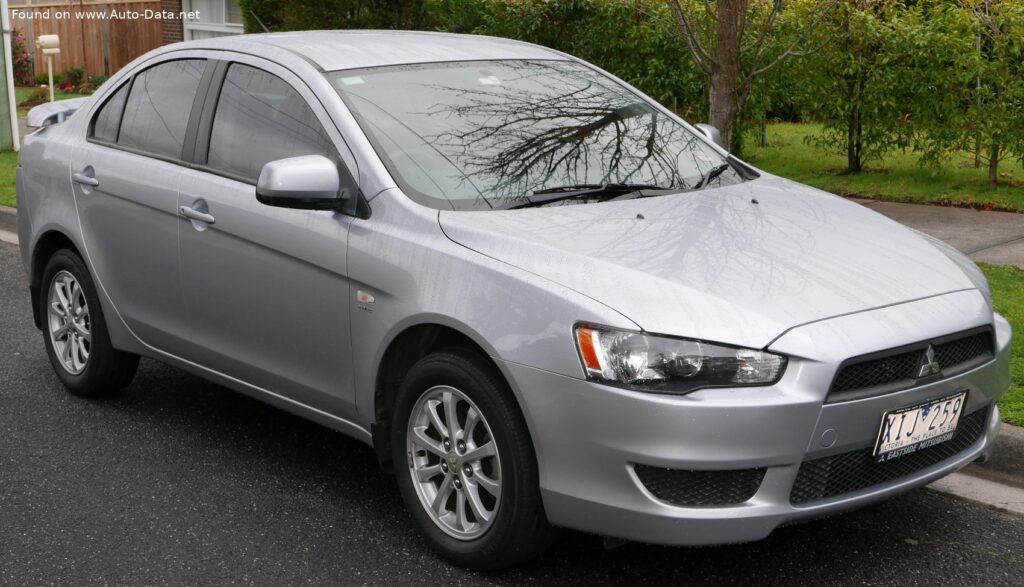
The Mitsubishi Lancer IX 2.0i (150 Hp) CVT is presented in a classic four-door sedan body style, designed to comfortably accommodate five occupants. Its exterior design, while not as overtly aggressive as its Evolution counterparts, still carries a distinctive Mitsubishi aesthetic, characterized by clean lines and a purposeful stance. With a length of 179.92 inches (4570 mm), a width of 69.29 inches (1760 mm), and a height of 59.25 inches (1505 mm), the Lancer IX offers a compact footprint that is easy to maneuver in urban environments, yet provides sufficient interior space. The wheelbase of 103.74 inches (2635 mm) contributes to a stable ride and a surprisingly roomy cabin for its class.
Inside, the Lancer IX prioritizes functionality and user-friendliness. While specific trim levels and interior features would vary by market, typical amenities for a vehicle of this era would include air conditioning, power windows, and an audio system. The sedan configuration provides a practical trunk space, making it suitable for families and individuals needing cargo capacity. The vehicle’s kerb weight of 3009.31 lbs (1365 kg) contributes to its agile handling characteristics.
Underpinning the Lancer IX’s ride and handling are a robust suspension system and reliable braking components. The front suspension employs a common and effective Spring Strut setup, while the rear features a Wishbone design, offering a good balance between comfort and stability. Braking duties are handled by ventilated discs at the front and solid discs at the rear, complemented by an Anti-lock Braking System (ABS) as a standard assisting system, enhancing safety during emergency stops. The steering system is a rack and pinion type, providing direct and predictable steering feedback. The vehicle rides on 205/60 R16 tires mounted on 6J x 16 wheel rims, a common size that offers a good compromise between ride comfort and handling precision.
Technical Specifications
| Category | Specification |
|---|---|
| General Information | |
| Brand | Mitsubishi |
| Model | Lancer |
| Generation | Lancer IX |
| Type (Engine) | 2.0i (150 Hp) CVT |
| Start of Production | October, 2010 |
| End of Production | March, 2013 |
| Powertrain Architecture | Internal Combustion Engine |
| Body Type | Sedan |
| Seats | 5 |
| Doors | 4 |
| Performance Specs | |
| Fuel Consumption (Urban) | 10.5 l/100 km (22.4 US mpg) |
| Fuel Consumption (Extra Urban) | 6.4 l/100 km (36.8 US mpg) |
| Fuel Consumption (Combined) | 8.4 l/100 km (28 US mpg) |
| Fuel Type | Petrol (Gasoline) |
| Acceleration 0 – 60 mph | 10 sec |
| Acceleration 0 – 100 km/h | 10.5 sec |
| Maximum Speed | 200 km/h (124.27 mph) |
| Emission Standard | Euro 4 |
| Weight-to-Power Ratio | 9.1 kg/Hp (109.9 Hp/tonne) |
| Weight-to-Torque Ratio | 6.9 kg/Nm (145.1 Nm/tonne) |
| Engine Specs | |
| Power | 150 Hp @ 6000 rpm |
| Power per Litre | 75.1 Hp/l |
| Torque | 198 Nm @ 4250 rpm (146.04 lb.-ft.) |
| Engine Layout | Front, Transverse |
| Engine Model/Code | 4B11 |
| Engine Displacement | 1998 cm3 (2.0 L / 121.93 cu. in.) |
| Number of Cylinders | 4 |
| Engine Configuration | Inline |
| Number of Valves per Cylinder | 4 |
| Fuel Injection System | Multi-port manifold injection |
| Engine Aspiration | Naturally aspirated engine |
| Valvetrain | DOHC |
| Engine Oil Capacity | 4.3 l (4.54 US qt) |
| Coolant Capacity | 7 l (7.4 US qt) |
| Space, Volume and Weights | |
| Kerb Weight | 1365 kg (3009.31 lbs) |
| Max. Weight | 1850 kg (4078.55 lbs) |
| Max Load | 485 kg (1069.24 lbs) |
| Fuel Tank Capacity | 59 l (15.59 US gal) |
| Dimensions | |
| Length | 4570 mm (179.92 in) |
| Width | 1760 mm (69.29 in) |
| Height | 1505 mm (59.25 in) |
| Wheelbase | 2635 mm (103.74 in) |
| Front Track | 1530 mm (60.24 in) |
| Rear (Back) Track | 1530 mm (60.24 in) |
| Minimum Turning Circle | 10.8 m (35.43 ft) |
| Drivetrain, Brakes and Suspension Specs | |
| Drivetrain Architecture | Front-wheel drive, Internal Combustion Engine |
| Drive Wheel | Front wheel drive |
| Number of Gears and Type of Gearbox | 6 gears, automatic transmission (CVT) |
| Front Suspension | Spring Strut |
| Rear Suspension | Wishbone |
| Front Brakes | Ventilated discs |
| Rear Brakes | Disc |
| Assisting Systems | ABS (Anti-lock braking system) |
| Steering Type | Steering rack and pinion |
| Tires Size | 205/60 R16 |
| Wheel Rims Size | 6J x 16 |
Legacy & Market Impact
The Mitsubishi Lancer nameplate carries a significant legacy, rooted in motorsports and a reputation for durable, value-oriented compact cars. While the “Lancer IX” designation for the 2010-2013 production period might refer to a specific variant or market region where this configuration was particularly relevant, it undeniably contributed to the broader Lancer narrative. During this time, the Lancer competed in the highly competitive compact sedan segment, facing rivals such as the Honda Civic, Toyota Corolla, Mazda 3, Nissan Sentra, Hyundai Elantra, and Kia Forte. Its appeal lay in its blend of Mitsubishi’s established reliability, a capable 2.0-liter engine, and the efficiency benefits of a CVT.
The Lancer IX 2.0i (150 Hp) CVT was likely aimed at consumers who sought a no-nonsense, dependable vehicle for daily commuting and family duties. Its focus on efficiency, coupled with a comfortable ride and practical interior, made it a strong contender in markets where affordability and low running costs were paramount. The presence of the 4B11 engine, shared with other Mitsubishi models including some iterations of the Lancer X, underscored its modern engineering and shared platform efficiencies.
Historically, this particular Lancer model represents a period when Mitsubishi was refining its offerings to meet evolving consumer demands for fuel efficiency and environmental responsibility, as evidenced by its Euro 4 compliance. It showcased Mitsubishi’s ability to offer a diverse range within the Lancer family, from exhilarating performance models to practical, economical sedans. The Lancer IX 2.0i (150 Hp) CVT, therefore, holds its place as a robust and sensible choice, embodying the core values of the Mitsubishi brand: reliability, value, and accessible technology for the everyday driver. Its continued production during the early 2010s speaks to the enduring demand for this specific configuration in various global markets, reinforcing the Lancer’s status as a truly international automotive staple.