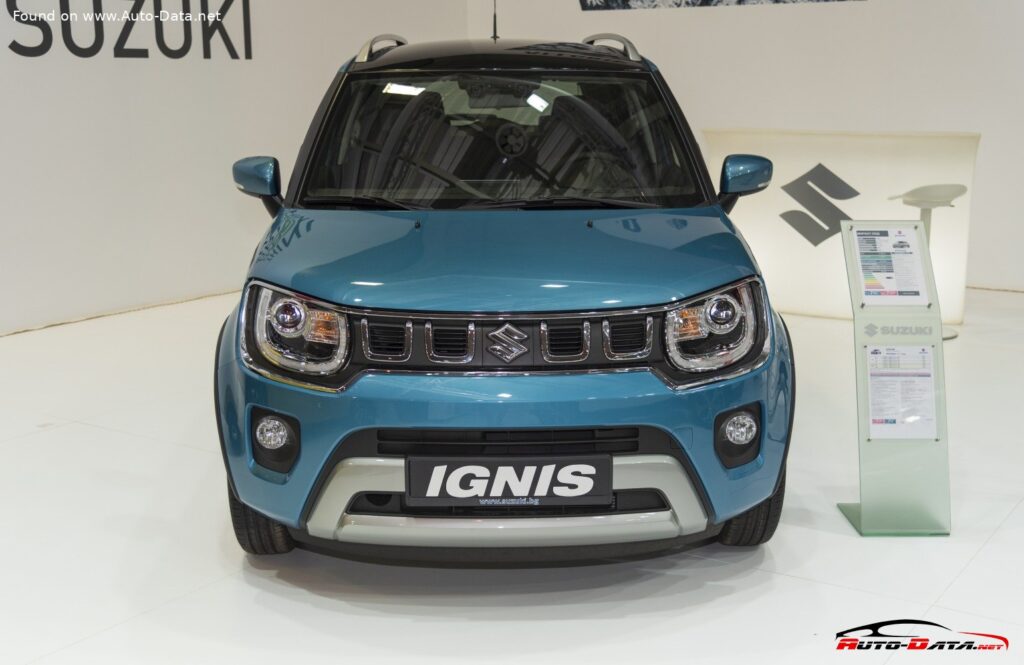
The Suzuki Ignis II (facelift 2020): A Compact Crossover for the Global Stage
The Suzuki Ignis II (facelift 2020) represents the refreshed iteration of Suzuki’s distinctive subcompact crossover, a vehicle renowned for its unique styling, compact dimensions, and surprising capability, particularly in its all-wheel-drive configurations. While not marketed in the United States, the Ignis has carved out a significant niche in European, Asian, and Oceanic markets, where its blend of city-friendly size and light SUV pretensions resonates with consumers seeking a versatile and efficient daily driver. This particular variant, introduced in February 2020, features a 1.2-liter mild-hybrid powertrain combined with a Continuously Variable Transmission (CVT) and Suzuki’s AllGrip 4WD system, underscoring its commitment to efficiency and all-weather traction. Positioned as a mini-SUV or a highly practical city car with elevated ground clearance, the Ignis continues to embody Suzuki’s expertise in creating small, robust, and characterful vehicles.
The Suzuki Ignis II (facelift 2020) Powertrain and Performance
Under the hood of the updated Suzuki Ignis II (facelift 2020) lies a sophisticated yet compact mild-hybrid electric vehicle (MHEV) powertrain. At its core is a 1.2-liter (1242 cubic centimeters or 75.79 cubic inches) K12C inline-four gasoline engine. This naturally aspirated unit is engineered for efficiency and smooth power delivery, featuring a DOHC (Double Overhead Camshaft) valvetrain with VVT (Variable Valve Timing) and multi-port manifold injection. It produces a respectable 91 horsepower at 6000 rpm and 87.03 lb.-ft. of torque at 4400 rpm, translating to a power-per-liter output of 73.3 horsepower per liter. The engine’s high compression ratio of 12.5:1 further aids in its combustion efficiency.
What truly distinguishes this powertrain is its mild-hybrid architecture. The K12C engine is augmented by a compact electric motor, which provides an additional 3 horsepower at 1000 rpm and a significant 36.88 lb.-ft. of torque from as low as 100 rpm. This electric assist system, classified as a power-assist or battery-assisted hybrid vehicle (BAHV), primarily supports the internal combustion engine during acceleration, provides regenerative braking, and allows for smoother engine restarts via its integrated starter generator. This setup reduces the load on the gasoline engine, contributing to improved fuel economy and lower emissions.
Power is channeled through a Continuously Variable Transmission (CVT), an automatic gearbox designed to optimize engine efficiency by continuously adjusting gear ratios. This results in a smooth, seamless driving experience, particularly beneficial in urban environments. The drivetrain architecture is particularly noteworthy: the internal combustion engine and the electric motor permanently drive the front wheels, while an electrically or mechanically controlled clutch engages the rear wheels when necessary, providing an on-demand All-Wheel Drive (4×4) system. This intelligent system, known as AllGrip in Suzuki’s nomenclature, enhances traction on slippery surfaces or light off-road trails without significantly impacting fuel efficiency during normal driving.
Fuel economy figures, measured under the WLTP (Worldwide Harmonized Light Vehicles Test Procedure), highlight the efficiency benefits of this mild-hybrid setup. At low speeds, the Ignis achieves approximately 36.8 US mpg (6.4 l/100 km). This improves to an impressive 46.1 US mpg (5.1 l/100 km) at medium speeds and peaks at around 48 US mpg (4.9 l/100 km) at high speeds, making it a very economical choice for its class. With a curb weight ranging from 1962.11 to 2028.25 lbs. (890-920 kg), the Ignis boasts a favorable weight-to-power ratio of 9.8 kg/Hp, or 102.2 Hp/tonne, which contributes to its agile performance.
Design & Features of the Suzuki Ignis II (facelift 2020)
The design of the Suzuki Ignis II (facelift 2020) retains its distinctive and somewhat polarizing aesthetic, which blends retro cues with modern crossover styling. Its compact, almost boxy silhouette, combined with large headlights and a prominent grille, gives it a unique road presence. As a 5-door crossover with seating for five, it maximizes interior space within its diminutive footprint.
Dimensionally, the Ignis measures 145.67 inches (3700 mm) in length, with a width ranging from 65.35 to 66.54 inches (1660-1690 mm) and a height of 63.19 inches (1605 mm). Its relatively long wheelbase of 95.87 inches (2435 mm) for its overall length contributes to a stable ride and generous interior volume. A significant feature for a vehicle of its size is its ground clearance of 7.09 inches (180 mm), which is more akin to larger SUVs and allows for confident navigation over uneven terrain or through deeper snow. The minimum turning circle of 30.84 feet (9.4 meters) ensures excellent maneuverability in tight urban spaces.
Standard features include a robust suspension setup, with an independent MacPherson strut system at the front and a torsion beam axle at the rear, providing a balance of comfort and handling. Braking is handled by ventilated discs at the front for effective stopping power, complemented by drum brakes at the rear. An Anti-lock Braking System (ABS) is standard, enhancing safety by preventing wheel lock-up during emergency braking. The vehicle typically comes with 15-inch or 16-inch wheels, shod with tires sized 175/65 R15 84H or 175/60 R16 82H, respectively, selected to balance ride comfort, grip, and efficiency.
Inside, the Ignis is known for its practical and functional cabin, often featuring a contrasting color scheme and a straightforward dashboard layout. Despite its compact exterior, the elevated seating position provides good visibility, a characteristic often sought after in crossovers. While specific infotainment and interior amenity details are not provided in the raw data, modern Suzuki vehicles typically offer touchscreens with smartphone integration and a suite of convenience features in their facelifted models, aligning with contemporary expectations.
Technical Specifications
| Category | Specification | US Equivalent |
|---|---|---|
General Information |
||
| Brand | Suzuki | |
| Model | Ignis | |
| Generation | Ignis II (facelift 2020) | |
| Type (Engine) | 1.2 (91 Hp) Mild Hybrid 4WD CVT | |
| Start of production | February, 2020 year | |
| Powertrain Architecture | MHEV (Mild Hybrid Electric Vehicle, power-assist hybrid, battery-assisted hybrid vehicles, BAHV) | |
| Body type | Crossover | |
| Seats | 5 | |
| Doors | 5 | |
Performance Specs |
||
| Fuel consumption at Low speed (WLTP) | 6.4 l/100 km | 36.8 US mpg |
| Fuel consumption at Medium speed (WLTP) | 5.1 l/100 km | 46.1 US mpg |
| Fuel consumption at High speed (WLTP) | 4.9 l/100 km | 48 US mpg |
| Fuel Type | Petrol (Gasoline) | |
| Weight-to-power ratio | 9.8 kg/Hp | 102.2 Hp/tonne |
| Weight-to-torque ratio | 7.5 kg/Nm | 132.6 Nm/tonne |
Electric Cars and Hybrids Specs |
||
| Electric motor 1 Power | 3 Hp @ 1000 rpm | |
| Electric motor Torque | 50 Nm @ 100 rpm | 36.88 lb.-ft. @ 100 rpm |
Internal Combustion Engine Specs |
||
| Power | 91 Hp @ 6000 rpm | |
| Power per liter | 73.3 Hp/l | |
| Torque | 118 Nm @ 4400 rpm | 87.03 lb.-ft. @ 4400 rpm |
| Engine layout | Front, Transverse | |
| Engine Model/Code | K12C | |
| Engine displacement | 1242 cm3 | 75.79 cu. in. |
| Number of cylinders | 4 | |
| Engine configuration | Inline | |
| Cylinder Bore | 73 mm | 2.87 in. |
| Piston Stroke | 74.2 mm | 2.92 in. |
| Compression ratio | 12.5:1 | |
| Number of valves per cylinder | 4 | |
| Fuel injection system | Multi-port manifold injection | |
| Valvetrain | DOHC, VVT | |
| Engine oil capacity | 3.3 l | 3.49 US qt |
| Coolant capacity | 4.2 l | 4.44 US qt |
Space, Volume and Weights |
||
| Kerb Weight | 890-920 kg | 1962.11 – 2028.25 lbs. |
| Fuel tank capacity | 30 l | 7.93 US gal |
Dimensions |
||
| Length | 3700 mm | 145.67 in. |
| Width | 1660-1690 mm | 65.35 – 66.54 in. |
| Height | 1605 mm | 63.19 in. |
| Wheelbase | 2435 mm | 95.87 in. |
| Front track | 1460 mm | 57.48 in. |
| Rear (Back) track | 1460 mm | 57.48 in. |
| Ride height (ground clearance) | 180 mm | 7.09 in. |
| Minimum turning circle (turning diameter) | 9.4 m | 30.84 ft. |
Drivetrain, Brakes and Suspension Specs |
||
| Drivetrain Architecture | The Internal combustion engine (ICE) and the electric motor permanently drive the front wheels of the vehicle, capable of running only in mixed mode, and if necessary through the electrically or mechanically controlled clutch, the rear wheels are driven. | |
| Drive wheel | All wheel drive (4×4) | |
| Number of gears and type of gearbox | automatic transmission CVT | |
| Front suspension | Independent type McPherson | |
| Rear suspension | Torsion | |
| Front brakes | Ventilated discs | |
| Rear brakes | Drum | |
| Assisting systems | ABS (Anti-lock braking system) | |
| Tires size | 175/65 R15 84H; 175/60 R16 82H | |
| Wheel rims size | 15; 16 | |
Legacy & Market Impact of the Suzuki Ignis II (facelift 2020)
The Suzuki Ignis II (facelift 2020), despite its absence from the North American market, holds a significant and well-defined position in its primary markets, particularly across Europe, Japan, Australia, and parts of Asia. Its legacy is built upon Suzuki’s reputation for producing reliable, practical, and often surprisingly capable small cars. The Ignis, in its second generation and subsequent facelift, perfectly encapsulates this philosophy, offering a distinctive alternative to more conventional subcompact hatchbacks and larger, more expensive crossovers.
In markets like Europe, where strict emissions regulations and high fuel prices make efficiency paramount, the Ignis’s mild-hybrid powertrain is a key selling point. Its excellent fuel economy, combined with a relatively low purchase price and running costs, positions it as an attractive option for budget-conscious buyers and those seeking an eco-friendlier vehicle. The availability of Suzuki’s AllGrip 4WD system is another significant differentiator, allowing the Ignis to compete with more specialized vehicles like the Fiat Panda 4×4 in offering genuine, albeit light-duty, off-road capability in a city-car package. This makes it particularly popular in regions with challenging winter conditions or rural areas where unpaved roads are common.
Competitors in its segment vary by region but generally include other compact city cars with a rugged aesthetic, such as the Dacia Sandero Stepway, some variants of the Toyota Aygo X, or even entry-level versions of larger subcompact SUVs like the Hyundai Venue or Kia Sonet in certain Asian markets. However, the Ignis often stands out due to its superior ground clearance, optional 4WD, and unique design. Its compact dimensions and tight turning radius make it an ideal urban companion, while its elevated driving position and practical interior appeal to those who appreciate the utility of an SUV without the associated bulk or fuel consumption.
The market impact of the Ignis is characterized by its ability to carve out a niche for itself as a “micro-SUV” or “supermini crossover.” It’s often praised for its cheerful character, ease of parking, and the surprising amount of interior space it offers for its external footprint. For many consumers outside the US, the Ignis represents a smart, no-nonsense choice that delivers on its promises of efficiency, maneuverability, and a touch of adventurous spirit. Its continued evolution with mild-hybrid technology ensures its relevance in an increasingly environmentally conscious automotive landscape, solidifying its place as a clever and enduring model in Suzuki’s global lineup. The 2020 facelift further refined its appeal, ensuring it remained competitive and fresh in a dynamic market segment.