Introduction to the Mercedes-Benz SLK (R170) AMG SLK 32
The Mercedes-Benz SLK (R170) AMG SLK 32 represents a significant chapter in the history of compact luxury roadsters, particularly for its blend of open-air driving pleasure and potent AMG-tuned performance. Introduced as part of the R170 generation’s facelift in 2000, with production spanning from January 2001 to March 2004, the Mercedes-Benz SLK (R170) AMG SLK 32 quickly established itself as a formidable contender in the performance roadster segment. This specific variant, the AMG SLK 32 V6, transformed the stylish yet sometimes criticized “Sportlich Leicht und Kurz” (Sporty, Light, and Short) SLK into a true pocket rocket, infused with the high-performance DNA of Mercedes-Benz’s in-house tuning arm, AMG.
Positioned above the standard SLK models, the AMG SLK 32 was designed to appeal to enthusiasts seeking a more exhilarating driving experience without sacrificing the comfort and prestige associated with the Mercedes-Benz brand. Its distinguishing feature was not just cosmetic enhancements but a thoroughly re-engineered powertrain and chassis, making it a serious rival to established sports cars of its era. The R170 generation was notable for pioneering the Vario-Roof, a retractable hardtop that offered the best of both worlds: the security and insulation of a coupe with the exhilaration of a convertible. The AMG SLK 32 pushed this concept further, combining this innovative roof with blistering acceleration and sharpened dynamics.
Powertrain and Performance: The Heart of the Mercedes-Benz SLK (R170, facelift 2000) AMG SLK 32 V6 (354 Hp) Automatic
At the core of the Mercedes-Benz SLK (R170, facelift 2000) AMG SLK 32 V6 (354 Hp) Automatic lies a meticulously crafted M 112.960 engine, a 3.2-liter (3199 cm3) V6 unit that was radically enhanced by AMG. Unlike its naturally aspirated counterparts, this engine featured a Lysholm twin-screw supercharger and an intercooler, a setup that dramatically boosted its output. The result was an impressive 354 horsepower delivered at 6100 rpm and a robust 331.9 lb.-ft. of torque peaking at 4400 rpm. This power-to-weight ratio of 249.3 Hp per tonne (or 4 kg/Hp) was exceptional for its class, allowing the compact roadster to achieve genuinely supercar-rivaling acceleration figures.
Power was sent to the rear wheels via a five-speed automatic transmission, which, while not as quick-shifting as modern dual-clutch units, was well-matched to the engine’s torque curve. This combination propelled the AMG SLK 32 from 0 to 60 mph in a blistering 4.9 seconds (0-100 km/h in 5.2 seconds), with an electronically limited top speed of 155.34 mph (250 km/h). The supercharger provided an immediate and linear power delivery, minimizing lag and ensuring thrilling responsiveness across the rev range, up to its maximum engine speed of 6200 rpm.
Despite its performance focus, the AMG SLK 32 adhered to the Euro 4 emission standard, demonstrating Mercedes-Benz’s commitment to balancing power with environmental responsibility for its time. Fuel economy, while not a primary concern for buyers of such a performance vehicle, was rated by NEDC at 21 US mpg combined (11.2 l/100 km), with urban figures at 14.5 US mpg (16.2 l/100 km) and extra-urban at 28 US mpg (8.4 l/100 km). The engine’s SOHC (Single Overhead Camshaft) valvetrain with three valves per cylinder, combined with a multi-port manifold injection system, optimized both performance and efficiency, a testament to the engineering prowess of AMG and Mercedes-Benz.
Design, Features, and Engineering
Exterior and Interior Design
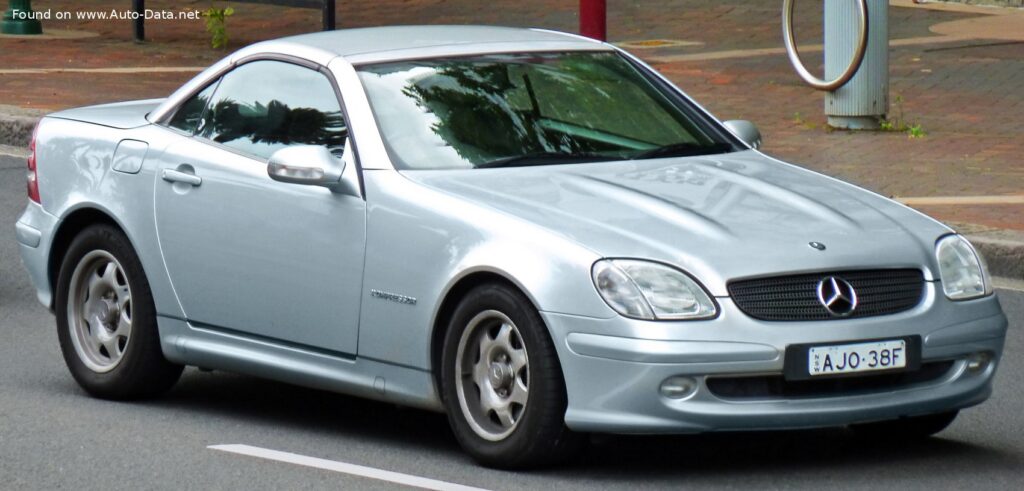
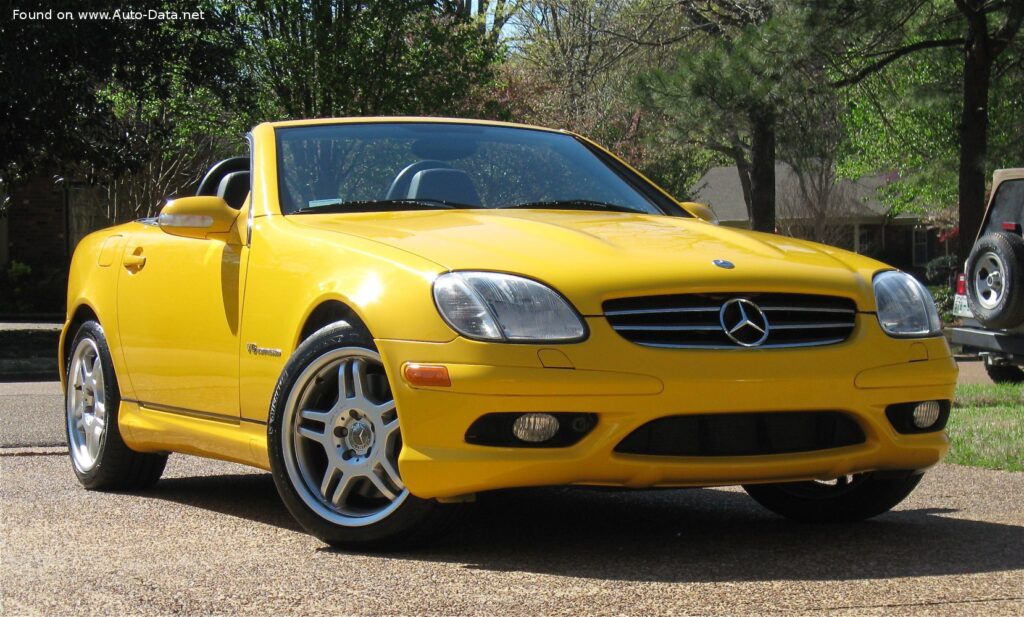
The Mercedes-Benz SLK (R170) AMG SLK 32 retained the fundamental design language of the facelifted R170 generation, characterized by its sleek lines and the innovative Vario-Roof. This electro-hydraulically operated retractable hardtop allowed the car to transform from a secure coupe to an open-air roadster in just 25 seconds, a revolutionary feature at the time. AMG’s influence was evident in subtle yet purposeful styling cues. These included a more aggressive front bumper with larger air intakes, redesigned side skirts, and a rear bumper that housed twin exhaust outlets. The car rode on unique 17-inch AMG alloy wheels, with wider tires at the rear (245/40 ZR 17) compared to the front (225/45 ZR 17) to handle the increased power and improve grip.
Inside, the two-seat cabin exuded luxury and sportiness. AMG-specific touches included sport seats designed for better lateral support, a thicker-rimmed steering wheel, and unique instrumentation with AMG branding. High-quality materials, typical of Mercedes-Benz, were used throughout, ensuring a premium feel. Despite its compact dimensions—a length of 157.87 inches, width of 67.52 inches, and height of 49.96 inches—the interior was surprisingly accommodating for two occupants. Trunk space varied between 5.12 cu. ft. (with the roof down) and 12.29 cu. ft. (with the roof up), offering reasonable practicality for a roadster.
Chassis and Dynamics
To complement the potent powertrain, AMG significantly upgraded the SLK’s chassis and suspension. The front suspension featured coil springs, a double wishbone setup, and a transverse stabilizer, while the rear utilized an independent multi-link suspension, also with coil springs and a transverse stabilizer. This configuration provided a firm yet compliant ride, crucial for both high-speed stability and comfortable cruising. The steering, a hydraulic cone worm with recirculation balls, offered precise feedback and a minimum turning circle of 34.45 feet, making the car agile in urban environments.
Braking performance was equally impressive, with large ventilated disc brakes at both the front (330 mm) and rear (300 mm), ensuring strong, fade-resistant stopping power. An Anti-lock Braking System (ABS) was standard, providing enhanced safety under hard braking. The kerb weight of 3130.56 lbs (1420 kg) contributed to the car’s agile feel, while a robust maximum weight of 3869.11 lbs (1755 kg) highlighted its solid construction. The drag coefficient of 0.33 was respectable for a roadster, contributing to both stability and efficiency at higher speeds.
Comprehensive Technical Specifications
| Category | Specification |
|---|---|
| Brand | Mercedes-Benz |
| Model | SLK |
| Generation | SLK (R170, facelift 2000) |
| Type (Engine) | AMG SLK 32 V6 (354 Hp) Automatic |
| Production Start | January, 2001 |
| Production End | March, 2004 |
| Body Type | Roadster |
| Seats | 2 |
| Doors | 2 |
| Powertrain Architecture | Internal Combustion engine, Rear wheel drive |
| Performance Specs | |
| Fuel Consumption (Urban, NEDC) | 14.5 US mpg (16.2 l/100 km) |
| Fuel Consumption (Extra Urban, NEDC) | 28 US mpg (8.4 l/100 km) |
| Fuel Consumption (Combined, NEDC) | 21 US mpg (11.2 l/100 km) |
| CO2 Emissions (NEDC) | 257 g/km |
| Fuel Type | Petrol (Gasoline) |
| Acceleration 0 – 60 mph | 4.9 sec |
| Acceleration 0 – 100 km/h | 5.2 sec |
| Maximum Speed | 155.34 mph (250 km/h, Electronically limited) |
| Braking 100 km/h – 0 | 37.7 m |
| Emission Standard | Euro 4 |
| Weight-to-Power Ratio | 4 kg/Hp, 249.3 Hp/tonne |
| Weight-to-Torque Ratio | 3.2 kg/Nm, 316.9 Nm/tonne |
| Engine Specs | |
| Power | 354 Hp @ 6100 rpm |
| Power per liter | 110.7 Hp/l |
| Torque | 331.9 lb.-ft. @ 4400 rpm (450 Nm) |
| Maximum Engine Speed | 6200 rpm |
| Engine Layout | Front, Longitudinal |
| Engine Model/Code | M 112.960 |
| Engine Displacement | 195.21 cu. in. (3199 cm3) |
| Number of Cylinders | 6 |
| Engine Configuration | V-engine |
| Cylinder Bore | 3.54 in. (89.9 mm) |
| Piston Stroke | 3.31 in. (84 mm) |
| Compression Ratio | 9:1 |
| Number of Valves per Cylinder | 3 |
| Fuel Injection System | Multi-port manifold injection |
| Engine Aspiration | Supercharger, Intercooler |
| Valvetrain | SOHC |
| Engine Oil Capacity | 8.45 US qt (8 l) |
| Coolant Capacity | 8.45 US qt (8 l) |
| Space, Volume, and Weights | |
| Kerb Weight | 3130.56 lbs (1420 kg) |
| Max. Weight | 3869.11 lbs (1755 kg) |
| Max Load | 738.55 lbs (335 kg) |
| Trunk (Boot) Space – minimum | 5.12 cu. ft. (145 l) |
| Trunk (Boot) Space – maximum | 12.29 cu. ft. (348 l) |
| Fuel Tank Capacity | 15.85 US gal (60 l) |
| Max. Roof Load | 66.14 lbs (30 kg) |
| Dimensions | |
| Length | 157.87 in. (4010 mm) |
| Width | 67.52 in. (1715 mm) |
| Height | 49.96 in. (1269 mm) |
| Wheelbase | 94.49 in. (2400 mm) |
| Front Track | 58.58 in. (1488 mm) |
| Rear (Back) Track | 58.15 in. (1477 mm) |
| Drag Coefficient (Cd) | 0.33 |
| Minimum Turning Circle | 34.45 ft. (10.5 m) |
| Drivetrain, Brakes, and Suspension Specs | |
| Drive Wheel | Rear wheel drive |
| Number of Gears and Type of Gearbox | 5 gears, automatic transmission |
| Front Suspension | Coil spring, Double wishbone, Transverse stabilizer |
| Rear Suspension | Independent multi-link suspension, Transverse stabilizer, Coil spring |
| Front Brakes | Ventilated discs, 330 mm |
| Rear Brakes | Ventilated discs, 300 mm |
| Assisting Systems | ABS (Anti-lock braking system) |
| Steering Type | Cone worm with recirculation balls |
| Power Steering | Hydraulic Steering |
| Front Wheel Tires | 225/45 ZR 17 |
| Rear Wheel Tires | 245/40 ZR 17 |
| Front Wheel Rims | 7.5 J x 17 H 2 |
| Rear Wheel Rims | 8.5 J x 17 H 2 |
Legacy and Market Impact of the Mercedes-Benz SLK (R170) AMG SLK 32
The Mercedes-Benz SLK (R170) AMG SLK 32 carved out a distinct niche for itself in the early 2000s, offering a unique proposition in the performance roadster market. It was often dubbed the “baby AMG” and represented a more accessible entry point into the world of AMG performance, albeit one that still delivered serious thrills. Its reputation was built on its explosive supercharged V6 engine, which provided a level of raw power and acceleration that surprised many, especially given the SLK’s otherwise more relaxed image.
In terms of competition, the AMG SLK 32 went head-to-head with some formidable rivals. Its primary competitors included the Porsche Boxster S and the BMW Z3 M Roadster (and later the Z4 M Roadster). While the Boxster S offered a more traditional mid-engine sports car purity and handling balance, and the M Roadster boasted BMW’s high-revving naturally aspirated inline-six, the AMG SLK 32 countered with its unique supercharged V6, delivering a surge of torque that felt different from its competitors. It appealed to buyers who appreciated Mercedes-Benz luxury and refinement but demanded uncompromising straight-line performance and a distinctive exhaust note.
The historical significance of the AMG SLK 32 extends beyond its performance figures. It demonstrated AMG’s growing prowess in transforming a broader range of Mercedes-Benz models into high-performance machines. It solidified the idea that AMG could produce compelling performance variants across various segments, not just large sedans and coupes. The car’s combination of the innovative Vario-Roof, luxurious appointments, and supercar-baiting acceleration made it a compelling package. It helped to redefine what a compact luxury roadster could be, offering a blend of comfort, style, and brutal power that was hard to match.
Today, the Mercedes-Benz SLK (R170) AMG SLK 32 is regarded as a modern classic by many enthusiasts. Its unique supercharged engine, engaging driving dynamics, and the practicality of its retractable hardtop make it a sought-after collector’s item. It stands as a testament to an era when AMG was rapidly expanding its portfolio, creating exciting and memorable vehicles that continue to captivate automotive aficionados. Its legacy is one of a compact roadster that dared to challenge more established sports cars, proving that great things, and immense power, can indeed come in smaller packages.