The Volkswagen Transporter (T5) Panel Van 1.9 TDI (86 Hp) L1H1: A European Workhorse
The Volkswagen Transporter, an iconic nameplate in the realm of light commercial vehicles, has a storied history spanning multiple generations. The T5 generation, produced from 2003 to 2009, continued this legacy, establishing itself as a dominant force in the European van market. This detailed article focuses on a specific variant: the Volkswagen Transporter (T5) Panel Van 1.9 TDI (86 Hp) L1H1. This particular model, characterized by its efficient turbodiesel engine and practical L1H1 (Short Wheelbase, Standard Roof) configuration, was designed as a versatile workhorse, catering to a wide array of businesses and trades across Europe and other international markets where robust and economical vans are indispensable. While not widely sold in the United States, its influence and engineering prowess are undeniable, showcasing Volkswagen’s expertise in developing highly functional and durable commercial vehicles.
Engine and Performance of the Volkswagen Transporter (T5) Panel Van 1.9 TDI (86 Hp) L1H1
At the heart of this particular Transporter T5 variant lies Volkswagen’s renowned 1.9-liter TDI (Turbocharged Direct Injection) engine. This four-cylinder, inline diesel powerplant, designated by the engine codes EA188 / AXC, delivered a modest but highly effective 86 horsepower (Hp) at 3500 revolutions per minute (rpm). More crucial for a commercial vehicle, however, was its torque output: a robust 200 Nm (approximately 147.51 lb.-ft.) available across a broad and usable rev range of 1600 to 2400 rpm. This low-end torque was instrumental in providing ample pulling power for heavy loads and challenging urban driving conditions, making it a favorite among tradespeople.
The engine’s architecture featured a SOHC (Single Overhead Camshaft) valvetrain with two valves per cylinder, emphasizing reliability and straightforward maintenance. Fuel delivery was handled by a sophisticated pump-nozzle (Unit Injector) system, a hallmark of Volkswagen’s TDI technology during this era, ensuring precise fuel atomization and combustion efficiency. Further enhancing performance and economy was a turbocharger coupled with an intercooler, which boosted air intake and optimized power delivery, especially at lower engine speeds.
Mated to a 5-speed manual transmission, the 1.9 TDI engine drove the front wheels, a common and efficient layout for panel vans of this size. While acceleration figures were not its strong suit, reflecting its utility-first design, the van could reach 60 mph from a standstill in an estimated 22.4 seconds, with a top speed of approximately 90.72 mph (146 km/h). Far more impressive were its fuel economy figures, particularly for a vehicle designed to cover long distances with varying loads. The extra-urban consumption was rated at an efficient 6.1 liters per 100 kilometers, translating to an impressive 38.6 US miles per gallon. This efficiency, combined with an 80-liter (21.13 US gallon) fuel tank, provided an excellent operating range, reducing downtime for refueling and lowering running costs – a critical factor for commercial operators. The engine adhered to the Euro 3 emission standard, reflecting the environmental regulations of its production period.
Design and Features: The Volkswagen Transporter (T5) Panel Van
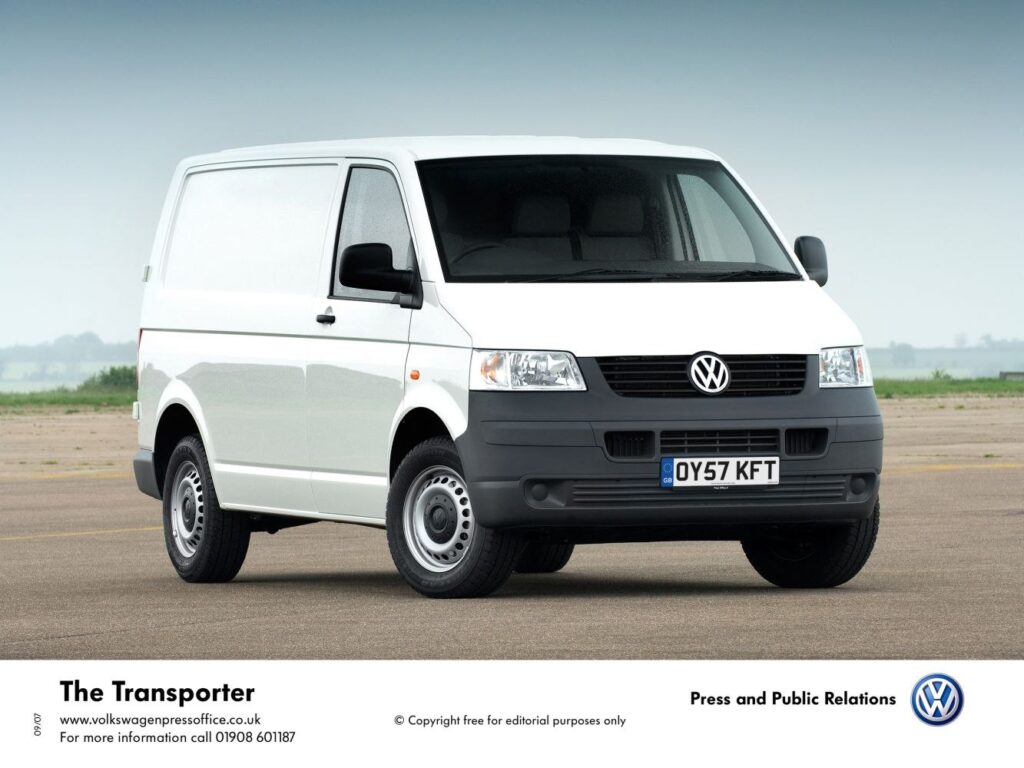
The T5 generation of the Transporter retained the functional and understated aesthetic that has defined the series for decades. The Panel Van configuration, specifically the L1H1 (Length 1, Height 1) variant, represented the shortest wheelbase and standard roof height option available, making it particularly agile for city driving and parking, yet still offering substantial cargo capacity. With a length of 192.52 inches (4890 mm), a width of 74.96 inches (1904 mm), and a height of 77.13 inches (1959 mm), it struck a balance between exterior compactness and interior utility. The generous wheelbase of 118.11 inches (3000 mm) contributed to stable handling, even when fully loaded.
The body type was a classic van, typically featuring 4 to 5 doors, including a sliding side door for easy access to the cargo area and rear barn doors or a tailgate. The cabin was designed for practicality, offering seating for 2 to 3 occupants, depending on the configuration, with durable materials chosen to withstand the rigors of daily commercial use. The interior was functional, focusing on ergonomics for the driver and providing essential storage compartments.
Cargo capacity was a primary consideration, and the T5 L1H1 delivered with a maximum trunk (boot) space of 5800 liters (204.83 cubic feet). Its kerb weight ranged from 3968.32 to 4409.25 lbs (1800-2000 kg), with a maximum permissible weight of 5732.02 to 6613.87 lbs (2600-3000 kg), allowing for a substantial maximum payload of 1763.7 to 2204.62 lbs (800-1000 kg). This impressive load-carrying capability was further augmented by a maximum roof load of 220.46 lbs (100 kg) and significant towing capacities, ranging from 1653.47 lbs (750 kg) without brakes to 5511.56 lbs (2500 kg) with brakes (8% gradient).
Suspension and braking systems were robust, designed for durability and comfort under load. The front featured an independent McPherson strut setup with coil springs and an anti-roll bar, while the rear utilized an independent coil spring system with a transverse stabilizer and trailing arms. Braking was handled by ventilated discs at both the front (308×29.5 mm) and rear (294×22 mm), complemented by an Anti-lock Braking System (ABS) for enhanced safety. Hydraulic power steering, utilizing a rack and pinion system, provided reliable and manageable steering feedback. The standard tire sizes were 205/65 R16 or 215/65 R16 on 6.5J x 16 wheel rims, providing a good balance of load capacity and ride comfort.
Technical Specifications: Volkswagen Transporter (T5) Panel Van 1.9 TDI (86 Hp) L1H1
| Category | Specification | Metric Value | US/Imperial Value |
|---|---|---|---|
General Information |
|||
| Brand | Volkswagen | ||
| Model | Transporter | ||
| Generation | Transporter (T5) Panel Van | ||
| Type (Engine) | 1.9 TDI (86 Hp) L1H1 | ||
| Start of Production | 2003 year | ||
| End of Production | 2009 year | ||
| Powertrain Architecture | Internal Combustion engine | ||
| Body type | Van | ||
| Seats | 2-3 | ||
| Doors | 4-5 | ||
Performance Specifications |
|||
| Fuel consumption (extra urban) | 6.1 l/100 km | 38.6 US mpg | |
| Fuel Type | Diesel | ||
| Acceleration 0 – 62 mph | 23.6 sec | ||
| Acceleration 0 – 60 mph (Calculated) | 22.4 sec | ||
| Maximum speed | 146 km/h | 90.72 mph | |
| Emission standard | Euro 3 | ||
| Weight-to-power ratio | 20.9 kg/Hp | 47.8 Hp/tonne | |
| Weight-to-torque ratio | 9 kg/Nm | 111.1 Nm/tonne | |
Engine Specifications |
|||
| Power | 86 Hp @ 3500 rpm | ||
| Power per liter | 45.4 Hp/l | ||
| Torque | 200 Nm @ 1600-2400 rpm | 147.51 lb.-ft. @ 1600-2400 rpm | |
| Engine layout | Front, Transverse | ||
| Engine Model/Code | EA188 / AXC | ||
| Engine displacement | 1896 cm3 | 1.9 liters (115.7 cu. in.) | |
| Number of cylinders | 4 | ||
| Engine configuration | Inline | ||
| Cylinder Bore | 79.5 mm | 3.13 in. | |
| Piston Stroke | 95.5 mm | 3.76 in. | |
| Compression ratio | 18:1 | ||
| Number of valves per cylinder | 2 | ||
| Fuel injection system | Pump-nozzle (Unit Injector) | ||
| Engine aspiration | Turbocharger, Intercooler | ||
| Valvetrain | SOHC | ||
| Engine oil capacity | 5.8 l | 6.13 US qt | |
| Coolant | 7.1 l | 7.5 US qt | |
Space, Volume and Weights |
|||
| Kerb Weight | 1800-2000 kg | 3968.32 – 4409.25 lbs. | |
| Max. weight (GVWR) | 2600-3000 kg | 5732.02 – 6613.87 lbs. | |
| Max load (Payload) | 800-1000 kg | 1763.7 – 2204.62 lbs. | |
| Trunk (boot) space – maximum | 5800 l | 204.83 cu. ft. | |
| Fuel tank capacity | 80 l | 21.13 US gal | |
| Max. roof load | 100 kg | 220.46 lbs. | |
| Permitted trailer load with brakes (8%) | 2500 kg | 5511.56 lbs. | |
| Permitted trailer load with brakes (12%) | 2200 kg | 4850.17 lbs. | |
| Permitted trailer load without brakes | 750 kg | 1653.47 lbs. | |
| Permitted towbar download | 100 kg | 220.46 lbs. | |
Dimensions |
|||
| Length | 4890 mm | 192.52 in. | |
| Width | 1904 mm | 74.96 in. | |
| Width including mirrors | 2242 mm | 88.27 in. | |
| Height | 1959 mm | 77.13 in. | |
| Wheelbase | 3000 mm | 118.11 in. | |
| Front track | 1628 mm | 64.09 in. | |
| Rear (Back) track | 1628 mm | 64.09 in. | |
| Front overhang | 894 mm | 35.2 in. | |
| Rear overhang | 996 mm | 39.21 in. | |
| Ride height (ground clearance) | 165 mm | 6.5 in. | |
| Minimum turning circle (diameter) | 11.9 m | 39.04 ft. | |
| Approach angle | 22° | ||
| Departure angle | 16° | ||
| Ramp-over (brakeover) angle | 14° | ||
| Wading depth | 300 mm | 11.81 in. | |
Drivetrain, Brakes and Suspension Specifications |
|||
| Drivetrain Architecture | Front-wheel drive (ICE drives front wheels) | ||
| Drive wheel | Front wheel drive | ||
| Number of gears and type of gearbox | 5 gears, manual transmission | ||
| Front suspension | Independent, McPherson with coil spring and anti-roll bar | ||
| Rear suspension | Independent coil spring, Transverse stabilizer, Trailing arm | ||
| Front brakes | Ventilated discs | 308×29.5 mm | |
| Rear brakes | Ventilated discs | 294×22 mm | |
| Assisting systems | ABS (Anti-lock braking system) | ||
| Steering type | Steering rack and pinion | ||
| Power steering | Hydraulic Steering | ||
| Tires size | 205/65 R16; 215/65 R16 | ||
| Wheel rims size | 6.5J x 16 | ||
Legacy and Market Impact of the Volkswagen Transporter (T5) Panel Van 1.9 TDI (86 Hp) L1H1
The Volkswagen Transporter T5 built upon the formidable reputation of its predecessors, particularly the T4, by introducing improved comfort, safety, and a more refined driving experience, while maintaining its core identity as a rugged and reliable commercial vehicle. The Volkswagen Transporter (T5) Panel Van 1.9 TDI (86 Hp) L1H1 variant, with its specific engine and body configuration, was especially significant in the European market. It was positioned as an accessible entry point into the T5 range, offering an optimal balance of purchase price, running costs, and load-carrying capability for small to medium-sized businesses.
In its primary markets, the T5 faced stiff competition from rivals such as the Ford Transit, Mercedes-Benz Vito, Renault Trafic (and its rebadged variants like the Opel Vivaro and Nissan Primastar), and the Citroën Jumpy/Peugeot Expert. Despite this crowded segment, the Transporter T5 consistently held its own, often being lauded for its build quality, residual values, and the strong brand loyalty it commanded. The 1.9 TDI engine, in particular, was praised for its legendary durability and exceptional fuel economy, critical attributes for commercial operators where every penny counts. Its relative simplicity compared to later, more complex diesel engines also contributed to lower maintenance costs and greater reliability in demanding usage scenarios.
The L1H1 configuration, being the most compact panel van offering, was particularly popular in urban environments where maneuverability and ease of parking were paramount. It served as the backbone for countless delivery services, tradesmen (electricians, plumbers, carpenters), and small businesses requiring a dependable vehicle for transporting tools and goods. Its interior volume, despite being the shortest variant, was cleverly maximized, offering a highly practical cargo space that could be customized with various shelving and racking systems.
The T5 generation, including this 1.9 TDI variant, solidified the Transporter’s status as more than just a utilitarian vehicle; it became a symbol of reliability and efficiency. Its design was both modern and timeless, ensuring that even after the end of its production run in 2009, these vans remained a common sight on European roads for many years, a testament to their enduring quality and robust engineering. The T5, and especially its economical TDI variants, played a crucial role in shaping the modern European light commercial vehicle landscape, proving that a workhorse could also be refined, efficient, and exceptionally long-lasting. Its legacy continues to influence subsequent Transporter generations, embodying Volkswagen’s commitment to practical, durable, and cost-effective transportation solutions.