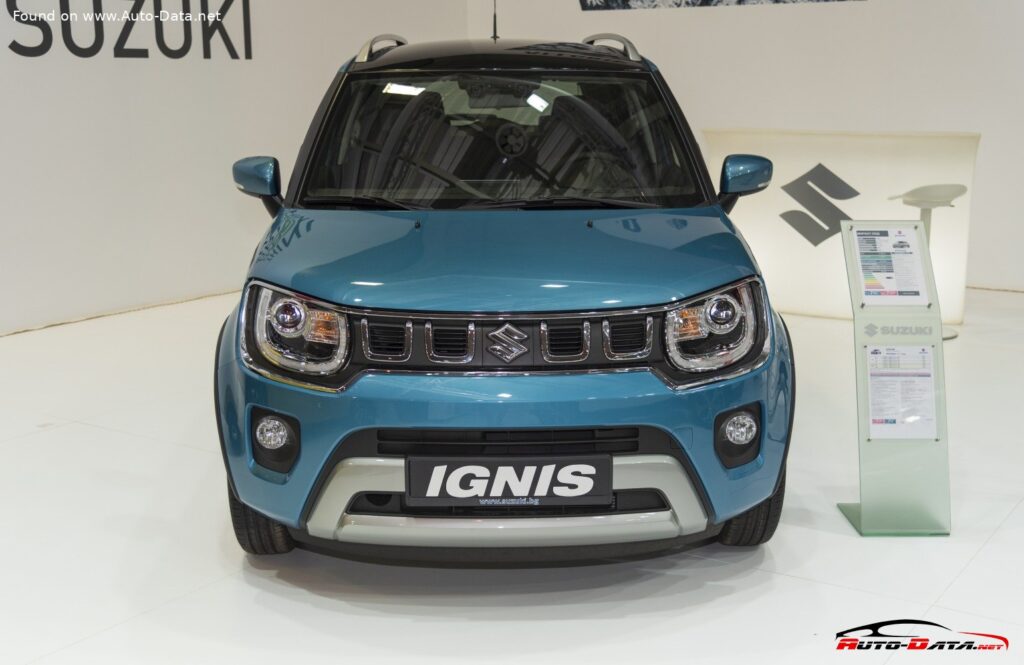
The Suzuki Ignis II (facelift 2020): A Compact Crossover for Global Markets
The Suzuki Ignis II (facelift 2020) represents a significant refresh of Suzuki’s distinctive subcompact crossover, a vehicle renowned in its primary markets for its unique styling, compact footprint, and surprising practicality. Launched in February 2020, this updated second-generation Ignis builds upon its predecessor’s success by integrating a more refined powertrain, enhanced efficiency, and subtle design tweaks. While not offered in the United States, the Ignis carves out a niche in Europe, Asia, and other global markets as an accessible and economical entry into the crossover segment, blending the maneuverability of a city car with the raised driving position and rugged aesthetics of an SUV. This particular variant, featuring the 1.2 Dualjet (83 Hp) Mild Hybrid system, exemplifies Suzuki’s commitment to delivering fuel-efficient and environmentally conscious mobility solutions.
Engine and Performance: The 1.2 Dualjet Mild Hybrid Powertrain
At the heart of the Suzuki Ignis II (facelift 2020) lies a sophisticated yet compact powertrain: the 1.2-liter Dualjet (K12D) inline four-cylinder engine, augmented by a Mild Hybrid Electric Vehicle (MHEV) system. This MHEV architecture, often referred to as a power-assist or battery-assisted hybrid, is designed to enhance fuel efficiency and reduce emissions without the complexity or cost of a full hybrid system. The internal combustion engine and the electric motor work in tandem, primarily driving the front wheels in a mixed mode.
The 1242 cubic centimeter (75.79 cubic inch) naturally aspirated gasoline engine produces a respectable 83 horsepower at 6000 rpm. This power output, combined with the mild hybrid assistance, provides a peppy feel for urban driving. Torque stands at 107 Newton-meters (78.92 lb.-ft.) delivered at a low 2800 rpm, ensuring brisk acceleration from a standstill and good responsiveness in city traffic. Power per liter is a healthy 66.8 horsepower per liter, indicating an efficient engine design.
Mated to a precise 5-speed manual transmission, the Ignis II (facelift 2020) achieves a 0 to 60 mph acceleration in an estimated 12.1 seconds, with 0 to 100 km/h taking 12.7 seconds. Its maximum speed is 165 km/h (102.53 mph), which is more than adequate for its intended use as a city and suburban commuter. The Dualjet engine features a DOHC (Double Overhead Camshaft) valvetrain and multi-port manifold injection, contributing to its efficiency and smooth operation. With a compression ratio of 12.5:1, the engine is optimized for fuel economy.
Fuel efficiency is a major highlight, thanks to the mild hybrid system and the engine’s inherent design. The combined WLTP fuel consumption is an impressive 5.1 liters per 100 kilometers, translating to approximately 46.1 US miles per gallon. CO2 emissions are rated at 114 g/km (WLTP), meeting stringent Euro 6 emission standards. This makes the Ignis a highly economical choice for drivers looking to minimize their environmental footprint and running costs. The vehicle’s lightweight construction, with a kerb weight of just 1973.14 lbs. (895 kg), further contributes to its agile performance and excellent fuel economy, resulting in an impressive weight-to-power ratio of 10.8 kg/Hp or 92.7 Hp/tonne.
Design and Features: A Distinctive and Practical Crossover
The Suzuki Ignis II (facelift 2020) retains its distinctive and somewhat polarizing design, which contributes to its unique appeal. As a 5-door crossover, it boasts a compact yet robust appearance. The facelift introduced subtle changes, including a refreshed front grille with chrome accents and redesigned bumpers, enhancing its rugged, mini-SUV aesthetic. Its boxy profile and prominent wheel arches give it a commanding presence despite its diminutive dimensions.
Measuring 145.67 inches (3700 mm) in length, 65.35 inches (1660 mm) in width, and 63.19 inches (1605 mm) in height, the Ignis is incredibly compact, making it ideal for navigating crowded urban streets and tight parking spaces. A generous wheelbase of 95.87 inches (2435 mm) helps maximize interior space, while a ground clearance of 7.09 inches (180 mm) allows it to tackle light off-road conditions or uneven urban terrain with confidence, a key attribute for a crossover. The tight minimum turning circle of 30.84 feet (9.4 m) further underscores its urban agility.
Inside, the Ignis offers seating for five occupants, a remarkable feat for a vehicle of its size. The interior is designed for practicality and durability, with a focus on maximizing usable space. The trunk space is versatile, offering a minimum of 9.43 cubic feet (267 liters) with all seats in place, expandable to a substantial 38.74 cubic feet (1097 liters) when the rear seats are folded down. This flexibility makes the Ignis surprisingly capable of carrying cargo, from weekly groceries to luggage for a weekend getaway.
Suspension components are typical for a vehicle in this segment, featuring an independent McPherson type setup at the front for comfortable ride quality and predictable handling, complemented by a torsion beam rear suspension. The vehicle comes with tire sizes 175/65 R15 or 175/60 R16, mounted on 15 or 16-inch wheel rims, offering a good balance of grip and ride comfort. The front-wheel-drive architecture is standard, aligning with its primary role as an urban and light-duty crossover.
Technical Specifications
| General Information | |
|---|---|
| Brand | Suzuki |
| Model | Ignis |
| Generation | Ignis II (facelift 2020) |
| Type (Engine) | 1.2 Dualjet (83 Hp) Mild Hybrid |
| Start of Production | February, 2020 |
| Powertrain Architecture | MHEV (Mild Hybrid Electric Vehicle, power-assist hybrid, battery-assisted hybrid vehicles, BAHV) |
| Body Type | Crossover |
| Seats | 5 |
| Doors | 5 |
| Performance Specifications | |
| Combined Fuel Consumption (WLTP) | 5.1 l/100 km (46.1 US mpg) |
| CO2 Emissions (WLTP) | 114 g/km |
| CO2 Emissions (NEDC equivalent) | 89 g/km |
| Fuel Type | Petrol (Gasoline) |
| Acceleration 0 – 60 mph | 12.1 sec |
| Acceleration 0 – 100 km/h | 12.7 sec |
| Maximum Speed | 165 km/h (102.53 mph) |
| Emission Standard | Euro 6 |
| Weight-to-Power Ratio | 10.8 kg/Hp (92.7 Hp/tonne) |
| Weight-to-Torque Ratio | 8.4 kg/Nm (119.6 Nm/tonne) |
| Engine Specifications | |
| Power | 83 Hp @ 6000 rpm |
| Power per Liter | 66.8 Hp/l |
| Torque | 107 Nm @ 2800 rpm (78.92 lb.-ft. @ 2800 rpm) |
| Engine Layout | Front, Transverse |
| Engine Model/Code | K12D |
| Engine Displacement | 1242 cm3 (75.79 cu. in.) |
| Number of Cylinders | 4 |
| Engine Configuration | Inline |
| Cylinder Bore | 73 mm (2.87 in.) |
| Piston Stroke | 74.2 mm (2.92 in.) |
| Compression Ratio | 12.5:1 |
| Number of Valves per Cylinder | 4 |
| Fuel Injection System | Multi-port manifold injection |
| Valvetrain | DOHC |
| Engine Oil Capacity | 3.3 l (3.49 US qt) |
| Engine Oil Specification | Not specified |
| Coolant Capacity | 4 l (4.23 US qt) |
| Space, Volume, and Weights | |
| Kerb Weight | 895 kg (1973.14 lbs.) |
| Max. Weight | 1330 kg (2932.15 lbs.) |
| Max Load | 435 kg (959.01 lbs.) |
| Trunk (Boot) Space – Minimum | 267 l (9.43 cu. ft.) |
| Trunk (Boot) Space – Maximum | 1097 l (38.74 cu. ft.) |
| Fuel Tank Capacity | 32 l (8.45 US gal) |
| Permitted Trailer Load with Brakes (12%) | 1000 kg (2204.62 lbs.) |
| Permitted Trailer Load without Brakes | 400 kg (881.85 lbs.) |
| Dimensions | |
| Length | 3700 mm (145.67 in.) |
| Width | 1660 mm (65.35 in.) |
| Height | 1605 mm (63.19 in.) |
| Wheelbase | 2435 mm (95.87 in.) |
| Ride Height (Ground Clearance) | 180 mm (7.09 in.) |
| Minimum Turning Circle (Turning Diameter) | 9.4 m (30.84 ft.) |
| Drivetrain, Brakes, and Suspension | |
| Drivetrain Architecture | Internal combustion engine and electric motor drive the front wheels in mixed mode. |
| Drive Wheel | Front-wheel drive |
| Number of Gears and Type of Gearbox | 5 gears, manual transmission |
| Front Suspension | Independent type McPherson |
| Rear Suspension | Torsion |
| Tires Size | 175/65 R15; 175/60 R16 |
| Wheel Rims Size | 15; 16 |
Legacy and Market Impact
The Suzuki Ignis, particularly the updated Ignis II (facelift 2020) with its mild-hybrid technology, continues to solidify its reputation as a smart, economical, and practical choice in its key markets. In regions like Europe and Asia, where compact dimensions, fuel efficiency, and affordability are paramount, the Ignis excels. It competes against a diverse range of vehicles, including other subcompact crossovers and city cars such as the Kia Picanto, Hyundai i10, Fiat Panda Cross, and even some smaller variants of the Dacia Sandero Stepway.
The Ignis’s unique blend of a distinctive, almost retro-futuristic design with genuine crossover capabilities – including a higher seating position and generous ground clearance – sets it apart from more conventional hatchbacks. Its light weight and efficient powertrain ensure low running costs, which is a significant draw for budget-conscious consumers and those seeking an environmentally friendlier vehicle. The mild-hybrid system is a crucial element of its appeal, demonstrating Suzuki’s commitment to modern powertrain technology to meet evolving emission standards and consumer demands for better fuel economy.
Historically, the Ignis lineage has always been about offering something different – a small car with a big personality and surprising utility. The 2020 facelift reinforced this by refining the package without altering its core identity. Its historical significance lies in proving that a compact vehicle can still offer a sense of adventure and practicality, challenging the notion that larger SUVs are the only option for those desiring a raised ride height. Its continued success in markets outside the U.S. underscores the global diversity of automotive preferences and the enduring appeal of well-executed, niche vehicles that prioritize efficiency, maneuverability, and a distinctive character. The Suzuki Ignis II (facelift 2020) stands as a testament to Suzuki’s expertise in creating compact, robust, and increasingly eco-conscious vehicles for a global audience.