Introduction to the Renault Espace III (JE)
The Renault Espace, a name synonymous with innovation in the European multi-purpose vehicle (MPV) segment, entered its third generation, internally designated JE, in 1996. This iteration of the pioneering French minivan continued to build on its predecessors’ legacy of spaciousness, modularity, and comfort. While the Espace was never officially sold in the United States, it played a pivotal role in shaping the family vehicle landscape across Europe and other international markets. The Renault Espace III (JE) represented a significant leap forward in design, engineering, and onboard technology for Renault, aiming to solidify its position against a growing number of competitors in the burgeoning MPV sector. The specific variant under review, the 3.0 V6 (167 Hp) Automatic, stood as a premium offering, combining robust performance with the convenience of an automatic transmission, catering to discerning families seeking a refined and capable people-mover.
Engine & Performance: Powering the Renault Espace III (JE)
At the heart of this particular Renault Espace III (JE) model was a potent 3.0-liter V6 gasoline engine, designated by Renault with the code Z7X. This naturally aspirated engine, configured in a V-layout with six cylinders, delivered a respectable 167 horsepower (Hp) at 5500 rpm. The power output translated to a specific output of 56.4 Hp per liter, a commendable figure for a minivan engine of its era. Torque figures were equally robust, peaking at 235 Nm (approximately 173.33 lb.-ft.) at 4500 rpm, providing ample pulling power for a vehicle designed to carry up to seven occupants and their luggage.
Power was channeled to the front wheels via a four-speed automatic transmission, emphasizing smooth power delivery and ease of driving, particularly in urban environments or during long-distance cruising. This powertrain combination allowed the Espace III to achieve a 0 to 60 mph acceleration time of a calculated 10.5 seconds (0-100 km/h in 11 seconds), with a top speed of 195 km/h (121.17 mph). While not a performance car, these figures were more than adequate for its intended purpose, offering confident overtaking and comfortable highway travel.
Fuel consumption, a significant consideration for any family vehicle, was rated by the manufacturer at 21 liters per 100 kilometers (11.2 US mpg) in urban driving, dropping to 9.6 l/100 km (24.5 US mpg) in extra-urban conditions. The combined fuel economy stood at 13.7 l/100 km (17.2 US mpg). These figures, while typical for a large V6 engine from the late 1990s, highlighted the trade-off between power and efficiency. The vehicle complied with the Euro 2 emission standard, reflecting the environmental regulations of its production period.
Design & Features of the Espace III (JE)
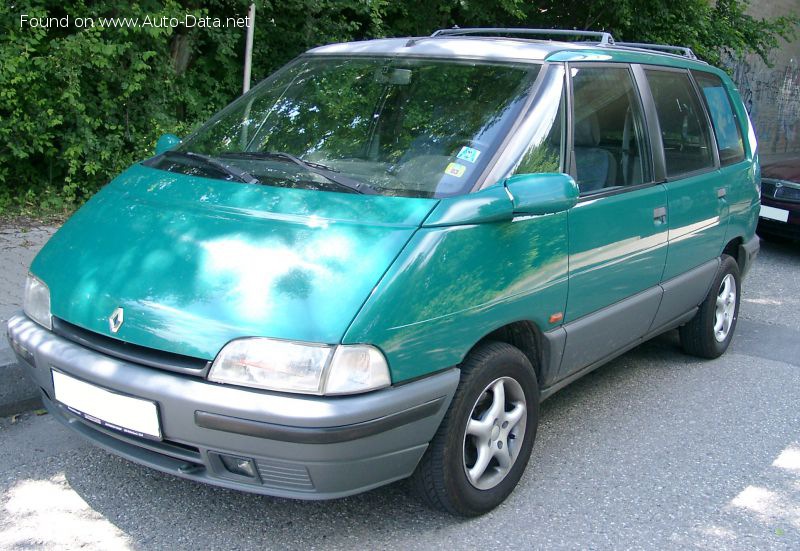
The third-generation Espace retained its distinctive, aerodynamic “one-box” silhouette, a design philosophy that maximized interior space and visibility. Measuring 177.83 inches (4517 mm) in length, 71.26 inches (1810 mm) in width, and 69.8 inches (1773 mm) in height, the Espace III presented a substantial yet elegant presence. Its 106.38-inch (2702 mm) wheelbase contributed significantly to interior roominess and ride comfort.
As a minivan or MPV, the Espace III was designed with versatility at its core. It featured five doors and a standard seating capacity for seven passengers. The interior was highly configurable, a hallmark of the Espace line, with removable and reclinable seats that allowed for numerous seating and cargo arrangements. This modularity was crucial for families, enabling easy transformation from a people-carrier to a cargo hauler. Minimum trunk space was a modest 9.71 cubic feet (275 liters) with all seats in place, expanding dramatically to an impressive 100.65 cubic feet (2850 liters) with the rear seats removed, underscoring its utility.
From a chassis perspective, the Espace III featured an independent McPherson strut front suspension with coil springs and an anti-roll bar, providing a comfortable and stable ride. The rear employed a semi-independent setup with coil springs. Braking was handled by ventilated discs at the front and disc brakes at the rear, augmented by an Anti-lock Braking System (ABS), a significant safety feature for the time. Steering was a rack and pinion system with hydraulic power assist, offering ease of maneuverability despite the vehicle’s size. The Espace III rolled on 15-inch wheels fitted with 205/65 R15 tires.
Technical Specifications
| Category | Specification | Metric Value | US Customary / Imperial Value |
|---|---|---|---|
| Brand | Renault | ||
| Model | Espace III (JE) | ||
| Type (Engine) | 3.0 V6 (167 Hp) Automatic | ||
| Production Start | 1996 | ||
| Production End | 2000 | ||
| Powertrain Architecture | Internal Combustion Engine | ||
| Body Type | Minivan, MPV | ||
| Seats | 7 | ||
| Doors | 5 | ||
| Performance Specs | |||
| Fuel Consumption (Urban) | 21 l/100 km | 11.2 US mpg | 13.5 UK mpg | |
| Fuel Consumption (Extra Urban) | 9.6 l/100 km | 24.5 US mpg | 29.4 UK mpg | |
| Fuel Consumption (Combined) | 13.7 l/100 km | 17.2 US mpg | 20.6 UK mpg | |
| CO2 Emissions | 325 g/km | ||
| Fuel Type | Petrol (Gasoline) | ||
| Acceleration 0-62 mph | 11 sec (0-100 km/h) | 10.5 sec (0-60 mph calculated) | |
| Maximum Speed | 195 km/h | 121.17 mph | |
| Emission Standard | Euro 2 | ||
| Weight-to-Power Ratio | 9.9 kg/Hp | 101.2 Hp/tonne | |
| Weight-to-Torque Ratio | 7 kg/Nm | 142.4 Nm/tonne | |
| Engine Specs | |||
| Power | 167 Hp @ 5500 rpm | ||
| Power per Liter | 56.4 Hp/l | ||
| Torque | 235 Nm @ 4500 rpm | 173.33 lb.-ft. @ 4500 rpm | |
| Engine Layout | Front, Transverse | ||
| Engine Model/Code | Z7X | ||
| Engine Displacement | 2963 cm3 | 3.0 liters | 180.81 cu. in. | |
| Number of Cylinders | 6 | ||
| Engine Configuration | V-engine | ||
| Cylinder Bore | 93 mm | 3.66 in. | |
| Piston Stroke | 72.7 mm | 2.86 in. | |
| Compression Ratio | 9.6:1 | ||
| Valves per Cylinder | 2 | ||
| Fuel Injection System | Multi-port manifold injection | ||
| Engine Aspiration | Naturally aspirated | ||
| Valvetrain | DOHC | ||
| Engine Oil Capacity | 7 l | 7.4 US qt | 6.16 UK qt | |
| Engine Oil Specification | Not specified in data | ||
| Coolant Capacity | 10 l | 10.57 US qt | 8.8 UK qt | |
| Space, Volume and Weights | |||
| Kerb Weight | 1650 kg | 3637.63 lbs. | |
| Maximum Weight | 2400 kg | 5291.09 lbs. | |
| Maximum Load | 750 kg | 1653.47 lbs. | |
| Trunk Space (Min.) | 275 l | 9.71 cu. ft. | |
| Trunk Space (Max.) | 2850 l | 100.65 cu. ft. | |
| Fuel Tank Capacity | 78 l | 20.61 US gal | 17.16 UK gal | |
| Permitted Trailer Load (with brakes) | 1800 kg | 3968.32 lbs. | |
| Permitted Trailer Load (without brakes) | 750 kg | 1653.47 lbs. | |
| Dimensions | |||
| Length | 4517 mm | 177.83 in. | |
| Width | 1810 mm | 71.26 in. | |
| Height | 1773 mm | 69.8 in. | |
| Wheelbase | 2702 mm | 106.38 in. | |
| Front Track | 1534 mm | 60.39 in. | |
| Rear Track | 1540 mm | 60.63 in. | |
| Front Overhang | 929 mm | 36.57 in. | |
| Rear Overhang | 886 mm | 34.88 in. | |
| Ride Height (Ground Clearance) | 110 mm | 4.33 in. | |
| Minimum Turning Circle | 11.4 m | 37.4 ft. | |
| Drivetrain, Brakes and Suspension Specs | |||
| Drivetrain Architecture | Internal combustion engine drives front wheels | ||
| Drive Wheel | Front wheel drive | ||
| Gearbox | 4 gears, automatic transmission | ||
| Front Suspension | Independent, McPherson with coil spring and anti-roll bar | ||
| Rear Suspension | Semi-independent, coil spring | ||
| Front Brakes | Ventilated discs | ||
| Rear Brakes | Disc | ||
| Assisting Systems | ABS (Anti-lock braking system) | ||
| Steering Type | Steering rack and pinion | ||
| Power Steering | Hydraulic Steering | ||
| Tires Size | 205/65 R15 | ||
| Wheel Rims Size | 15 inches | ||
Legacy & Market Impact
The Renault Espace, particularly the third generation, continued to be a significant player in the European MPV market during its production run from 1996 to 2000. It built upon the groundbreaking success of its predecessors, which had virtually invented the modern European minivan segment. While American consumers were more familiar with domestic offerings like the Chrysler Voyager (which was also sold in Europe as a competitor) or the Ford Windstar, the Espace carved out a niche as a more stylish, often more technologically advanced, and distinctly European alternative.
In its primary markets, the Espace III faced stiff competition from a growing array of rivals. These included the Volkswagen Sharan and its badge-engineered siblings, the Ford Galaxy and SEAT Alhambra, all part of a joint venture to produce a large MPV. Other competitors included the Peugeot 806/Citroën Evasion and the Fiat Ulysse/Lancia Zeta, which were also joint ventures. Despite this fierce competition, the Espace III maintained its reputation for innovative design, exceptional interior flexibility, and a comfortable ride, qualities that were highly valued by European families.
The 3.0 V6 automatic variant, in particular, represented the pinnacle of the Espace III range, offering a premium driving experience. Its powerful engine and smooth transmission appealed to buyers who frequently traveled long distances or desired a more refined alternative to the common four-cylinder diesel or gasoline options. Its comprehensive feature set, including available safety technologies like ABS, contributed to its appeal as a safe and competent family vehicle.
The Espace III’s legacy is defined by its role in solidifying the MPV as a viable and desirable family car choice in Europe. It showcased Renault’s commitment to innovation and ergonomic design, influencing subsequent generations of minivans and crossovers. Even though it didn’t grace American showrooms, its impact on global automotive design, particularly in the realm of family transportation, is undeniable. It remains a testament to Renault’s foresight in anticipating the needs of modern families and delivering a vehicle that combined practicality with a distinctive French flair.