Introduction to the Seat Ibiza IV ST (facelift 2012) 1.6 TDI (105 Hp)
The Seat Ibiza IV ST (facelift 2012) 1.6 TDI (105 Hp) represents a significant offering within the European subcompact segment, particularly for those prioritizing practicality and fuel efficiency. Launched in 2012 as part of the fourth-generation Ibiza lineup, this specific model benefited from a mid-cycle refresh that brought updated styling cues and technological refinements. SEAT, a Spanish automotive manufacturer and a subsidiary of the Volkswagen Group, positioned the Ibiza as a youthful and sporty alternative to its platform siblings, the Volkswagen Polo and Skoda Fabia.
The “ST” designation stands for “Sport Tourer,” indicating its station wagon (estate) body style, which significantly expanded its utility compared to the standard hatchback. This variant catered to a demographic seeking the compact dimensions and agile handling of a subcompact car but requiring additional cargo capacity for family needs or active lifestyles. Powered by a robust 1.6-liter TDI (Turbocharged Direct Injection) diesel engine producing 105 horsepower, this Ibiza model was engineered for impressive fuel economy and lower emissions, making it an attractive proposition in markets with a strong preference for diesel powertrains. Produced from 2012 to 2015, the facelifted Ibiza ST 1.6 TDI carved out a niche for itself as a practical, economical, and well-equipped contender in a highly competitive segment.
Engine and Performance: The Heart of the Seat Ibiza IV ST (facelift 2012)
At the core of the Seat Ibiza IV ST (facelift 2012) 1.6 TDI (105 Hp) lies a highly efficient and well-regarded powertrain from the Volkswagen Group. The 1.6-liter (1598 cm³ or 97.52 cu. in.) inline-four diesel engine, designated with the model code CLNA, utilizes a sophisticated common rail fuel injection system, a turbocharger, and an intercooler to deliver a compelling blend of power and economy. This setup allows the engine to produce 105 horsepower at 4400 rpm, providing ample thrust for daily driving and highway cruising.
Equally important is the torque output, rated at a healthy 184.39 lb.-ft. (250 Nm) available across a broad rev range, from 1500 to 2500 rpm. This wide torque band contributes significantly to the car’s drivability, offering strong low-end pull and reducing the need for frequent gear changes, especially in urban environments. The engine’s layout is front, transverse, driving the front wheels through a precise 5-speed manual transmission, a common and reliable configuration for vehicles in this class.
Performance figures for the Ibiza ST 1.6 TDI were quite respectable for its segment and intended purpose. It could accelerate from 0 to 60 mph in an estimated 10.4 seconds, with a maximum speed of 116.82 mph (188 km/h). These numbers underscore its capability as a comfortable and competent long-distance cruiser, not just an urban commuter.
However, where this specific powertrain truly shined was in its fuel economy and environmental credentials. The combined fuel consumption was an impressive 56 US mpg (4.2 l/100 km), with extra-urban figures reaching an outstanding 65.3 US mpg (3.6 l/100 km). Urban driving still yielded a commendable 46.1 US mpg (5.1 l/100 km). These figures, coupled with CO2 emissions of just 109 g/km, meant the Ibiza ST 1.6 TDI met the stringent Euro 5 emission standard, making it a cost-effective and environmentally conscious choice for European consumers at the time. The engine also featured a particulate filter, a crucial component for reducing harmful emissions from diesel engines. The compression ratio of 16.5:1 and four valves per cylinder further optimized combustion efficiency.
Design and Features of the Seat Ibiza IV ST (facelift 2012)
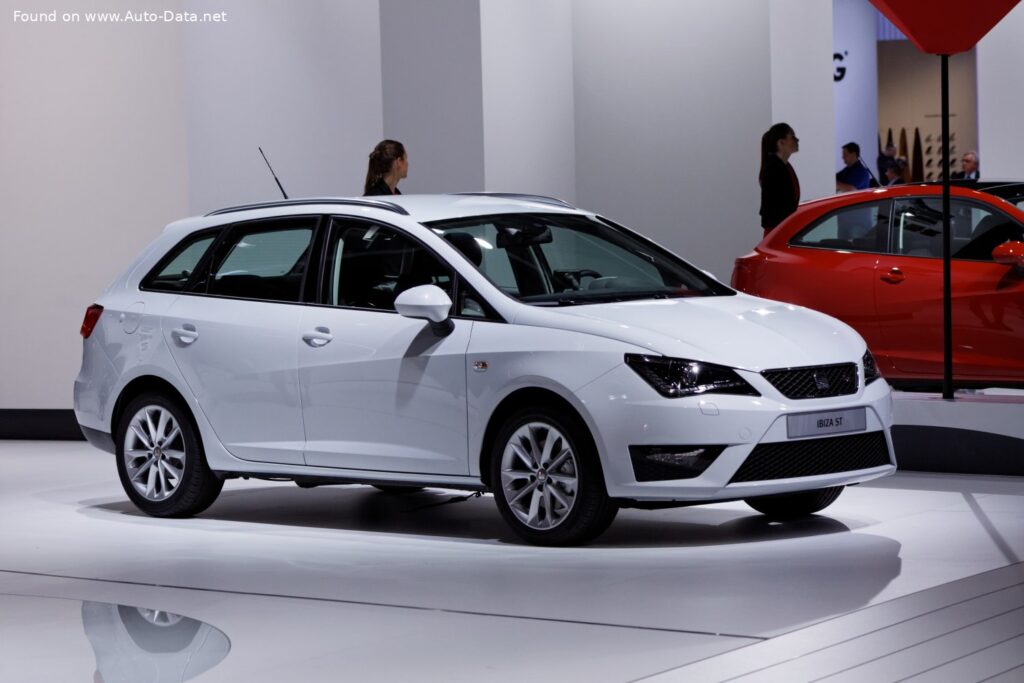
The Seat Ibiza IV ST (facelift 2012) retained the sharp, dynamic styling that characterized the fourth-generation Ibiza, while the facelift introduced subtle refinements to keep it fresh and competitive. As a station wagon (estate), its primary design differentiator was the extended roofline and rear overhang, providing a significant boost in cargo volume without overly compromising the car’s compact footprint. With a length of 166.77 inches (4236 mm), a width of 66.65 inches (1693 mm), and a height of 56.89 inches (1445 mm), the Ibiza ST remained maneuverable in tight city conditions. Its wheelbase of 97.2 inches (2469 mm) ensured a stable ride.
The facelift updated the front fascia with redesigned headlights, a more assertive grille, and revised bumper styling, aligning it with SEAT’s evolving design language. The overall aesthetic aimed for a sporty yet sophisticated look, appealing to a younger demographic than some of its more conservative competitors. The five-door body type provided easy access for all five occupants, while the interior was designed with ergonomics and practicality in mind.
Inside, the Ibiza ST offered a comfortable and functional cabin. While not luxurious, the materials and build quality were typical of the Volkswagen Group standard for the segment, emphasizing durability and user-friendliness. Key features included a well-laid-out dashboard, intuitive controls, and supportive seating. The most compelling feature of the ST variant was its cargo capacity: a minimum trunk space of 15.19 cu. ft. (430 liters), significantly more than the hatchback, making it genuinely versatile for families or individuals needing extra storage.
For safety and driving dynamics, the Ibiza ST was equipped with a robust set of features. It utilized an independent McPherson strut front suspension with coil springs and an anti-roll bar, paired with a trailing arm rear suspension. This setup provided a balanced ride, offering a good compromise between comfort and agile handling. Braking power came from ventilated discs at the front and disc brakes at the rear, complemented by an Anti-lock Braking System (ABS) for enhanced control during emergency stops. The electric power steering system offered light and precise steering, making parking and city driving effortless, with a minimum turning circle of 34.38 ft. (10.48 m).
Technical Specifications
| Category | Specification | US Equivalent |
|---|---|---|
| Brand | Seat | |
| Model | Ibiza IV ST (facelift 2012) | |
| Engine Type | 1.6 TDI (105 Hp) | |
| Production Years | 2012 – 2015 | |
| Body Type | Station wagon (estate) | |
| Seats | 5 | |
| Doors | 5 | |
| Performance Specifications | ||
| Fuel Consumption (Urban) | 5.1 l/100 km | 46.1 US mpg |
| Fuel Consumption (Extra Urban) | 3.6 l/100 km | 65.3 US mpg |
| Fuel Consumption (Combined) | 4.2 l/100 km | 56 US mpg |
| CO2 Emissions | 109 g/km | |
| Fuel Type | Diesel | |
| Acceleration 0-60 mph | 10.4 sec | |
| Maximum Speed | 188 km/h | 116.82 mph |
| Emission Standard | Euro 5 | |
| Weight-to-Power Ratio | 11.7 kg/Hp | 85.7 Hp/tonne |
| Engine Specifications | ||
| Power | 105 Hp @ 4400 rpm | |
| Torque | 250 Nm @ 1500-2500 rpm | 184.39 lb.-ft. @ 1500-2500 rpm |
| Engine Layout | Front, Transverse | |
| Engine Model/Code | CLNA | |
| Engine Displacement | 1598 cm³ | 1.6 Liters (97.52 cu. in.) |
| Number of Cylinders | 4 | Inline |
| Cylinder Bore | 79.5 mm | 3.13 in. |
| Piston Stroke | 80.5 mm | 3.17 in. |
| Compression Ratio | 16.5:1 | |
| Valves per Cylinder | 4 | |
| Fuel Injection System | Diesel Commonrail | |
| Engine Aspiration | Turbocharger, Intercooler | |
| Engine Oil Capacity | 3.6 l | 3.8 US qt |
| Coolant Capacity | 5.6 l | 5.92 US qt |
| Engine Systems | Particulate filter | |
| Dimensions, Volume, and Weights | ||
| Kerb Weight | 1225 kg | 2700.66 lbs. |
| Max. Weight | 1680 kg | 3703.77 lbs. |
| Max Load | 455 kg | 1003.1 lbs. |
| Trunk Space (Minimum) | 430 l | 15.19 cu. ft. |
| Fuel Tank Capacity | 45 l | 11.89 US gal |
| Length | 4236 mm | 166.77 in. |
| Width | 1693 mm | 66.65 in. |
| Height | 1445 mm | 56.89 in. |
| Wheelbase | 2469 mm | 97.2 in. |
| Front Track | 1465 mm | 57.68 in. |
| Rear Track | 1457 mm | 57.36 in. |
| Minimum Turning Circle | 10.48 m | 34.38 ft. |
| Drivetrain, Brakes, and Suspension | ||
| Drivetrain Architecture | Front-wheel drive | |
| Gearbox | 5 gears, manual transmission | |
| Front Suspension | Independent, McPherson with coil spring and anti-roll bar | |
| Rear Suspension | Trailing arm | |
| Front Brakes | Ventilated discs | |
| Rear Brakes | Disc | |
| Assisting Systems | ABS (Anti-lock braking system) | |
| Steering Type | Steering rack and pinion | |
| Power Steering | Electric Steering | |
Legacy and Market Impact of the Seat Ibiza IV ST (facelift 2012)
The Seat Ibiza IV ST (facelift 2012), particularly with the 1.6 TDI (105 Hp) engine, played a crucial role in SEAT’s strategy to broaden its appeal in the highly competitive European market. As a brand within the Volkswagen Group, SEAT was often tasked with embodying a more passionate, design-driven, and slightly sportier image compared to its more conservative German and Czech siblings. The Ibiza, as SEAT’s best-selling model for many years, was central to this identity.
The introduction of the ST (Sport Tourer) body style for the Ibiza was a strategic move to capture market share from buyers who needed the practicality of a station wagon but preferred the compact dimensions and lower running costs of a subcompact car. In Europe, where space is often at a premium and fuel efficiency is a significant purchasing factor, the Ibiza ST offered a compelling package. It competed directly with other subcompact estates such as the Skoda Fabia Combi, Renault Clio Estate, and even larger compact hatchbacks, offering a more versatile alternative to the standard Ibiza hatchback.
The 1.6 TDI (105 Hp) engine was a cornerstone of its market success. During the 2012-2015 production period, diesel engines were still highly favored in Europe for their superior fuel economy and strong torque delivery, especially for drivers covering longer distances or those seeking lower operating costs. The Ibiza ST 1.6 TDI delivered exceptional combined fuel economy of 56 US mpg and low CO2 emissions, which translated into significant savings on fuel and, in many European countries, lower vehicle taxes. This made it an attractive option for both private buyers and fleet operators.
The facelift in 2012 helped to keep the Ibiza fresh against newer rivals, ensuring its design remained contemporary and its interior features competitive. While not revolutionary, the updates solidified its position as a reliable, economical, and practical choice. Its reputation was built on Volkswagen Group engineering, offering a blend of robust mechanicals, decent driving dynamics, and SEAT’s distinct styling.
In terms of legacy, the Ibiza ST helped to establish the viability of a subcompact station wagon in Europe, demonstrating that practicality didn’t have to come at the expense of style or compact size. It contributed to SEAT’s image as a brand that offered sensible yet engaging vehicles. Although the demand for small diesel station wagons has since waned with the shift towards SUVs and electric vehicles, the Ibiza IV ST 1.6 TDI remains a testament to an era when fuel-efficient diesel power and versatile body styles were paramount to European consumers. It is remembered as a well-rounded and impactful model within its specific market segment.