The Rover 75 (facelift 2004) 4.6 V8 (260 Hp) Automatic: A British Swan Song
The Rover 75, particularly its facelifted 2004 iteration featuring the potent 4.6 V8 engine and automatic transmission, represents a fascinating and somewhat improbable chapter in the history of the British automotive industry. Launched originally in 1998, the Rover 75 was Rover’s ambitious entry into the compact executive car segment, aiming to blend traditional British luxury and craftsmanship with modern engineering. The 2004 facelift brought subtle styling enhancements, but it was the introduction of the V8 variant that truly set this model apart. Developed by MG Rover’s Special Products division (often associated with the MG ZT 260, its sportier sibling), this particular Rover 75 was a rear-wheel-drive powerhouse, a stark departure from the standard front-wheel-drive architecture of the rest of the lineup. While never officially sold in the United States, the Rover 75 carved out a niche in its primary European market, offering a distinctive blend of elegance, comfort, and, in V8 guise, surprising performance, particularly in the face of its more mainstream German competitors.
Engine and Performance: The American Heart of the Rover 75
At the core of this unique Rover 75 variant was a formidable American powerplant: a 4.6-liter (4601 cm3 or 280.77 cu. in.) naturally aspirated V8 engine, famously sourced from Ford’s modular engine family, specifically a unit akin to those found in contemporary Ford Mustang models. This SOHC (Single Overhead Camshaft) V8, designated with the model code 2L2E, was a significant departure from Rover’s traditional inline-four and V6 engines. It delivered a robust 260 horsepower at 5000 rpm and a substantial 302.4 lb.-ft. of torque at 4000 rpm. This power was channeled to the rear wheels via a 4-speed automatic transmission, a crucial engineering feat considering the standard Rover 75 was a front-wheel-drive platform. The conversion involved extensive re-engineering of the chassis, including a modified floorpan and a bespoke rear suspension setup to accommodate the prop shaft and differential.
The performance figures for such a luxurious sedan were impressive for its time. The Rover 75 4.6 V8 could accelerate from 0 to 60 mph in a swift 6.8 seconds, reaching a top speed of 150.99 mph (243 km/h). This level of performance transformed the genteel Rover 75 into a genuine sleeper, capable of surprising many on the open road. With a weight-to-power ratio of 6.5 kg/Hp (154.8 Hp/tonne) and a weight-to-torque ratio of 4.1 kg/Nm (244 Nm/tonne), the car offered a compelling blend of straight-line speed and effortless cruising ability. Fuel economy, as expected from a large V8 in a luxury sedan of this era, was not its strong suit. Combined fuel consumption was rated at 17.6 US mpg (13.4 l/100 km), with urban figures dropping to 12.9 US mpg (18.3 l/100 km), reflecting the engine’s displacement and the car’s weight. CO2 emissions stood at 319 g/km, placing it within the Euro 3 emission standard.
Design and Features: Classic British Elegance with a Performance Edge
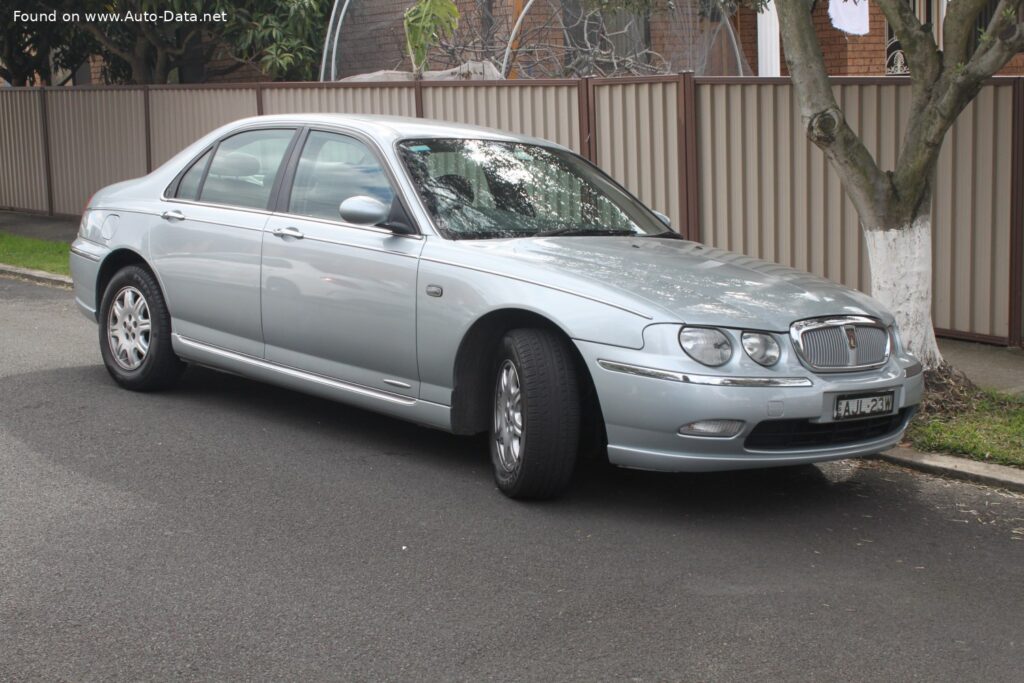
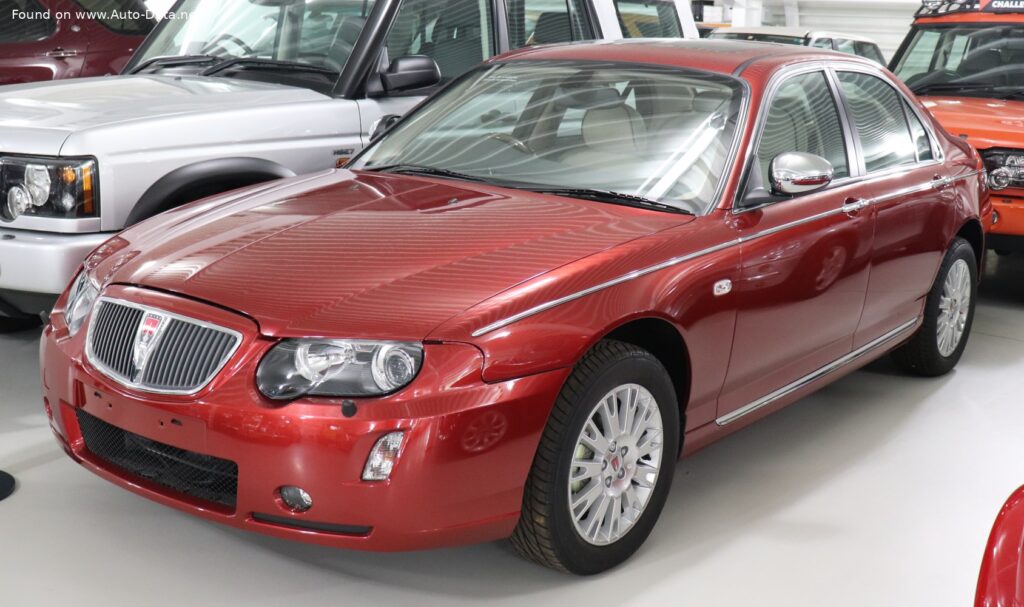
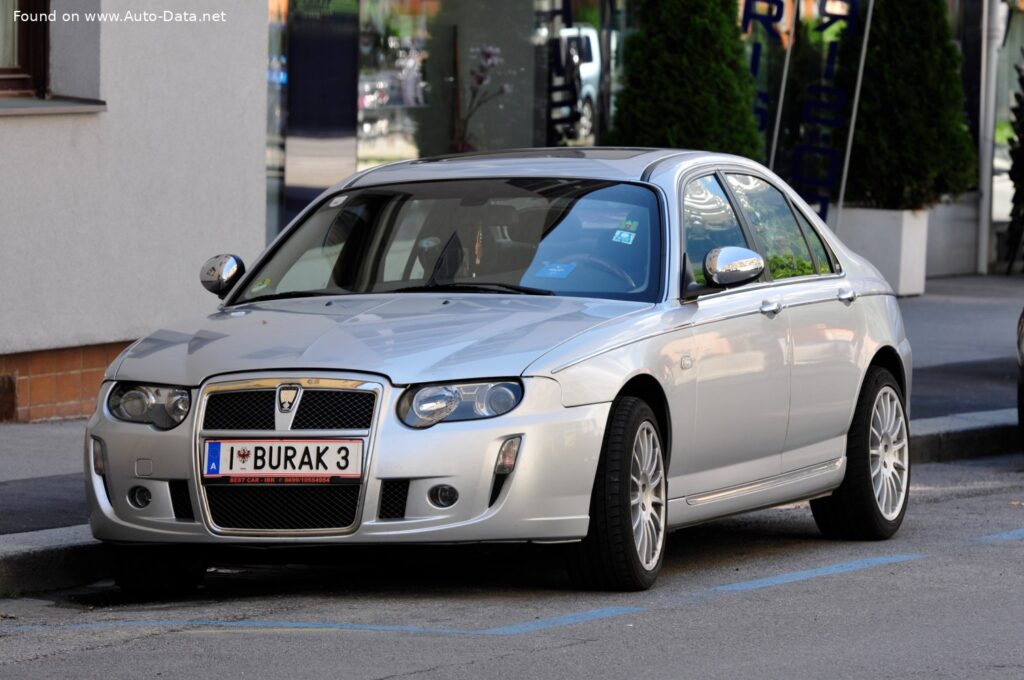
The Rover 75‘s design, even after the 2004 facelift, retained its distinctive “retro-modern” aesthetic, characterized by classic British styling cues reminiscent of Rovers from decades past. The sedan body type featured elegant curves, chrome accents, and a refined presence that aimed to evoke a sense of timeless luxury. The facelift brought minor revisions to the grille, headlights, and bumpers, subtly modernizing the look without losing its inherent character. Measuring 186.97 inches (4749 mm) in length, 79.09 inches (2009 mm) in width (including mirrors), and 56.06 inches (1424 mm) in height, with a generous wheelbase of 108.11 inches (2746 mm), the Rover 75 offered ample space for five occupants within its plush interior.
Inside, the Rover 75 continued its theme of traditional luxury. High-quality materials, often including wood and leather trim, created an inviting and comfortable cabin environment. While specific feature lists can vary, standard amenities would typically include climate control, power windows, and an advanced audio system. For a car of its era, safety features were becoming increasingly important, and the Rover 75 included an Anti-lock Braking System (ABS) as standard, complementing its ventilated disc brakes (325 mm front, 332 mm rear). The independent McPherson strut front suspension with a coil spring and anti-roll bar, combined with an independent multi-link spring rear suspension with a stabilizer, provided a comfortable yet controlled ride, especially crucial for handling the increased power and rear-wheel-drive dynamics of the V8 model. The hydraulic power steering, a rack and pinion system, offered precise feedback, while tire sizes of 215/50 R17 or 225/45 R18 on 17- or 18-inch wheel rims ensured adequate grip.
Technical Specifications
| Category | Specification |
|---|---|
| Brand | Rover |
| Model | 75 |
| Generation | 75 (facelift 2004) |
| Type (Engine) | 4.6 V8 (260 Hp) Automatic |
| Production Start | 2004 |
| Production End | 2005 |
| Powertrain Architecture | Internal Combustion engine |
| Body Type | Sedan |
| Seats | 5 |
| Doors | 4 |
| Performance Specs | |
| Fuel Consumption (Urban) | 12.9 US mpg (18.3 l/100 km) |
| Fuel Consumption (Extra Urban) | 22.4 US mpg (10.5 l/100 km) |
| Fuel Consumption (Combined) | 17.6 US mpg (13.4 l/100 km) |
| CO2 Emissions | 319 g/km |
| Fuel Type | Gasoline (Petrol) |
| Acceleration 0 – 60 mph | 6.8 sec |
| Maximum Speed | 150.99 mph (243 km/h) |
| Emission Standard | Euro 3 |
| Weight-to-Power Ratio | 6.5 kg/Hp (154.8 Hp/tonne) |
| Weight-to-Torque Ratio | 4.1 kg/Nm (244 Nm/tonne) |
| Engine Specs | |
| Power | 260 Hp @ 5000 rpm |
| Power per Liter | 56.5 Hp/l |
| Torque | 302.4 lb.-ft. @ 4000 rpm (410 Nm @ 4000 rpm) |
| Maximum Engine Speed | 6000 rpm |
| Engine Layout | Front, Longitudinal |
| Engine Model/Code | 2L2E |
| Engine Displacement | 4.6 liters (4601 cm3 / 280.77 cu. in.) |
| Number of Cylinders | 8 |
| Engine Configuration | V-engine |
| Cylinder Bore | 3.55 in. (90.2 mm) |
| Piston Stroke | 3.54 in. (90 mm) |
| Compression Ratio | 9.4:1 |
| Valves per Cylinder | 2 |
| Fuel Injection System | Multi-port manifold injection |
| Engine Aspiration | Naturally aspirated |
| Valvetrain | SOHC |
| Engine Oil Capacity | 4.97 US qt (4.7 l) |
| Coolant Capacity | 13.31 US qt (12.6 l) |
| Space, Volume and Weights | |
| Kerb Weight | 3703.77 lbs. (1680 kg) |
| Max. Weight (Gross Vehicle Weight Rating) | 4784.03 lbs. (2170 kg) |
| Max Load | 1080.27 lbs. (490 kg) |
| Trunk (Boot) Space – Minimum | 15.26 cu. ft. (432 l) |
| Permitted Trailer Load with Brakes (12%) | 3527.4 lbs. (1600 kg) |
| Permitted Trailer Load without Brakes | 1653.47 lbs. (750 kg) |
| Permitted Towbar Download | 220.46 lbs. (100 kg) |
| Dimensions | |
| Length | 186.97 in. (4749 mm) |
| Width including Mirrors | 79.09 in. (2009 mm) |
| Height | 56.06 in. (1424 mm) |
| Wheelbase | 108.11 in. (2746 mm) |
| Front Track | 59.33 in. (1507 mm) |
| Rear Track | 59.21 in. (1504 mm) |
| Minimum Turning Circle (Diameter) | 37.27 ft. (11.36 m) |
| Drivetrain, Brakes and Suspension Specs | |
| Drivetrain Architecture | Rear-wheel drive; Internal Combustion engine drives the rear wheels. |
| Drive Wheel | Rear wheel drive |
| Number of Gears and Type of Gearbox | 4 gears, automatic transmission |
| Front Suspension | Independent, McPherson type with coil spring and anti-roll bar |
| Rear Suspension | Independent multi-link spring suspension with stabilizer |
| Front Brakes | Ventilated discs, 12.80 in. (325 mm) |
| Rear Brakes | Ventilated discs, 13.07 in. (332 mm) |
| Assisting Systems | ABS (Anti-lock braking system) |
| Steering Type | Steering rack and pinion |
| Power Steering | Hydraulic Steering |
| Tires Size | 215/50 R17; 225/45 R18 |
| Wheel Rims Size | 17; 18 |
Legacy and Market Impact: A Bold Experiment in Rover’s Final Years
The Rover 75, particularly its V8 variant, holds a unique place in automotive history. It was an ambitious project undertaken during a tumultuous period for Rover, representing a last-ditch effort to inject excitement and performance into a brand struggling with its identity and financial viability. In its primary European market, the Rover 75 competed against established players like the BMW 3-Series, Mercedes-Benz C-Class, and Audi A4, as well as more mainstream alternatives such as the Ford Mondeo and Opel Vectra/Vauxhall Vectra. While the standard Rover 75 offered a compelling alternative for buyers seeking something distinct from the German norm, the V8 model was truly a niche offering, appealing to enthusiasts who appreciated its blend of classic British styling and unexpected American muscle.
The V8 variant’s significance is amplified by its context: it was one of the final new models to emerge from MG Rover before the company’s collapse in 2005. The engineering feat of converting the front-wheel-drive platform to rear-wheel drive to accommodate the V8 engine demonstrated a remarkable level of ingenuity and passion within the company, even as its broader financial situation deteriorated. This car, alongside its MG ZT 260 sibling, became a symbol of MG Rover’s desperate, yet admirable, attempts to innovate and compete against insurmountable odds. Today, the Rover 75 4.6 V8 is considered a rare and collectible item, celebrated for its unique powertrain, comfortable ride, and its status as a poignant artifact from the twilight years of a historic British marque. It stands as a testament to what could have been, a bold and charismatic executive sedan that dared to be different, leaving an indelible mark on the landscape of European performance cars.