The Mitsubishi Lancer IX (facelift 2015) 2.4 (168 Hp): A Persistent Contender
The Mitsubishi Lancer has long been a global nameplate synonymous with reliability, affordability, and, in its more performance-oriented variants, rallying prowess. While much of the automotive world, particularly in North America, had moved on to the tenth generation (often simply referred to as the Lancer) by the mid-2010s, certain markets continued to embrace and evolve the preceding generation. The Mitsubishi Lancer IX (facelift 2015) 2.4 (168 Hp) represents a significant late-life update to this enduring platform, specifically tailored for regions where its robust engineering and proven design continued to be highly valued. Produced from 2015 to 2017, this particular iteration offered a compelling blend of practicality, a reasonably potent engine, and traditional Mitsubishi durability in a compact sedan package. It served as a testament to the longevity of a successful design, adapted to remain competitive in its specific market segments, primarily in parts of Asia, the Middle East, and some developing economies.
This detailed review delves into the specifics of this interesting variant, examining its powertrain, design philosophy, technical specifications, and its lasting impact within the automotive landscape it inhabited. Despite its limited presence in markets like the United States by this point, its continued production and refinement highlight Mitsubishi’s strategic approach to cater to diverse global demands.
Engine and Performance: The Heart of the Mitsubishi Lancer IX (facelift 2015)
Under the hood of the Mitsubishi Lancer IX (facelift 2015) 2.4 (168 Hp) lies the robust 4B12 engine, a 2.4-liter (2360 cm3 or 144.02 cu. in.) naturally aspirated inline-four powerplant. This engine, known for its strong mid-range torque and dependable operation, delivers a respectable 168 horsepower at 6000 rpm. The power output is complemented by 226 Nm (166.69 lb.-ft.) of torque, peaking at 4100 rpm. This configuration provides ample motivation for the sedan, ensuring confident acceleration and comfortable cruising.
The 4B12 engine features a Double Overhead Camshaft (DOHC) valvetrain with four valves per cylinder, a setup that enhances breathing efficiency and contributes to both power and fuel economy. Fuel delivery is managed by a multi-port manifold injection system, a proven technology that offers a good balance of performance and reliability. With a compression ratio of 10.5:1, the engine is optimized for gasoline (petrol) and offers a decent power-to-liter ratio of 71.2 Hp/l.
Power is sent to the front wheels via a 5-speed manual transmission. This choice of gearbox emphasizes driver engagement and offers a direct connection to the engine’s output, a preference for many drivers in the markets where this Lancer variant thrived. The front-wheel-drive architecture is typical for the segment, contributing to predictable handling and efficient packaging.
In terms of fuel efficiency, the Mitsubishi Lancer IX (facelift 2015) 2.4 (168 Hp) delivers competitive figures for its class and era. In urban driving conditions, it achieves approximately 22 US mpg (10.7 l/100 km). On the highway, this improves significantly to around 30.9 US mpg (7.6 l/100 km), while the combined cycle rating stands at a respectable 25 US mpg (9.4 l/100 km). These figures highlight the engine’s balance of performance and sensible fuel consumption, making it an economical choice for daily commuting and longer journeys.
Design and Features: Enduring Form, Modern Touches
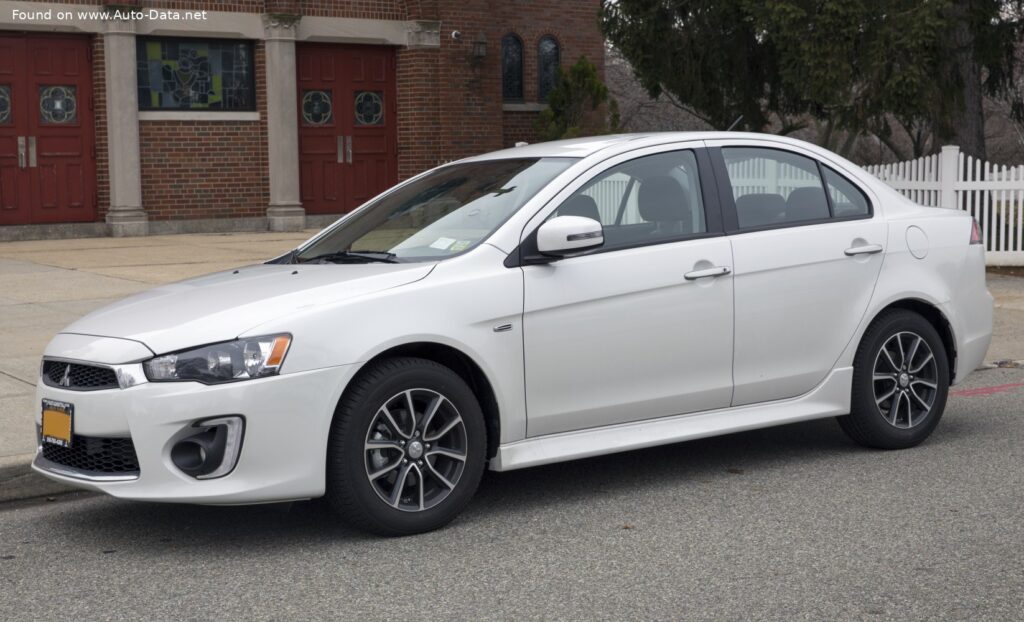
The Mitsubishi Lancer IX (facelift 2015) retains the classic four-door sedan body type, a timeless and practical choice for families and individuals alike. The 2015 facelift brought subtle yet effective updates to the exterior, aiming to refresh its appearance and bring it in line with contemporary design trends while maintaining its recognizable Lancer silhouette. These updates typically included revised front fascia elements, such as a restyled grille and bumper, and updated lighting signatures, giving it a sharper and more modern look.
Measuring 182.09 inches (4625 mm) in length, 69.29 inches (1760 mm) in width (80.47 inches or 2044 mm including mirrors), and standing between 58.27 to 59.25 inches (1480-1505 mm) tall, the Lancer offers a well-proportioned stance. Its wheelbase of 103.74 inches (2635 mm) contributes to a stable ride and a surprisingly spacious interior for five occupants. The vehicle’s curb weight of 2976.24 lbs (1350 kg) is relatively light for its class, contributing to its agile feel and fuel efficiency.
Inside, the Lancer provides seating for five passengers, with a focus on ergonomics and durability. While specific interior features can vary by market and trim level, the facelift likely introduced updated upholstery, improved infotainment options, and minor revisions to the dashboard layout to enhance user experience. Practicality is a strong suit, with a minimum trunk (boot) space of 14.13 cu. ft. (400 liters), ample for daily errands or weekend getaways.
Safety features for the 2015 model year, even on an older platform, typically included an Anti-lock Braking System (ABS) for enhanced stopping power and control. The suspension system comprises an independent McPherson strut setup with coil springs and an anti-roll bar at the front, paired with an independent multi-link spring suspension with a stabilizer bar at the rear. This combination provides a comfortable ride quality and competent handling characteristics. Braking is handled by ventilated discs at the front and solid discs at the rear, ensuring reliable deceleration. The car rides on 18-inch wheels, fitted with 215/45 R18 tires, which not only contribute to its aesthetic appeal but also provide a good grip on the road.
Technical Specifications
| Category | Specification |
|---|---|
| General Information | |
| Brand | Mitsubishi |
| Model | Lancer IX (facelift 2015) |
| Engine Type | 2.4 (168 Hp) |
| Production Start | 2015 year |
| Production End | 2017 year |
| Body Type | Sedan |
| Seats | 5 |
| Doors | 4 |
| Performance Specs | |
| Power | 168 Hp @ 6000 rpm |
| Torque | 226 Nm (166.69 lb.-ft.) @ 4100 rpm |
| Fuel Consumption (Urban) | 22 US mpg (10.7 l/100 km) |
| Fuel Consumption (Extra Urban) | 30.9 US mpg (7.6 l/100 km) |
| Fuel Consumption (Combined) | 25 US mpg (9.4 l/100 km) |
| Fuel Type | Petrol (Gasoline) |
| Weight-to-Power Ratio | 8 kg/Hp, 124.4 Hp/tonne |
| Engine Specs | |
| Engine Model/Code | 4B12 |
| Engine Displacement | 2360 cm3 (144.02 cu. in.) |
| Number of Cylinders | 4 |
| Engine Configuration | Inline |
| Cylinder Bore | 3.46 in. (88 mm) |
| Piston Stroke | 3.82 in. (97 mm) |
| Compression Ratio | 10.5:1 |
| Valves per Cylinder | 4 |
| Fuel Injection System | Multi-port manifold injection |
| Engine Aspiration | Naturally aspirated |
| Valvetrain | DOHC |
| Engine Oil Capacity | 4.86 US qt (4.6 l) |
| Coolant Capacity | 7.4 US qt (7 l) |
| Dimensions & Weights | |
| Length | 182.09 in. (4625 mm) |
| Width | 69.29 in. (1760 mm) |
| Width incl. Mirrors | 80.47 in. (2044 mm) |
| Height | 58.27 – 59.25 in. (1480-1505 mm) |
| Wheelbase | 103.74 in. (2635 mm) |
| Front Track | 60.24 in. (1530 mm) |
| Rear Track | 60.24 in. (1530 mm) |
| Ride Height (Ground Clearance) | 5.79 in. (147 mm) |
| Minimum Turning Circle | 32.81 ft (10.0 m) |
| Kerb Weight | 2976.24 lbs (1350 kg) |
| Max. Weight | 4078.55 lbs (1850 kg) |
| Max Load | 1102.31 lbs (500 kg) |
| Trunk (Boot) Space | 14.13 cu. ft. (400 l) |
| Fuel Tank Capacity | 15.59 US gal (59 l) |
| Max. Roof Load | 176.37 lbs (80 kg) |
| Permitted Towbar Download | 121.25 lbs (55 kg) |
| Drivetrain, Brakes & Suspension | |
| Drivetrain Architecture | Front-wheel drive, Internal Combustion Engine |
| Drive Wheel | Front wheel drive |
| Gearbox Type | 5-speed manual transmission |
| Front Suspension | Independent, McPherson strut with coil spring and anti-roll bar |
| Rear Suspension | Independent multi-link spring suspension with stabilizer |
| Front Brakes | Ventilated discs |
| Rear Brakes | Disc |
| Assisting Systems | ABS (Anti-lock braking system) |
| Steering Type | Rack and pinion |
| Power Steering | Hydraulic Steering |
| Tires Size | 215/45 R18 |
| Wheel Rims Size | 18 inches |
Legacy and Market Impact
The Mitsubishi Lancer, in its various forms and generations, has cultivated a reputation for being a dependable and practical vehicle across the globe. The Mitsubishi Lancer IX (facelift 2015) 2.4 (168 Hp), despite its later production run and focus on specific international markets, continued this legacy. By 2015, the Lancer nameplate had largely completed its run in the North American market in its traditional form, making this specific facelifted IX generation a curious but important chapter in its global story. It wasn’t a model designed to compete head-to-head with the latest offerings from Japanese or Korean manufacturers in highly developed markets, but rather to serve as a reliable and value-oriented option in regions where durability and proven technology were paramount.
In its primary markets, this Lancer variant faced competition from other long-running compact sedans, such as the Toyota Corolla, Honda Civic, and Hyundai Elantra, which also offered various generations and engine options tailored to local preferences. The Lancer’s appeal lay in its strong build quality, the robust performance of its 2.4-liter engine, and the straightforward reliability of its mechanical components, including the 5-speed manual transmission. Its relatively simple, yet effective, engineering made it easy to maintain and repair, a crucial factor in many developing economies.
The 2015 facelift was a strategic move by Mitsubishi to extend the life cycle of a successful platform, offering updated aesthetics and features without incurring the significant development costs of an all-new generation. This approach allowed Mitsubishi to maintain a competitive presence in key markets, providing a familiar and trusted product to its loyal customer base. The Lancer IX’s long production run, culminating in this facelifted version, is a testament to its fundamental soundness and ability to adapt to changing market conditions. It reinforced Mitsubishi’s image as a manufacturer of durable and practical vehicles, even as the brand began to shift its global focus towards SUVs and crossovers. Ultimately, the Mitsubishi Lancer IX (facelift 2015) 2.4 (168 Hp) stands as a significant footnote in the Lancer’s extensive history, representing its enduring appeal and strategic market positioning in its final years of production.