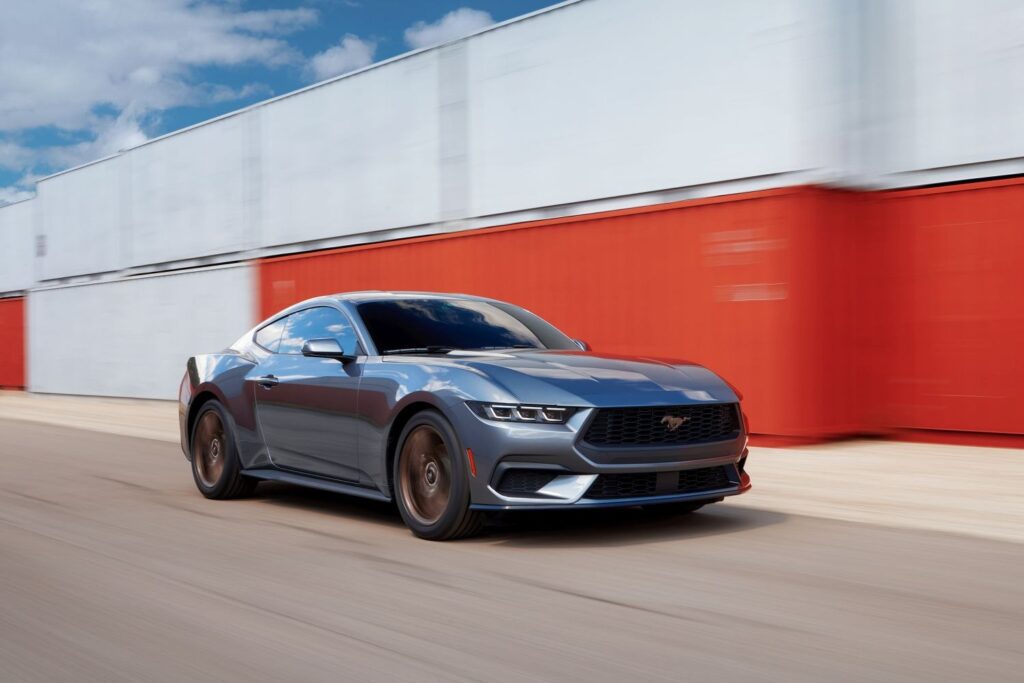
The Seventh-Generation Ford Mustang: A Modern American Icon
The Ford Mustang, an automotive legend since its debut in 1964, continues its storied legacy with the introduction of its seventh generation. The Ford Mustang VII GT 5.0 V8 (446 Hp), which commenced production in February 2024, represents a sophisticated evolution of the iconic pony car. Retaining its fundamental appeal as a powerful, rear-wheel-drive sports coupe, the Mustang VII blends aggressive styling with advanced technology and a potent naturally aspirated V8 engine. This generation aims to solidify the Mustang’s position in the global automotive landscape, offering a compelling package for enthusiasts seeking an authentic American performance experience.
Available primarily as a two-door coupe or fastback with seating for four, the Mustang VII GT 5.0 V8 (446 Hp) is engineered to deliver exhilarating performance while embracing modern efficiency and connectivity. It builds upon decades of Mustang heritage, incorporating design cues and engineering principles that resonate with both long-time fans and a new generation of drivers. While the vehicle maintains its core identity, it introduces significant updates across its powertrain, chassis, and interior, ensuring its relevance in an ever-evolving market.
Engine & Performance: The Heart of the Ford Mustang VII GT 5.0 V8 (446 Hp)
The Potent Coyote V8
At the core of the Ford Mustang VII GT 5.0 V8 (446 Hp) lies the revered “Coyote” V8 engine, a name synonymous with high-performance Ford vehicles. This 5.0-liter (5038 cm3 or 307.44 cu. in.) naturally aspirated powerplant is a marvel of modern engineering, delivering a robust 446 horsepower at a thrilling 7250 rpm. Its impressive power-per-liter ratio of 88.5 Hp/l underscores its efficiency and high-revving nature. Torque output stands at a substantial 398.28 lb.-ft. (540 Nm) at 5100 rpm, providing ample thrust across a broad rev range, critical for both spirited driving and everyday usability.
The engine’s layout is a classic front-longitudinal configuration, ensuring optimal weight distribution for a performance vehicle. It features an advanced architecture with eight cylinders in a V-engine configuration, four valves per cylinder, and a Double Overhead Camshaft (DOHC) valvetrain with Twin Independent Variable Cam Timing (Ti-VCT). This sophisticated valvetrain technology allows for precise control over valve timing, optimizing both power output and fuel efficiency. Fuel delivery is handled by a sophisticated system combining both direct injection and multi-port manifold injection, a strategy that maximizes combustion efficiency and power delivery across the entire operating spectrum. Despite its high-performance credentials, the engine also incorporates a Start & Stop System, contributing to improved fuel economy and reduced emissions during urban driving.
Driving Dynamics and Efficiency
The Mustang VII GT 5.0 V8 (446 Hp) is equipped with a purist-pleasing 6-speed manual transmission, sending power directly to the rear wheels. This traditional drivetrain architecture offers an engaging and visceral driving experience, allowing the driver to fully exploit the V8’s powerband. Performance figures are impressive, with the vehicle accelerating from 0 to 60 mph in a swift 5 seconds, and 0 to 100 km/h in 5.3 seconds. Its top speed is electronically limited to 155.34 mph (250 km/h), a common practice for high-performance vehicles.
Despite its formidable power, Ford has made strides in optimizing the Mustang’s fuel economy. According to WLTP standards, the combined fuel consumption is rated at 19.6 US mpg (12 l/100 km). CO2 emissions are reported at 274 g/km, reflecting the balance between performance and environmental considerations. The car’s weight-to-power ratio of 3.9 kg/Hp (257.4 Hp/tonne) and weight-to-torque ratio of 3.2 kg/Nm (311.6 Nm/tonne) highlight its athletic build and potent capabilities, promising a dynamic and responsive driving experience.
Design & Features: Modern Aggression Meets Classic Lines
Exterior and Dimensions
The seventh-generation Ford Mustang retains its unmistakable silhouette while introducing a more chiseled and aggressive aesthetic. The design pays homage to its predecessors with its long hood, short deck, and muscular haunches, but integrates sharper lines and contemporary details that give it a fresh, modern appeal. As a coupe or fastback, it features two doors and a 2+2 seating configuration, making it a functional sports car for both solo drives and occasional passenger transport.
Dimensions for the Mustang VII GT are substantial, contributing to its commanding road presence. It measures 189.37 inches (4810 mm) in length, 75.43 inches (1916 mm) in width (extending to 82.56 inches or 2097 mm including mirrors), and stands between 54.88 to 55.67 inches (1394-1414 mm) tall. The wheelbase is a generous 107.05 inches (2719 mm), providing a stable platform for high-speed performance and comfortable cruising. A minimum turning circle of 40.03 feet (12.2 m) indicates a manageable maneuverability for a vehicle of its size. The trunk space is practical for a sports coupe, offering 13.45 cu. ft. (381 liters) of cargo volume.
Chassis, Suspension, and Brakes
Underneath its sculpted body, the Mustang VII GT features a thoroughly engineered chassis designed for dynamic handling. The front suspension employs an independent McPherson strut setup with coil springs and an anti-roll bar, providing precise steering response and excellent road holding. At the rear, an independent multi-link spring suspension with a stabilizer ensures superior ride comfort and handling characteristics, a significant evolution from earlier Mustang generations.
Braking performance is crucial for a car with the Mustang GT’s capabilities. It is equipped with robust ventilated disc brakes on all four wheels: large 390×36 mm discs at the front and 355×28 mm discs at the rear. These powerful brakes, coupled with an Anti-lock Braking System (ABS), provide confident stopping power in various conditions. Steering is handled by an electric power steering system with a rack and pinion setup, offering precise control and feedback to the driver. The vehicle rides on a staggered wheel and tire setup, with 255/40 R19 tires on 9J x 19 rims at the front and wider 275/40 R19 tires on 9.5J x 19 rims at the rear, optimizing grip and handling balance.
The curb weight of the Mustang VII GT 5.0 V8 (446 Hp) is 3820.61 lbs. (1733 kg), with a maximum permissible weight of 4706.87 lbs. (2135 kg) and a maximum load capacity of 886.26 lbs. (402 kg). These figures underscore the robust construction designed to handle the car’s performance capabilities.
Technical Specifications: Ford Mustang VII GT 5.0 V8 (446 Hp)
| Category | Specification | Value |
|---|---|---|
| General Information | ||
| Brand | Ford | |
| Model | Mustang | |
| Generation | Mustang VII | |
| Type (Engine) | GT 5.0 V8 (446 Hp) | |
| Start of Production | February, 2024 | |
| Powertrain Architecture | Internal Combustion engine | |
| Body Type | Coupe, Fastback | |
| Seats | 4 | |
| Doors | 2 | |
| Performance Specs | ||
| Combined Fuel Consumption (WLTP) | 19.6 US mpg (12 l/100 km) | |
| CO2 Emissions (WLTP) | 274 g/km | |
| Fuel Type | Petrol (Gasoline) | |
| Acceleration 0 – 60 mph | 5.0 sec | |
| Acceleration 0 – 100 km/h | 5.3 sec | |
| Maximum Speed | 155.34 mph (250 km/h) | |
| Weight-to-Power Ratio | 3.9 kg/Hp, 257.4 Hp/tonne | |
| Weight-to-Torque Ratio | 3.2 kg/Nm, 311.6 Nm/tonne | |
| Engine Specs | ||
| Power | 446 Hp @ 7250 rpm | |
| Power per Liter | 88.5 Hp/l | |
| Torque | 398.28 lb.-ft. (540 Nm) @ 5100 rpm | |
| Engine Layout | Front, Longitudinal | |
| Engine Model/Code | Coyote | |
| Engine Displacement | 307.44 cu. in. (5038 cm3) | |
| Number of Cylinders | 8 | |
| Engine Configuration | V-engine | |
| Cylinder Bore | 3.66 in. (93 mm) | |
| Piston Stroke | 3.65 in. (92.7 mm) | |
| Compression Ratio | 12:1 | |
| Number of Valves per Cylinder | 4 | |
| Fuel Injection System | Direct injection and Multi-port manifold injection | |
| Engine Aspiration | Naturally aspirated engine | |
| Valvetrain | DOHC, Ti-VCT | |
| Engine Oil Capacity | 10.04 US qt (9.5 l) | |
| Engine Oil Specification | Not provided | |
| Coolant Capacity | 11.73 US qt (11.1 l) | |
| Engine Systems | Start & Stop System | |
| Space, Volume and Weights | ||
| Kerb Weight | 3820.61 lbs. (1733 kg) | |
| Max. Weight | 4706.87 lbs. (2135 kg) | |
| Max Load | 886.26 lbs. (402 kg) | |
| Trunk (boot) Space – Minimum | 13.45 cu. ft. (381 l) | |
| Dimensions | ||
| Length | 189.37 in. (4810 mm) | |
| Width | 75.43 in. (1916 mm) | |
| Width with Mirrors Folded | 77.95 in. (1980 mm) | |
| Width Including Mirrors | 82.56 in. (2097 mm) | |
| Height | 54.88 – 55.67 in. (1394-1414 mm) | |
| Wheelbase | 107.05 in. (2719 mm) | |
| Front Track | 62.4 in. (1585 mm) | |
| Rear (Back) Track | 64.65 in. (1642 mm) | |
| Minimum Turning Circle (Turning Diameter) | 40.03 ft. (12.2 m) | |
| Drivetrain, Brakes and Suspension Specs | ||
| Drivetrain Architecture | The Internal combustion engine (ICE) drives the rear wheels of the vehicle. | |
| Drive Wheel | Rear wheel drive | |
| Number of Gears and Type of Gearbox | 6 gears, manual transmission | |
| Front Suspension | Independent, type McPherson with coil spring and anti-roll bar | |
| Rear Suspension | Independent multi-link spring suspension with stabilizer | |
| Front Brakes | Ventilated discs, 390×36 mm | |
| Rear Brakes | Ventilated discs, 355×28 mm | |
| Assisting Systems | ABS (Anti-lock braking system) | |
| Steering Type | Steering rack and pinion | |
| Power Steering | Electric Steering | |
| Tires Size (Front) | 255/40 R19 | |
| Tires Size (Rear) | 275/40 R19 | |
| Wheel Rims Size (Front) | 9J x 19 | |
| Wheel Rims Size (Rear) | 9.5J x 19 | |
Legacy & Market Impact of the Ford Mustang VII GT 5.0 V8 (446 Hp)
The Ford Mustang has always been more than just a car; it’s a cultural phenomenon and a testament to American automotive ingenuity. The seventh-generation Ford Mustang VII GT 5.0 V8 (446 Hp) continues this legacy, solidifying its reputation as a leading contender in the sports coupe segment. Its enduring appeal lies in its unique blend of accessible performance, iconic styling, and a deep connection to its heritage. In a rapidly electrifying automotive world, the decision to offer a new generation with a powerful, naturally aspirated V8 and a manual transmission underscores Ford’s commitment to enthusiasts and the preservation of the traditional driving experience.
The Mustang’s primary market remains North America, where it competes fiercely with other domestic performance vehicles. While direct rivals like the Chevrolet Camaro and Dodge Challenger are undergoing significant transformations or discontinuations, the Mustang stands as the last remaining traditional pony car, offering a distinct advantage. Globally, the Mustang has expanded its reach, becoming a recognized and desired sports car in Europe, Asia, and Australia. In these international markets, it competes with a broader array of performance vehicles, from European sports coupes like the BMW 4-Series and Audi A5 to Japanese offerings such as the Nissan Z. The Mustang’s competitive edge often comes from its potent V8, rear-wheel-drive purity, and relatively attainable price point compared to many European luxury performance cars.
The historical significance of the Mustang cannot be overstated. From its inception, it democratized sports car ownership, making performance accessible to a wider audience. The seventh generation continues this tradition, offering a modern, technology-rich interior alongside its raw mechanical prowess. Its blend of advanced chassis dynamics, powerful braking, and the visceral thrill of the Coyote V8 ensures it remains relevant and exciting. The inclusion of modern features like the Start & Stop System and sophisticated fuel injection, while maintaining the beloved natural aspiration, showcases a thoughtful evolution rather than a radical departure.
Ultimately, the Ford Mustang VII GT 5.0 V8 (446 Hp) is poised to maintain its status as a benchmark for performance and style. It is a car that appeals to both the purist who craves a manual gearbox and a roaring V8, and the modern driver who appreciates contemporary design and technology. Its market impact will likely be defined by its ability to bridge the gap between automotive tradition and the demands of the 21st century, ensuring the Mustang’s roar echoes for generations to come.