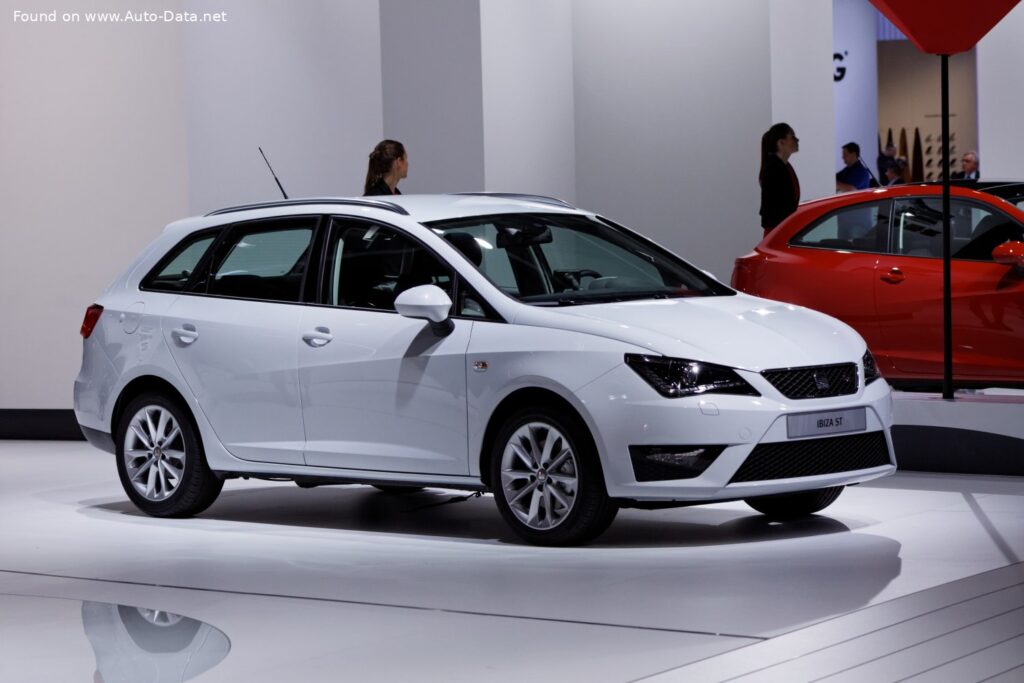
The Seat Ibiza IV ST (facelift 2012) 1.6 TDI (90 Hp) DSG: A Practical European Compact
The Seat Ibiza IV ST (facelift 2012) represents a significant iteration in the lineage of Seat’s popular supermini, specifically targeting the practical needs of European families and individuals. As a brand of the Volkswagen Group, Seat, based in Spain, has long been recognized for injecting a sportier, more design-focused flair into the robust engineering platforms shared with its German and Czech siblings (Volkswagen and Skoda). The fourth generation Ibiza, launched in 2008, received a notable facelift in 2012, refreshing its aesthetic and refining its mechanical offerings. This particular variant, the ST (Sport Tourer or station wagon), equipped with the efficient 1.6 TDI (90 Hp) diesel engine and a 7-speed DSG automatic transmission, was positioned as a highly economical and versatile option within the competitive European B-segment. It emphasized cargo capacity and fuel efficiency, making it a compelling choice for consumers prioritizing utility without sacrificing nimble city driving or long-distance comfort.
Engine and Performance: The Efficient 1.6 TDI and DSG Combination
At the heart of this Seat Ibiza IV ST (facelift 2012) model lies the venerable 1.6-liter TDI (Turbocharged Direct Injection) diesel engine, a powerplant widely utilized across the Volkswagen Group’s compact vehicle lineup. Delivering a modest but highly effective 90 horsepower at 4200 rpm, this engine was not designed for outright speed but rather for exceptional fuel economy and strong low-end torque. Its peak torque figure of 230 Nm (169.64 lb.-ft.) is available across a broad rev range, from 1500 to 2500 rpm, which is crucial for effortless daily driving, especially when laden with passengers or cargo. This characteristic torque delivery allows the Ibiza ST to feel more sprightly than its horsepower figure might suggest, making light work of urban traffic and providing adequate overtaking power on highways.
The engine’s inline four-cylinder configuration, with 1598 cubic centimeters (97.52 cu. in.) of displacement, features a common rail fuel injection system and a turbocharger with an intercooler, optimizing combustion efficiency and power delivery. With a compression ratio of 16.5:1 and four valves per cylinder, it was engineered to meet the Euro 5 emission standards prevalent at the time, underscoring its environmental consciousness.
Paired with this efficient diesel engine is a sophisticated 7-speed DSG (Direct Shift Gearbox) automatic transmission. This dual-clutch unit is renowned for its rapid, seamless gear changes, which contribute significantly to both the car’s fuel efficiency and its smooth driving dynamics. The DSG’s ability to pre-select the next gear means virtually no interruption in power delivery during shifts, enhancing the driving experience. This powertrain combination enables the Ibiza ST to accelerate from 0 to 60 mph in a respectable 11.4 seconds (0-100 km/h in 12 seconds) and reach a top speed of 110.6 mph (178 km/h).
Fuel economy figures are a standout feature for this diesel model. The official combined cycle rating is an impressive 4.3 liters per 100 km, translating to approximately 54.7 US mpg. In extra-urban driving, this figure improves further to 3.7 l/100 km (63.6 US mpg), while urban consumption is rated at 5.2 l/100 km (45.2 US mpg). These numbers highlight the car’s inherent efficiency, making it a cost-effective choice for high-mileage drivers in Europe, where diesel fuel was and remains a popular option. CO2 emissions are also kept low at 112 g/km, further solidifying its eco-friendly credentials for its era.
Design and Features: Practicality Meets Spanish Flair
The 2012 facelift brought subtle yet effective enhancements to the Seat Ibiza’s exterior design, particularly evident in the ST (Station Wagon) variant. The Ibiza ST maintained the sharp, angular lines characteristic of Seat’s design language, penned by Luc Donckerwolke, giving it a distinctive and sporty appearance that differentiated it from its Volkswagen Polo and Skoda Fabia counterparts. The facelift introduced redesigned headlights with optional LED daytime running lights, a revised grille, and updated bumper designs, lending it a more contemporary and aggressive stance.
As a 5-door, 5-seat station wagon, the Ibiza ST’s primary appeal lay in its enhanced practicality over the standard hatchback. With an overall length of 166.77 inches (4236 mm), it offered a significantly larger cargo area. The trunk space, a crucial aspect for any station wagon, provided a minimum of 430 liters (15.19 cu. ft.) of volume, making it highly versatile for carrying luggage, groceries, or sports equipment. The five-door configuration provided easy access for passengers and cargo alike.
Inside, the facelifted Ibiza featured improved materials and revised trim options, aiming to elevate the cabin’s perceived quality. While the interior design remained functional and driver-focused, typical of Volkswagen Group vehicles, Seat added its own touches to enhance the sporty ambiance. Standard features for a car of this segment and era would typically include air conditioning, power windows, remote central locking, and a competent audio system. Safety was also a key consideration, with standard equipment including ABS (Anti-lock Braking System), airbags, and seatbelt pretensioners. The steering system utilized an electric power steering unit, contributing to light steering effort at low speeds for easy maneuverability and more weighted feedback at higher speeds. The turning circle of 34.38 feet (10.48 m) underscored its agility in urban environments.
The chassis setup featured an independent McPherson strut front suspension with coil springs and an anti-roll bar, paired with a semi-independent trailing arm rear suspension. This configuration, common in compact cars, provided a good balance of ride comfort and handling precision. Braking duties were handled by ventilated discs at the front and solid discs at the rear, ensuring confident stopping power.
Technical Specifications
| Category | Specification |
|---|---|
| Brand | Seat |
| Model | Ibiza IV ST (facelift 2012) |
| Type (Engine) | 1.6 TDI (90 Hp) DSG |
| Production Start | 2012 |
| Production End | 2015 |
| Body Type | Station wagon (estate), 5 Doors, 5 Seats |
| Powertrain Architecture | Internal Combustion Engine, Front-wheel drive |
| Performance Specs | |
| Fuel Consumption (Urban) | 5.2 l/100 km (45.2 US mpg) |
| Fuel Consumption (Extra Urban) | 3.7 l/100 km (63.6 US mpg) |
| Fuel Consumption (Combined) | 4.3 l/100 km (54.7 US mpg) |
| CO2 Emissions | 112 g/km |
| Fuel Type | Diesel |
| Acceleration 0-60 mph | 11.4 sec |
| Acceleration 0-100 km/h | 12 sec |
| Maximum Speed | 110.6 mph (178 km/h) |
| Emission Standard | Euro 5 |
| Weight-to-Power Ratio | 13.6 kg/Hp (73.5 Hp/tonne) |
| Weight-to-Torque Ratio | 5.3 kg/Nm (187.9 Nm/tonne) |
| Engine Specs | |
| Power | 90 Hp @ 4200 rpm |
| Power per liter | 56.3 Hp/l |
| Torque | 230 Nm (169.64 lb.-ft.) @ 1500-2500 rpm |
| Engine Layout | Front, Transverse |
| Engine Model/Code | CAYB |
| Engine Displacement | 1598 cm3 (1.6 liters / 97.52 cu. in.) |
| Number of Cylinders | 4, Inline |
| Cylinder Bore | 79.5 mm (3.13 in.) |
| Piston Stroke | 80.5 mm (3.17 in.) |
| Compression Ratio | 16.5:1 |
| Valves per Cylinder | 4 |
| Fuel Injection System | Diesel Commonrail |
| Engine Aspiration | Turbocharger, Intercooler |
| Engine Oil Capacity | 4.3 l (4.54 US qt) |
| Coolant Capacity | 8 l (8.45 US qt) |
| Engine Systems | Particulate filter |
| Space, Volume and Weights | |
| Kerb Weight | 1224 kg (2698.46 lbs.) |
| Max. Weight | 1700 kg (3747.86 lbs.) |
| Max Load | 476 kg (1049.4 lbs.) |
| Trunk (Boot) Space – Minimum | 430 l (15.19 cu. ft.) |
| Fuel Tank Capacity | 45 l (11.89 US gal) |
| Dimensions | |
| Length | 4236 mm (166.77 in.) |
| Width | 1693 mm (66.65 in.) |
| Height | 1445 mm (56.89 in.) |
| Wheelbase | 2469 mm (97.2 in.) |
| Front Track | 1465 mm (57.68 in.) |
| Rear Track | 1457 mm (57.36 in.) |
| Minimum Turning Circle | 10.48 m (34.38 ft.) |
| Drivetrain, Brakes and Suspension | |
| Drive Wheel | Front wheel drive |
| Gearbox | 7 gears, automatic transmission DSG |
| Front Suspension | Independent, McPherson with coil spring and anti-roll bar |
| Rear Suspension | Trailing arm |
| Front Brakes | Ventilated discs |
| Rear Brakes | Disc |
| Assisting Systems | ABS (Anti-lock braking system) |
| Steering Type | Steering rack and pinion |
| Power Steering | Electric Steering |
Legacy and Market Impact in the European Landscape
The Seat Ibiza IV ST (facelift 2012) played a vital role in Seat’s strategy to capture a broader share of the European compact car market. While the Ibiza hatchback was a perennial best-seller, the ST variant specifically catered to the growing demand for practical, compact station wagons that offered the agility of a supermini with the load-carrying capabilities approaching a larger family car. In markets like Germany, Italy, and Spain, where compact estates are particularly popular, the Ibiza ST was a strong contender.
Its primary competitors included other B-segment estates not typically seen in the US market, such as the Skoda Fabia Combi (sharing the same platform), the Renault Clio Estate, and the Peugeot 207 SW. What set the Ibiza ST apart was its distinctive Spanish design flair and its positioning as the more “sporty” choice within the conservative Volkswagen Group hierarchy. While sharing mechanicals with the Polo and Fabia, the Ibiza consistently aimed for a more dynamic driving experience and a youthful aesthetic.
The 1.6 TDI (90 Hp) DSG variant, in particular, was a testament to the European market’s preference for highly efficient diesel powertrains, especially in vehicles designed for utility and longer journeys. Its combination of impressive fuel economy, low CO2 emissions, and the convenience of a DSG automatic transmission made it an attractive proposition for both private buyers and fleet operators. The car’s robust build quality, derived from its Volkswagen Group underpinnings, contributed to a reputation for reliability and solid engineering.
During its production run from 2012 to 2015, the facelifted Ibiza ST reinforced Seat’s image as a brand that offered style, practicality, and value within the compact segment. It demonstrated that a compact car could be both economical and engaging, providing ample space without a significant increase in footprint. While never sold in the North American market, the Ibiza IV ST remains a significant example of a well-executed European compact station wagon that successfully blended design, efficiency, and everyday usability, leaving a lasting legacy as a practical and stylish choice for its target audience.