The Mercedes-Benz SLK (R170, facelift 2000) SLK 230 Kompressor (197 Hp) Automatic: A Compact Luxury Roadster Refined
The Mercedes-Benz SLK (R170, facelift 2000) SLK 230 Kompressor (197 Hp) Automatic represents a significant refresh of Mercedes-Benz’s groundbreaking compact luxury roadster. Introduced in February 2000, this updated R170 generation further solidified the SLK’s position in the premium two-seater segment, building upon the original model’s innovative design and engaging driving dynamics. The SLK, an acronym for “Sportlich, Leicht, Kurz” (Sporty, Light, Short), perfectly encapsulated the car’s philosophy. Its defining feature, the retractable “Vario-roof” hardtop, offered the best of both worlds: the security and refinement of a coupe with the open-air exhilaration of a convertible, a concept that was revolutionary for its time and quickly adopted by competitors. The SLK 230 Kompressor variant, in particular, provided a compelling blend of performance and everyday usability, powered by a supercharged inline-four engine paired with a smooth automatic transmission, making it a popular choice for discerning drivers seeking a stylish and versatile personal luxury vehicle.
Engineering and Performance: The Supercharged Heart of the Mercedes-Benz SLK (R170, facelift 2000)
At the core of the SLK 230 Kompressor’s appeal was its robust and responsive powertrain. The facelifted model retained the highly regarded 2.3-liter (2295 cm³) M 111.983 inline-four engine, but with a significant power bump, now producing 197 horsepower at 5300 rpm. This increase in output was largely due to refinements in the supercharger system, which included an intercooler to manage intake air temperatures more effectively. The engine’s supercharger, a hallmark of Mercedes-Benz’s “Kompressor” branding, provided instant throttle response and a broad, flat torque curve, delivering 206.52 lb-ft of torque available from a low 2500 rpm all the way up to 5000 rpm. This characteristic made the SLK 230 Kompressor feel potent and eager, whether cruising on the highway or navigating twisty backroads.
Power was channeled to the rear wheels via a 5-speed automatic transmission, offering smooth and precise shifts that complemented the engine’s power delivery. This combination allowed the 2888-pound roadster to accelerate from 0 to 60 mph in a swift 6.8 seconds, with a top speed electronically limited to 147.26 mph. Despite its performance credentials, the SLK 230 Kompressor aimed for a balance of sportiness and efficiency, achieving a combined fuel economy of approximately 25 US mpg. Its Euro 4 emission standard compliance reflected Mercedes-Benz’s commitment to environmental responsibility even in a performance-oriented vehicle. The car’s weight-to-power ratio of 6.6 kg/Hp (150.4 Hp/tonne) further underscored its nimble character.
Design and Features of the SLK (R170) Facelift
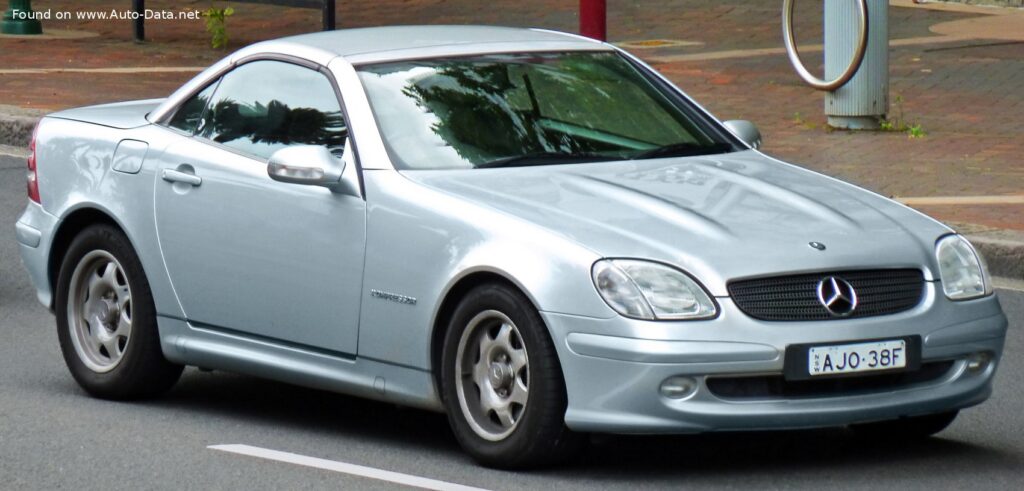
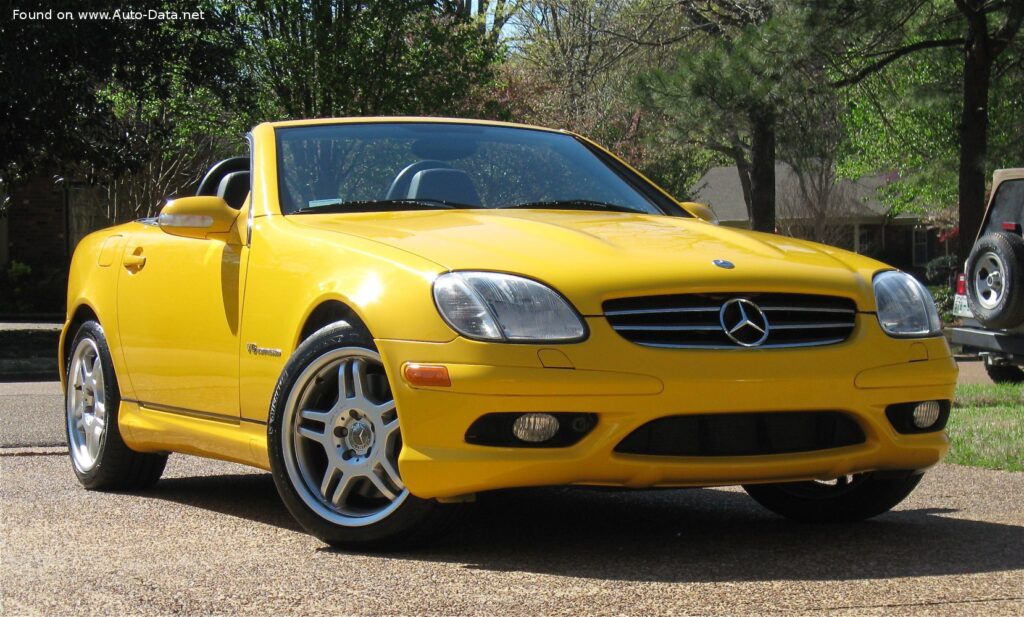
The R170 generation of the SLK was a two-door, two-seat roadster, and the 2000 facelift brought subtle yet impactful enhancements to its already distinctive styling. The original R170, launched in 1996, was celebrated for its crisp, modern lines and aggressive stance, drawing inspiration from Mercedes-Benz’s racing heritage. The facelift introduced updated front and rear bumpers, redesigned side skirts, and new clear-lens headlights and taillights, giving the car a more contemporary and refined appearance. New wheel designs were also part of the package, enhancing its sporty demeanor.
The interior of the SLK 230 Kompressor (R170 facelift) maintained Mercedes-Benz’s reputation for quality and ergonomics. While compact, the cabin was well-appointed with premium materials. The most celebrated feature, the “Vario-roof” retractable hardtop, could transform the car from a secure coupe to an open-air roadster in just 25 seconds, operated by a simple button. This innovation significantly increased the car’s versatility and appeal, offering enhanced security, weather protection, and noise isolation compared to traditional soft-top convertibles. Standard features included air conditioning, power windows, and a premium audio system. Safety was also a priority, with the SLK featuring anti-lock brakes (ABS), front airbags, and side airbags, reflecting Mercedes-Benz’s commitment to occupant protection.
Technical Specifications: Mercedes-Benz SLK (R170, facelift 2000) SLK 230 Kompressor (197 Hp) Automatic
| Category | Specification |
|---|---|
| General Information | |
| Brand | Mercedes-Benz |
| Model | SLK |
| Generation | SLK (R170, facelift 2000) |
| Type (Engine) | SLK 230 Kompressor (197 Hp) Automatic |
| Start of Production | February, 2000 |
| End of Production | April, 2004 |
| Powertrain Architecture | Internal Combustion engine |
| Body Type | Roadster |
| Seats | 2 |
| Doors | 2 |
| Performance Specs | |
| Fuel Consumption (Urban NEDC) | 13.5 l/100 km (17.4 US mpg) |
| Fuel Consumption (Extra Urban NEDC) | 7 l/100 km (33.6 US mpg) |
| Fuel Consumption (Combined NEDC) | 9.4 l/100 km (25 US mpg) |
| CO2 Emissions (NEDC) | 226 g/km |
| Fuel Type | Petrol (Gasoline) |
| Acceleration 0 – 60 mph | 6.8 sec |
| Acceleration 0 – 100 km/h | 7.2 sec |
| Maximum Speed | 237 km/h (147.26 mph) |
| Emission Standard | Euro 4 |
| Weight-to-Power Ratio | 6.6 kg/Hp (150.4 Hp/tonne) |
| Weight-to-Torque Ratio | 4.7 kg/Nm (213.7 Nm/tonne) |
| Engine Specs | |
| Power | 197 Hp @ 5300 rpm |
| Power per Liter | 85.8 Hp/l |
| Torque | 280 Nm @ 2500-5000 rpm (206.52 lb.-ft.) |
| Engine Layout | Front, Longitudinal |
| Engine Model/Code | M 111.983 |
| Engine Displacement | 2295 cm³ (140.05 cu. in.) |
| Number of Cylinders | 4 |
| Engine Configuration | Inline |
| Cylinder Bore | 90.9 mm (3.58 in.) |
| Piston Stroke | 88.4 mm (3.48 in.) |
| Compression Ratio | 9:1 |
| Number of Valves per Cylinder | 4 |
| Fuel Injection System | Multi-port manifold injection |
| Engine Aspiration | Supercharger, Intercooler |
| Valvetrain | DOHC |
| Engine Oil Capacity | 5.5 l (5.81 US qt) |
| Coolant Capacity | 8 l (8.45 US qt) |
| Space, Volume and Weights | |
| Kerb Weight | 1310 kg (2888.06 lbs.) |
| Max. Weight | 1645 kg (3626.6 lbs.) |
| Max Load | 335 kg (738.55 lbs.) |
| Trunk (boot) Space – Minimum | 145 l (5.12 cu. ft.) |
| Trunk (boot) Space – Maximum | 348 l (12.29 cu. ft.) |
| Fuel Tank Capacity | 60 l (15.85 US gal) |
| Max. Roof Load | 30 kg (66.14 lbs.) |
| Dimensions | |
| Length | 4010 mm (157.87 in.) |
| Width | 1715 mm (67.52 in.) |
| Height | 1279 mm (50.35 in.) |
| Wheelbase | 2400 mm (94.49 in.) |
| Front Track | 1488 mm (58.58 in.) |
| Rear (Back) Track | 1485 mm (58.46 in.) |
| Drag Coefficient (Cd) | 0.33 |
| Minimum Turning Circle | 10.6 m (34.78 ft.) |
| Drivetrain, Brakes and Suspension Specs | |
| Drivetrain Architecture | The Internal combustion engine (ICE) drives the rear wheels of the vehicle. |
| Drive Wheel | Rear wheel drive |
| Number of Gears and Type of Gearbox | 5 gears, automatic transmission |
| Front Suspension | Coil spring, Double wishbone, Transverse stabilizer |
| Rear Suspension | Independent multi-link suspension, Transverse stabilizer, Coil spring |
| Front Brakes | Ventilated discs |
| Rear Brakes | Disc |
| Assisting Systems | ABS (Anti-lock braking system) |
| Steering Type | Cone worm with recirculation balls |
| Power Steering | Hydraulic Steering |
| Front Wheel Tires | 205/55 R 16 91 V |
| Rear Wheel Tires | 225/50 R 16 92 V |
| Front Wheel Rims | 7 J x 16 H 2 |
| Rear Wheel Rims | 8 J x 16 H 2 |
Legacy and Market Impact of the Mercedes-Benz SLK (R170)
The Mercedes-Benz SLK (R170) made a significant splash when it debuted, and the facelifted 2000 model, including the SLK 230 Kompressor, continued to cement its legacy. It was a pivotal model for Mercedes-Benz, demonstrating the brand’s ability to innovate beyond its traditional luxury sedans and coupes. By offering a compact, stylish, and technologically advanced roadster, Mercedes-Benz successfully attracted a younger demographic and carved out a new niche in the luxury market.
The SLK’s primary competitors in its segment included the BMW Z3, Porsche Boxster, and the Audi TT Roadster. While the Z3 offered a more traditional roadster experience and the Boxster focused on pure sports car performance, the SLK distinguished itself with its unique retractable hardtop, which offered unparalleled refinement and practicality for a convertible. This “Vario-roof” became a major selling point, making the SLK a versatile daily driver that could be enjoyed year-round, regardless of weather conditions.
The SLK 230 Kompressor, in particular, was praised for its balance of performance, luxury, and relative affordability within the Mercedes-Benz lineup. Its supercharged engine provided a distinctive driving character, offering strong torque at lower RPMs, which made it enjoyable for both city driving and highway cruising. The R170 generation, especially after its 2000 facelift, matured into a highly desirable vehicle, blending Mercedes-Benz’s renowned engineering with a fun, sporty persona. It was seen as a more accessible entry into the Mercedes-Benz sports car ownership experience, contributing significantly to the brand’s image as a purveyor of diverse and innovative luxury vehicles. The success of the R170 SLK paved the way for subsequent generations, establishing the SLK as a lasting fixture in the luxury roadster segment.