Introduction to the Renault Espace III (JE, Phase II, 2000)
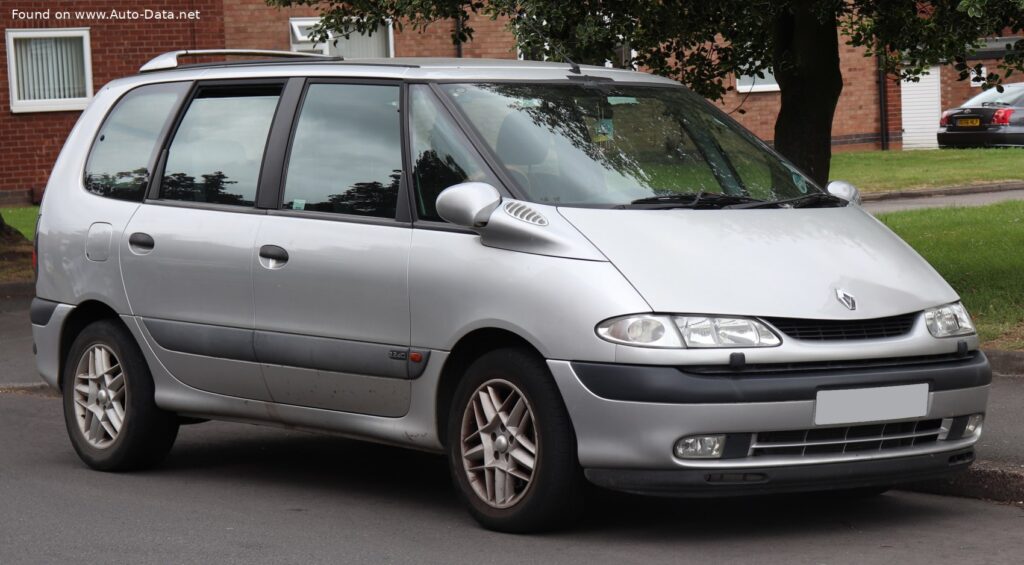
The Renault Espace holds a significant place in automotive history, particularly in Europe, as one of the pioneering and most influential multi-purpose vehicles (MPVs), commonly known as minivans in the United States. The third generation, designated as the Espace III, continued this legacy with a focus on interior flexibility, comfort, and a distinctive, futuristic design for its era. The specific variant under review, the Renault Espace III (JE, Phase II, 2000) 2.0i 16V (140 Hp), represents a mid-cycle refresh of this generation, produced from 2000 to 2002. This updated model aimed to keep the Espace competitive in an increasingly crowded European MPV segment, offering enhanced features and refined aesthetics.
Unlike many of its contemporaries, the Espace III retained a unique composite body construction, utilizing a galvanized steel chassis with non-structural composite body panels, a hallmark of its design partner, Matra. This approach contributed to its distinctive styling and resistance to minor dents and corrosion, though it was a departure from conventional steel unibody construction. Positioned as a versatile family hauler, the Espace III, especially in its 2000 Phase II iteration, offered seven-seat capacity and a highly adaptable interior, making it a popular choice for large families and those prioritizing spaciousness and modularity over traditional sedan or station wagon formats in its primary European market.
Engine and Performance of the Renault Espace III (JE, Phase II, 2000)
Powering the Renault Espace III (JE, Phase II, 2000) 2.0i 16V (140 Hp) is Renault’s F4R engine, a naturally aspirated, 2.0-liter (1998 cm³) inline four-cylinder unit. This engine, known for its robust design and smooth operation, features a DOHC (Double Overhead Camshaft) valvetrain with four valves per cylinder, totaling 16 valves. Fuel delivery is managed by a multi-port manifold injection system, providing precise fuel metering for efficiency and responsiveness.
The F4R engine in this configuration produces a respectable 140 horsepower at 5500 rpm, translating to a power output of 70.1 horsepower per liter. Torque peaks at 138.66 lb.-ft. (188 Nm) at 3750 rpm, providing ample pulling power for a vehicle of its size and intended use. This engine is mounted transversely at the front and drives the front wheels, a common and efficient layout for minivans.
Mated to a 5-speed manual transmission, the powertrain allows the Espace III to accelerate from 0 to 60 mph in a computed 11 seconds (0-100 km/h in 11.6 seconds). While not designed for outright speed, its maximum speed of 114.95 mph (185 km/h) is more than adequate for European highway cruising. The vehicle’s weight-to-power ratio stands at 11.2 kg per horsepower, or 89.5 horsepower per tonne, indicating a balanced performance profile for family transportation.
Fuel economy figures for the 2.0i 16V engine were competitive for its class at the time. The combined cycle consumption is rated at 8.9 liters per 100 kilometers, which translates to approximately 26.4 US miles per gallon. Urban consumption is 11.9 l/100 km (19.8 US mpg), and extra-urban is 7.2 l/100 km (32.7 US mpg). With CO2 emissions of 211 g/km, this model complied with the Euro 3 emission standard, a significant environmental benchmark for vehicles produced in the early 2000s. The fuel tank capacity of 20.61 US gallons (78 liters) ensured a decent range for long trips.
Design and Features
The Versatility of the Renault Espace III (JE, Phase II, 2000)
The Espace III’s design was a bold statement in its time, characterized by smooth, rounded lines and a cohesive, aerodynamic silhouette. As a minivan or MPV, its primary function was to offer maximum interior space and flexibility, and the Espace III delivered on this promise. With five doors and seating for seven passengers, it was designed from the ground up to be a practical family vehicle.
The exterior dimensions underscore its family-friendly nature: a length of 177.83 inches (4517 mm), a width of 71.26 inches (1810 mm), and a height of 69.8 inches (1773 mm). A generous wheelbase of 106.38 inches (2702 mm) contributed significantly to interior volume and a stable ride. The large glass area provided excellent visibility, a crucial safety and comfort feature for a family vehicle.
Inside, the Espace III truly shone. The innovative seating system allowed for individual seats to be removed, slid, and folded, creating a vast array of configurations. This modularity was a key selling point, enabling owners to prioritize passenger space, cargo capacity, or a balance of both. Minimum trunk space was a respectable 9.71 cubic feet (275 liters), but with the rear seats removed, this expanded to an enormous 100.65 cubic feet (2850 liters), rivaling that of many commercial vans.
For its time, the Espace III also incorporated important safety and driving assistance features. An Anti-lock Braking System (ABS) was standard, enhancing control during emergency braking. The braking system itself comprised ventilated discs at the front and solid discs at the rear, providing reliable stopping power. The steering system was a hydraulic power-assisted rack and pinion setup, offering ease of maneuverability for a vehicle of its size, particularly useful in urban environments with a minimum turning circle of 37.4 feet (11.4 meters). The vehicle rode on 205/65 R15 tires fitted to 15-inch wheel rims, providing a comfortable and compliant ride.
Suspension-wise, the Espace III featured an independent McPherson strut system with coil springs and an anti-roll bar at the front, offering good stability and handling. The rear utilized a semi-independent setup with coil springs, a common and cost-effective solution for a front-wheel-drive MPV. The maximum payload capacity was 1620.4 lbs. (735 kg), while it could tow a trailer with brakes up to 3571.49 lbs. (1620 kg), further highlighting its utility.
Technical Specifications
| Category | Specification | Value (US/Imperial) |
|---|---|---|
General Information |
||
| Brand | Renault | – |
| Model | Espace | – |
| Generation | Espace III (JE, Phase II, 2000) | – |
| Type (Engine) | 2.0i 16V (140 Hp) | – |
| Production Start | 2000 year | – |
| Production End | 2002 year | – |
| Powertrain Architecture | Internal Combustion engine | – |
| Body Type | Minivan, MPV | – |
| Seats | 7 | – |
| Doors | 5 | – |
Performance Specifications |
||
| Fuel Consumption (Urban) | 11.9 l/100 km | 19.8 US mpg |
| Fuel Consumption (Extra Urban) | 7.2 l/100 km | 32.7 US mpg |
| Fuel Consumption (Combined) | 8.9 l/100 km | 26.4 US mpg |
| CO2 Emissions | 211 g/km | – |
| Fuel Type | Petrol (Gasoline) | – |
| Acceleration 0 – 60 mph | 11 sec | – |
| Acceleration 0 – 100 km/h | 11.6 sec | – |
| Maximum Speed | 185 km/h | 114.95 mph |
| Emission Standard | Euro 3 | – |
| Weight-to-Power Ratio | 11.2 kg/Hp | 89.5 Hp/tonne |
| Weight-to-Torque Ratio | 8.3 kg/Nm | 120.1 Nm/tonne |
Engine Specifications |
||
| Power | 140 Hp @ 5500 rpm | – |
| Power per Liter | 70.1 Hp/l | – |
| Torque | 188 Nm @ 3750 rpm | 138.66 lb.-ft. @ 3750 rpm |
| Engine Layout | Front, Transverse | – |
| Engine Model/Code | F4R | – |
| Engine Displacement | 1998 cm3 | 121.93 cu. in. (2.0 Liters) |
| Number of Cylinders | 4 | – |
| Engine Configuration | Inline | – |
| Cylinder Bore | 82.7 mm | 3.26 in. |
| Piston Stroke | 93 mm | 3.66 in. |
| Compression Ratio | 9.8:1 | – |
| Valves per Cylinder | 4 | – |
| Fuel Injection System | Multi-port manifold injection | – |
| Engine Aspiration | Naturally aspirated | – |
| Valvetrain | DOHC | – |
| Engine Oil Capacity | 5.3 l | 5.6 US qt |
| Coolant Capacity | 8.8 l | 9.3 US qt |
Space, Volume, and Weights |
||
| Kerb Weight | 1565 kg | 3450.23 lbs. |
| Max. Weight | 2300 kg | 5070.63 lbs. |
| Max. Load | 735 kg | 1620.4 lbs. |
| Trunk Space (Minimum) | 275 l | 9.71 cu. ft. |
| Trunk Space (Maximum) | 2850 l | 100.65 cu. ft. |
| Fuel Tank Capacity | 78 l | 20.61 US gal |
| Max. Roof Load | 80 kg | 176.37 lbs. |
| Permitted Trailer Load (with brakes) | 1620 kg | 3571.49 lbs. |
| Permitted Trailer Load (without brakes) | 750 kg | 1653.47 lbs. |
Dimensions |
||
| Length | 4517 mm | 177.83 in. |
| Width | 1810 mm | 71.26 in. |
| Width (including mirrors) | 2070 mm | 81.5 in. |
| Height | 1773 mm | 69.8 in. |
| Wheelbase | 2702 mm | 106.38 in. |
| Front Track | 1534 mm | 60.39 in. |
| Rear Track | 1540 mm | 60.63 in. |
| Front Overhang | 929 mm | 36.57 in. |
| Rear Overhang | 886 mm | 34.88 in. |
| Ride Height (Ground Clearance) | 110 mm | 4.33 in. |
| Minimum Turning Circle | 11.4 m | 37.4 ft. |
Drivetrain, Brakes, and Suspension |
||
| Drivetrain Architecture | Internal combustion engine drives front wheels | – |
| Drive Wheel | Front wheel drive | – |
| Number of Gears | 5 | – |
| Gearbox Type | Manual transmission | – |
| Front Suspension | Independent, McPherson with coil spring and anti-roll bar | – |
| Rear Suspension | Semi-independent, coil spring | – |
| Front Brakes | Ventilated discs | – |
| Rear Brakes | Disc | – |
| Assisting Systems | ABS (Anti-lock braking system) | – |
| Steering Type | Steering rack and pinion | – |
| Power Steering | Hydraulic Steering | – |
| Tires Size | 205/65 R15 | – |
| Wheel Rims Size | 15 inches | – |
Legacy and Market Impact
The Renault Espace III (JE, Phase II, 2000) in the European Market
The Renault Espace III, particularly in its Phase II iteration from 2000, played a crucial role in solidifying Renault’s dominance in the European MPV segment. While the concept of a dedicated family minivan was pioneered by Chrysler in North America, Renault, in collaboration with Matra, brought the Espace to Europe in 1984, effectively creating the European MPV class. The third generation continued this innovative spirit, becoming a benchmark for interior flexibility and passenger comfort.
In the early 2000s, the European market for minivans was highly competitive. The Espace III faced rivals such as the Ford Galaxy/Volkswagen Sharan/SEAT Alhambra trio, the Citroën C8/Peugeot 807/Fiat Ulysse/Lancia Phedra “Eurovans,” and the Opel Zafira (a more compact 7-seater). What set the Espace apart was its unique design philosophy, including the composite body panels and its exceptional modular interior. These features contributed to its reputation as a sophisticated, practical, and family-friendly vehicle that offered a refined driving experience compared to some of its more utilitarian competitors.
The 2.0i 16V (140 Hp) variant was a popular engine choice, offering a good balance of performance and fuel economy for a vehicle of its size. It appealed to families looking for a reliable and capable engine without the higher running costs often associated with larger displacement or diesel options. Its compliance with the Euro 3 emission standard was also a selling point, signaling a commitment to environmental responsibility in an increasingly eco-conscious market.
The Espace III’s legacy is one of innovation and influence. It demonstrated that a family vehicle could be both highly practical and stylish, pushing the boundaries of interior design and modularity. While never officially imported to the United States, its impact on automotive design and the family vehicle segment in Europe was profound. It helped shape consumer expectations for what a modern family car could be, emphasizing space, versatility, and comfort above all else. Even after its production ended in 2002, paving the way for the more conventional Espace IV, the Espace III remains a testament to Renault’s daring and influential approach to vehicle design in the late 20th and early 21st centuries. Its robust engineering and thoughtful design ensured its continued presence on European roads for many years, cementing its place as an automotive icon in its segment.