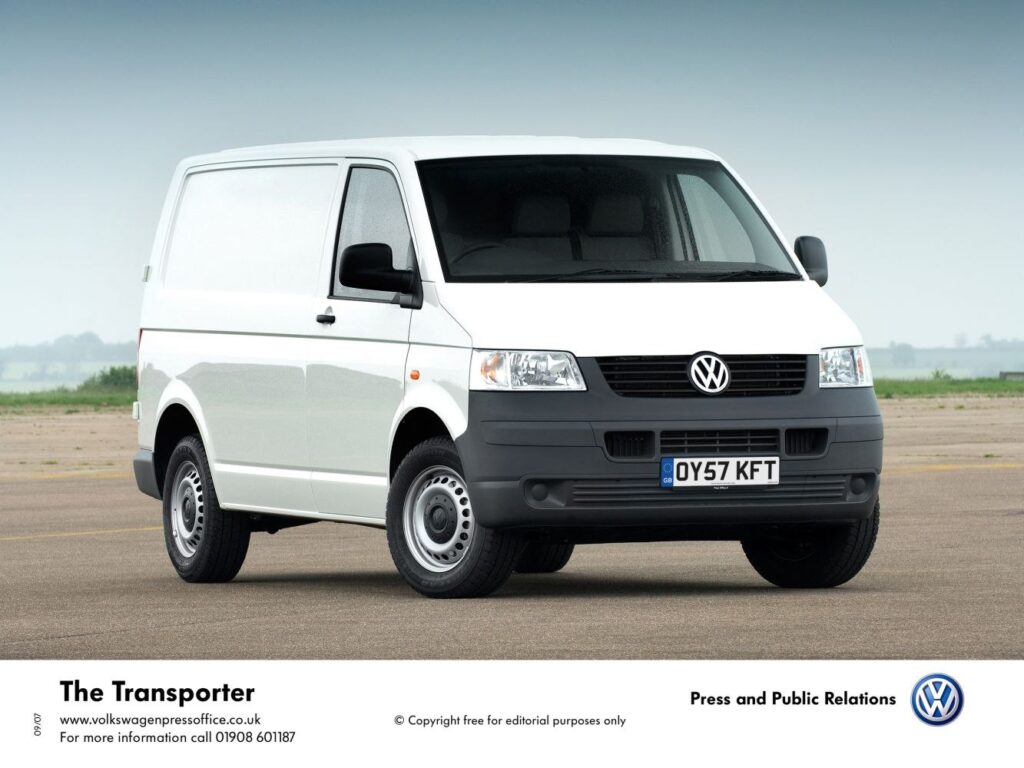
Introduction to the Volkswagen Transporter (T5) Panel Van 1.9 TDI (86 Hp) L2H3
The Volkswagen Transporter, a name synonymous with utility, reliability, and versatility in the global commercial vehicle market, entered its fifth generation (T5) in 2003. Among its many configurations, the Volkswagen Transporter (T5) Panel Van 1.9 TDI (86 Hp) L2H3 represented a core offering for businesses requiring significant cargo capacity combined with economical operation. Produced from 2003 to 2009, this specific variant was a long-wheelbase (L2) and high-roof (H3) panel van, designed to maximize internal volume for diverse commercial applications across Europe and other international markets. While the T5 generation was not officially imported into the United States, its predecessors, such as the T4 (marketed as the Eurovan), left a lasting impression, and the T5 continued Volkswagen’s tradition of building robust, front-wheel-drive vans that prioritized practicality and efficiency.
The Transporter (T5) built upon a rich heritage dating back to the iconic Type 2 “Bus” of the 1950s, evolving into a modern, sophisticated workhorse. The 1.9 TDI (Turbocharged Direct Injection) engine, a staple of Volkswagen’s powertrain lineup during this era, provided a balance of power and exceptional fuel economy, critical factors for fleet operators and small businesses. This particular L2H3 model, with its extended length and elevated roofline, was tailored for tradespeople, delivery services, and any operation demanding substantial cargo space without the bulk or operating costs of a larger truck.
Engine and Performance of the Volkswagen Transporter (T5) Panel Van 1.9 TDI (86 Hp) L2H3
At the heart of the Volkswagen Transporter (T5) Panel Van 1.9 TDI (86 Hp) L2H3 was Volkswagen’s well-regarded EA188 / AXC code 1.9-liter (1896 cm³) inline-four diesel engine. This unit was a prime example of the brand’s commitment to diesel technology, featuring a SOHC (Single Overhead Camshaft) valvetrain with two valves per cylinder and a sophisticated Pump-nozzle (Unit Injector) fuel injection system. Coupled with a turbocharger and intercooler, this setup was engineered to deliver strong low-end torque and impressive fuel efficiency, rather than outright speed.
The engine produced a modest but highly usable 86 horsepower at 3500 rpm, which, when combined with 200 Nm (147.51 lb-ft) of torque available across a broad range from 1600 to 2400 rpm, made the van highly capable of carrying heavy loads and navigating urban environments. The torque-to-weight ratio of 106.4 Nm per tonne underscored its practical hauling ability. Power was transmitted to the front wheels via a robust 5-speed manual transmission, a common and reliable choice for commercial vehicles of this class, optimizing both control and fuel economy.
While acceleration figures might seem leisurely by passenger car standards—0 to 62 mph (100 km/h) in 24.7 seconds, and a calculated 0-60 mph in 23.5 seconds—they were perfectly adequate for a commercial vehicle designed for utility. The top speed of 84.51 mph (136 km/h) ensured it could handle highway cruising, albeit without setting any speed records. Fuel economy was a significant selling point, with an extra-urban consumption figure of 7 liters per 100 km, translating to a respectable 33.6 US mpg. This efficiency, combined with an 80-liter (21.13 US gallon) fuel tank, provided an excellent operating range, reducing downtime for refueling and lowering running costs for businesses.
Design and Features of the Volkswagen Transporter (T5) Panel Van 1.9 TDI (86 Hp) L2H3
The Volkswagen Transporter (T5) Panel Van 1.9 TDI (86 Hp) L2H3 was designed with a clear focus on functionality and durability. Its panel van body type, characterized by windowless sides in the cargo area, emphasized security and maximum usable interior space. The “L2H3” designation was crucial: L2 indicated a long wheelbase of 133.86 inches (3400 mm), providing a stable platform and ample internal length, while H3 signified a high roof, dramatically increasing the cargo volume. With a maximum trunk (boot) space of 9300 liters (328.43 cubic feet), this Transporter variant offered exceptional capacity for its class, making it ideal for large deliveries, mobile workshops, or extensive equipment transport.
Measuring 208.27 inches (5290 mm) in length, 74.96 inches (1904 mm) in width (88.27 inches including mirrors), and a towering 96.85 inches (2460 mm) in height, the L2H3 commanded presence and offered cavernous interior dimensions. Despite its size, a turning circle of 43.31 feet (13.2 meters) aided maneuverability in urban settings. The robust build was evident in its kerb weight, ranging from 4144.69 to 4592.23 lbs (1880-2083 kg), and a substantial maximum payload capacity of 2021.64 – 2028.25 lbs (917-920 kg). Furthermore, it boasted impressive towing capabilities, rated for a permitted trailer load with brakes (12%) of 4850.17 lbs (2200 kg).
In terms of driver comfort and safety, the T5 featured a practical cabin with 2-3 seats, designed for long hours of operation. The suspension system, with an independent McPherson setup with coil springs and an anti-roll bar at the front, and an independent coil spring with a transverse stabilizer and trailing arm at the rear, provided a comfortable ride for a commercial vehicle and stable handling, even when fully loaded. Braking was handled by ventilated discs at both the front (308×29.5 mm) and rear (294×22 mm), augmented by an Anti-lock Braking System (ABS) for enhanced safety. Hydraulic power steering, coupled with a steering rack and pinion, ensured responsive and manageable steering, crucial for navigating tight city streets and parking lots. Standard tire sizes were 205/65 R16 or 215/65 R16 on 6.5J x 16 steel wheels, providing durability and load-bearing capability.
Technical Specifications
| Category | Specification | US Equivalent / Notes |
|---|---|---|
| General Information | ||
| Brand | Volkswagen | |
| Model | Transporter | |
| Generation | Transporter (T5) Panel Van | |
| Type (Engine) | 1.9 TDI (86 Hp) L2H3 | |
| Production Start | 2003 year | |
| Production End | 2009 year | |
| Powertrain Architecture | Internal Combustion engine | |
| Body Type | Van | |
| Seats | 2-3 | |
| Doors | 4-5 | |
| Performance Specifications | ||
| Fuel Consumption (extra urban) | 7 l/100 km | 33.6 US mpg |
| Fuel Type | Diesel | |
| Acceleration 0 – 100 km/h | 24.7 sec | |
| Acceleration 0 – 62 mph | 24.7 sec | |
| Acceleration 0 – 60 mph (Calculated) | 23.5 sec | |
| Maximum Speed | 136 km/h | 84.51 mph |
| Emission Standard | Euro 3 | |
| Weight-to-Power Ratio | 21.9 kg/Hp | 45.7 Hp/tonne |
| Weight-to-Torque Ratio | 9.4 kg/Nm | 106.4 Nm/tonne |
| Engine Specifications | ||
| Power | 86 Hp @ 3500 rpm. | |
| Power per liter | 45.4 Hp/l | |
| Torque | 200 Nm @ 1600-2400 rpm. | 147.51 lb-ft @ 1600-2400 rpm. |
| Engine Layout | Front, Transverse | |
| Engine Model/Code | EA188 / AXC | |
| Engine Displacement | 1896 cm³ | 1.9 liters / 115.7 cu. in. |
| Number of Cylinders | 4 | |
| Engine Configuration | Inline | |
| Cylinder Bore | 79.5 mm | 3.13 in. |
| Piston Stroke | 95.5 mm | 3.76 in. |
| Compression Ratio | 18:1 | |
| Number of Valves per Cylinder | 2 | |
| Fuel Injection System | Pump-nozzle (Unit Injector) | |
| Engine Aspiration | Turbocharger, Intercooler | |
| Valvetrain | SOHC | |
| Engine Oil Capacity | 5.8 l | 6.13 US qt |
| Coolant Capacity | 7.1 l | 7.5 US qt |
| Space, Volume, and Weights | ||
| Kerb Weight | 1880-2083 kg | 4144.69 – 4592.23 lbs. |
| Max. Weight | 2800-3000 kg | 6172.94 – 6613.87 lbs. |
| Max Load | 917-920 kg | 2021.64 – 2028.25 lbs. |
| Trunk (boot) Space – maximum | 9300 l | 328.43 cu. ft. |
| Fuel Tank Capacity | 80 l | 21.13 US gal |
| Permitted Trailer Load with Brakes (8%) | 2500 kg | 5511.56 lbs. |
| Permitted Trailer Load with Brakes (12%) | 2200 kg | 4850.17 lbs. |
| Permitted Trailer Load without Brakes | 750 kg | 1653.47 lbs. |
| Permitted Towbar Download | 100 kg | 220.46 lbs. |
| Dimensions | ||
| Length | 5290 mm | 208.27 in. |
| Width | 1904 mm | 74.96 in. |
| Width including mirrors | 2242 mm | 88.27 in. |
| Height | 2460 mm | 96.85 in. |
| Wheelbase | 3400 mm | 133.86 in. |
| Front Track | 1628 mm | 64.09 in. |
| Rear (Back) Track | 1628 mm | 64.09 in. |
| Front Overhang | 894 mm | 35.2 in. |
| Rear Overhang | 996 mm | 39.21 in. |
| Ride Height (Ground Clearance) | 165 mm | 6.5 in. |
| Minimum Turning Circle (diameter) | 13.2 m | 43.31 ft. |
| Approach Angle | 22° | |
| Departure Angle | 16° | |
| Wading Depth | 300 mm | 11.81 in. |
| Drivetrain, Brakes, and Suspension Specifications | ||
| Drivetrain Architecture | Internal combustion engine drives front wheels. | Front-wheel drive |
| Drive Wheel | Front wheel drive | |
| Number of Gears and Type of Gearbox | 5 gears, manual transmission | |
| Front Suspension | Independent, McPherson with coil spring and anti-roll bar | |
| Rear Suspension | Independent coil spring, Transverse stabilizer, Trailing arm | |
| Front Brakes | Ventilated discs, 308×29.5 mm | |
| Rear Brakes | Ventilated discs, 294×22 mm | |
| Assisting Systems | ABS (Anti-lock braking system) | |
| Steering Type | Steering rack and pinion | |
| Power Steering | Hydraulic Steering | |
| Tire Sizes | 205/65 R16; 215/65 R16 | |
| Wheel Rims Size | 6.5J x 16 | |
Legacy and Market Impact of the Volkswagen Transporter (T5) Panel Van
The Volkswagen Transporter (T5) Panel Van 1.9 TDI (86 Hp) L2H3, like its many siblings in the T5 range, continued the Transporter’s formidable legacy as a dominant force in the European and international light commercial vehicle (LCV) segments. Despite not being sold in the United States, its impact was profound in markets where commercial vans are the backbone of countless businesses. The T5 generation, and specifically this panel van variant, solidified Volkswagen’s reputation for producing highly durable, practical, and cost-effective vehicles for commercial use.
Its primary market was Europe, where it faced stiff competition from rivals such as the Ford Transit, Mercedes-Benz Vito, Renault Trafic (Opel Vivaro/Nissan Primastar), and Fiat Ducato. What set the Transporter apart was its car-like driving dynamics, a trait inherited from its passenger-oriented Multivan and California variants, combined with robust commercial capabilities. The 1.9 TDI engine, even in its 86 HP configuration, was lauded for its longevity and excellent real-world fuel economy, crucial for reducing total cost of ownership for fleet managers. Its Euro 3 emission standard was competitive for its time, reflecting a balance between environmental considerations and commercial practicality.
The L2H3 configuration, with its extended length and high roof, was particularly popular among tradesmen, couriers, and logistics companies who needed to transport bulky items or substantial volumes of goods. Its generous cargo capacity, coupled with the ability to carry a significant payload and tow heavy trailers, made it an indispensable tool for a wide array of professions. The independent suspension system, a rarity in some commercial vehicles, contributed to a more comfortable ride and better handling, reducing driver fatigue on long routes.
The T5 Transporter enjoyed strong resale values, a testament to its perceived reliability and build quality. Its modular design allowed for extensive customization, from shelving systems to refrigeration units, further enhancing its appeal to diverse businesses. The Transporter’s success wasn’t just about its technical specifications; it was about Volkswagen’s understanding of the commercial vehicle user’s needs – a vehicle that could withstand the rigors of daily work, be economical to run, and offer a comfortable, practical workspace. The 1.9 TDI (86 Hp) L2H3 variant perfectly embodied these principles, cementing the T5’s place as a truly iconic and impactful commercial vehicle in its era.