The Seat Ibiza IV ST (facelift 2012) FR 1.4 TSI (150 Hp) DSG: A Dynamic European Compact Wagon
The Seat Ibiza IV ST (facelift 2012) FR 1.4 TSI (150 Hp) DSG represents a compelling blend of practicality, performance, and style within the European B-segment. Launched as part of the fourth generation Ibiza’s mid-cycle refresh in 2012, this particular variant, the “ST” (Sport Tourer) station wagon, combined the versatility of an estate body with the sporty credentials of the “FR” (Formula Racing) trim. Seat, the Spanish marque under the Volkswagen Group umbrella, has consistently aimed to inject a more emotional and youthful appeal into its vehicles compared to its German and Czech siblings (Volkswagen and Skoda). The Ibiza, as Seat’s long-standing compact offering, plays a crucial role in its European market strategy, providing an accessible entry point to the brand’s sporty ethos.
While never officially sold in the United States, the Ibiza IV ST (facelift 2012) FR 1.4 TSI (150 Hp) DSG was a significant player in markets like Spain, Germany, the UK, and Italy. It offered European consumers a more engaging alternative to its platform-mates, the Volkswagen Polo and Skoda Fabia, especially in this performance-oriented station wagon configuration. The facelift introduced subtle but effective styling updates, enhancing its contemporary look and aligning it with Seat’s evolving design language. This model, produced from 2012 to 2015, showcased advanced powertrain technology for its class, making it a noteworthy example of European compact engineering.
Engine and Performance: The Advanced FR 1.4 TSI (150 Hp) DSG Powertrain
At the heart of the Seat Ibiza IV ST (facelift 2012) FR 1.4 TSI (150 Hp) DSG lies a sophisticated 1.4-liter (1390 cm3 or 84.82 cu. in.) inline-four gasoline engine, designated with codes such as CAVF, CNUB, CTHF, or CTJB. This particular engine is a prime example of Volkswagen Group’s “Twincharger” technology, featuring both turbocharging and supercharging. This innovative setup was designed to deliver strong low-end torque from the supercharger, effectively eliminating turbo lag, while the turbocharger took over at higher RPMs to provide sustained power. The result was a remarkably flexible and potent engine for its displacement.
The engine produces a healthy 150 horsepower at 5800 rpm, translating to an impressive power-per-liter figure of 107.9 Hp/l. Torque output is equally robust, peaking at 220 Nm (162.26 lb.-ft.) across a broad range from 1250 to 4500 rpm. This wide torque band contributes significantly to the car’s responsive and engaging driving experience. Power is sent to the front wheels via a quick-shifting 7-speed automatic DSG (Direct-Shift Gearbox) transmission, a dual-clutch unit renowned for its rapid gear changes and efficiency.
Performance figures for the Ibiza FR 1.4 TSI are quite respectable for a compact station wagon. It can accelerate from 0 to 60 mph in a brisk 7.6 seconds (0-100 km/h in 8 seconds) and reach a top speed of 131.73 mph (212 km/h). Despite its sporty demeanor, the Twincharger engine and DSG transmission also contributed to decent fuel economy. The combined fuel consumption is rated at 39.9 US mpg (5.9 l/100 km), with CO2 emissions of 139 g/km, meeting Euro 5 emission standards. This balance of performance and efficiency was a key selling point in the European market, where fuel costs and emissions regulations are significant factors. The engine features direct fuel injection, a 10:1 compression ratio, and a 4-valve per cylinder configuration, all contributing to its efficient combustion.
Design and Features: Sporty Practicality
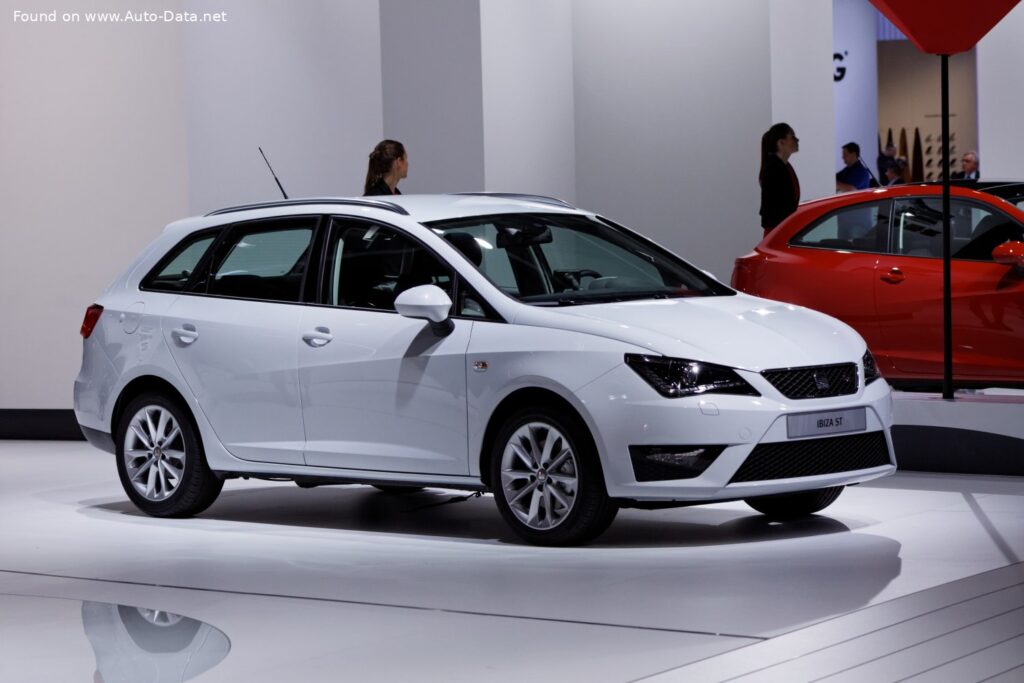
The Seat Ibiza IV ST (facelift 2012) FR 1.4 TSI (150 Hp) DSG adopted a 5-door station wagon (estate) body type, which Seat branded as “Sport Tourer” (ST). This body style offered a significant increase in practicality over the standard Ibiza hatchback, providing 430 liters (15.19 cu. ft.) of minimum trunk space. This made it an attractive option for young families or individuals needing more cargo capacity without sacrificing the compact dimensions suitable for urban European environments. The exterior design, refreshed in 2012, featured sharper lines, redesigned headlights and taillights, and a more aggressive front fascia that accentuated its sporty character.
The “FR” trim level further enhanced its visual and dynamic appeal. Externally, this typically included sportier bumpers, unique alloy wheels (7.0J x 17 with 215/40 R17 tires), and FR badging. Inside, the FR trim usually meant sport seats, a leather-wrapped steering wheel, and specific interior accents that underscored its performance orientation. The Ibiza ST’s dimensions were compact, with a length of 166.93 inches (4240 mm), a width of 66.65 inches (1693 mm), and a height of 66.65 inches (1693 mm), making it agile and easy to maneuver, with a minimum turning circle of 34.38 feet (10.48 m).
Underneath, the Ibiza featured an independent McPherson strut front suspension with coil springs and an anti-roll bar, paired with a semi-independent coil spring rear suspension. This setup provided a good balance of comfort and handling, with the FR trim likely benefiting from a slightly firmer tune for enhanced agility. Braking was handled by ventilated discs at the front and solid discs at the rear, complemented by an Anti-lock Braking System (ABS) for improved safety. The steering system was a responsive rack and pinion type, contributing to the car’s engaging driving dynamics. With a kerb weight of 2821.92 lbs (1280 kg), the power-to-weight ratio stood at 117.2 Hp/tonne, indicating a lively performance for its class.
Technical Specifications
| Category | Specification |
|---|---|
| General Information | |
| Brand | Seat |
| Model | Ibiza |
| Generation | Ibiza IV ST (facelift 2012) |
| Type (Engine) | FR 1.4 TSI (150 Hp) DSG |
| Start of Production | 2012 year |
| End of Production | 2015 year |
| Powertrain Architecture | Internal Combustion Engine |
| Body type | Station wagon (estate) |
| Seats | 5 |
| Doors | 5 |
| Performance Specs | |
| Fuel consumption (economy) – urban | 7.5 l/100 km (31.4 US mpg) |
| Fuel consumption (economy) – extra urban | 5.1 l/100 km (46.1 US mpg) |
| Fuel consumption (economy) – combined | 5.9 l/100 km (39.9 US mpg) |
| CO2 emissions | 139 g/km |
| Fuel Type | Petrol (Gasoline) |
| Acceleration 0 – 60 mph | 7.6 seconds |
| Acceleration 0 – 100 km/h | 8 seconds |
| Maximum speed | 212 km/h (131.73 mph) |
| Emission standard | Euro 5 |
| Weight-to-power ratio | 8.5 kg/Hp (117.2 Hp/tonne) |
| Weight-to-torque ratio | 5.8 kg/Nm (171.9 Nm/tonne) |
| Engine Specs | |
| Power | 150 Hp @ 5800 rpm |
| Power per liter | 107.9 Hp/l |
| Torque | 220 Nm (162.26 lb.-ft.) @ 1250-4500 rpm |
| Engine layout | Front, Transverse |
| Engine Model/Code | CAVF, CNUB, CTHF, CTJB |
| Engine displacement | 1390 cm3 (84.82 cu. in.) |
| Number of cylinders | 4 |
| Engine configuration | Inline |
| Cylinder Bore | 76.5 mm (3.01 in.) |
| Piston Stroke | 75.6 mm (2.98 in.) |
| Compression ratio | 10:1 |
| Number of valves per cylinder | 4 |
| Fuel injection system | Direct injection |
| Engine aspiration | Turbocharging and Supercharger, Intercooler |
| Engine oil capacity | 3.6 l (3.8 US qt) |
| Coolant | 5.6 l (5.92 US qt) |
| Space, Volume and Weights | |
| Kerb Weight | 1280 kg (2821.92 lbs) |
| Max. weight | 1735 kg (3825.02 lbs) |
| Max load | 455 kg (1003.1 lbs) |
| Trunk (boot) space – minimum | 430 l (15.19 cu. ft.) |
| Fuel tank capacity | 45 l (11.89 US gal) |
| Dimensions | |
| Length | 4240 mm (166.93 in.) |
| Width | 1693 mm (66.65 in.) |
| Height | 1693 mm (66.65 in.) |
| Wheelbase | 2469 mm (97.2 in.) |
| Front track | 1465 mm (57.68 in.) |
| Rear (Back) track | 1457 mm (57.36 in.) |
| Minimum turning circle (turning diameter) | 10.48 m (34.38 ft.) |
| Drivetrain, Brakes and Suspension Specs | |
| Drivetrain Architecture | The Internal combustion engine (ICE) drives the front wheels of the vehicle. |
| Drive wheel | Front wheel drive |
| Number of gears and type of gearbox | 7 gears, automatic transmission DSG |
| Front suspension | Independent, type McPherson with coil spring and anti-roll bar |
| Rear suspension | Semi-independent, coil spring |
| Front brakes | Ventilated discs |
| Rear brakes | Disc |
| Assisting systems | ABS (Anti-lock braking system) |
| Steering type | Steering rack and pinion |
| Tires size | 215/40 R17 |
| Wheel rims size | 7.0J x 17 |
Legacy and Market Impact of the Seat Ibiza IV ST (facelift 2012) FR 1.4 TSI (150 Hp) DSG
The Seat Ibiza has long been a cornerstone of the Spanish brand’s success, particularly in Europe. The fourth-generation, and specifically the facelifted 2012 model in its ST (Sport Tourer) and FR (Formula Racing) guise with the advanced 1.4 TSI engine, carved out a distinct niche in the highly competitive European B-segment. In this market, it faced formidable rivals such as its platform siblings, the Volkswagen Polo and Skoda Fabia, as well as other popular compacts like the Ford Fiesta, Renault Clio, and Opel Corsa. What set the Ibiza FR ST apart was its unique combination of sporty styling, engaging driving dynamics, and the enhanced practicality of a station wagon.
Seat’s brand identity within the Volkswagen Group is often characterized by its focus on design, sportiness, and a youthful appeal. The Ibiza FR 1.4 TSI (150 Hp) DSG perfectly embodied this philosophy. Its punchy twin-charged engine, paired with the responsive DSG transmission, offered a driving experience that was arguably more spirited than many of its direct competitors, especially those without a dedicated performance variant. The FR trim level, in particular, attracted buyers who wanted a car that looked and felt dynamic without making the leap to a full-blown hot hatch.
The decision to offer a performance-oriented station wagon in this segment was also a smart move, catering to a demographic that needed more space but wasn’t willing to compromise on driving enjoyment. The Ibiza ST provided a practical solution for active lifestyles, offering ample cargo volume for luggage, sports equipment, or family necessities, while still being nimble enough for city driving and enjoyable on winding roads.
Historically, the 1.4 TSI Twincharger engine, while innovative and powerful for its size, did face some reliability concerns in earlier iterations, which the facelifted models generally addressed through revisions. Nevertheless, its technological prowess and ability to deliver both strong performance and reasonable fuel economy were undeniable. The engine’s advanced design, combining both supercharging and turbocharging, was a testament to the engineering capabilities of the Volkswagen Group at the time, pushing the boundaries of what small-displacement engines could achieve.
Ultimately, the Seat Ibiza IV ST (facelift 2012) FR 1.4 TSI (150 Hp) DSG cemented the Ibiza’s reputation as a stylish, dynamic, and versatile compact car. It demonstrated Seat’s ability to imbue its vehicles with a distinctive character, offering a compelling alternative for European buyers seeking a blend of sportiness and everyday usability in a compact package. Its legacy lies in its contribution to shaping Seat’s image as the “emotional” brand of the Volkswagen Group and showcasing advanced powertrain technology in an accessible segment.