The Volvo V60 I (2013 Facelift): A Refined Swedish Estate
The Volvo V60 I (2013 facelift) represents a significant evolution of Volvo’s first-generation premium compact executive wagon, a vehicle that masterfully blended Scandinavian design, renowned safety, and practical utility. Introduced as part of a comprehensive refresh for the 2014 model year, and in this specific 2.0 T4 (190 Hp) configuration from 2015 to 2018, this iteration of the V60 solidified its position as a sophisticated and family-friendly alternative in a segment often dominated by German rivals. While the V60 was available globally, this particular powertrain, with its efficient 2.0-liter turbocharged engine paired with a manual transmission, was a popular and well-regarded choice, particularly in European markets, where it offered a compelling balance of performance, fuel economy, and driver engagement.
Engine and Performance: The Drive-E T4 Powertrain
At the heart of the 2015-2018 Volvo V60 I (2013 facelift) 2.0 T4 lies Volvo’s advanced Drive-E powertrain, an inline four-cylinder engine designed for optimal efficiency and responsive performance. Codenamed B4204T19, this 2.0-liter (1969 cm3 or 120.16 cu. in.) gasoline engine features direct injection and is boosted by a turbocharger and intercooler, ensuring robust power delivery across a wide rev range. It produces a healthy 190 horsepower at 4700 rpm, translating to an impressive 96.5 horsepower per liter.
More notably, the engine delivers a substantial 221.27 lb.-ft. of torque, available from a remarkably low 1300 rpm and sustained up to 4000 rpm. This broad torque band is crucial for real-world driving, providing strong acceleration from a standstill and effortless overtaking capabilities. Paired with a precise 6-speed manual transmission, this front-wheel-drive configuration offers an engaging driving experience. The V60 2.0 T4 accelerates from 0 to 60 mph in a brisk 6.9 seconds and can reach a top speed of 139.81 mph.
Despite its spirited performance, the Drive-E engine is also engineered for efficiency. It boasts a combined fuel economy rating of 40.6 US mpg (5.8 liters per 100 km), an impressive figure for a premium wagon of its size and power. This efficiency is further underscored by its CO2 emissions of 135 g/km, reflecting Volvo’s commitment to environmental responsibility. The engine’s DOHC valvetrain and a compression ratio of 11.3:1 contribute to its refined operation and strong thermodynamic efficiency.
Design and Features: Scandinavian Practicality and Safety
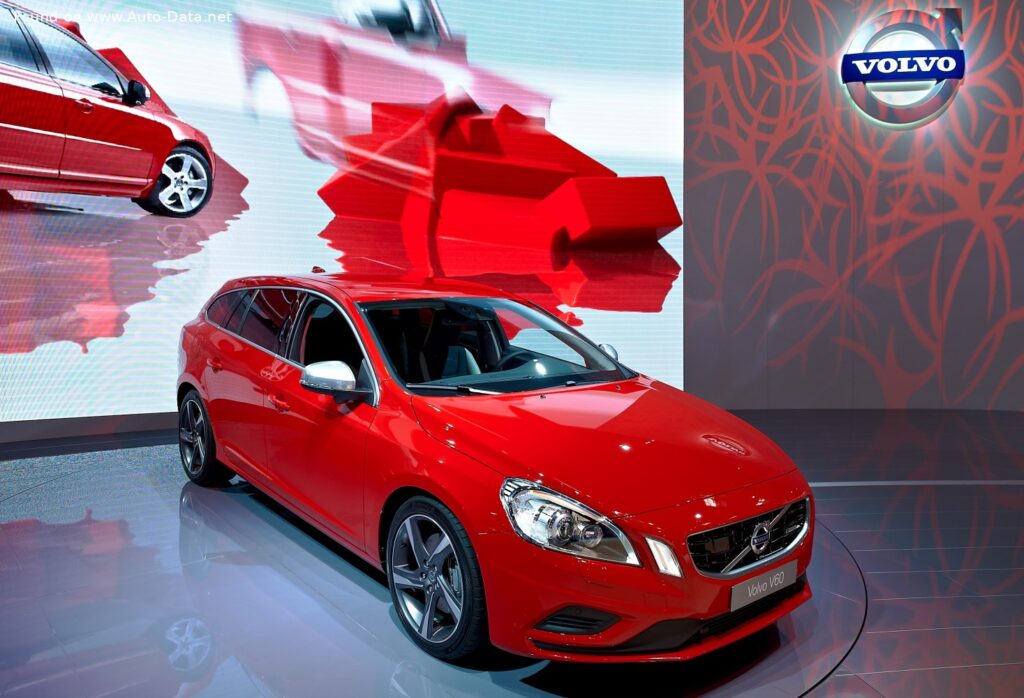
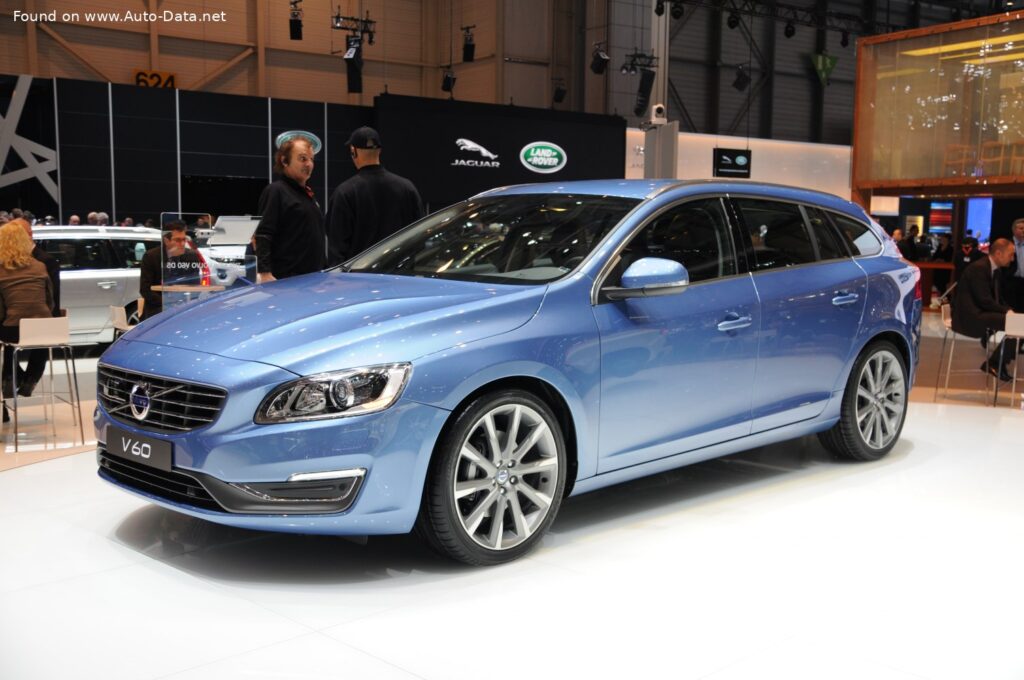
The Volvo V60 I (2013 facelift) maintained its distinctive profile as a five-door, five-seat station wagon, or “estate” as it’s known in Europe. The facelift introduced several aesthetic enhancements, including a redesigned front fascia with a wider grille, updated headlights, and new LED daytime running lights, giving the V60 a more contemporary and assertive presence. The overall design language remained true to Volvo’s Scandinavian roots: clean, elegant, and functional, eschewing overt flashiness for understated sophistication.
Measuring 182.48 inches in length, 74.76 inches in width, and 58.43 inches in height, with a wheelbase of 109.29 inches, the V60 strikes a balance between maneuverability and interior space. While some competitors offered slightly larger cargo areas, the V60’s 15.19 cubic feet (430 liters) of trunk space was practical for daily use and expandable with the rear seats folded. The interior continued Volvo’s tradition of ergonomic design and high-quality materials, with comfortable seating and intuitive controls.
Volvo’s unwavering commitment to safety is a hallmark of the V60. While the provided data specifically mentions ABS (Anti-lock Braking System) and ventilated disc brakes at the front with solid discs at the rear, the V60 of this era was equipped with a comprehensive suite of active and passive safety features. These typically included City Safety (Volvo’s low-speed collision avoidance system), pedestrian detection, blind-spot information system (BLIS), lane-keeping aid, and a robust passenger cell designed to protect occupants in various collision scenarios. The independent McPherson front suspension with coil springs and an anti-roll bar, combined with an independent coil spring rear suspension, contributed to a comfortable and stable ride, while the rack and pinion steering provided precise control.
Technical Specifications
| Category | Specification |
|---|---|
| General Information | |
| Brand | Volvo |
| Model | V60 |
| Generation | V60 I (2013 facelift) |
| Type (Engine) | 2.0 T4 (190 Hp) |
| Start of Production | 2015 year |
| End of Production | 2018 year |
| Powertrain Architecture | Internal Combustion Engine |
| Body Type | Station wagon (estate) |
| Seats | 5 |
| Doors | 5 |
| Performance Specs | |
| Fuel Consumption (Combined) | 40.6 US mpg (5.8 l/100 km) |
| CO2 Emissions | 135 g/km |
| Fuel Type | Petrol (Gasoline) |
| Acceleration 0-60 mph | 6.9 sec |
| Acceleration 0-100 km/h | 7.3 sec |
| Maximum Speed | 139.81 mph (225 km/h) |
| Engine Specs | |
| Power | 190 Hp @ 4700 rpm |
| Power per liter | 96.5 Hp/l |
| Torque | 221.27 lb.-ft. @ 1300-4000 rpm (300 Nm) |
| Engine Layout | Front, Transverse |
| Engine Model/Code | B4204T19 |
| Engine Displacement | 120.16 cu. in. (1969 cm3) |
| Number of Cylinders | 4 |
| Engine Configuration | Inline |
| Cylinder Bore | 3.23 in. (82 mm) |
| Piston Stroke | 3.67 in. (93.2 mm) |
| Compression Ratio | 11.3:1 |
| Valves per Cylinder | 4 |
| Fuel Injection System | Direct Injection |
| Engine Aspiration | Turbocharger, Intercooler |
| Valvetrain | DOHC |
| Engine Oil Capacity | 6.23 US qt (5.9 l) |
| Coolant Capacity | 8.77 US qt (8.3 l) |
| Space, Volume and Weights | |
| Trunk (Boot) Space – Minimum | 15.19 cu. ft. (430 l) |
| Fuel Tank Capacity | 17.83 US gal (67.5 l) |
| Dimensions | |
| Length | 182.48 in. (4635 mm) |
| Width | 74.76 in. (1899 mm) |
| Height | 58.43 in. (1484 mm) |
| Wheelbase | 109.29 in. (2776 mm) |
| Front Track | 62.52 – 62.13 in. (1588-1578 mm) |
| Rear (Back) Track | 62.4 – 62.01 in. (1585-1575 mm) |
| Ride Height (Ground Clearance) | 5.35 in. (136 mm) |
| Minimum Turning Circle | 37.73 – 40.68 ft. (11.5 – 12.4 m) |
| Drivetrain, Brakes and Suspension Specs | |
| Drivetrain Architecture | Front-wheel drive (ICE drives front wheels) |
| Drive Wheel | Front-wheel drive |
| Number of Gears and Type of Gearbox | 6 gears, Manual Transmission |
| Front Suspension | Independent, McPherson with coil spring and anti-roll bar |
| Rear Suspension | Independent coil spring |
| Front Brakes | Ventilated discs |
| Rear Brakes | Disc |
| Assisting Systems | ABS (Anti-lock Braking System) |
| Steering Type | Steering rack and pinion |
Legacy and Market Impact of the Volvo V60 I (2013 Facelift)
The Volvo V60 I (2013 facelift) played a crucial role in Volvo’s product lineup, serving as a compelling option in the competitive premium compact executive segment. While the V60 was sold in North America, this specific 2.0 T4 (190 Hp) manual transmission variant was predominantly targeted at European markets, where its blend of efficiency, performance, and driver engagement resonated strongly with consumers. In the US, the V60 often featured more powerful engines and predominantly automatic transmissions, catering to different market preferences.
Its primary competitors included the BMW 3 Series Touring, Audi A4 Avant, and Mercedes-Benz C-Class Estate. Against these formidable German rivals, the V60 carved out its niche by offering a distinctly Swedish perspective on luxury and practicality. Volvo’s reputation for unparalleled safety was a major selling point, often surpassing competitors in standard safety equipment and innovative preventative technologies. The V60 also stood out for its comfortable ride, serene interior, and a design aesthetic that felt both contemporary and timeless.
The introduction of the Drive-E engines, like the 2.0 T4, marked a significant technological shift for Volvo. It showcased the brand’s ability to develop highly efficient, powerful, and scalable four-cylinder engines that could replace larger, less efficient five- and six-cylinder units without compromising performance. This move was pivotal in Volvo’s strategy for reducing emissions and improving fuel economy across its range, laying the groundwork for future electrification efforts.
The Volvo V60 I (2013 facelift), particularly in its 2.0 T4 configuration, is remembered as a well-rounded and sensible choice for those seeking a premium wagon. It offered a practical body style, a strong emphasis on safety, and an engaging driving experience, especially with the manual gearbox. Its legacy lies in its contribution to solidifying Volvo’s image as a leader in safety and design, and as a brand that successfully adapted its powertrain philosophy to meet modern demands for efficiency and performance, all while maintaining its unique Scandinavian identity. The V60 continued to be a beloved model, paving the way for its successors and reinforcing the enduring appeal of the premium station wagon.