The Mercedes-Benz SLK (R170): Pioneering the Modern Luxury Roadster
The Mercedes-Benz SLK, specifically the first-generation R170 chassis, marked a significant departure for the German luxury automaker when it debuted in July 1996. Positioned as a compact luxury roadster, the SLK (Sportlich, Leicht, Kurz – German for Sporty, Light, Short) was designed to offer the thrill of open-air motoring combined with Mercedes-Benz’s renowned refinement and build quality. Its most innovative feature, the electro-hydraulic “vario-roof” retractable hardtop, allowed owners to transform the car from a secure coupe to a sun-loving roadster in a mere 25 seconds, a concept that would redefine the segment and influence countless competitors.
This article focuses on the Mercedes-Benz SLK (R170) SLK 200 (136 Hp) variant, a model primarily aimed at European and other international markets where smaller engine displacements were favored due to taxation structures and fuel economy considerations. While the US market predominantly received more powerful Kompressor (supercharged) and V6 engine options, the SLK 200 played a crucial role as an accessible entry point into the SLK lineup, offering the same stylish design and groundbreaking roof technology with a focus on efficiency for its segment.
Engine and Performance of the Mercedes-Benz SLK (R170) SLK 200 (136 Hp)
Powering the Mercedes-Benz SLK (R170) SLK 200 is a naturally aspirated 2.0-liter (1998 cm³) inline-four engine, designated as the M 111.946. This engine, a staple in Mercedes-Benz’s smaller and mid-range vehicles of the era, was engineered for smooth operation and reliable performance. It features a Double Overhead Camshaft (DOHC) valvetrain with four valves per cylinder, contributing to efficient breathing and power delivery. Fuel is supplied via a multi-port manifold injection system, ensuring precise fuel metering for optimal combustion.
The M 111.946 engine in the SLK 200 produces a respectable 136 horsepower at 5500 rpm. Torque output stands at 140.14 lb.-ft., available across a broad rev range between 3700 and 4500 rpm, which aids in flexible driving characteristics. Despite its relatively modest power output compared to its supercharged siblings, the SLK 200 was no slouch, capable of accelerating from 0 to 60 mph in a brisk 8.8 seconds and reaching a top speed of 129.25 mph. This performance, coupled with its compact dimensions and rear-wheel-drive architecture, offered an engaging driving experience, especially when paired with the standard 5-speed manual transmission.
Fuel economy was a notable aspect of the SLK 200, particularly for its target markets. According to NEDC (New European Driving Cycle) figures, the vehicle achieved a combined fuel consumption of 25.8 US mpg. Urban driving saw consumption at 18.2 US mpg, while extra-urban cruising improved significantly to 34.1 US mpg. These figures, alongside CO2 emissions of 217 g/km, highlighted its efficiency credentials within the premium roadster segment of its time, providing a balance of performance and economic operation.
Design and Features
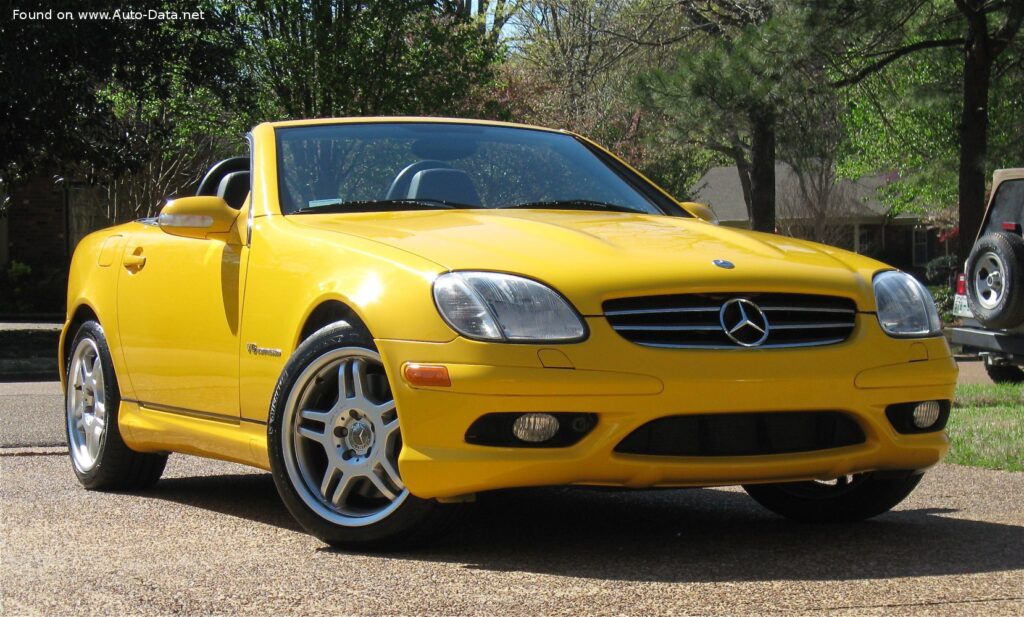
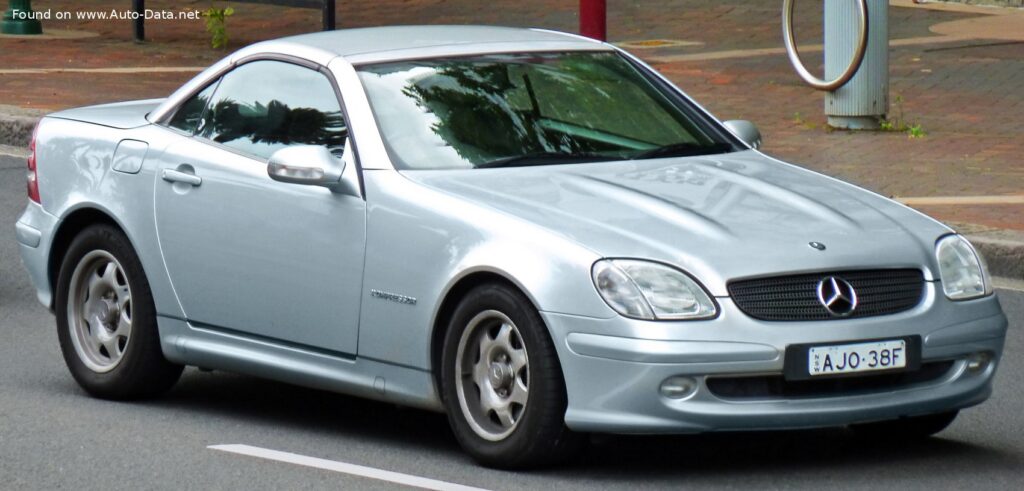
The Mercedes-Benz SLK (R170) presented a fresh, youthful design language for the brand, distinct from its more traditional sedan and coupe offerings. Its compact dimensions – a length of 157.28 inches, width of 67.52 inches, and height of 50.55 inches – contributed to its agile appearance. The two-door roadster body type, with seating for two, exuded sportiness and elegance, drawing inspiration from classic Mercedes-Benz roadsters while incorporating modern styling cues of the late 1990s. The distinctive front fascia, with its wide grille and integrated headlights, gave the SLK a confident road presence.
However, the undisputed star feature of the R170 was its innovative “vario-roof.” This electro-hydraulic retractable hardtop offered the best of both worlds: the security, insulation, and sleek lines of a coupe when closed, and the exhilarating open-air freedom of a traditional roadster when stowed. The mechanism was a marvel of engineering for its time, smoothly folding the roof into the trunk with the push of a button, a process that took approximately 25 seconds. This innovation effectively eliminated the compromises associated with soft-top roadsters, such as susceptibility to vandalism, noise intrusion, and less weather protection.
Inside, the SLK 200 offered a driver-focused cockpit with a blend of comfort and sporty aesthetics. Quality materials, typical of Mercedes-Benz, were used throughout, though the overall design was more contemporary and less opulent than larger Mercedes models. Standard features for the era likely included power windows, power mirrors, air conditioning, and a basic audio system. Safety features were also a priority, with Anti-lock Braking System (ABS) as standard, along with dual front airbags. The chassis was well-engineered, featuring a double wishbone front suspension and an independent multi-link rear suspension, providing a balanced ride and handling. Braking was handled by ventilated discs at the front (273 mm) and solid discs at the rear (278 mm), ensuring confident stopping power. The hydraulic power steering system, with a recirculating ball design, offered precise control and a good feel for the road.
Technical Specifications
| Mercedes-Benz SLK (R170) SLK 200 (136 Hp) – Specifications | |
|---|---|
| General Information | |
| Brand | Mercedes-Benz |
| Model | SLK |
| Generation | SLK (R170) |
| Type (Engine) | SLK 200 (136 Hp) |
| Production Start | July, 1996 |
| Production End | February, 2000 |
| Powertrain Architecture | Internal Combustion Engine |
| Body type | Roadster |
| Seats | 2 |
| Doors | 2 |
| Performance Specs | |
| Fuel Consumption (Urban, NEDC) | 12.9 l/100 km (18.2 US mpg) |
| Fuel Consumption (Extra Urban, NEDC) | 6.9 l/100 km (34.1 US mpg) |
| Fuel Consumption (Combined, NEDC) | 9.1 l/100 km (25.8 US mpg) |
| CO2 Emissions (NEDC) | 217 g/km |
| Fuel Type | Petrol (Gasoline) |
| Acceleration 0 – 60 mph | 8.8 sec |
| Acceleration 0 – 100 km/h | 9.3 sec |
| Maximum Speed | 208 km/h (129.25 mph) |
| Braking 100 km/h – 0 | 37.5 m |
| Weight-to-Power Ratio | 8.8 kg/Hp |
| Weight-to-Torque Ratio | 6.3 kg/Nm |
| Engine Specs | |
| Power | 136 Hp @ 5500 rpm |
| Power per liter | 68.1 Hp/l |
| Torque | 190 Nm (140.14 lb.-ft.) @ 3700-4500 rpm |
| Maximum Engine Speed | 6250 rpm |
| Engine Layout | Front, Longitudinal |
| Engine Model/Code | M 111.946 |
| Engine Displacement | 1998 cm³ (2.0 liters / 121.93 cu. in.) |
| Number of Cylinders | 4 |
| Engine Configuration | Inline |
| Cylinder Bore | 89.9 mm (3.54 in.) |
| Piston Stroke | 78.7 mm (3.1 in.) |
| Compression Ratio | 10.4:1 |
| Number of Valves per Cylinder | 4 |
| Fuel Injection System | Multi-port manifold injection |
| Engine Aspiration | Naturally aspirated |
| Valvetrain | DOHC |
| Engine Oil Capacity | 5.5 l (5.81 US qt) |
| Coolant Capacity | 8 l (8.45 US qt) |
| Space, Volume, and Weights | |
| Kerb Weight | 1195 kg (2634.52 lbs.) |
| Max. Weight | 1530 kg (3373.07 lbs.) |
| Max Load | 335 kg (738.55 lbs.) |
| Trunk (Boot) Space – Minimum | 145 l (5.12 cu. ft.) |
| Trunk (Boot) Space – Maximum | 348 l (12.29 cu. ft.) |
| Fuel Tank Capacity | 53 l (14 US gal) |
| Max. Roof Load | 30 kg (66.14 lbs.) |
| Dimensions | |
| Length | 3995 mm (157.28 in.) |
| Width | 1715 mm (67.52 in.) |
| Height | 1284 mm (50.55 in.) |
| Wheelbase | 2400 mm (94.49 in.) |
| Front Track | 1488 mm (58.58 in.) |
| Rear (Back) Track | 1471 mm (57.91 in.) |
| Drag Coefficient (Cd) | 0.33 |
| Minimum Turning Circle | 10.5 m (34.45 ft.) |
| Drivetrain, Brakes, and Suspension Specs | |
| Drivetrain Architecture | Rear-wheel drive |
| Drive Wheel | Rear wheel drive |
| Number of Gears and Type of Gearbox | 5 gears, manual transmission |
| Front Suspension | Coil spring, Double wishbone, Transverse stabilizer |
| Rear Suspension | Independent multi-link suspension, Coil spring |
| Front Brakes | Ventilated discs, 273 mm |
| Rear Brakes | Disc, 278 mm |
| Assisting Systems | ABS (Anti-lock braking system) |
| Steering Type | Cone worm with recirculation balls |
| Power Steering | Hydraulic Steering |
| Tires Size | 205/60 R 15 91 H |
| Wheel Rims Size | 7 J x 15 H 2 |
Legacy and Market Impact of the Mercedes-Benz SLK (R170)
The Mercedes-Benz SLK (R170) made a considerable splash in the automotive world, carving out a new niche for Mercedes-Benz and leaving a lasting legacy. It was conceived at a time when the market for compact luxury roadsters was burgeoning, and the SLK quickly established itself as a formidable contender. Its primary competitors in Europe included the BMW Z3, the Porsche Boxster (though often positioned higher in performance and price), and later, the Audi TT Roadster. The SLK 200, in particular, offered a compelling value proposition, providing the prestige of the three-pointed star and the innovative vario-roof technology at a more attainable price point than its more powerful stablemates or some rivals.
The most significant impact of the SLK (R170) was undoubtedly its pioneering “vario-roof” retractable hardtop. Before the SLK, hardtop convertibles were rare and often cumbersome. Mercedes-Benz’s elegant and reliable solution quickly became a benchmark, influencing a wave of new models from other manufacturers that adopted similar technology. This innovation alone solidified the R170’s place in automotive history, proving that a convertible could offer both the joy of open-air driving and the practicality and security of a fixed-roof coupe.
For the Mercedes-Benz brand, the SLK (R170) was crucial for several reasons. It attracted a younger demographic to the brand, expanding Mercedes-Benz’s appeal beyond its traditional, more conservative customer base. Its stylish design and innovative features helped to inject a sense of modernity and fun into the lineup. While the SLK 200 (136 Hp) was not typically sold in the United States, its existence highlights Mercedes-Benz’s strategic approach to global markets, tailoring engine options to suit regional preferences for fuel economy, emissions, and taxation. In the US, the R170 was highly successful, with the SLK 230 Kompressor and later the SLK 320 becoming popular choices, demonstrating the strong demand for the platform’s blend of luxury, sportiness, and convertible convenience.
Today, the Mercedes-Benz SLK (R170) remains a popular choice on the used car market, appreciated for its distinctive styling, robust engineering, and the enduring appeal of its retractable hardtop. It represents a pivotal moment in Mercedes-Benz’s history, showcasing its ability to innovate and adapt to evolving market demands, ultimately shaping the landscape of the modern luxury roadster.