Introduction to the Renault Espace III (JE, Phase II, 2000) 2.2 dCi 16V (129 Hp)
The Renault Espace, a pioneering multi-purpose vehicle (MPV) that largely defined the segment in Europe, entered its third generation (JE) in 1996. The specific variant under review, the Renault Espace III (JE, Phase II, 2000) 2.2 dCi 16V (129 Hp), represents the updated version introduced in 2000, benefiting from a mid-cycle refresh that brought technological advancements and subtle styling cues to keep it competitive in the burgeoning European family car market. While the Espace never officially graced American showrooms, it played a pivotal role in popularizing the minivan concept across the Atlantic, demonstrating Renault’s innovative approach to space and modularity. This particular model, equipped with a robust 2.2-liter dCi diesel engine, was a cornerstone of its lineup, offering a compelling blend of fuel efficiency, torque, and practicality for large families and those requiring flexible passenger and cargo solutions.
The third-generation Espace, unlike its predecessors which were built by Matra, was entirely developed and manufactured by Renault, albeit retaining the innovative composite body panels over a galvanized steel chassis. This 2000 Phase II iteration continued to push the boundaries of interior design and functionality, cementing its reputation as a comfortable, safe, and highly adaptable family hauler. Its design ethos prioritized passenger comfort and versatility, making it a benchmark in the European MPV segment during its production run from 2000 to 2002.
Engine and Performance of the Renault Espace III (JE, Phase II, 2000) 2.2 dCi 16V (129 Hp)
At the heart of this particular Renault Espace III (JE, Phase II, 2000) 2.2 dCi 16V (129 Hp) model is a sophisticated 2.2-liter (2188 cm³ or 133.52 cu. in.) G9T inline-four diesel engine. This unit, featuring a DOHC (Dual Overhead Camshaft) valvetrain with 3 valves per cylinder and common rail direct fuel injection, was a significant step forward in diesel technology for its time. It produced a respectable 129 horsepower at 4000 rpm, which was more than adequate for moving the Espace with authority. More importantly for a family vehicle of its size, the engine delivered a substantial 213.89 lb.-ft. of torque at a low 1750 rpm. This ample low-end torque was crucial for effortless acceleration, particularly when the vehicle was fully loaded with passengers and cargo, and for navigating European city traffic or cruising on the autobahn.
Power was channeled to the front wheels via a smooth-shifting 5-speed manual transmission, offering drivers direct control over the powertrain. This setup allowed the Espace to accelerate from 0 to 60 mph in a reasonable 11.8 seconds, with a top speed of 113.71 mph. While not a performance car, these figures highlight its capability as a competent cruiser. Fuel efficiency was a strong suit for the 2.2 dCi engine, boasting a combined consumption figure of 33.1 US mpg (7.1 l/100 km). This made it an economical choice for long-distance travel, a key selling point in the European market where diesel fuel was widely available and often more affordable. Emissions were rated at 189 g/km CO2, meeting the Euro 3 emission standard prevalent at the turn of the millennium. The engine’s robust design, coupled with its turbocharged aspiration, ensured a responsive and refined driving experience for a vehicle of its class.
Design and Features of the Renault Espace III
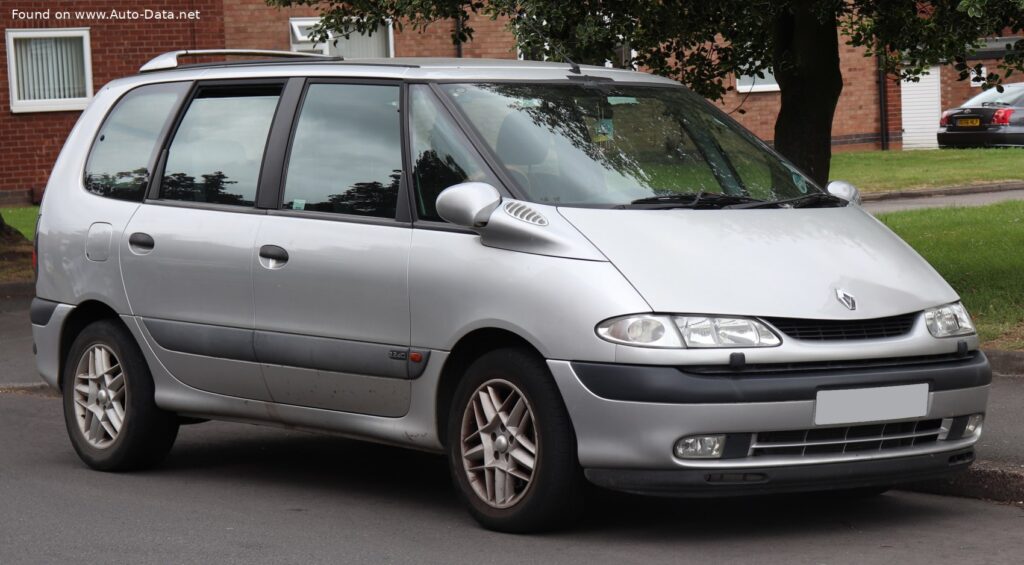
The Renault Espace III (JE, Phase II, 2000) carried forward the distinctive “one-box” design philosophy that had made its predecessors so recognizable. As a Minivan or MPV, its primary objective was to maximize interior space and versatility. The vehicle measured 177.83 inches in length, 71.26 inches in width (81.5 inches including mirrors), and 69.8 inches in height, with a generous wheelbase of 106.38 inches. These dimensions contributed to a remarkably spacious cabin, capable of comfortably seating seven occupants across three rows. The five-door configuration, including a large rear tailgate, facilitated easy access for passengers and cargo.
A standout feature of the Espace III was its highly modular interior. The individual seats in the second and third rows could be easily removed, folded, or reconfigured, transforming the vehicle from a full seven-seater to a spacious two-seater cargo hauler. Minimum trunk space started at a respectable 9.71 cubic feet, expanding dramatically to an cavernous 100.65 cubic feet with the rear seats removed, underscoring its utility. This adaptability was a significant draw for families needing to transport everything from groceries to camping gear.
The Phase II refresh brought subtle exterior enhancements, typically including revised headlamps, grille, and taillight designs, along with updated interior trim and material choices to elevate the cabin ambiance. Standard features for the era often included power windows, central locking, and climate control, with higher trims offering more luxurious options. For safety, the Espace III was equipped with an Anti-lock Braking System (ABS), a crucial feature for stability during emergency braking. The vehicle rode on 225/55 R16 tires mounted on 16-inch wheel rims, providing a good balance of ride comfort and handling. Its suspension system comprised an independent McPherson setup with coil springs and an anti-roll bar at the front, paired with a semi-independent coil spring rear suspension, designed to absorb road imperfections and provide a smooth ride for all occupants. Braking was handled by ventilated discs at the front and drum brakes at the rear, a common configuration for MPVs of this period.
Technical Specifications
| Category | Specification |
|---|---|
| Brand | Renault |
| Model | Espace |
| Generation | Espace III (JE, Phase II, 2000) |
| Engine Type | 2.2 dCi 16V (129 Hp) |
| Production Start | 2000 |
| Production End | 2002 |
| Powertrain Architecture | Internal Combustion Engine |
| Body Type | Minivan, MPV |
| Seats | 7 |
| Doors | 5 |
| Performance Specs | |
| Fuel Consumption (Urban) | 26.7 US mpg (8.8 l/100 km) |
| Fuel Consumption (Extra Urban) | 38.6 US mpg (6.1 l/100 km) |
| Fuel Consumption (Combined) | 33.1 US mpg (7.1 l/100 km) |
| CO2 Emissions | 189 g/km |
| Fuel Type | Diesel |
| Acceleration 0-60 mph | 11.8 sec |
| Maximum Speed | 113.71 mph (183 km/h) |
| Emission Standard | Euro 3 |
| Weight-to-Power Ratio | 13.5 kg/Hp |
| Engine Specs | |
| Power | 129 Hp @ 4000 rpm |
| Power per liter | 59 Hp/l |
| Torque | 213.89 lb.-ft. @ 1750 rpm (290 Nm) |
| Engine Layout | Front, Transverse |
| Engine Model/Code | G9T |
| Engine Displacement | 2.2 liters (2188 cm³ / 133.52 cu. in.) |
| Number of Cylinders | 4 |
| Engine Configuration | Inline |
| Cylinder Bore | 3.43 in (87 mm) |
| Piston Stroke | 3.62 in (92 mm) |
| Compression Ratio | 22:1 |
| Valves per Cylinder | 3 |
| Fuel Injection System | Diesel Commonrail |
| Engine Aspiration | Turbocharger |
| Valvetrain | DOHC |
| Engine Oil Capacity | 8.03 US qt (7.6 l) |
| Engine Oil Specification | Not Specified |
| Coolant Capacity | 7.93 US qt (7.5 l) |
| Space, Volume and Weights | |
| Kerb Weight | 3829.43 lbs (1737 kg) |
| Max. Weight | 5533.6 lbs (2510 kg) |
| Max Load | 1704.17 lbs (773 kg) |
| Trunk (boot) space – minimum | 9.71 cu. ft. (275 l) |
| Trunk (boot) space – maximum | 100.65 cu. ft. (2850 l) |
| Fuel Tank Capacity | 20.61 US gal (78 l) |
| Max. Roof Load | 176.37 lbs (80 kg) |
| Permitted Trailer Load with brakes (12%) | 4409.25 lbs (2000 kg) |
| Permitted Trailer Load without brakes | 1653.47 lbs (750 kg) |
| Dimensions | |
| Length | 177.83 in (4517 mm) |
| Width | 71.26 in (1810 mm) |
| Width including mirrors | 81.5 in (2070 mm) |
| Height | 69.8 in (1773 mm) |
| Wheelbase | 106.38 in (2702 mm) |
| Front Track | 60.39 in (1534 mm) |
| Rear Track | 60.63 in (1540 mm) |
| Front Overhang | 36.57 in (929 mm) |
| Rear Overhang | 34.88 in (886 mm) |
| Ride Height (Ground Clearance) | 4.33 in (110 mm) |
| Minimum Turning Circle | 37.4 ft (11.4 m) |
| Drivetrain, Brakes, and Suspension Specs | |
| Drivetrain Architecture | Front-wheel drive |
| Drive Wheel | Front-wheel drive |
| Number of Gears and Type | 5 gears, manual transmission |
| Front Suspension | Independent, McPherson with coil spring and anti-roll bar |
| Rear Suspension | Semi-independent, coil spring |
| Front Brakes | Ventilated discs |
| Rear Brakes | Drum |
| Assisting Systems | ABS (Anti-lock braking system) |
| Steering Type | Steering rack and pinion |
| Power Steering | Hydraulic Steering |
| Tires Size | 225/55 R16 |
| Wheel Rims Size | 16 inches |
Legacy and Market Impact of the Renault Espace III
The Renault Espace, particularly the third generation, holds a significant place in automotive history as one of Europe’s definitive MPVs. While the minivan concept originated in North America, the Espace was instrumental in popularizing and refining it for the European market, offering a distinctively French interpretation of family transport. The Renault Espace III (JE, Phase II, 2000) 2.2 dCi 16V (129 Hp) was a popular choice within its segment due to its compelling combination of space, comfort, and the economical yet powerful dCi diesel engine.
During its time, the Espace faced stiff competition from other European manufacturers who quickly joined the MPV bandwagon. Key rivals included the Ford Galaxy, Volkswagen Sharan, and SEAT Alhambra – a trio of jointly developed models that offered similar seating and versatility. Other competitors might have included the Peugeot 806/Citroën Evasion (Eurovans) and the Chrysler Voyager, which, despite its American roots, had a strong presence in European markets. What set the Espace apart was its unique design aesthetic, which often felt more avant-garde and less utilitarian than some of its competitors. Its composite body panels were also a notable distinction, contributing to a perceived quality and durability.
The third generation, and especially the Phase II refresh, solidified the Espace’s reputation for innovation and practicality. It was praised for its comfortable ride, bright and airy cabin, and the sheer flexibility of its seating arrangements, which truly embodied the “multi-purpose” aspect of an MPV. The introduction of more refined and efficient dCi diesel engines, like the 2.2-liter unit, further enhanced its appeal, making it a sensible choice for families needing to balance space with running costs. Its legacy lies in its contribution to shaping the family car landscape in Europe, proving that practicality didn’t have to come at the expense of distinctive design or advanced engineering. Even though it never crossed the Atlantic to the United States, the Renault Espace remains an iconic vehicle in the annals of European automotive design and a testament to Renault’s ingenuity in creating vehicles tailored to the specific needs of its primary market. Its influence can still be seen in the design and packaging of modern crossovers and larger family vehicles, which continue to prioritize flexible interiors and passenger comfort.