The Toyota Harrier I (XU10): A Pioneer in the Luxury Crossover Segment
The Toyota Harrier I (XU10) represents a pivotal moment in automotive history, particularly in the evolution of the sport utility vehicle (SUV) and crossover segments. Launched in 1997 for the Japanese market, and specifically the 3.0 V6 24V (220 Hp) Automatic variant produced between 1998 and 2000, this vehicle was instrumental in defining what would become known as the luxury crossover. While sold as the Toyota Harrier in its home market and other regions, it gained international acclaim and significant market share in North America as the first-generation Lexus RX 300. This dual identity underscored its innovative concept: blending the ride comfort and handling characteristics of a sedan with the elevated driving position, cargo capacity, and perceived versatility of an SUV.
Before the Toyota Harrier I (XU10), the SUV market was largely dominated by truck-based, body-on-frame vehicles, which often sacrificed on-road refinement for rugged capability. Toyota, with the Harrier, dared to challenge this paradigm, introducing a unibody construction that promised a smoother, more car-like driving experience. This strategic move resonated deeply with consumers seeking practicality and luxury without the compromises of traditional SUVs. The 3.0-liter V6 engine, coupled with an automatic transmission, provided a compelling blend of performance and sophistication, cementing the Harrier’s reputation as a trailblazer in a rapidly expanding market segment.
Powertrain and Performance of the Toyota Harrier I (XU10)
The 3.0-liter V6 Engine
At the heart of the 1998-2000 Toyota Harrier I (XU10) lay the robust and widely respected 1MZ-FE engine. This 3.0-liter (2995 cm³ or 182.77 cu. in.) V6 unit was engineered with a 24-valve DOHC (Double Overhead Camshaft) valvetrain, a configuration that allowed for superior airflow and efficiency. Power output for this specific variant was an impressive 220 horsepower (Hp) delivered at 5800 revolutions per minute (rpm), making it one of the more potent engines in its class at the time. The engine’s design focused on smoothness and refinement, characteristic of Toyota’s engineering philosophy, ensuring a quiet and comfortable ride even under acceleration.
Torque production was equally commendable, with the 1MZ-FE generating 224.22 pound-feet (lb.-ft.), or 304 Nm, at a relatively accessible 4400 rpm. This ample torque at mid-range rpms was crucial for providing responsive acceleration and effortless highway cruising, qualities highly valued in a vehicle designed for comfort and practicality. The engine utilized a multi-port manifold injection system, ensuring precise fuel delivery and optimal combustion, which contributed to both performance and efficiency. As a naturally aspirated engine, it delivered linear power delivery without the complexities or potential lag associated with forced induction systems.
Transmission and Drivetrain
Power was seamlessly transferred to the pavement via a 4-speed automatic transmission. While modern vehicles often feature more gears, the 4-speed automatic of the era was a reliable and smooth-shifting unit, perfectly matched to the engine’s power band for a relaxed driving experience. The specified variant of the Toyota Harrier I (XU10) featured a front-wheel-drive (FWD) drivetrain architecture, meaning the internal combustion engine drove the front wheels. This FWD setup contributed to better fuel efficiency and lighter weight compared to traditional all-wheel-drive systems, aligning with the Harrier’s focus on on-road comfort and economy.
Performance Metrics and Fuel Economy
Despite its substantial size and luxury aspirations, the Toyota Harrier I (XU10) 3.0 V6 demonstrated spirited performance. It could accelerate from 0 to 60 miles per hour (mph) in approximately 8.1 seconds, a respectable figure for a crossover of its vintage. Its maximum speed was electronically limited to 111.85 mph (180 km/h), reflecting its design as a comfortable cruiser rather than an outright performance machine.
Fuel economy figures, while not groundbreaking by today’s standards, were competitive for a V6-powered vehicle of its size. The combined fuel consumption was rated at 10.6 liters per 100 kilometers (l/100 km), which translates to approximately 22.2 US miles per gallon (mpg). In urban driving conditions, it achieved about 19 US mpg (12.4 l/100 km), while extra-urban driving saw figures around 24 US mpg (9.8 l/100 km). These figures highlighted Toyota’s ability to balance power with practical efficiency.
Design and Interior Features
Exterior Aesthetics and Dimensions
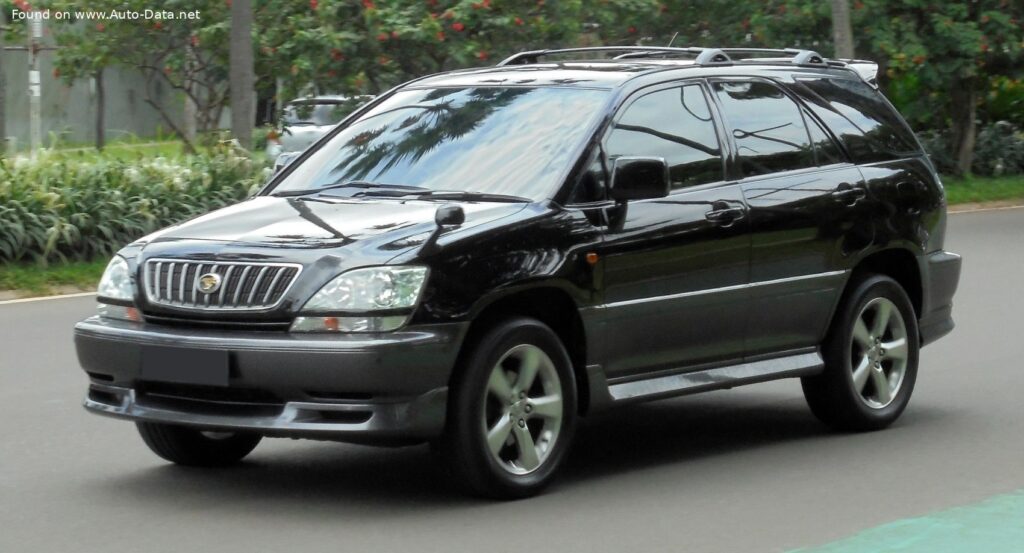
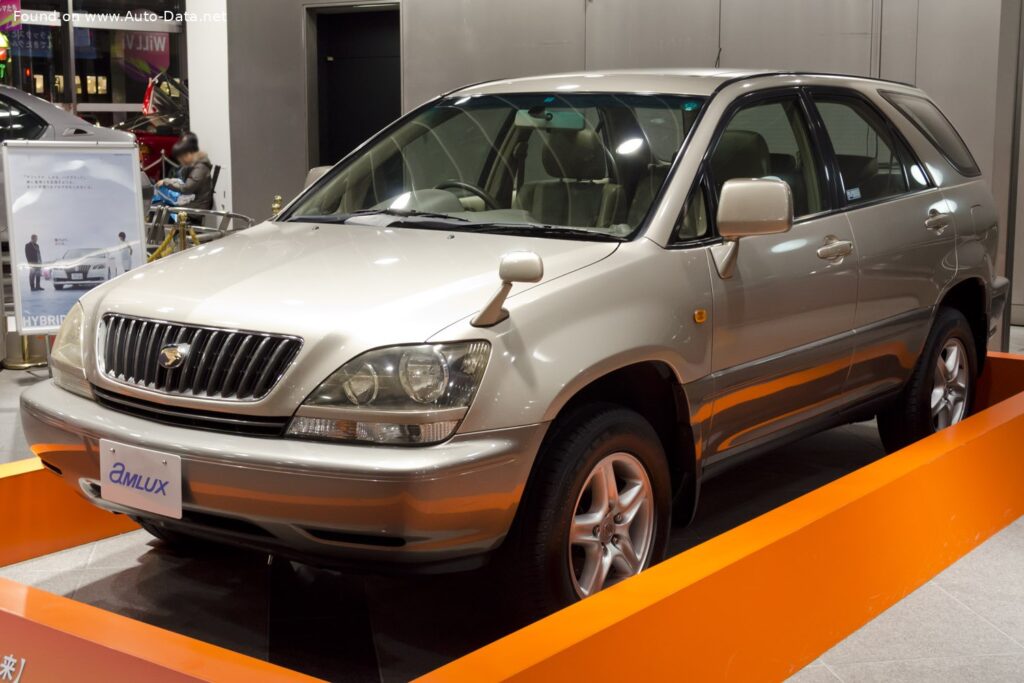
The Toyota Harrier I (XU10) pioneered a distinctive design language that blurred the lines between a traditional SUV and a luxury sedan. Its body type was classified as an SUV/Crossover, featuring a sleek, aerodynamic profile that was a stark contrast to the boxy, utilitarian SUVs prevalent at the time. With an overall length of 180.12 inches (4575 mm), a width of 71.46 inches (1815 mm), and a height of 65.55 inches (1665 mm), the Harrier presented a substantial yet elegant stance. The wheelbase measured 102.95 inches (2615 mm), contributing to a stable ride and generous interior space. Its relatively low roofline and car-like proportions were key to its appeal, offering the command driving position of an SUV without the visual bulk. The vehicle rode on 215/70 R16 99S tires mounted on 6.5J x 16 ET35 wheel rims, providing a comfortable ride and adequate grip.
Interior Comfort and Technology
Inside, the Harrier I (XU10) was designed with a focus on luxury, comfort, and practicality for its five occupants. The cabin layout was intuitive, with high-quality materials and a refined finish that set it apart from more rugged SUVs. Seating for five adults was generous, with ample legroom and headroom, making it suitable for long journeys. The design prioritized ergonomics, ensuring controls were within easy reach and visibility was excellent.
One of the Harrier’s most appealing features was its versatile cargo capacity. With the rear seats in place, the trunk offered a substantial 30.37 cubic feet (860 liters) of space. Folding down the rear seats significantly expanded this volume to an impressive 75.22 cubic feet (2130 liters), providing exceptional utility for luggage, sports equipment, or larger items. This flexibility was a major selling point, combining the passenger comfort of a sedan with the cargo-hauling ability of an SUV.
In terms of technology and safety for its era, the Harrier I (XU10) was well-equipped. It featured an Anti-lock Braking System (ABS) as standard, a crucial safety enhancement that improved control during emergency braking. The steering system was a responsive rack and pinion setup, complemented by hydraulic power steering, which provided comfortable and precise maneuverability. Suspension components included Spring Struts at the front and a Wishbone setup at the rear, a configuration chosen to optimize ride comfort and handling dynamics, further reinforcing its car-like characteristics. Braking duties were handled by ventilated discs at the front and disc brakes at the rear, ensuring confident stopping power.
Technical Specifications
| Feature | Specification |
|---|---|
| Brand | Toyota |
| Model | Harrier |
| Generation | Harrier I (XU10) |
| Engine Type | 3.0 V6 24V (220 Hp) Automatic |
| Production Start | 1998 |
| Production End | 2000 |
| Powertrain Architecture | Internal Combustion Engine |
| Body Type | SUV, Crossover |
| Seats | 5 |
| Doors | 5 |
| Fuel Type | Petrol (Gasoline) |
| Fuel Consumption (Urban) | 12.4 l/100 km (19 US mpg) |
| Fuel Consumption (Extra Urban) | 9.8 l/100 km (24 US mpg) |
| Fuel Consumption (Combined) | 10.6 l/100 km (22.2 US mpg) |
| Acceleration 0-60 mph | 8.1 sec |
| Maximum Speed | 111.85 mph (180 km/h) |
| Power | 220 Hp @ 5800 rpm |
| Torque | 224.22 lb.-ft. (304 Nm) @ 4400 rpm |
| Engine Layout | Front, Longitudinal |
| Engine Model/Code | 1MZ-FE |
| Engine Displacement | 2995 cm³ (182.77 cu. in.) |
| Number of Cylinders | 6 |
| Engine Configuration | V-engine |
| Cylinder Bore | 3.44 in. (87.5 mm) |
| Piston Stroke | 3.27 in. (83 mm) |
| Compression Ratio | 10.5:1 |
| Valves per Cylinder | 4 |
| Fuel Injection System | Multi-port manifold injection |
| Engine Aspiration | Naturally aspirated |
| Valvetrain | DOHC |
| Engine Oil Capacity | 4.7 l (4.97 US qt) |
| Coolant Capacity | 9 l (9.51 US qt) |
| Kerb Weight | 3637.63 lbs. (1650 kg) |
| Weight-to-Power Ratio | 7.5 kg/Hp |
| Weight-to-Torque Ratio | 5.4 kg/Nm |
| Trunk Space (Minimum) | 30.37 cu. ft. (860 l) |
| Trunk Space (Maximum) | 75.22 cu. ft. (2130 l) |
| Fuel Tank Capacity | 17.17 US gal (65 l) |
| Length | 180.12 in. (4575 mm) |
| Width | 71.46 in. (1815 mm) |
| Height | 65.55 in. (1665 mm) |
| Wheelbase | 102.95 in. (2615 mm) |
| Front Track | 61.61 in. (1565 mm) |
| Rear Track | 61.02 in. (1550 mm) |
| Drive Wheel | Front Wheel Drive |
| Gearbox Type | 4 gears, automatic transmission |
| Front Suspension | Spring Strut |
| Rear Suspension | Wishbone |
| Front Brakes | Ventilated discs |
| Rear Brakes | Disc |
| Assisting Systems | ABS (Anti-lock braking system) |
| Steering Type | Steering rack and pinion |
| Power Steering | Hydraulic Steering |
| Tires Size | 215/70 R16 99S |
| Wheel Rims Size | 6.5J x 16 ET35 |
Legacy and Market Impact
Pioneering the Luxury Crossover Segment
The Toyota Harrier I (XU10), particularly in its guise as the Lexus RX 300 in North America, fundamentally redefined the automotive landscape. Before its introduction, SUVs were largely seen as utilitarian, rugged vehicles with truck-like characteristics. The Harrier, however, dared to combine the best attributes of a luxury sedan – comfort, refined handling, and a sophisticated interior – with the practicality, versatility, and elevated driving position of an SUV. This fusion created an entirely new vehicle category: the luxury crossover.
Its unibody construction, derived from the Toyota Camry platform, was a radical departure from the body-on-frame designs prevalent in SUVs of the time. This allowed for a significantly more comfortable ride, superior handling dynamics, and reduced noise, vibration, and harshness (NVH) levels, making it a joy to drive on paved roads. For many consumers, the Harrier/RX offered the perfect solution: a vehicle that looked substantial and capable, yet drove with the ease and refinement of a car.
Reputation and Competitors
The reputation of the Toyota Harrier I (XU10) was, and continues to be, one of impeccable reliability, exceptional build quality, and enduring comfort. These hallmarks of the Toyota and Lexus brands were fully embodied in the Harrier, contributing to its immediate success and long-term appeal. Its smooth V6 engine and automatic transmission were lauded for their seamless operation, further enhancing the luxury experience.
In its primary market of Japan, the Harrier faced competition from domestic rivals, but its unique positioning helped it stand out. Globally, and particularly as the Lexus RX 300, it carved out a niche that few competitors had yet entered. While vehicles like the Mercedes-Benz M-Class (W163) were emerging around the same time, the Harrier/RX offered a distinctively Japanese take on luxury and utility, focusing more on refinement and ease of use rather than rugged off-road prowess. Later, other luxury brands would follow suit, with models like the BMW X5 and Acura MDX entering the fray, but the Harrier/RX had already established itself as the segment’s pioneer.
Historical Significance
The historical significance of the Toyota Harrier I (XU10) cannot be overstated. It was not just another new model; it was a category creator. Its success demonstrated to the global automotive industry that there was a massive demand for vehicles that offered SUV aesthetics and practicality without the traditional compromises in ride quality and fuel efficiency. This insight led to a paradigm shift, inspiring countless other manufacturers to develop their own car-based crossovers, ultimately leading to the dominance of the crossover segment we see today. The Harrier effectively paved the way for modern family vehicles, demonstrating that a blend of luxury, utility, and car-like driving dynamics was not only possible but highly desirable. Its legacy lives on in every subsequent crossover that prioritizes comfort and everyday usability over extreme off-road capability.