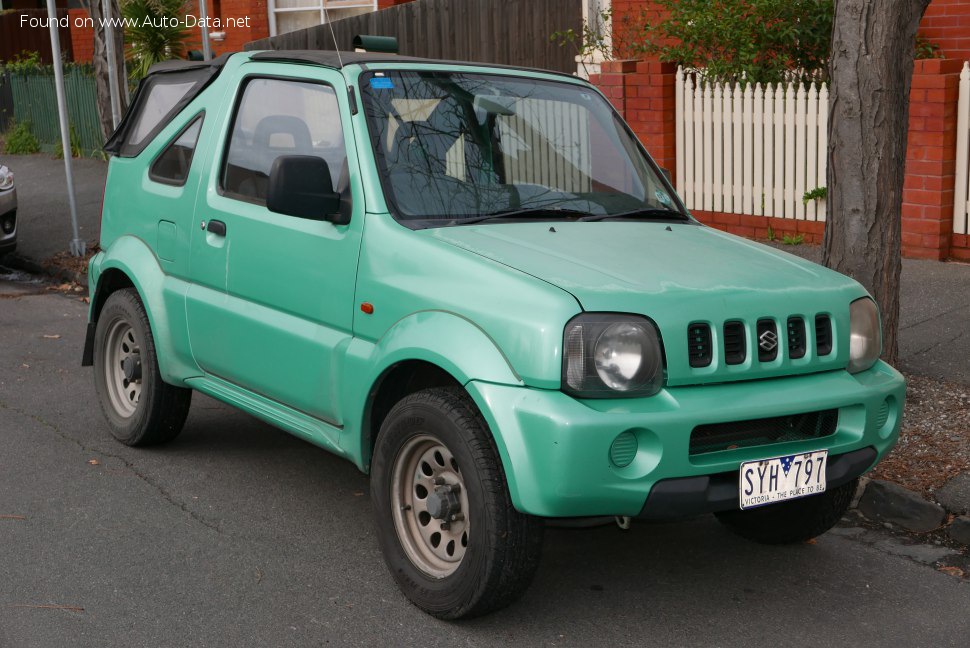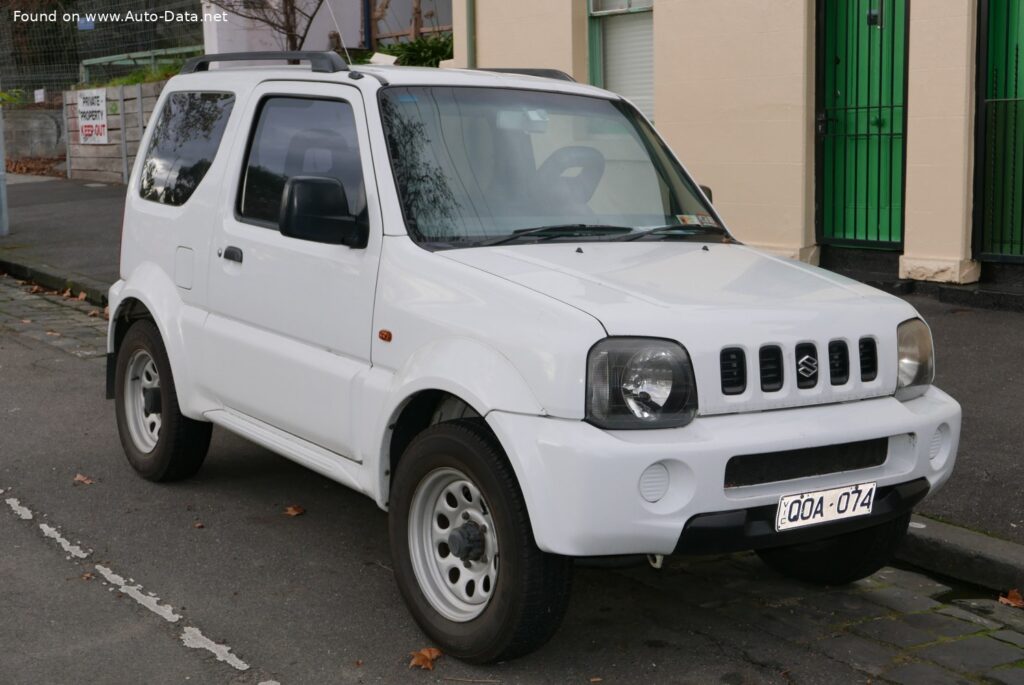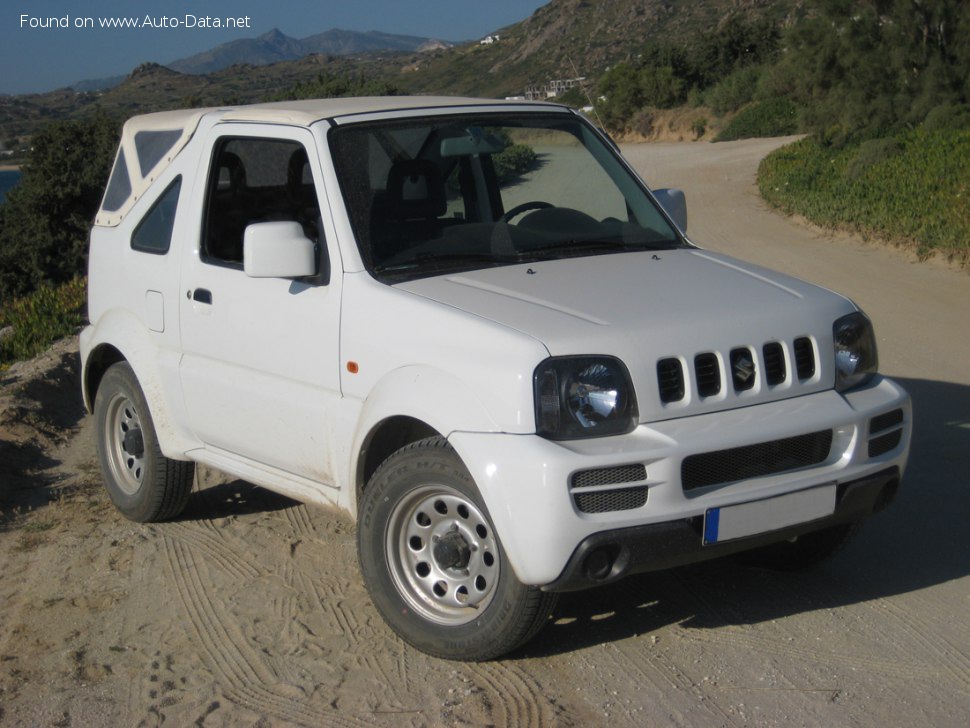
Suzuki Jimny Cabrio III (facelift 2005) 1.3 VVT (85 Hp) 4WD
The Suzuki Jimny Cabrio III (facelift 2005) 1.3 VVT (85 Hp) 4WD represents a significant iteration of Suzuki’s long-running and highly regarded compact off-road vehicle lineage. Introduced in 2005 as a refreshed version of the third-generation Jimny, this model continued to champion the brand’s commitment to small, capable, and affordable four-wheel-drive vehicles. While not a primary market contender in the United States, where larger SUVs typically dominate, the Jimny has carved out a substantial niche in European, Asian, and other global markets, celebrated for its rugged simplicity, impressive off-road prowess, and compact dimensions. This particular variant, with its convertible body style, offered an added element of open-air adventure, blending the utility of an off-roader with the enjoyment of a soft-top.
The Jimny’s history dates back to 1970, with each generation building upon a core philosophy of lightweight construction, robust ladder-frame chassis, and effective four-wheel-drive systems. The third generation, launched in 1998, moved towards a more refined, yet still undeniably capable, package. The 2005 facelift brought subtle but important updates, primarily focusing on powertrain enhancements and minor aesthetic revisions, ensuring the Jimny remained competitive and compliant with evolving emission standards. This model, produced from 2005 to 2009, cemented the Jimny’s reputation as a unique offering in a market increasingly moving towards car-based crossovers.
Engine and Performance: The Heart of the Suzuki Jimny Cabrio III (facelift 2005)
Powering the Suzuki Jimny Cabrio III (facelift 2005) is a 1.3-liter (1328 cm3 or 81.04 cu. in.) M13A inline-four gasoline engine, featuring Suzuki’s Variable Valve Timing (VVT) technology. This engine setup was a key improvement for the facelifted model, designed to offer a better balance of power, fuel efficiency, and reduced emissions. The VVT system optimizes valve timing for improved engine breathing across various RPMs, contributing to a smoother power delivery and enhanced torque at lower engine speeds, which is crucial for off-road applications.
The engine generates a respectable 85 horsepower at 6000 rpm and 110 Nm (81.13 lb.-ft.) of torque at 4100 rpm. While these figures might seem modest by contemporary standards, especially for a vehicle with off-road aspirations, they are well-suited to the Jimny’s lightweight construction and intended use. The power-to-weight ratio stands at 72.6 Hp per tonne (13.8 kg/Hp), indicating an efficient use of its available power. Power is delivered to all four wheels via a durable 5-speed manual transmission, providing the driver with precise control over gear selection, a preference for many off-road enthusiasts.
Performance figures reflect its utilitarian nature rather than outright speed. The Jimny Cabrio III accelerates from 0 to 60 mph in approximately 13.4 seconds, with a top speed of 86.99 mph (140 km/h). These numbers emphasize that the Jimny is engineered for conquering challenging terrain and navigating urban environments, not for high-speed highway cruising. Fuel economy for the combined NEDC cycle is rated at 32.2 US mpg (7.3 l/100 km), with urban consumption at 25.3 US mpg (9.3 l/100 km) and extra-urban at 37.9 US mpg (6.2 l/100 km). CO2 emissions are 174 g/km, meeting Euro 4 emission standards of its time. The drivetrain architecture features a part-time all-wheel-drive system, where the internal combustion engine permanently drives the rear wheels, and the front wheels can be engaged through an electrically or mechanically operated clutch when 4WD is needed, offering versatility for both on-road efficiency and off-road traction.
The Suzuki Jimny Cabrio III (facelift 2005): Design and Features
The design of the Suzuki Jimny Cabrio III (facelift 2005) is characterized by its compact, boxy, and functional aesthetic, a hallmark of the Jimny series. This particular model combines the robust characteristics of an off-road vehicle with the undeniable appeal of a cabriolet. With a 3-door body and seating for four, it offers a unique blend of practicality and open-air enjoyment. Its dimensions are remarkably compact: 144.29 inches (3665 mm) in length, 62.99 inches (1600 mm) in width (70.08 inches or 1780 mm including mirrors), and 65.16 inches (1655 mm) in height. The short wheelbase of 88.58 inches (2250 mm) and wide tracks (53.35 inches front, 53.74 inches rear) contribute significantly to its agility and stability on uneven terrain.
A key attribute of the Jimny’s off-road capability is its generous ground clearance of 7.48 inches (190 mm), complemented by impressive approach (37°), departure (46°), and ramp-over (31°) angles. These figures allow the vehicle to tackle steep inclines, descents, and obstacles without scraping its undercarriage. The suspension system consists of rigid axles with coil springs at both the front and rear, a robust setup known for its durability and articulation in challenging conditions. Steering is a cone worm with recirculation balls type, assisted by hydraulic power steering, providing direct feedback and ease of maneuverability, especially at low speeds or during off-road driving. Braking is handled by front disc brakes and rear drum brakes, supplemented by an Anti-lock Braking System (ABS) for enhanced safety.
The interior of the Jimny is designed with practicality in mind, featuring durable materials and a straightforward layout. While trunk space is minimal at 3.99 cu. ft. (113 liters), the focus is clearly on passenger accommodation and off-road utility rather than cargo volume. The convertible roof mechanism allows for an immersive driving experience, letting occupants connect more directly with their surroundings, a significant draw for adventure seekers. The 15-inch wheels, shod with 205/70 R15 tires, provide a good balance between on-road comfort and off-road grip.
Technical Specifications
| Category | Specification |
|---|---|
| Brand | Suzuki |
| Model | Jimny |
| Generation | Jimny Cabrio III (facelift 2005) |
| Type (Engine) | 1.3 VVT (85 Hp) 4WD |
| Production Start | 2005 |
| Production End | 2009 |
| Powertrain Architecture | Internal Combustion engine |
| Body type | Off-road vehicle, Cabriolet |
| Seats | 4 |
| Doors | 3 |
| Performance Specs | |
| Fuel consumption (economy) – urban (NEDC) | 9.3 l/100 km (25.3 US mpg) |
| Fuel consumption (economy) – extra urban (NEDC) | 6.2 l/100 km (37.9 US mpg) |
| Fuel consumption (economy) – combined (NEDC) | 7.3 l/100 km (32.2 US mpg) |
| CO2 emissions (NEDC) | 174 g/km |
| Fuel Type | Petrol (Gasoline) |
| Acceleration 0 – 60 mph | 13.4 sec |
| Maximum speed | 140 km/h (86.99 mph) |
| Emission standard | Euro 4 |
| Weight-to-power ratio | 13.8 kg/Hp (72.6 Hp/tonne) |
| Weight-to-torque ratio | 10.6 kg/Nm (94 Nm/tonne) |
| Engine Specs | |
| Power | 85 Hp @ 6000 rpm |
| Power per liter | 64 Hp/l |
| Torque | 110 Nm @ 4100 rpm (81.13 lb.-ft. @ 4100 rpm) |
| Engine layout | Front, Longitudinal |
| Engine Model/Code | M13A |
| Engine displacement | 1328 cm3 (81.04 cu. in.) |
| Number of cylinders | 4 |
| Engine configuration | Inline |
| Cylinder Bore | 78 mm (3.07 in.) |
| Piston Stroke | 69.5 mm (2.74 in.) |
| Compression ratio | 9.5:1 |
| Number of valves per cylinder | 4 |
| Fuel injection system | Multi-port manifold injection |
| Engine aspiration | Naturally aspirated engine |
| Valvetrain | DOHC |
| Engine oil capacity | 4 l (4.23 US qt) |
| Coolant capacity | 5.9 l (6.23 US qt) |
| Space, Volume and Weights | |
| Kerb Weight | 1170 kg (2579.41 lbs.) |
| Max. weight | 1420 kg (3130.56 lbs.) |
| Max load | 250 kg (551.16 lbs.) |
| Trunk (boot) space – minimum | 113 l (3.99 cu. ft.) |
| Fuel tank capacity | 40 l (10.57 US gal) |
| Permitted trailer load with brakes (12%) | 1300 kg (2866.01 lbs.) |
| Permitted trailer load without brakes | 350 kg (771.62 lbs.) |
| Permitted towbar download | 75 kg (165.35 lbs.) |
| Dimensions | |
| Length | 3665 mm (144.29 in.) |
| Width | 1600 mm (62.99 in.) |
| Width including mirrors | 1780 mm (70.08 in.) |
| Height | 1655 mm (65.16 in.) |
| Wheelbase | 2250 mm (88.58 in.) |
| Front track | 1355 mm (53.35 in.) |
| Rear (Back) track | 1365 mm (53.74 in.) |
| Ride height (ground clearance) | 190 mm (7.48 in.) |
| Minimum turning circle (turning diameter) | 9.8 m (32.15 ft.) |
| Approach angle | 37° |
| Departure angle | 46° |
| Ramp-over (brakeover) angle | 31° |
| Drivetrain, Brakes and Suspension Specs | |
| Drivetrain Architecture | ICE drives rear wheels permanently; front wheels driven through electrically or mechanically operated clutch if necessary. |
| Drive wheel | All wheel drive (4×4) |
| Number of gears and type of gearbox | 5 gears, manual transmission |
| Front suspension | Coil spring, Rigid axle suspension |
| Rear suspension | Rigid axle suspension, Coil spring |
| Front brakes | Disc |
| Rear brakes | Drum |
| Assisting systems | ABS (Anti-lock braking system) |
| Steering type | Cone worm with recirculation balls |
| Power steering | Hydraulic Steering |
| Tires size | 205/70 R15 |
| Wheel rims size | 6J x 15 |
Legacy and Market Impact
The Suzuki Jimny, and specifically the Suzuki Jimny Cabrio III (facelift 2005), holds a distinctive place in the automotive landscape. Its legacy is built on a reputation for being an unpretentious, highly capable, and remarkably durable off-road vehicle. In an era where many manufacturers were transitioning to more road-oriented unibody SUVs, the Jimny steadfastly retained its body-on-frame construction, rigid axles, and robust 4WD system with a low-range transfer case, features that are paramount for serious off-road enthusiasts.
Its primary market impact was felt predominantly in regions like Europe, Asia, Australia, and South America, where there was a strong demand for compact, efficient, and genuinely capable 4x4s. In these markets, the Jimny competed with a diverse range of vehicles, from smaller utilitarian models like the Lada Niva to more refined compact SUVs such as the Daihatsu Terios or select variants of the Fiat Panda 4×4. However, the Jimny consistently stood out due to its unwavering commitment to off-road performance in a small package, often being the only vehicle in its size class to offer such extensive capabilities.
The convertible variant added another layer to its appeal, particularly in warmer climates or for recreational use. It allowed drivers and passengers to fully immerse themselves in their surroundings, whether traversing scenic trails or enjoying a beach drive, making it a lifestyle vehicle for many. This combination of ruggedness and open-air freedom contributed to its enduring popularity and a loyal following.
The 2005 facelift, with its improved VVT engine and Euro 4 compliance, ensured the Jimny remained relevant and environmentally responsible for its time. This continuous evolution, while maintaining its core identity, allowed the Jimny to bridge the gap between traditional utilitarian 4x4s and the emerging demand for more refined compact vehicles. Its historical significance lies in proving that true off-road capability doesn’t require a large footprint or an exorbitant price tag. The Jimny’s enduring design, mechanical simplicity, and undeniable charm have cemented its status as a cult classic and a testament to Suzuki’s expertise in building robust, go-anywhere vehicles that continue to inspire adventure.