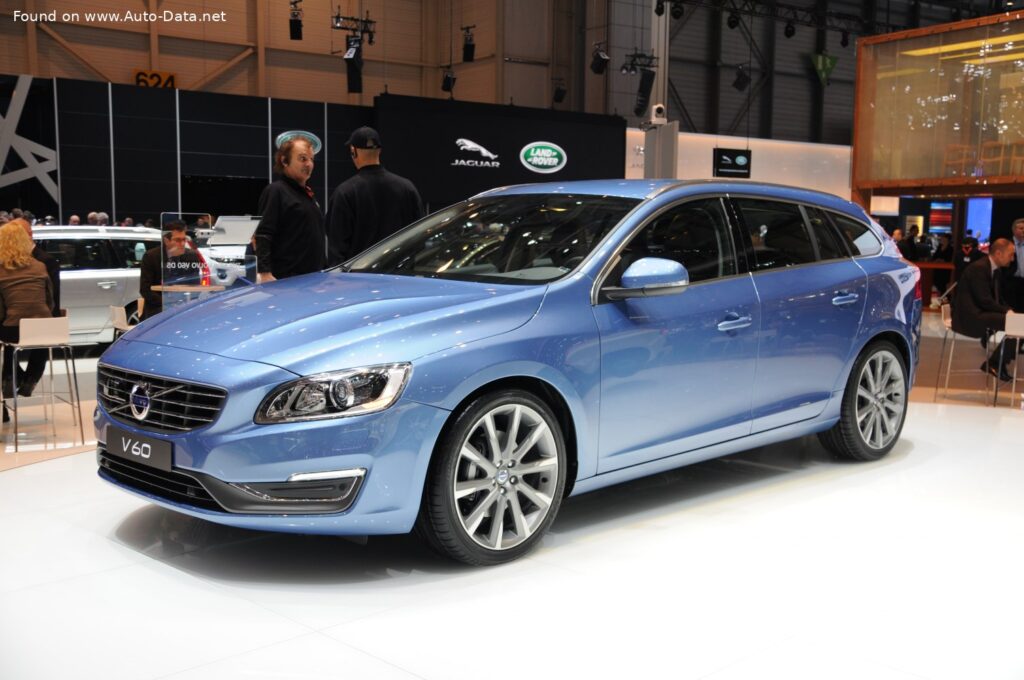
The Volvo V60 I (2013 Facelift) 2.0 T5: A Premium Sports Wagon Refined
The Volvo V60 I (2013 facelift) 2.0 T5 represents a pivotal moment in the evolution of Volvo’s premium mid-size estate, showcasing a comprehensive refresh that combined significant aesthetic and technological updates with a proven and potent powertrain. Launched as part of the extensively revised 60 series lineup for the 2014 model year, with production commencing in 2013, this particular variant deftly navigated the transition between Volvo’s historical engine-sharing strategies and its future independent powertrain development. The V60 itself was strategically positioned as a sophisticated sports wagon, engineered to captivate buyers who desired the inherent practicality and versatility of an estate vehicle without compromising on dynamic styling, engaging driving dynamics, or a driver-focused experience. In its primary market of Europe, it directly competed with established German rivals such as the BMW 3 Series Touring and the Audi A4 Avant, offering a distinctively Scandinavian interpretation of the premium family hauler.
Design Evolution and Facelift Enhancements
The 2013 facelift marked the most substantial visual and technological overhaul for the first-generation V60 since its inception. Externally, the car adopted a more cohesive, sophisticated, and assertive appearance, aligning with Volvo’s evolving contemporary design language. The most striking transformation occurred at the front, where the previous generation’s distinctive, somewhat polarizing twin-headlamp design was elegantly replaced by a more streamlined, single-piece headlight unit. This new assembly seamlessly integrated LED daytime running lights, contributing to a more modern and upscale aesthetic. The front grille was also widened, featuring more prominent horizontal bars that visually lowered the car’s stance, giving it a more planted and confident road presence. Both the front and rear bumpers were meticulously restyled, resulting in a cleaner, more streamlined look that enhanced the vehicle’s aerodynamic profile. Furthermore, a thoughtful detail improvement involved relocating the visible washer nozzles to be discreetly hidden under the bonnet, underscoring Volvo’s commitment to refined aesthetics and attention to detail. These exterior revisions were instrumental in successfully modernizing the V60’s design, elevating its premium appeal and ensuring its competitiveness in a fiercely contested segment.
The interior of the facelifted V60 also benefited from a series of crucial technological and ergonomic enhancements. The most significant innovation was the introduction of the Adaptive Digital Display, a fully configurable TFT (Thin-Film Transistor) crystal screen that replaced the traditional analog instrument cluster. This advanced system allowed the driver unprecedented personalization, offering three distinct display themes: “Elegance,” which presented a classic, minimalist layout; “Eco,” designed to highlight fuel efficiency metrics and encourage economical driving; and “Performance,” featuring a prominent central tachometer and a real-time power meter for a more dynamic driving experience. The cabin environment was further elevated through refined material choices, including new upholstery options and updated trim accents, reinforcing Volvo’s reputation for Scandinavian luxury. The Sensus infotainment system received a significant update, offering improved connectivity features, a more intuitive user interface, and enhanced functionality. Despite these modernizations, the signature Volvo “floating” center stack remained a central design feature, widely praised for its unique aesthetic, logical button layout, and driver-centric orientation.
Engine and Performance of the Volvo V60 I (2013 Facelift) 2.0 T5
At the heart of this specific Volvo V60 I (2013 facelift) 2.0 T5 model lies the B4204T7 engine, a robust 2.0-liter (1999 cc) inline-four cylinder unit. This particular engine holds a significant place in Volvo’s powertrain history, as it was a notable member of the Ford EcoBoost family, a legacy of Volvo’s tenure under Ford ownership and the subsequent transitional period. Engineered for a harmonious balance of performance and fuel efficiency, the engine features advanced technologies such as direct fuel injection and a sophisticated turbocharger equipped with an intercooler. These elements combine to produce a substantial 240 horsepower at 5500 rpm, delivering brisk acceleration and confident highway cruising capabilities. Peak torque stands at an impressive 320 Nm (approximately 236 lb-ft), a key characteristic of this engine being its remarkably wide and flat torque curve. Maximum torque is available from a low 1800 rpm and sustained all the way up to 5000 rpm, ensuring strong, linear acceleration and effortless overtaking in a wide range of real-world driving situations. The power-per-liter figure of 120.1 Hp/l was highly competitive for its era, serving as a testament to the efficiency and effectiveness of its forced-induction technology.
This potent power is seamlessly transmitted to the front wheels through a 6-speed Geartronic automatic transmission. This torque-converter gearbox was meticulously programmed to deliver smooth, unobtrusive shifts during normal driving, thereby significantly enhancing overall ride comfort and refinement. However, it was also capable of responding quickly and decisively to more spirited driver inputs, providing a more engaging driving experience when desired. The synergy between the 240-horsepower engine and the responsive automatic gearbox enables the V60 T5 to accelerate from 0 to 100 km/h (0 to 62 mph) in a respectable 7.7 seconds, a performance figure that firmly upholds its “sports wagon” moniker. Despite its performance credentials, the vehicle achieved a combined fuel consumption rating of 8.2 liters per 100 kilometers (approximately 28.7 miles per gallon US) and proudly complied with the stringent Euro 5 emission standard, showcasing Volvo’s commitment to environmental responsibility alongside dynamic capability.
Chassis, Handling, and Uncompromised Safety
The first-generation V60 was built upon the robust Ford EUCD platform, a versatile architecture that also underpinned other successful Volvo models such as the S60 sedan and the XC60 crossover. Volvo’s chassis engineers meticulously tuned this platform to deliver a dynamic yet inherently comfortable driving experience, a hallmark of the brand. The suspension setup, featuring MacPherson struts at the front and a sophisticated multi-link arrangement at the rear, offered a superb balance between absorbing road imperfections and maintaining composure and stability during enthusiastic cornering. The traditional rack-and-pinion steering system provided decent feedback to the driver, ensuring predictable responses and a reassuring sense of control. The kerb weight of 1696 kg (approximately 3739 pounds) contributed to a solid, planted, and secure feel on the road, further enhancing driver confidence.
As is synonymous with the Volvo brand, safety was an unequivocally paramount consideration in the V60’s design and engineering. The 2013 facelift model came standard with an advanced iteration of City Safety, Volvo’s groundbreaking autonomous emergency braking system. This system was capable of preventing or significantly mitigating low-speed collisions at speeds up to 50 km/h (31 mph), a pioneering feature for its time. The reinforced passenger safety cell, a fundamental element of Volvo engineering, was meticulously designed to protect occupants in a wide array of impact scenarios, including frontal, side, and rear collisions. Furthermore, a comprehensive suite of active safety systems was available, solidifying the V60’s position as a leader in vehicle safety within its class. These advanced technologies included the Blind Spot Information System (BLIS), which alerted the driver to vehicles in their blind spots; Cross Traffic Alert, invaluable when reversing out of parking spaces; Lane Keeping Aid, which gently steered the car back into its lane if it drifted unintentionally; and Adaptive Cruise Control, which automatically maintained a set distance from the vehicle ahead. Anti-lock brakes (ABS) and advanced stability control systems were, of course, standard equipment, providing an additional layer of active safety and control.
Technical Specifications
| Category | Specification |
|---|---|
| Model Year | 2014 (Production started 2013) |
| Vehicle Type | Premium Mid-Size Estate / Sports Wagon |
| Engine Code | B4204T7 (Ford EcoBoost family) |
| Engine Type | 2.0-liter (1999 cc) Inline-Four Cylinder |
| Fuel System | Direct Fuel Injection |
| Induction | Turbocharger with Intercooler |
| Horsepower | 240 HP @ 5500 rpm |
| Torque | 320 Nm (approx. 236 lb-ft) @ 1800-5000 rpm |
| Power-per-liter | 120.1 Hp/l |
| Transmission | 6-speed Geartronic Automatic |
| Drivetrain | Front-Wheel Drive (FWD) |
| 0-100 km/h (0-62 mph) | 7.7 seconds |
| Combined Fuel Consumption | 8.2 l/100 km (approx. 28.7 mpg US) |
| Emissions Standard | Euro 5 |
| Platform | Ford EUCD |
| Front Suspension | MacPherson Struts |
| Rear Suspension | Multi-link |
| Steering | Rack-and-Pinion |
| Kerb Weight | 1696 kg (approx. 3739 lbs) |
| Standard Safety Features | City Safety (up to 50 km/h / 31 mph), ABS, Stability Control |
| Available Safety Features | BLIS, Cross Traffic Alert, Lane Keeping Aid, Adaptive Cruise Control |
Legacy and Market Impact
The Volvo V60 I (2013 facelift) 2.0 T5 played a crucial role in maintaining Volvo’s strong presence in the premium mid-size segment, particularly in its primary European market. Its refreshed design and enhanced technology helped to solidify its reputation as a stylish, safe, and dynamically capable alternative to the established German luxury brands. While perhaps not achieving the sheer volume of its rivals like the BMW 3 Series Touring or Audi A4 Avant, the V60 carved out a significant niche, appealing to buyers who valued Volvo’s unique blend of sophisticated Scandinavian design, industry-leading safety innovations, and a more understated yet equally premium driving experience. Its focus on comfort, refinement, and practical utility, combined with the energetic performance of the T5 engine, made it a compelling proposition for families and professionals alike.
Historically, this specific V60 variant is significant for bridging a critical period in Volvo’s corporate development. It showcased the brand’s ability to take an externally sourced engine (the Ford EcoBoost) and integrate it seamlessly into its own distinct product philosophy, delivering performance and efficiency that met Volvo’s exacting standards. This model represented the peak refinement of the first-generation V60 before Volvo transitioned entirely to its new Scalable Product Architecture (SPA) and its own family of Drive-E powertrains. As such, it stands as a testament to Volvo’s engineering prowess and its commitment to continuous improvement, even during periods of significant corporate change. The V60 I’s legacy is one of a well-executed sports wagon that successfully balanced practicality with passion, solidifying Volvo’s image as a forward-thinking premium automaker that never compromises on its core values of safety, quality, and human-centric design.