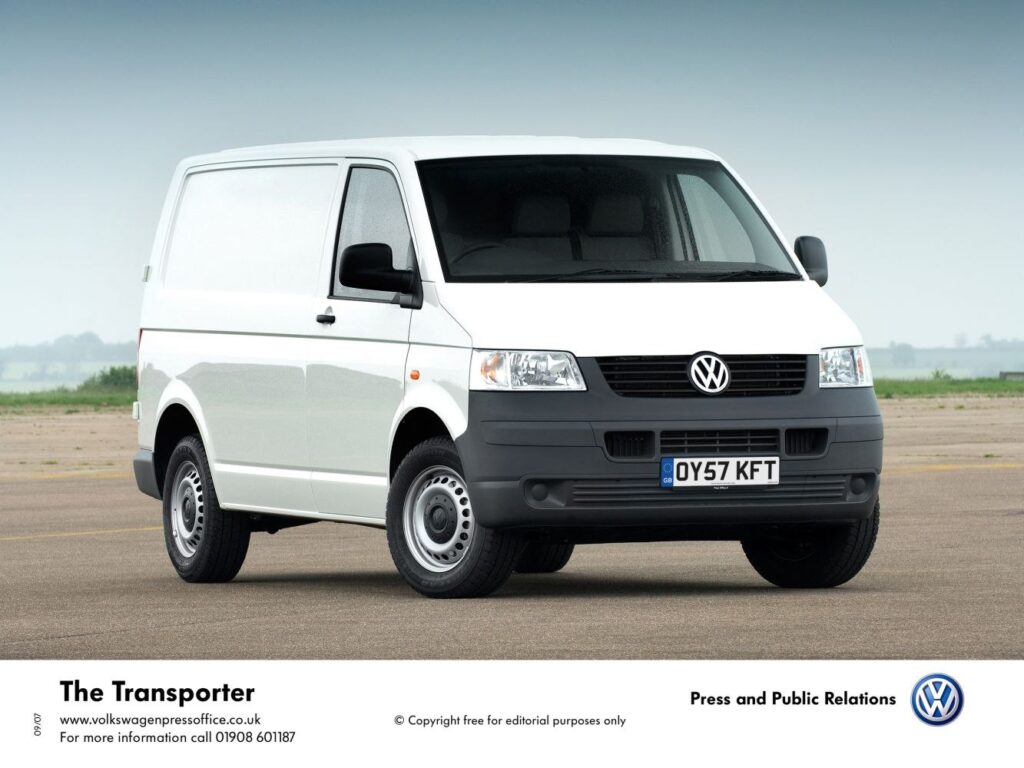
Volkswagen Transporter (T5) Panel Van 2.0 (116 Hp) L2H2
The Volkswagen Transporter (T5) Panel Van 2.0 (116 Hp) L2H2 represents a specific and highly practical configuration of the fifth-generation Volkswagen Transporter. This iconic light commercial vehicle, produced by the renowned German automaker, served as a cornerstone of commercial fleets across Europe and many international markets from 2003 to 2009. While not officially sold in the United States, the T5 continued Volkswagen’s celebrated tradition of robust and versatile vans, building upon the legacy of its predecessors like the T1 “Bus” and subsequent generations. This particular variant, the L2H2, was engineered to maximize cargo volume and utility, making it an indispensable tool for tradespeople, delivery services, and businesses requiring substantial load-carrying capabilities combined with Volkswagen’s reputation for reliability and practical design. Its naturally aspirated petrol engine offered a straightforward and dependable alternative in a market increasingly dominated by diesel powertrains.
Engine and Performance of the Volkswagen Transporter (T5) Panel Van
Powering the Volkswagen Transporter (T5) Panel Van 2.0 (116 Hp) L2H2 is a 2.0-liter, four-cylinder, naturally aspirated petrol engine, identified by the internal code AXA and belonging to the venerable EA113 engine family. This powerplant was a testament to Volkswagen’s commitment to offering diverse powertrain options, providing a simpler, often lower-cost alternative to the more prevalent TDI diesel engines favored in the European commercial vehicle sector. It delivers a respectable 116 horsepower (85 kW) at 5200 rpm, coupled with a peak torque of 170 Nm (approximately 125 lb-ft) available across a broad and usable range from 2700 to 4700 rpm.
The engine’s design prioritizes durability and mechanical simplicity over outright performance, featuring a Single Overhead Camshaft (SOHC) valvetrain with two valves per cylinder and utilizing a multi-port manifold injection system. This configuration contributed to its reputation for longevity and ease of maintenance, crucial attributes for a vehicle destined for demanding commercial use.
In terms of driving dynamics, the T5 L2H2 with this petrol engine was engineered for function rather than speed. It accelerates from 0 to 100 km/h (approximately 0-62 mph) in 17.9 seconds and achieves a maximum speed of 158 km/h (about 98 mph). While these figures may seem modest by passenger car standards, they were perfectly adequate for the van’s intended duties, which primarily involved urban and suburban deliveries and logistical support. The engine is exclusively paired with a 5-speed manual transmission, directing power efficiently to the front wheels, a standard and effective drivetrain layout for the Transporter range. The vehicle also complied with the Euro 4 emission standard, reflecting its contemporary environmental considerations. Its extra-urban fuel consumption was rated at 8.4 liters per 100 kilometers (approximately 28 miles per gallon), and the substantial 80-liter (21.1-gallon) fuel tank ensured a considerable operating range, minimizing downtime for refueling.
Design and Features: The L2H2 Configuration
The L2H2 designation is central to understanding the utility and design philosophy of this particular Volkswagen Transporter variant. “L2” signifies the long wheelbase, measuring 3400 mm (133.9 inches), a significant extension compared to the standard L1’s 3000 mm (118.1 inches). This extended wheelbase contributes directly to the vehicle’s substantial overall length of 5290 mm (208.3 inches), providing a larger and more stable platform for cargo. “H2” denotes the high roof, which increases the vehicle’s total height to 2160 mm (85.0 inches). This combination of length and height dramatically defines its primary function: to offer an expansive and practical load area.
The result of this L2H2 configuration is an impressive maximum cargo volume of 7.8 cubic meters (7800 liters or approximately 275 cubic feet). This generous volume positioned it as one of the most capacious options in the mid-size van segment of its era, making it ideally suited for tradespeople, artisans, and delivery services that needed to transport bulky, albeit not necessarily excessively heavy, items. Access to this vast cargo area is facilitated by a standard sliding door on the passenger side, alongside symmetrical twin rear barn doors. These doors open wide, allowing for easy loading and unloading, even with forklifts for palletized goods, enhancing its operational efficiency.
The cabin of the Volkswagen Transporter (T5) Panel Van is typically utilitarian, designed with an emphasis on durability, functionality, and driver ergonomics for long working hours. It typically offers seating for a driver and one or two passengers, depending on the specific configuration, with hard-wearing materials chosen to withstand the rigors of daily commercial use.
Underpinning the T5 L2H2 is a sophisticated chassis and suspension system, designed to strike a balance between robust load-carrying capability and commendable driver comfort. Unusually for a commercial vehicle of its period, the T5 platform employs an independent suspension system on all four corners. The front features a McPherson strut setup with a coil spring and an anti-roll bar, while the rear utilizes an independent trailing arm design, also with coil springs and a stabilizer. This advanced setup provides a more composed ride and superior handling characteristics compared to the more traditional leaf-spring rear suspensions found on many rivals, particularly noticeable when the van is unladen. Braking performance is assured by ventilated disc brakes on both the front (308 mm / 12.1 inches) and rear (294 mm / 11.6 inches) axles, with an Anti-lock Braking System (ABS) included as a standard safety feature, crucial for maintaining control under heavy braking or adverse conditions. The hydraulic power-assisted rack-and-pinion steering system yields a minimum turning circle of 13.2 meters (43.3 feet), a respectable figure for a vehicle of its length, significantly aiding maneuverability in tight urban environments and loading docks.
In terms of capacity, the L2H2 model boasts a Gross Vehicle Weight Rating (GVWR) of 2850 kg (6283 lbs). With a kerb weight ranging from 1845 kg (4068 lbs) to 2048 kg (4515 lbs) depending on optional equipment, its maximum payload capacity falls between 802 kg (1768 lbs) and 1005 kg (2216 lbs). This broad payload range makes it suitable for a wide array of logistics and trade applications. Furthermore, its towing capabilities are noteworthy, rated at 2000 kg (4409 lbs) for a braked trailer on a 12% gradient, and 750 kg (1653 lbs) for an unbraked trailer, further enhancing its versatility for businesses that require additional hauling capacity.
Technical Specifications
| Category | Specification |
|---|---|
| Model | Volkswagen Transporter (T5) Panel Van 2.0 (116 Hp) L2H2 |
| Production Years | 2003 – 2009 |
| Body Type | Panel Van (L2H2 – Long Wheelbase, High Roof) |
| Engine Type | 2.0-liter, 4-cylinder, naturally aspirated petrol (AXA, EA113 family) |
| Valvetrain | SOHC, 2 valves per cylinder, Multi-port manifold injection |
| Horsepower (HP) | 116 hp (85 kW) at 5200 rpm |
| Torque | 170 Nm (125 lb-ft) at 2700-4700 rpm |
| 0-100 km/h (0-62 mph) | 17.9 seconds |
| Maximum Speed | 158 km/h (98 mph) |
| Transmission | 5-speed Manual |
| Drivetrain | Front-Wheel Drive (FWD) |
| Emissions Standard | Euro 4 |
| Extra-Urban Fuel Consumption | 8.4 L/100km (approx. 28 MPG) |
| Fuel Tank Capacity | 80 liters (21.1 gallons) |
| Wheelbase (L2) | 3400 mm (133.9 inches) |
| Overall Length | 5290 mm (208.3 inches) |
| Overall Height (H2) | 2160 mm (85.0 inches) |
| Cargo Volume | 7.8 cubic meters (7800 liters / 275 cubic feet) |
| Front Suspension | McPherson strut, coil spring, anti-roll bar |
| Rear Suspension | Independent trailing arm, coil springs, stabilizer |
| Front Brakes | Ventilated Disc (308 mm / 12.1 inches) |
| Rear Brakes | Ventilated Disc (294 mm / 11.6 inches) |
| Safety Features | ABS (Anti-lock Braking System) |
| Steering Type | Hydraulic power-assisted rack-and-pinion |
| Minimum Turning Circle | 13.2 meters (43.3 feet) |
| Gross Vehicle Weight Rating (GVWR) | 2850 kg (6283 lbs) |
| Kerb Weight | 1845 kg – 2048 kg (4068 lbs – 4515 lbs) |
| Maximum Payload Capacity | 802 kg – 1005 kg (1768 lbs – 2216 lbs) |
| Towing Capacity (Braked, 12% gradient) | 2000 kg (4409 lbs) |
| Towing Capacity (Unbraked) | 750 kg (1653 lbs) |
Legacy and Market Impact
The Volkswagen Transporter T5, and particularly its highly versatile panel van configurations like the L2H2, carved out a significant legacy in the light commercial vehicle segment. While the T5 never officially crossed the Atlantic to the American market, its impact across Europe, Asia, and other international territories was profound. It continued Volkswagen’s unbroken tradition of producing segment-defining vans that began with the original Type 2 (T1) in the 1950s. The T5 was celebrated for its robust build quality, comfortable and car-like driving experience (a significant improvement over many rivals), and its sheer adaptability to a multitude of commercial applications.
In its primary markets, the Transporter T5 faced stiff competition from established players such as the Ford Transit, Mercedes-Benz Vito/Sprinter, Renault Trafic, and Opel Vivaro. However, the T5 consistently held its own, often being lauded for its superior ergonomics, refined ride, and strong residual values. The availability of diverse engine options, including this reliable 2.0-liter petrol unit, meant it could cater to a wide range of operational needs and budgets, from small businesses needing a simple workhorse to larger fleets prioritizing efficiency and driver comfort.
The L2H2 configuration, with its extended wheelbase and high roof, was especially crucial for businesses requiring maximum load space without stepping up to a larger, heavier commercial vehicle. Its impressive cargo volume and payload, combined with decent towing capabilities, made it a true multi-purpose vehicle. Tradespeople, from plumbers and electricians to carpenters and delivery drivers, relied on the T5 L2H2 for its ability to transport tools, materials, and goods efficiently and securely. Its independent suspension all-around was a notable differentiator, offering a smoother ride and better handling than many competitors, which often utilized simpler, leaf-spring rear axles. This enhanced driver comfort, a key factor for professionals spending long hours on the road.
The Volkswagen Transporter T5’s reputation for mechanical dependability and its practical design ensured it remained a popular choice throughout its production run and continued to be a highly sought-after used vehicle for many years thereafter. It solidified the Transporter’s position as a premium offering in the commercial van segment, blending passenger car refinement with commercial vehicle toughness. The T5’s success laid a strong foundation for its successor, the T6, ensuring that the Transporter line remains a benchmark for light commercial vehicles globally, continuing to adapt and innovate to meet the evolving demands of businesses worldwide.