The Renault Espace IV 1.9 dCi (120 Hp): A Pillar of European MPV Design
The Renault Espace IV 1.9 dCi (120 Hp) represents a significant chapter in the history of the European multi-purpose vehicle (MPV) segment. Produced by the French automaker Renault between 2002 and 2006, this iteration of the Espace continued the model’s pioneering legacy, which began with the original Espace in 1984. The fourth-generation Espace, often simply referred to as Espace IV, brought a fresh design language, enhanced technology, and improved practicality to the market. While never officially sold in the United States, the Espace IV was a cornerstone of family transportation across Europe, offering a compelling blend of spaciousness, versatility, and efficiency, particularly with its popular diesel engine options like the 1.9 dCi variant.
This particular model, equipped with the 1.9 dCi engine producing 120 horsepower, was a workhorse for many families and businesses. It highlighted Renault’s commitment to diesel technology, which was highly favored in Europe for its fuel economy and torque characteristics, especially in larger vehicles. The Espace IV moved away from its predecessor’s more rounded aesthetic, adopting a bolder, more contemporary design that emphasized its substantial interior volume and sophisticated presence on the road. It competed fiercely in a crowded segment, setting benchmarks for comfort, safety, and modular interior design.
Powertrain and Performance of the Renault Espace IV 1.9 dCi (120 Hp)
At the heart of this particular Espace IV model was Renault’s widely utilized F9Q 1.9-liter dCi (direct common rail injection) diesel engine. This inline four-cylinder powerplant, transversely mounted at the front, delivered 120 horsepower at 4000 rpm and a robust 199.14 lb.-ft. of torque at a low 2000 rpm. The inclusion of a turbocharger and intercooler was crucial, not only for boosting power output from its 114.11 cubic inch (1870 cm³) displacement but also for ensuring a broad, usable torque band, which is vital for a vehicle designed to carry up to seven passengers and their luggage.
Power was channeled to the front wheels via a smooth-shifting 6-speed manual transmission, a common and efficient choice for European vehicles of this type. This drivetrain architecture contributed to the vehicle’s impressive fuel economy figures: an estimated 34.6 US mpg combined, with highway driving potentially yielding up to 40.6 US mpg. Such efficiency was a major selling point in markets where fuel costs were a significant consideration for families. Despite its considerable curb weight of 3902.18 pounds, the Espace IV 1.9 dCi could accelerate from 0 to 60 mph in a respectable 12.5 seconds, reaching a maximum speed of 111.85 mph. These figures underscored its capability as a family hauler, prioritizing steady cruising and load-carrying ability over outright sprint performance. The engine met the Euro 3 emission standard, reflecting the environmental regulations of its time.
Exterior Design and Interior Versatility
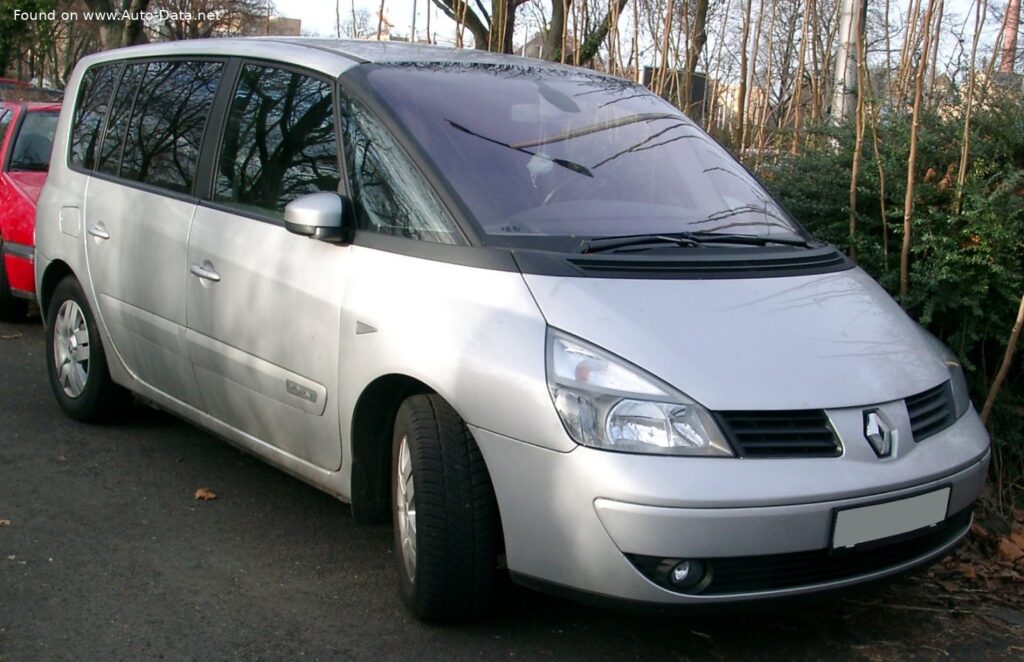
The Renault Espace IV marked a distinct evolution in the model’s design philosophy. Moving past the more organic shapes of previous generations, the Espace IV adopted a more angular, yet still flowing, aesthetic. Its large glass areas and prominent front grille gave it a commanding road presence. At 183.5 inches long, 73.23 inches wide (82.83 inches including mirrors), and between 68.03 to 70.16 inches tall, the Espace IV was a substantial vehicle, designed from the ground up to maximize interior space and passenger comfort. Its wheelbase of 110.35 inches contributed to a stable ride and generous cabin room.
However, it was the interior where the Espace truly shone. As a 5-door minivan or MPV with seating for seven, its strength lay in its remarkable modularity. Individual seats in the second and third rows could be slid, folded, or even removed entirely, allowing for countless configurations to suit varying passenger and cargo needs. Minimum trunk space started at 10.28 cubic feet, but with the rear seats removed, this expanded to an cavernous 101 cubic feet, transforming the Espace into a highly practical cargo carrier. This flexibility, combined with a comfortable and airy cabin environment, made it an ideal choice for large families or those requiring significant load-carrying capacity. Safety features, including an Anti-lock Braking System (ABS), were standard, reflecting the growing emphasis on occupant protection in the early 2000s. The hydraulic power steering system ensured ease of maneuverability despite the vehicle’s size, with a turning circle of 37.07 feet.
Technical Specifications: Renault Espace IV 1.9 dCi (120 Hp) (2002-2006)
The following table details the key technical specifications for the Renault Espace IV 1.9 dCi (120 Hp) produced between 2002 and 2006:
| Category | Specification |
|---|---|
| General Information | |
| Brand | Renault |
| Model | Espace |
| Generation | Espace IV |
| Engine Type | 1.9 dCi (120 Hp) |
| Production Start | 2002 |
| Production End | 2006 |
| Body Type | Minivan, MPV |
| Seats | 7 |
| Doors | 5 |
| Performance Specs | |
| Fuel Consumption (Urban) | 27.4 US mpg (8.6 l/100 km) |
| Fuel Consumption (Extra Urban) | 40.6 US mpg (5.8 l/100 km) |
| Fuel Consumption (Combined) | 34.6 US mpg (6.8 l/100 km) |
| CO2 Emissions | 183 g/km |
| Fuel Type | Diesel |
| Acceleration 0-60 mph | 12.5 seconds |
| Maximum Speed | 111.85 mph (180 km/h) |
| Emission Standard | Euro 3 |
| Weight-to-Power Ratio | 14.8 kg/Hp |
| Engine Specs | |
| Power | 120 Hp @ 4000 rpm |
| Torque | 199.14 lb.-ft. @ 2000 rpm (270 Nm) |
| Engine Layout | Front, Transverse |
| Engine Model/Code | F9Q |
| Engine Displacement | 1.9 Liters (1870 cm³, 114.11 cu. in.) |
| Number of Cylinders | 4, Inline |
| Cylinder Bore | 3.15 in. (80 mm) |
| Piston Stroke | 3.66 in. (93 mm) |
| Compression Ratio | 18.3:1 |
| Valves per Cylinder | 2 |
| Fuel Injection System | Diesel Commonrail |
| Engine Aspiration | Turbocharger, Intercooler |
| Engine Oil Capacity | 5.07 US qt (4.8 l) |
| Coolant Capacity | 9.83 US qt (9.3 l) |
| Dimensions, Volume, Weights | |
| Kerb Weight | 3902.18 lbs. (1770 kg) |
| Maximum Weight | 5522.58 lbs. (2505 kg) |
| Maximum Load | 1620.4 lbs. (735 kg) |
| Trunk Space (Minimum) | 10.28 cu. ft. (291 l) |
| Trunk Space (Maximum) | 101 cu. ft. (2860 l) |
| Fuel Tank Capacity | 21.93 US gal (83 l) |
| Maximum Roof Load | 176.37 lbs. (80 kg) |
| Permitted Trailer Load (with brakes) | 4409.25 lbs. (2000 kg) |
| Permitted Trailer Load (without brakes) | 1620.4 lbs. (735 kg) |
| Length | 183.5 in. (4661 mm) |
| Width | 73.23 in. (1860 mm) |
| Width (incl. mirrors) | 82.83 in. (2104 mm) |
| Height | 68.03 – 70.16 in. (1728 – 1782 mm) |
| Wheelbase | 110.35 in. (2803 mm) |
| Front Track | 61.97 in. (1574 mm) |
| Rear Track | 61.26 in. (1556 mm) |
| Front Overhang | 40.39 in. (1026 mm) |
| Rear Overhang | 32.76 in. (832 mm) |
| Ground Clearance | 6.89 in. (175 mm) |
| Drag Coefficient (Cd) | 0.35 |
| Minimum Turning Circle | 37.07 ft. (11.3 m) |
| Drivetrain, Brakes, Suspension | |
| Drive Wheel | Front-wheel drive |
| Gearbox Type | 6-speed manual transmission |
| Front Suspension | Independent, McPherson Strut |
| Rear Suspension | Torsion Beam |
| Front Brakes | Ventilated Discs |
| Rear Brakes | Disc |
| Assisting Systems | ABS (Anti-lock Braking System) |
| Steering Type | Rack and Pinion |
| Power Steering | Hydraulic Steering |
| Tire Sizes | 225/60 R16; 225/55 R17 |
| Wheel Rim Sizes | 16; 17 inches |
Legacy and Market Impact of the Renault Espace IV
The Renault Espace IV, particularly in its 1.9 dCi (120 Hp) guise, continued the model line’s tradition as a highly respected and influential MPV in the European market. Since its inception, the Espace has been synonymous with innovation in family transportation, essentially defining the modern European minivan segment. The fourth generation built upon this heritage, introducing a more robust and premium feel while retaining the practicality and versatility that customers expected.
In Europe, the Espace IV faced stiff competition from rivals such as the Ford Galaxy, Volkswagen Sharan, Citroën C8, and Peugeot 807. What set the Espace apart was often its distinct French design flair, its emphasis on interior light and modularity, and a reputation for comfort on long journeys. The 1.9 dCi engine, while not the most powerful in the lineup, struck an excellent balance between performance, running costs, and reliability, making it a popular choice for families and fleet operators alike. Its diesel powertrain offered the kind of low-end torque and fuel efficiency that was highly valued in European driving conditions, from city commutes to extended highway trips across continents.
The Espace IV’s impact extended beyond just sales figures; it influenced how other manufacturers approached MPV design, particularly in terms of flexible seating arrangements and integrated storage solutions. While it never crossed the Atlantic to the American market, primarily due to different consumer preferences favoring SUVs and larger domestic minivans, its principles of maximizing interior space within a relatively compact footprint resonated deeply with European buyers. The Espace IV cemented Renault’s position as a leader in the segment for several years, embodying a blend of practicality, comfort, and distinctive style that many European families came to appreciate. Its legacy endures as a testament to thoughtful engineering aimed at the specific needs of its primary market.