The Volvo V60 I (2013 facelift) 2.0 T6 (306 Hp) Automatic: A Blend of Swedish Sophistication and Potent Performance
The Volvo V60, introduced in 2010, marked a significant chapter in the Swedish automaker’s commitment to combining practical utility with dynamic styling and advanced engineering. The first generation, designated V60 I, received a notable facelift in 2013, refining its aesthetics and introducing a new generation of powertrains. Among these, the Volvo V60 I (2013 facelift) 2.0 T6 (306 Hp) Automatic stood out as a particularly compelling offering, showcasing Volvo’s innovative Drive-E engine strategy and positioning the V60 as a formidable contender in the premium mid-size station wagon segment. This particular variant, produced from 2014 to 2018, embodied Volvo’s evolving design language and its unwavering focus on safety, comfort, and now, exhilarating performance.
Engine and Performance: The Drive-E Revolution in the Volvo V60 I (2013 facelift)
At the heart of the V60 I (2013 facelift) 2.0 T6 lies Volvo’s groundbreaking Drive-E powertrain architecture, a testament to the brand’s engineering prowess. Eschewing the traditional larger displacement engines often associated with “T6” badging, Volvo introduced a highly sophisticated 2.0-liter (1969 cm³) inline four-cylinder engine. What truly set this engine apart was its innovative twin-charging system, employing both a supercharger and a turbocharger, augmented by an intercooler. This ingenious setup delivered immediate throttle response at low RPMs thanks to the supercharger, which then seamlessly handed off to the turbocharger for sustained power at higher engine speeds, effectively eliminating turbo lag and providing a broad, flat torque curve.
The result was an impressive output of 306 horsepower at 5700 rpm, translating to a remarkable 155.4 horsepower per liter – a figure typically seen in much more specialized performance vehicles. Torque was equally robust, peaking at 295.02 lb.-ft. (400 Nm) across a wide band from 1500 to 4500 rpm, ensuring potent acceleration in nearly any driving scenario. Mated to an advanced 8-speed automatic transmission, this powertrain channeled its power to the front wheels (Front Wheel Drive architecture), allowing the V60 T6 to sprint from 0 to 60 mph in a swift 5.7 seconds (0-100 km/h in 6 seconds) and achieve a top speed of 142.92 mph (230 km/h). Despite its high performance, the Drive-E engine also boasted impressive fuel economy for its class, with a combined rating of 35.1 US mpg (6.7 l/100 km) and CO2 emissions of 157 g/km, showcasing Volvo’s commitment to efficiency without compromising on driving enjoyment.
Design and Features: Scandinavian Elegance Meets Practicality
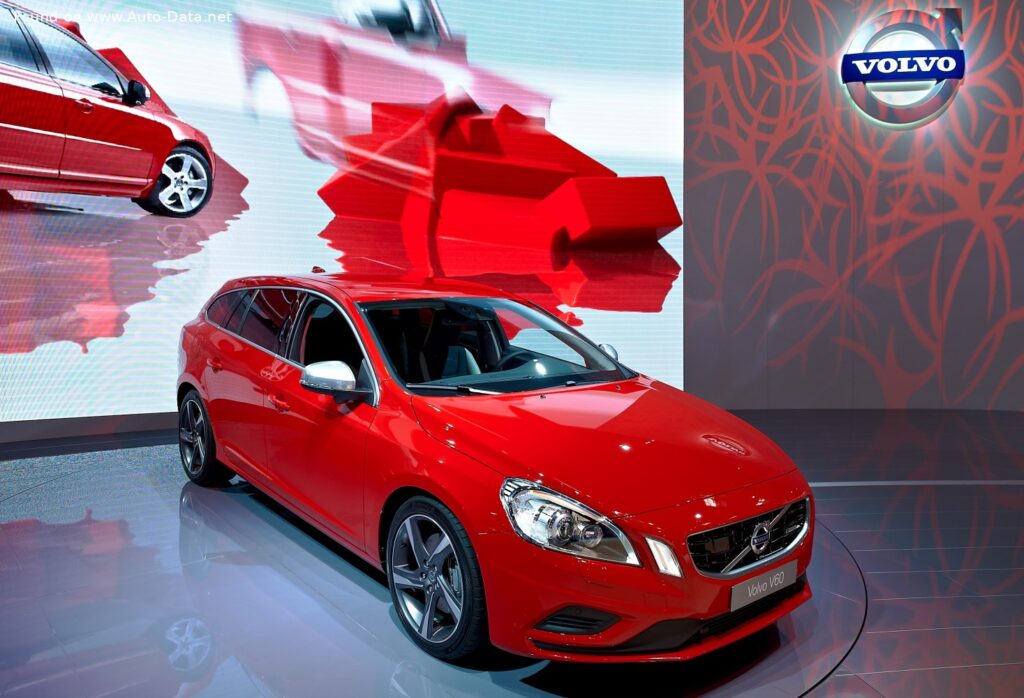
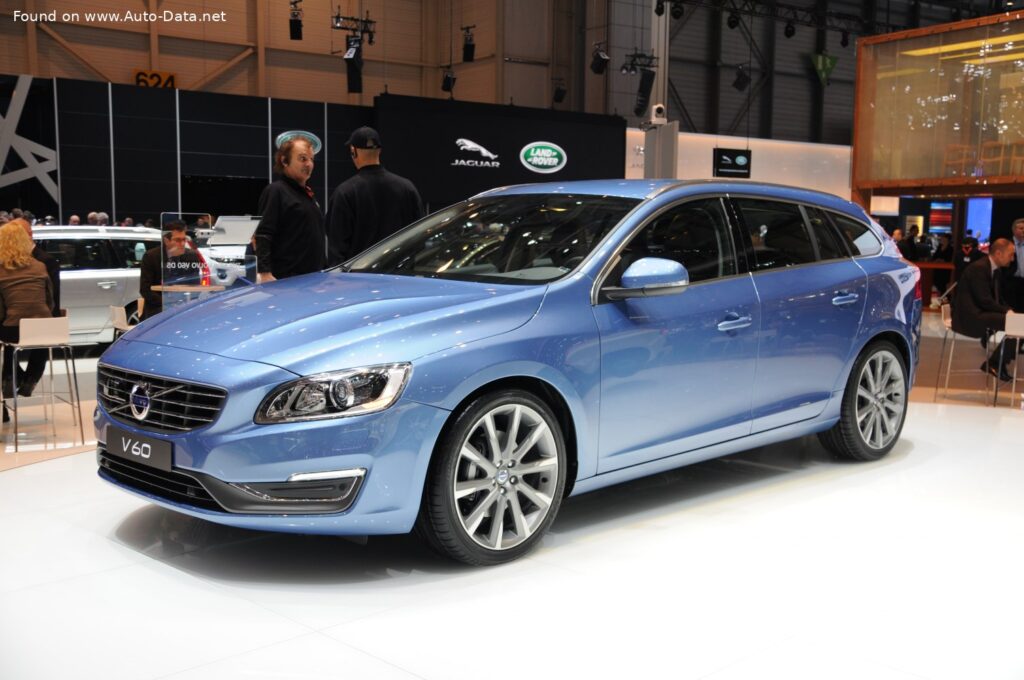
The 2013 facelift for the V60 I brought a series of refinements that enhanced its already appealing design. The “station wagon (estate)” body type retained its sleek, coupe-like profile, a departure from the boxy wagons of Volvo’s past, yet it never sacrificed practicality. The front fascia received a significant update, featuring a wider grille, redesigned headlights that integrated LED daytime running lights, and a more sculpted bumper, giving the car a more assertive and contemporary presence. Around the back, the V60 maintained its distinctive vertical taillights, a Volvo signature, but with updated internal graphics.
Inside, the V60 continued Volvo’s tradition of creating a driver-focused, ergonomically sound, and luxurious cabin. High-quality materials, meticulous craftsmanship, and intuitive controls defined the interior experience. Seating for five adults was comfortable, with particular attention paid to front-seat ergonomics, a long-standing Volvo hallmark. While the V60’s trunk space, at 15.19 cu. ft. (430 liters), was competitive within the segment, its emphasis was more on dynamic styling than outright cargo volume, appealing to buyers who valued aesthetics alongside utility. As a modern Volvo, safety features were paramount, even in 2014. While the specific list of assisting systems provided only mentions ABS (Anti-lock braking system), the V60 I generation was renowned for pioneering features like City Safety (automatic braking to prevent low-speed collisions), pedestrian detection, and a suite of advanced driver-assistance systems that contributed to its strong safety ratings globally. The steering system, a rack and pinion setup, provided precise and communicative feedback, complementing the car’s independent McPherson strut front and coil spring rear suspension for a balanced ride and handling.
Technical Specifications: Volvo V60 I (2013 facelift) 2.0 T6 (306 Hp) Automatic
| Category | Specification |
|---|---|
| Brand | Volvo |
| Model | V60 |
| Generation | V60 I (2013 facelift) |
| Type (Engine) | 2.0 T6 (306 Hp) Automatic |
| Start of Production | 2014 year |
| End of Production | 2018 year |
| Powertrain Architecture | Internal Combustion engine |
| Body type | Station wagon (estate) |
| Seats | 5 |
| Doors | 5 |
| Performance Specs | |
| Fuel consumption (urban) | 26.4 US mpg (8.9 l/100 km) |
| Fuel consumption (extra urban) | 43.6 US mpg (5.4 l/100 km) |
| Fuel consumption (combined) | 35.1 US mpg (6.7 l/100 km) |
| CO2 emissions | 157 g/km |
| Fuel Type | Petrol (Gasoline) |
| Acceleration 0 – 60 mph | 5.7 sec |
| Acceleration 0 – 100 km/h | 6 sec |
| Maximum speed | 142.92 mph (230 km/h) |
| Engine Specs | |
| Power | 306 Hp @ 5700 rpm |
| Power per liter | 155.4 Hp/l |
| Torque | 295.02 lb.-ft. (400 Nm) @ 1500-4500 rpm |
| Engine layout | Front, Transverse |
| Engine Model/Code | B4204T9 |
| Engine displacement | 120.16 cu. in. (1969 cm³) |
| Number of cylinders | 4 |
| Engine configuration | Inline |
| Cylinder Bore | 3.23 in. (82 mm) |
| Piston Stroke | 3.67 in. (93.2 mm) |
| Compression ratio | 10.3:1 |
| Number of valves per cylinder | 4 |
| Fuel injection system | Direct injection |
| Engine aspiration | Turbocharging and Supercharger, Intercooler |
| Valvetrain | DOHC |
| Engine oil capacity | 5.71 US qt (5.4 l) |
| Coolant capacity | 8.77 US qt (8.3 l) |
| Space, Volume and Weights | |
| Trunk (boot) space – minimum | 15.19 cu. ft. (430 l) |
| Fuel tank capacity | 17.83 US gal (67.5 l) |
| Dimensions | |
| Length | 182.48 in. (4635 mm) |
| Width | 74.76 in. (1899 mm) |
| Height | 58.43 in. (1484 mm) |
| Wheelbase | 109.29 in. (2776 mm) |
| Front track | 62.52 – 62.13 in. (1588-1578 mm) |
| Rear (Back) track | 62.4 – 62.01 in. (1585-1575 mm) |
| Ride height (ground clearance) | 5.35 in. (136 mm) |
| Minimum turning circle (turning diameter) | 37.73 – 40.68 ft. (11.5 – 12.4 m) |
| Drivetrain, Brakes and Suspension Specs | |
| Drivetrain Architecture | The Internal combustion engine (ICE) drives the front wheels of the vehicle. |
| Drive wheel | Front wheel drive |
| Number of gears and type of gearbox | 8 gears, automatic transmission |
| Front suspension | Independent, type McPherson with coil spring and anti-roll bar |
| Rear suspension | Independent coil spring |
| Front brakes | Ventilated discs |
| Rear brakes | Disc |
| Assisting systems | ABS (Anti-lock braking system) |
| Steering type | Steering rack and pinion |
Legacy and Market Impact
The Volvo V60 I (2013 facelift) 2.0 T6 (306 Hp) Automatic played a crucial role in redefining Volvo’s image, particularly in North America and other global markets where the brand sought to shed its conservative perception. This specific model demonstrated that Volvo could deliver not just unparalleled safety and comfort, but also genuine driving excitement and cutting-edge engine technology. The Drive-E T6 engine, with its twin-charging innovation, was a bold statement, proving that a smaller displacement four-cylinder could outperform larger V6 and even some V8 engines in terms of both power delivery and efficiency. This powertrain became a benchmark for future Volvo models, establishing a new direction for the brand’s engineering philosophy.
In the premium mid-size wagon segment, the V60 T6 competed against established rivals such as the BMW 3 Series Touring (F31), Audi A4 Avant (B8/B9), and the Mercedes-Benz C-Class Wagon (S205). While these German competitors often offered more diverse powertrain options, the V60 T6 carved out a niche for itself with its unique Scandinavian luxury, distinctive design, and an emphasis on holistic safety that was, and remains, a Volvo hallmark. Its front-wheel-drive configuration (though AWD was available on other T6 variants) appealed to buyers prioritizing efficiency and confident handling, while the powerful engine ensured it was never found wanting in performance.
The V60’s reputation grew among families and enthusiasts alike, appreciated for its practical five-door, five-seat layout combined with a sporty demeanor. It represented a sophisticated alternative to SUVs, offering a lower center of gravity and more engaging driving dynamics without sacrificing much in terms of utility for most users. The 2013 facelifted V60 T6 is remembered as a pivotal model that helped cement Volvo’s modern identity: a purveyor of safe, stylish, and technologically advanced vehicles that are also genuinely enjoyable to drive. Its legacy is evident in the continued success of the V60 lineage and Volvo’s ongoing commitment to innovative powertrain solutions and elegant design.