The Renault Espace IV 2.0i Turbo 16V (163 Hp): A European Minivan Icon
The Renault Espace IV, introduced in 2002, represented the fourth generation of Renault’s pioneering Multi-Purpose Vehicle (MPV), a segment that the French automaker largely popularized in Europe. This particular variant, the Renault Espace IV 2.0i Turbo 16V (163 Hp), was a key offering in the lineup from its production start in 2002 until 2005. Designed as a spacious and versatile family hauler, the Espace IV continued its predecessors’ legacy of innovation, offering a sophisticated blend of comfort, practicality, and driving dynamics tailored for the European market. While never officially sold in the United States, the Espace series played a crucial role in shaping the perception and acceptance of minivans across the Atlantic, influencing automotive design and consumer expectations for family vehicles.
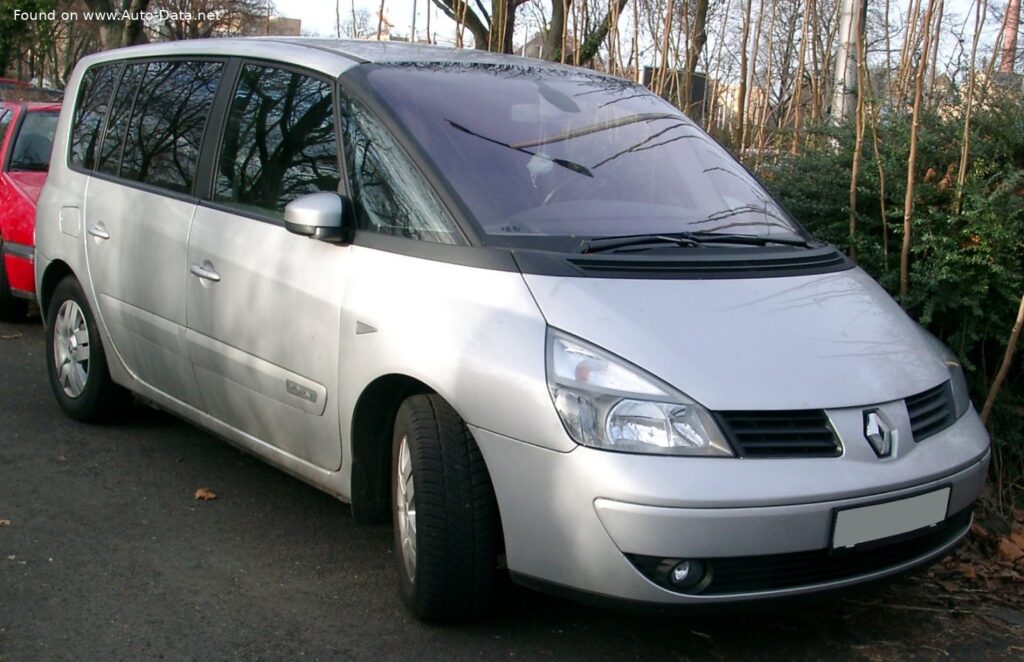
The Espace IV moved away from the slightly more angular designs of previous generations, adopting a smoother, more rounded aesthetic that was characteristic of Renault’s early 2000s design language. It aimed to provide a premium and comfortable experience for up to seven occupants, making it a popular choice for large families and those requiring flexible cargo and passenger configurations. This 2.0-liter turbocharged model specifically offered a compelling balance of performance and fuel efficiency, positioning it as a practical yet capable option within its competitive segment.
The Renault Espace IV 2.0i Turbo 16V (163 Hp) Powertrain and Performance
At the heart of the Renault Espace IV 2.0i Turbo 16V (163 Hp) is a robust and efficient internal combustion engine. This variant is powered by a 2.0-liter (1998 cm³ or 121.93 cu. in.) inline-four gasoline engine, internally designated as the F4R. The engine benefits from a turbocharger and intercooler, enhancing its power output and efficiency. It features a Double Overhead Camshaft (DOHC) valvetrain with 4 valves per cylinder, ensuring optimal airflow and combustion. Fuel is delivered via a multi-port manifold injection system, providing precise fuel delivery for smooth operation and responsiveness.
This powertrain generates a respectable 163 horsepower at 5000 rpm, offering ample power for both city driving and highway cruising. The torque output is equally impressive for a vehicle of its class, delivering 184.39 lb.-ft. (250 Nm) at a low 2000 rpm. This early peak torque ensures strong acceleration from a standstill and effortless overtaking maneuvers, even when the vehicle is fully loaded. The engine is mounted transversely at the front and drives the front wheels, a common and efficient layout for MPVs, optimizing interior space and traction.
Power is channeled through a precise 6-speed manual transmission, allowing the driver to fully utilize the engine’s power band. This combination enables the Espace IV 2.0i Turbo to accelerate from 0 to 60 mph in a brisk 9.4 seconds (0-100 km/h in 9.9 seconds), with a maximum speed of 127.38 mph (205 km/h). Despite its size and performance, the vehicle maintains reasonable fuel economy for its era, with a combined rating of 24.2 US mpg (9.7 l/100 km). Urban consumption is rated at 18.2 US mpg (12.9 l/100 km), and extra-urban consumption at 29.8 US mpg (7.9 l/100 km). The vehicle complies with the Euro 3 emission standard, reflecting its environmental considerations during its production period.
Design and Features of the Renault Espace IV
The Renault Espace IV, particularly the 2.0i Turbo 16V (163 Hp) model, is a quintessential European minivan, characterized by its practical yet stylish design. Its body type is defined as a Minivan or MPV, featuring five doors for easy access and a standard seven-seat configuration, emphasizing its role as a family vehicle. The exterior dimensions are substantial, with a length of 183.5 inches (4661 mm), a width of 73.23 inches (1860 mm) (82.83 inches or 2104 mm including mirrors), and a height ranging from 68.03 to 70.16 inches (1728-1782 mm). These dimensions contribute to a spacious interior and a commanding road presence.
The design of the Espace IV was a significant departure from its predecessors, adopting a more monolithic, aerodynamic form with a drag coefficient (Cd) of 0.35. The large glass areas and panoramic windshield created an airy and bright cabin, enhancing the sense of space. Inside, the Espace IV truly excelled in versatility. Its modular seating system allowed for various configurations, from maximizing passenger capacity to providing an enormous cargo area. Minimum trunk space started at 10.28 cu. ft. (291 l), which could expand to an impressive 101 cu. ft. (2860 l) with the rear seats removed or folded, making it incredibly adaptable for different family needs, from grocery runs to hauling furniture.
Underneath, the Espace IV featured an independent McPherson type front suspension and a trailing arm rear suspension, designed to provide a comfortable ride quality typical of French automobiles, while maintaining stable handling. Braking power was supplied by ventilated discs at the front and solid discs at the rear, complemented by an Anti-lock Braking System (ABS) for enhanced safety during emergency stops. Steering was handled by a hydraulic rack and pinion system, offering a direct and responsive feel. The vehicle rode on 225/65 R15 tires mounted on 15-inch wheel rims, providing a good balance of comfort and grip. Its 110.35-inch (2803 mm) wheelbase contributed to a stable ride, and a minimum turning circle of 37.07 feet (11.3 m) made it reasonably maneuverable for its size.
Technical Specifications: Renault Espace IV 2.0i Turbo 16V (163 Hp)
| Category | Specification | US Equivalent |
|---|---|---|
General Information |
||
| Brand | Renault | |
| Model | Espace | |
| Generation | Espace IV | |
| Type (Engine) | 2.0i Turbo 16V (163 Hp) | |
| Start of Production | 2002 year | |
| End of Production | 2005 year | |
| Powertrain Architecture | Internal Combustion engine | |
| Body type | Minivan, MPV | |
| Seats | 7 | |
| Doors | 5 | |
Performance Specifications |
||
| Fuel consumption (economy) – urban | 12.9 l/100 km | 18.2 US mpg |
| Fuel consumption (economy) – extra urban | 7.9 l/100 km | 29.8 US mpg |
| Fuel consumption (economy) – combined | 9.7 l/100 km | 24.2 US mpg |
| CO2 emissions | 232 g/km | |
| Fuel Type | Petrol (Gasoline) | |
| Acceleration 0 – 60 mph | 9.4 sec | |
| Acceleration 0 – 100 km/h | 9.9 sec | |
| Maximum speed | 205 km/h | 127.38 mph |
| Emission standard | Euro 3 | |
| Weight-to-power ratio | 10.8 kg/Hp | 92.6 Hp/tonne |
| Weight-to-torque ratio | 7 kg/Nm | 142 Nm/tonne |
Engine Specifications |
||
| Power | 163 Hp @ 5000 rpm | |
| Power per liter | 81.6 Hp/l | |
| Torque | 250 Nm @ 2000 rpm | 184.39 lb.-ft. @ 2000 rpm |
| Engine layout | Front, Transverse | |
| Engine Model/Code | F4R | |
| Engine displacement | 1998 cm³ | 121.93 cu. in. |
| Number of cylinders | 4 | |
| Engine configuration | Inline | |
| Cylinder Bore | 82.7 mm | 3.26 in. |
| Piston Stroke | 93 mm | 3.66 in. |
| Compression ratio | 10:1 | |
| Number of valves per cylinder | 4 | |
| Fuel injection system | Multi-port manifold injection | |
| Engine aspiration | Turbocharger, Intercooler | |
| Valvetrain | DOHC | |
| Engine oil capacity | 5.4 l | 5.71 US qt |
| Coolant | 9.3 l | 9.83 US qt |
Space, Volume and Weights |
||
| Kerb Weight | 1760 kg | 3880.14 lbs. |
| Max. weight | 2475 kg | 5456.44 lbs. |
| Max load | 715 kg | 1576.31 lbs. |
| Trunk (boot) space – minimum | 291 l | 10.28 cu. ft. |
| Trunk (boot) space – maximum | 2860 l | 101 cu. ft. |
| Fuel tank capacity | 83 l | 21.93 US gal |
| Max. roof load | 80 kg | 176.37 lbs. |
| Permitted trailer load with brakes (12%) | 2000 kg | 4409.25 lbs. |
| Permitted trailer load without brakes | 750 kg | 1653.47 lbs. |
| Permitted towbar download | 85 kg | 187.39 lbs. |
Dimensions |
||
| Length | 4661 mm | 183.5 in. |
| Width | 1860 mm | 73.23 in. |
| Width including mirrors | 2104 mm | 82.83 in. |
| Height | 1728-1782 mm | 68.03 – 70.16 in. |
| Wheelbase | 2803 mm | 110.35 in. |
| Front track | 1574 mm | 61.97 in. |
| Rear (Back) track | 1556 mm | 61.26 in. |
| Front overhang | 1026 mm | 40.39 in. |
| Rear overhang | 832 mm | 32.76 in. |
| Ride height (ground clearance) | 175 mm | 6.89 in. |
| Drag coefficient (Cd) | 0.35 | |
| Minimum turning circle (turning diameter) | 11.3 m | 37.07 ft. |
Drivetrain, Brakes and Suspension Specifications |
||
| Drivetrain Architecture | The Internal combustion engine (ICE) drives the front wheels of the vehicle. | |
| Drive wheel | Front wheel drive | |
| Number of gears and type of gearbox | 6 gears, manual transmission | |
| Front suspension | Independent type McPherson | |
| Rear suspension | Trailing arm | |
| Front brakes | Ventilated discs | |
| Rear brakes | Disc | |
| Assisting systems | ABS (Anti-lock braking system) | |
| Steering type | Steering rack and pinion | |
| Power steering | Hydraulic Steering | |
| Tires size | 225/65 R15 | |
| Wheel rims size | 15 | |
Legacy and Market Impact of the Renault Espace IV
The Renault Espace holds a significant place in automotive history, particularly in Europe, as one of the pioneers of the modern MPV segment. The Espace IV, and specifically the Renault Espace IV 2.0i Turbo 16V (163 Hp) variant, continued this legacy, adapting to evolving consumer tastes and technological advancements of the early 2000s. While not a revolutionary leap like the original Espace, the fourth generation refined the concept, offering a more car-like driving experience, enhanced safety features, and a greater emphasis on interior luxury and modularity.
In its primary market, Europe, the Espace IV faced stiff competition from other established players in the large MPV segment. Key rivals included the Volkswagen Sharan and its badge-engineered twin, the Ford Galaxy, as well as the ‘Eurovans’ – the Citroën C8, Peugeot 807, Fiat Ulysse, and Lancia Phedra, which were all products of a joint venture. The Espace IV stood out with its distinctive French design philosophy, often offering a more avant-garde interior and a focus on comfort that was characteristic of Renault. Its innovative modular seating, vast interior space, and comfortable ride made it a compelling choice for families seeking a versatile and practical vehicle that didn’t compromise on style or driving pleasure.
The reputation of the Espace series was built on its ability to transport families and their luggage in comfort and safety, and the Espace IV upheld this. It was praised for its spacious cabin, flexible seating arrangements, and the strong performance offered by engines like the 2.0i Turbo. Its historical significance lies in its role in defining the European family car for several decades, proving that practical vehicles could also be desirable and technologically advanced. While the popularity of traditional minivans like the Espace has waned in recent years, largely due to the rise of SUVs, the Espace IV remains a testament to a period when MPVs were at the forefront of family transportation, offering a unique blend of utility, comfort, and innovative design.
The Espace IV, including the 2.0i Turbo 16V (163 Hp) model, cemented Renault’s position as a leader in the MPV segment, showcasing its engineering prowess and understanding of European family needs. Its absence from the U.S. market highlights the divergent automotive preferences between continents, where American consumers largely favored larger, truck-based SUVs or more traditional minivans like the Chrysler Voyager, rather than the more car-like, design-focused European MPVs.