The Volvo V60 I (2013 Facelift) 2.0 T6 (306 Hp) AWD Automatic: A Detailed Overview
The Volvo V60 I (2013 facelift) represents a pivotal moment for the Swedish automaker, showcasing its commitment to blending sophisticated Scandinavian design with robust engineering and advanced safety. The V60, first introduced in 2010, is a compact executive station wagon, primarily aimed at the European market but also making its mark globally, including in North America. This particular iteration, featuring the potent 2.0 T6 (306 Hp) AWD Automatic powertrain, was a highlight of the refreshed first generation, produced from 2014 to 2018. It positioned the V60 as a compelling choice for buyers seeking a practical yet performance-oriented vehicle without sacrificing Volvo’s renowned safety credentials or elegant aesthetics. The 2013 facelift brought subtle but significant changes, updating the exterior styling, refining the interior, and introducing Volvo’s new generation of Drive-E powertrains, of which the 2.0 T6 was a flagship.
Engine and Performance: The Drive-E Revolution in the Volvo V60 I (2013 Facelift)
At the heart of the Volvo V60 I (2013 facelift) 2.0 T6 (306 Hp) AWD Automatic lies Volvo’s innovative Drive-E powertrain philosophy. Unlike previous “T6” designations which typically indicated a six-cylinder engine, this version featured a highly advanced 2.0-liter (1969 cm³ or 120.16 cu. in.) inline four-cylinder engine, internally designated B4204T9. This engine was a technological marvel, employing a unique twin-charging system that combined both a supercharger and a turbocharger. The supercharger provided instant boost at lower engine speeds, effectively eliminating turbo lag and ensuring brisk acceleration from a standstill. As engine RPMs climbed, the turbocharger took over, delivering sustained power throughout the mid-range and into the upper RPMs, augmented by an intercooler to optimize air density.
This sophisticated setup allowed the compact 2.0-liter unit to produce an impressive 306 horsepower at 5700 rpm and a substantial 295.02 lb.-ft. (400 Nm) of torque, available across a broad range from 2100 to 4800 rpm. Power was efficiently managed by an 8-speed automatic transmission, providing smooth and precise shifts. Coupled with Volvo’s Haldex-based All-Wheel Drive (AWD) system, this powertrain delivered exceptional traction and stability in various driving conditions. The performance figures were noteworthy for a family-oriented station wagon: acceleration from 0 to 60 mph was achieved in a swift 5.7 seconds, and the top speed was electronically limited to 155.34 mph (250 km/h). Despite its powerful output, the Drive-E engine also demonstrated commendable fuel efficiency, with a combined rating of 33.6 US mpg (7 l/100 km), and CO2 emissions of 163 g/km, reflecting Volvo’s commitment to balancing performance with environmental responsibility.
Design and Features: Scandinavian Practicality Meets Premium Aesthetics
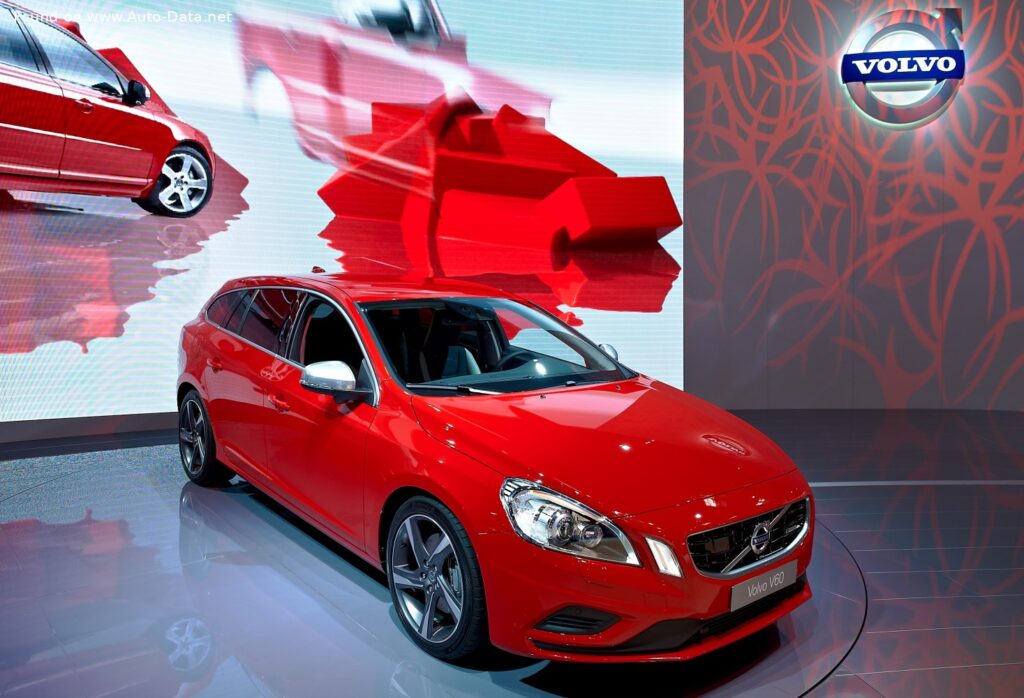
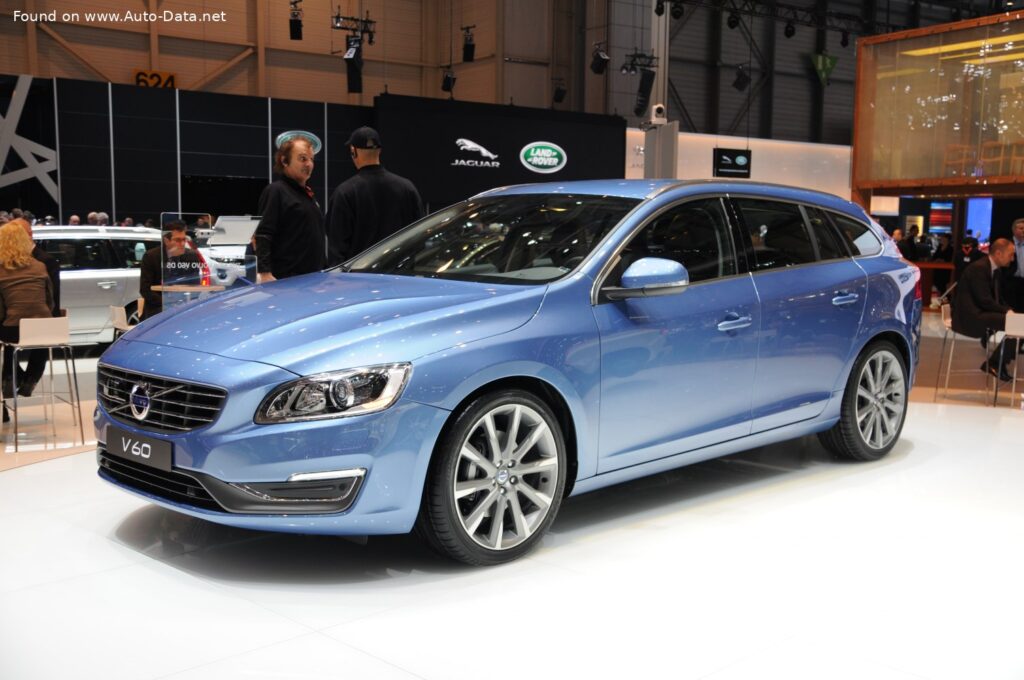
The Volvo V60 I (2013 facelift) maintained its characteristic station wagon (estate) body type, offering a blend of sporty aesthetics and practical utility. The facelift introduced a more cohesive and sophisticated look. Up front, the separate headlights were replaced by a single, larger headlamp unit, giving the car a wider and more assertive stance. The grille was updated, and new chrome accents were added, contributing to a more premium feel. At the rear, the V60 retained its distinctive vertical taillights, a Volvo hallmark, which were subtly revised to integrate more smoothly with the refreshed design. The overall dimensions of 182.48 inches (4635 mm) in length and 71.85 inches (1825 mm) in width provided a compact yet spacious footprint.
Inside, the V60 offered a refined and ergonomically designed cabin typical of Volvo. High-quality materials, comfortable seating for five occupants, and intuitive controls were hallmarks. The 2013 facelift also brought updates to the infotainment system and instrument cluster, enhancing the user experience. As a station wagon, practicality was key, offering a minimum trunk space of 15.19 cu. ft. (430 liters), making it suitable for families and active lifestyles. Safety, a core tenet of the Volvo brand, was paramount. While specific advanced driver-assistance systems (ADAS) would vary by trim and optional packages, fundamental safety features like ABS (Anti-lock Braking System) were standard, ensuring controlled braking in emergency situations. The robust body structure and comprehensive airbag systems further contributed to its strong safety performance.
Technical Specifications: Volvo V60 I (2013 Facelift) 2.0 T6 (306 Hp) AWD Automatic
| General Information | |
|---|---|
| Brand | Volvo |
| Model | V60 |
| Generation | V60 I (2013 facelift) |
| Type (Engine) | 2.0 T6 (306 Hp) AWD Automatic |
| Production Start | 2014 year |
| Production End | 2018 year |
| Powertrain Architecture | Internal Combustion engine |
| Body Type | Station wagon (estate) |
| Seats | 5 |
| Doors | 5 |
| Performance Specifications | |
| Fuel consumption (economy) – urban | 25.8 US mpg (9.1 l/100 km) |
| Fuel consumption (economy) – extra urban | 40.6 US mpg (5.8 l/100 km) |
| Fuel consumption (economy) – combined | 33.6 US mpg (7 l/100 km) |
| CO2 emissions | 163 g/km |
| Fuel Type | Petrol (Gasoline) |
| Acceleration 0 – 60 mph | 5.7 sec |
| Acceleration 0 – 100 km/h | 6 sec |
| Maximum speed | 155.34 mph (250 km/h) |
| Engine Specifications | |
| Power | 306 Hp @ 5700 rpm |
| Power per liter | 155.4 Hp/l |
| Torque | 295.02 lb.-ft. (400 Nm) @ 2100-4800 rpm |
| Engine layout | Front, Transverse |
| Engine Model/Code | B4204T9 |
| Engine displacement | 120.16 cu. in. (1969 cm³) |
| Number of cylinders | 4 |
| Engine configuration | Inline |
| Cylinder Bore | 3.23 in. (82 mm) |
| Piston Stroke | 3.67 in. (93.2 mm) |
| Compression ratio | 10.3:1 |
| Number of valves per cylinder | 4 |
| Fuel injection system | Direct injection |
| Engine aspiration | Turbocharging and Supercharger, Intercooler |
| Valvetrain | DOHC |
| Engine oil capacity | 6.23 US qt (5.9 l) |
| Engine oil specification | Not specified |
| Coolant | 8.77 US qt (8.3 l) |
| Space, Volume and Weights | |
| Trunk (boot) space – minimum | 15.19 cu. ft. (430 l) |
| Fuel tank capacity | 17.83 US gal (67.5 l) |
| Max. roof load | 165.35 lbs. (75 kg) |
| Dimensions | |
| Length | 182.48 in. (4635 mm) |
| Width | 71.85 in. (1825 mm) |
| Width with mirrors folded | 74.76 in. (1899 mm) |
| Width including mirrors | 82.56 in. (2097 mm) |
| Height | 58.43 in. (1484 mm) |
| Wheelbase | 109.29 in. (2776 mm) |
| Front track | 62.52 – 62.13 in. (1588-1578 mm) |
| Rear (Back) track | 62.4 – 62.01 in. (1585-1575 mm) |
| Ride height (ground clearance) | 5.35 in. (136 mm) |
| Drag coefficient (Cd) | 0.29 |
| Minimum turning circle (turning diameter) | 37.73 – 40.68 ft. (11.5 – 12.4 m) |
| Drivetrain, Brakes and Suspension Specifications | |
| Drive wheel | All wheel drive (4×4) |
| Number of gears and type of gearbox | 8 gears, automatic transmission |
| Front suspension | Independent, type McPherson with coil spring and anti-roll bar |
| Rear suspension | Independent coil spring |
| Front brakes | Ventilated discs |
| Rear brakes | Disc |
| Assisting systems | ABS (Anti-lock braking system) |
| Steering type | Steering rack and pinion |
Legacy and Market Impact of the Volvo V60 I (2013 Facelift)
The Volvo V60 I (2013 facelift), particularly in its powerful 2.0 T6 AWD Automatic guise, solidified Volvo’s reputation as a purveyor of safe, stylish, and increasingly dynamic premium vehicles. In its primary European market, the V60 competed fiercely with established German rivals such as the BMW 3 Series Touring, Audi A4 Avant, and Mercedes-Benz C-Class Wagon. What set the V60 apart was its distinctive Scandinavian design language, a strong emphasis on practical functionality, and, crucially, its pioneering safety technologies. The Drive-E engines, introduced with this facelift, marked a significant shift for Volvo, demonstrating that powerful performance could be achieved with smaller, more efficient four-cylinder engines, moving away from larger, thirstier units.
In North America, the V60 carved out a niche as a sophisticated alternative in a market largely dominated by SUVs. While station wagons traditionally have a smaller market share in the U.S., the V60 appealed to a discerning clientele who valued its combination of elegant design, premium interior, engaging driving dynamics, and the inherent practicality of a wagon. The T6 powertrain, with its impressive horsepower and all-wheel drive, further enhanced its appeal, offering a compelling blend of speed and all-weather capability. The model contributed to Volvo’s brand resurgence in the mid-2010s, showcasing the company’s forward-thinking approach to powertrain technology and its unwavering commitment to safety and design. The V60 I set the stage for future Volvo models, influencing the design language and technological direction of the brand for years to come, proving that a station wagon could be both sensible and exhilarating.