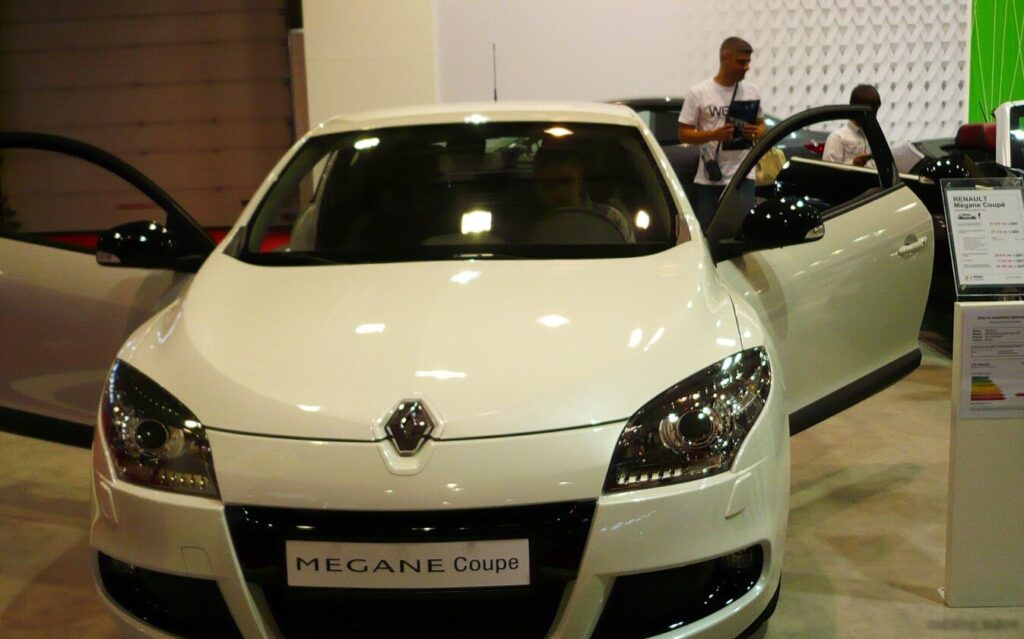
The Renault Megane III CC (Phase III, 2014): A European Convertible with Diesel Efficiency
The
Renault Megane III CC (Phase III, 2014) 1.6 dCi (130 Hp) start&stop
represents a significant offering in the European compact convertible segment during its production run from 2014 to 2016. As a Coupe-Cabriolet (CC), it combined the practicality and security of a coupe with the open-air exhilaration of a convertible, thanks to its sophisticated retractable hardtop roof. While Renault models, and specifically diesel variants like this dCi, were not officially sold in the United States, the Megane CC played a crucial role in Renault’s portfolio across Europe and other international markets, targeting drivers seeking a blend of style, efficiency, and versatility. This particular iteration, part of the third-generation Megane and a later “Phase III” refresh, showcased Renault’s commitment to modern diesel technology, offering impressive fuel economy and reduced emissions, a hallmark of European automotive engineering.
The Megane III CC was designed to appeal to a broad demographic, from young couples to empty-nesters, who appreciated its distinctive styling and the dual-purpose nature of its body type. Its position in the market was characterized by a balance of everyday usability and weekend leisure, providing a comfortable four-seater experience, albeit with typical convertible compromises in rear space and trunk volume when the roof was stowed. This model, with its 1.6-liter dCi engine, was particularly relevant in a European landscape where diesel powertrains were highly favored for their torque characteristics and superior fuel efficiency, making it an economical choice for both city driving and longer journeys.
Engine and Performance of the Renault Megane III CC (Phase III, 2014)
At the heart of this specific
Renault Megane III CC (Phase III, 2014)
variant is the advanced 1.6-liter (1598 cm³ or 97.52 cubic inches) dCi inline-four diesel engine, designated with the R9M code. This powerplant, engineered by Renault, delivered a respectable 130 horsepower at 4000 rpm, which for a compact convertible, provided a good balance of performance and economy. More notably, the engine produced a robust 236.02 lb.-ft. (320 Nm) of torque, available at a low 1750 rpm. This ample low-end torque was a key characteristic of modern diesel engines, contributing to effortless acceleration and strong in-gear flexibility, making it well-suited for varied driving conditions from urban commutes to highway cruising.
Paired with a precise 6-speed manual transmission, the Megane III CC could accelerate from 0 to 60 mph in a competitive 10.3 seconds (0-100 km/h in 10.8 seconds) and reach a maximum speed of 127.38 mph (205 km/h). These figures, while not sports car territory, were entirely adequate for its market segment and target audience. A crucial aspect of this engine was its incorporation of a Start & Stop system, a technology designed to automatically shut off the engine when the vehicle is stationary (e.g., at a traffic light) and restart it seamlessly when the driver is ready to move. This system, along with a particulate filter, significantly contributed to its impressive fuel efficiency and reduced CO2 emissions, allowing it to meet the stringent Euro 5b emission standard.
Fuel economy was a standout feature, reflecting the engine’s efficiency. The combined fuel consumption was rated between 4.4-4.8 liters per 100 km, translating to an excellent 53.5 – 49 US mpg. Even in urban settings, it managed 44.4 – 39.9 US mpg, and on the highway, it could achieve between 60.3 – 56 US mpg. These figures underscored the economic benefits of the dCi engine, offering a compelling proposition for drivers concerned with running costs and environmental impact. The engine’s layout was front, transverse, driving the front wheels, a common and efficient configuration for vehicles in this class.
Design and Features
The
Renault Megane III CC (Phase III, 2014)
was instantly recognizable by its Coupe-Cabriolet body type, featuring a distinctively styled retractable hardtop. This design offered the best of both worlds: the noise insulation and security of a fixed roof when closed, and the exhilarating open-air experience of a convertible at the touch of a button. The transformation from coupe to cabriolet was a key selling point, enhancing its versatility and appeal. The car measured 176.57 inches (4485 mm) in length, 71.3 inches (1811 mm) in width (81.57 inches or 2072 mm including mirrors), and 56.46 inches (1434 mm) in height, with a wheelbase of 102.72 inches (2609 mm). These dimensions placed it firmly in the compact segment, offering maneuverability while still providing reasonable interior space for four occupants.
Aesthetically, the Phase III refresh brought subtle updates to the Megane CC, aligning its front fascia with Renault’s contemporary design language, including a larger Renault badge and updated headlamp graphics. The exterior design was characterized by smooth lines and a balanced profile, whether the roof was up or down. Inside, the cabin offered a comfortable environment, with an emphasis on quality materials and ergonomic design. Standard features for the era would have included air conditioning, electric power steering, and a range of infotainment options. Safety was also a priority, with standard Anti-lock Braking System (ABS), and a suite of airbags, though specific details on advanced driver-assistance systems would vary by trim level.
The trunk space was a typical compromise for a retractable hardtop convertible. With the roof up, it offered a usable 14.73 cubic feet (417 liters) of cargo volume. However, when the roof was stowed away for open-top driving, this volume was significantly reduced to 7.45 cubic feet (211 liters), requiring careful packing for trips. The car rode on 225/45 R17 tires mounted on 7J x 17 alloy wheels, providing a good balance of grip and ride comfort. The suspension setup featured an independent McPherson type at the front and a semi-independent, coil spring system at the rear, tuned for a comfortable yet competent driving experience. Braking duties were handled by ventilated discs at the front and drum brakes at the rear, complemented by ABS.
Technical Specifications
| Category | Specification |
|---|---|
|
General Information |
|
| Brand | Renault |
| Model | Megane |
| Generation | Megane III CC (Phase III, 2014) |
| Type (Engine) | 1.6 dCi (130 Hp) start&stop |
| Start of Production | 2014 year |
| End of Production | 2016 year |
| Powertrain Architecture | Internal Combustion engine |
| Body type | Coupe – Cabriolet |
| Seats | 4 |
| Doors | 2 |
|
Performance Specs |
|
| Fuel consumption (economy) – urban | 5.3-5.9 l/100 km (44.4 – 39.9 US mpg) |
| Fuel consumption (economy) – extra urban | 3.9-4.2 l/100 km (60.3 – 56 US mpg) |
| Fuel consumption (economy) – combined | 4.4-4.8 l/100 km (53.5 – 49 US mpg) |
| CO2 emissions | 115-123 g/km |
| Fuel Type | Diesel |
| Acceleration 0 – 60 mph | 10.3 sec |
| Acceleration 0 – 100 km/h | 10.8 sec |
| Maximum speed | 127.38 mph (205 km/h) |
| Emission standard | Euro 5 b |
| Weight-to-power ratio | 12.5 kg/Hp (80.2 Hp/tonne) |
| Weight-to-torque ratio | 5.1 kg/Nm (197.4 Nm/tonne) |
|
Engine Specs |
|
| Power | 130 Hp @ 4000 rpm |
| Power per liter | 81.4 Hp/l |
| Torque | 236.02 lb.-ft. (320 Nm) @ 1750 rpm |
| Engine layout | Front, Transverse |
| Engine Model/Code | R9M |
| Engine displacement | 1598 cm³ (97.52 cu. in.) |
| Number of cylinders | 4 |
| Engine configuration | Inline |
| Cylinder Bore | 3.15 in. (80 mm) |
| Piston Stroke | 3.13 in. (79.5 mm) |
| Compression ratio | 15.4:1 |
| Number of valves per cylinder | 2 |
| Fuel injection system | Diesel Commonrail |
| Engine aspiration | Turbocharger, Intercooler |
| Engine oil capacity | 5.5 l (5.81 US qt) |
| Engine systems | Start & Stop System, Particulate filter |
|
Space, Volume and Weights |
|
| Kerb Weight | 3573.69 lbs. (1621 kg) |
| Max. weight | 4446.72 lbs. (2017 kg) |
| Max load | 873.03 lbs. (396 kg) |
| Trunk (boot) space – minimum | 7.45 cu. ft. (211 l) |
| Trunk (boot) space – maximum | 14.73 cu. ft. (417 l) |
| Fuel tank capacity | 15.85 US gal (60 l) |
| Permitted trailer load with brakes (12%) | 1653.47 lbs. (750 kg) |
| Permitted trailer load without brakes | 1653.47 lbs. (750 kg) |
|
Dimensions |
|
| Length | 176.57 in. (4485 mm) |
| Width | 71.3 in. (1811 mm) |
| Width including mirrors | 81.57 in. (2072 mm) |
| Height | 56.46 in. (1434 mm) |
| Wheelbase | 102.72 in. (2609 mm) |
| Front track | 60.87 in. (1546 mm) |
| Rear (Back) track | 60.91 in. (1547 mm) |
| Front overhang | 33.94 in. (862 mm) |
| Rear overhang | 39.92 in. (1014 mm) |
| Ride height (ground clearance) | 4.72 in. (120 mm) |
| Drag coefficient (Cd) | 0.310 |
| Minimum turning circle (turning diameter) | 35.93 ft. (10.95 m) |
|
Drivetrain, Brakes and Suspension Specs |
|
| Drivetrain Architecture | The Internal combustion engine (ICE) drives the front wheels of the vehicle. |
| Drive wheel | Front wheel drive |
| Number of gears and type of gearbox | 6 gears, manual transmission |
| Front suspension | Independent type McPherson |
| Rear suspension | Semi-independent, coil spring |
| Front brakes | Ventilated discs |
| Rear brakes | Drum |
| Assisting systems | ABS (Anti-lock braking system) |
| Steering type | Steering rack and pinion |
| Power steering | Electric Steering |
| Tires size | 225/45 R17 |
| Wheel rims size | 7J x 17 |
Legacy and Market Impact
The
Renault Megane III CC (Phase III, 2014) 1.6 dCi (130 Hp) start&stop
carries the legacy of a long line of European compact convertibles, a segment that has seen fluctuating popularity but consistently offers a unique blend of practicality and open-air enjoyment. In its primary European market, the Megane CC competed against rivals such as the Volkswagen Eos, Peugeot 308 CC, and Opel Astra TwinTop. Each of these models offered a similar retractable hardtop concept, and the competition was fierce, particularly in terms of design, roof mechanism reliability, and powertrain efficiency.
Renault’s Megane CC distinguished itself with its distinctive styling, a comfortable ride, and, in the case of the 1.6 dCi, exceptional fuel economy. The diesel engine, with its strong torque delivery and low running costs, was a significant draw for European consumers, especially in countries with higher fuel prices and tax structures that favored efficient diesels. The Start & Stop system further enhanced its appeal as an environmentally conscious and economical choice, contributing to its Euro 5b emission rating which was important for urban access and taxation in many European cities.
While the Megane CC was a familiar sight on European roads, it was never officially imported or sold in the United States. This was primarily due to several factors: the declining popularity of compact convertibles in the US market, the general consumer preference for larger vehicles, and the limited demand for diesel passenger cars outside of trucks and SUVs at the time. Furthermore, the cost of homologation and adapting a European-specific model like the Megane CC to meet stringent US safety and emissions regulations would have been prohibitive for a niche segment.
Despite its absence from the North American market, the Megane III CC, particularly this Phase III diesel variant, cemented Renault’s reputation for producing innovative and efficient vehicles tailored to European tastes. It represented a mature phase in the development of the compact retractable hardtop, offering a well-rounded package of style, comfort, and remarkable efficiency for its class. Its significance lies in its contribution to the diversity of the European automotive landscape, providing a stylish and economical option for those who desired the versatility of a coupe with the freedom of a convertible. As the market shifted towards SUVs and crossovers, the era of the compact Coupe-Cabriolet began to wane, making models like the Megane III CC a testament to a specific period in automotive design and consumer preference.