
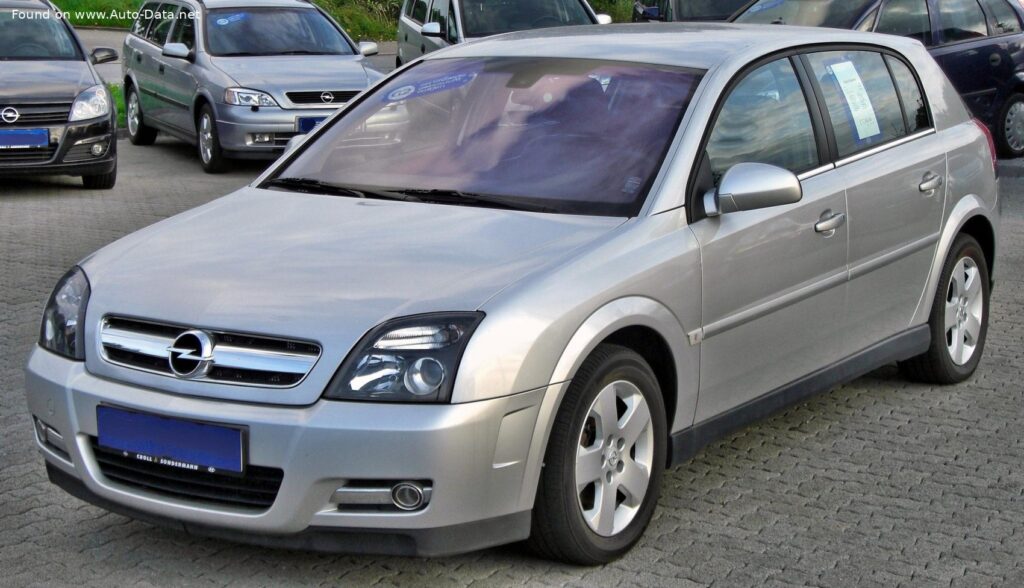
The Opel Signum: A European Executive Hatchback Experiment
The Opel Signum 2.2i 16V ECOTEC (155 Hp) Automatic represents a distinctive chapter in European automotive design, produced by the German automaker Opel from May 2003 to 2005. Positioned as a premium, large family car or executive car, the Signum was a unique offering in the D-segment, sharing its platform and many mechanical components with the Opel Vectra C. However, unlike the conventional sedan or wagon variants of the Vectra, the Signum carved out its own niche with an extended wheelbase and a versatile five-door hatchback body style, aiming to blend the spaciousness of a wagon with the sleek profile of a hatchback and the comfort of an executive sedan.
Designed primarily for the European market, where it was also sold under the Vauxhall Signum badge in the United Kingdom, this vehicle was never officially imported into the United States. Its market strategy revolved around providing enhanced rear passenger comfort and flexibility, a concept Opel referred to as ‘FlexSpace,’ distinguishing it from more traditional segment rivals. This particular variant, equipped with the 2.2-liter ECOTEC gasoline engine and an automatic transmission, offered a balance of performance and practicality for the discerning European buyer.
Engine and Performance: The Opel Signum 2.2i 16V ECOTEC (155 Hp) Automatic Powertrain
At the heart of this particular Opel Signum model is the Z22YH engine, a 2.2-liter (2198 cm³ or 134.13 cu. in.) 16-valve ECOTEC inline-four cylinder unit. This naturally aspirated gasoline engine features direct injection, a technology that was becoming more prevalent in the early 2000s for its ability to improve fuel efficiency and power output simultaneously. With a compression ratio of 12:1 and a DOHC (Double Overhead Camshaft) valvetrain, the engine was engineered for smooth power delivery and responsiveness.
The Z22YH engine generates a respectable 155 horsepower at 5600 rpm, translating to a power-per-liter figure of 70.5 horsepower per liter. Torque peaks at 220 Newton-meters (approximately 162.26 lb.-ft.) at 3800 rpm, providing ample pulling power for daily driving and highway cruising. Power is delivered to the front wheels via a 5-speed automatic transmission, emphasizing comfort and ease of driving over outright sportiness. This setup allows the Signum to accelerate from 0 to 60 mph in a reasonable 10.5 seconds, with a top speed of 128 mph (206 km/h).
Despite its size and the automatic transmission, the Signum 2.2i 16V ECOTEC aimed for competitive fuel economy for its era. Combined fuel consumption figures stood at 9.1 liters per 100 kilometers, which translates to approximately 25.8 US miles per gallon. Urban driving yielded around 19 US mpg, while extra-urban conditions could see figures as high as 32.7 US mpg, showcasing the engine’s efficiency during longer journeys.
Design and Features: Innovative Versatility
The Opel Signum’s design was its most distinguishing feature. While sharing the front-end styling of the Vectra C, its profile diverged significantly from the B-segment hatchback norm. Built on an extended wheelbase (2830 mm or 111.42 inches), which was notably longer than the Vectra sedan, the Signum offered exceptional rear legroom, rivaling that of larger executive sedans. The five-door hatchback body type, measuring 182.52 inches in length and 70.79 inches in width, gave it a sleek, almost coupe-like appearance from some angles, while maintaining the practicality of a liftback.
Opel’s ‘FlexSpace’ seating system was a cornerstone of the Signum’s interior. Instead of a traditional three-seat rear bench, the Signum featured two individual rear seats that could slide fore and aft, recline, and be folded down independently. A third, smaller central seat could also be specified, or the space could be configured with a versatile console featuring storage and even a refrigerator. This modularity allowed owners to prioritize either passenger comfort or cargo capacity, making it highly adaptable for various needs.
Standard features for the Signum included a robust safety package for its time, incorporating ABS (Anti-lock Braking System) for improved braking control. The steering system utilized a hydraulic rack and pinion setup, providing direct and communicative feedback to the driver. The vehicle rode on a suspension system featuring coil springs at both the front and rear, tuned for a comfortable ride quality. Braking was handled by ventilated discs at the front and solid discs at the rear. The 215/55 R16 tires on 6.5J x 16-inch wheel rims provided a good balance of grip and ride comfort.
With a minimum trunk (boot) space of 12.89 cubic feet (365 liters), expandable to a generous 49.79 cubic feet (1410 liters) with the rear seats folded, the Signum offered impressive cargo flexibility for an executive-oriented vehicle. Its curb weight of 3384.1 lbs (1535 kg) and a maximum permissible weight of 4519.48 lbs (2050 kg) underscored its substantial build quality.
Technical Specifications
| Category | Specification |
|---|---|
| Brand | Opel |
| Model | Signum |
| Generation | Signum |
| Type (Engine) | 2.2i 16V ECOTEC (155 Hp) Automatic |
| Production Start | May, 2003 |
| Production End | 2005 |
| Powertrain Architecture | Internal Combustion engine |
| Body Type | Hatchback |
| Seats | 5 |
| Doors | 5 |
| Fuel Type | Petrol (Gasoline) |
| Fuel Consumption (Urban) | 12.4 l/100 km (19 US mpg) |
| Fuel Consumption (Extra Urban) | 7.2 l/100 km (32.7 US mpg) |
| Fuel Consumption (Combined) | 9.1 l/100 km (25.8 US mpg) |
| Acceleration 0-60 mph | 10.5 sec |
| Maximum Speed | 128 mph (206 km/h) |
| Power | 155 Hp @ 5600 rpm |
| Torque | 220 Nm (162.26 lb.-ft.) @ 3800 rpm |
| Engine Layout | Front, Transverse |
| Engine Model/Code | Z22YH |
| Engine Displacement | 2198 cm³ (134.13 cu. in.) |
| Number of Cylinders | 4 |
| Engine Configuration | Inline |
| Cylinder Bore | 86 mm (3.39 in.) |
| Piston Stroke | 94.6 mm (3.72 in.) |
| Compression Ratio | 12:1 |
| Valves per Cylinder | 4 |
| Fuel Injection System | Direct injection |
| Engine Aspiration | Naturally aspirated engine |
| Valvetrain | DOHC |
| Engine Oil Capacity | 5 l (5.28 US qt) |
| Coolant Capacity | 7.6 l (8.03 US qt) |
| Kerb Weight | 1535 kg (3384.1 lbs) |
| Max. Weight | 2050 kg (4519.48 lbs) |
| Max Load | 515 kg (1135.38 lbs) |
| Trunk (boot) Space (min) | 365 l (12.89 cu. ft.) |
| Trunk (boot) Space (max) | 1410 l (49.79 cu. ft.) |
| Fuel Tank Capacity | 60 l (15.85 US gal) |
| Length | 4636 mm (182.52 in.) |
| Width | 1798 mm (70.79 in.) |
| Height | 1466 mm (57.72 in.) |
| Wheelbase | 2830 mm (111.42 in.) |
| Front Track | 1524 mm (60 in.) |
| Rear Track | 1512 mm (59.53 in.) |
| Drag Coefficient (Cd) | 0.33 |
| Drivetrain Architecture | Front-wheel drive (ICE drives front wheels) |
| Drive Wheel | Front wheel drive |
| Gearbox | 5 gears, automatic transmission |
| Front Suspension | Coil spring |
| Rear Suspension | Coil spring |
| Front Brakes | Ventilated discs |
| Rear Brakes | Disc |
| Assisting Systems | ABS (Anti-lock braking system) |
| Steering Type | Steering rack and pinion |
| Power Steering | Hydraulic Steering |
| Tires Size | 215/55 R16 |
| Wheel Rims Size | 6.5J x 16 |
Legacy and Market Impact of the Opel Signum
The Opel Signum was an ambitious vehicle that attempted to carve out a new niche in the competitive European automotive landscape. Its unique blend of executive car space, hatchback versatility, and an extended wheelbase offered a compelling proposition for buyers seeking something beyond the conventional sedan, wagon, or even the burgeoning SUV segment. Opel envisioned the Signum appealing to business users and families who desired enhanced comfort and flexibility, particularly for rear passengers, without the bulk of a full-size executive sedan or the utility-focused image of an estate car.
However, the Signum’s innovative approach ultimately met with limited commercial success. Its distinctive styling, which blended elements of a traditional hatchback with a somewhat elongated, almost MPV-like profile, proved polarizing. Many buyers in the D-segment preferred the more traditional styling and established prestige of rivals such as the Volkswagen Passat, Ford Mondeo, or even premium offerings from BMW and Mercedes-Benz. Furthermore, the market was already seeing a shift towards SUVs and conventional wagons for family practicality, making the Signum’s ‘executive hatchback’ concept a harder sell.
Competitors in its primary market included not only mainstream D-segment contenders but also more avant-garde vehicles like the Renault Vel Satis, another car that prioritized interior space and unique design over conventional aesthetics. While the Signum was praised for its comfortable ride, generous rear legroom, and the clever FlexSpace seating system, its sales volumes never reached Opel’s expectations. Its production run was relatively short, ending in 2007, just four years after its introduction, with the 2.2i 16V ECOTEC (155 Hp) Automatic variant being available from 2003 to 2005.
Despite its commercial struggles, the Opel Signum remains an interesting footnote in automotive history, showcasing an automaker’s willingness to experiment with body styles and interior configurations to meet perceived market demands. It highlighted a period where manufacturers were exploring various ways to offer more flexible and comfortable interiors, particularly for rear passengers, a trend that would later be largely absorbed by the rise of crossovers and SUVs. Today, the Signum is remembered as a comfortable, practical, and somewhat quirky European car that dared to be different.
