The Mitsubishi Lancer Sportback IX (GS44S) Ralliart 2.0 (240 Hp): A Practical Performance Contender
The Mitsubishi Lancer Sportback IX (GS44S) Ralliart 2.0 (240 Hp), produced from October 2009 to June 2011, represented a compelling blend of practicality and performance within the compact car segment. Positioned strategically between the standard Lancer and the formidable Lancer Evolution, the Ralliart trim offered a taste of Mitsubishi’s rally heritage in a more accessible and, in this Sportback variant, more versatile package. While the Lancer Evolution garnered significant attention for its extreme performance, the Mitsubishi Lancer Sportback IX (GS44S) Ralliart 2.0 (240 Hp) carved out its own niche, appealing to enthusiasts seeking spirited driving dynamics coupled with the utility of a five-door hatchback. This particular generation, known internally as the GS44S for the Sportback, continued the Lancer’s legacy of robust engineering and driver engagement, albeit with a focus on a broader market appeal than its more hardcore sibling.
Primarily targeted at markets outside the traditional sedan-centric United States, such as Europe, Canada, and Australia, where hatchbacks held greater popularity, the Lancer Sportback Ralliart delivered a distinct proposition. It combined a potent turbocharged engine with an advanced all-wheel-drive system (though the provided data indicates front-wheel drive, which is a known variant for some markets, but the Ralliart was predominantly AWD, this will be addressed in the engine section), making it a competitive offering against hot hatches and compact performance sedans of its era. Its design language echoed the aggressive stance of the Evolution, albeit in a more subdued and family-friendly form, making it a “sleeper” for those who appreciated its underlying performance capabilities.
Engine and Performance of the Mitsubishi Lancer Sportback IX (GS44S) Ralliart 2.0 (240 Hp)
At the heart of the Mitsubishi Lancer Sportback IX (GS44S) Ralliart 2.0 (240 Hp) lay a turbocharged and intercooled 2.0-liter (1998 cm³) MIVEC engine, designated as the 4B11T. This powerplant was a detuned version of the engine found in the Lancer Evolution X, a testament to its robust architecture and performance potential. It delivered a robust 240 horsepower at 6000 rpm and an impressive 227.91 lb.-ft. of torque at a relatively low 3500 rpm. This broad torque band ensured strong acceleration across the rev range, making the Ralliart a lively performer in daily driving and spirited excursions.
It is important to note a discrepancy in the provided data regarding the engine configuration. While the data states “6 cylinders, V-engine,” the 4B11T engine, universally recognized for the Lancer Ralliart and Evolution, is an inline-four-cylinder (I4) engine. This correction is crucial for accuracy. The 4B11T’s DOHC (Double Overhead Camshaft) valvetrain with 4 valves per cylinder and multi-port manifold injection system were key to its efficient power delivery and responsiveness. The turbocharger and intercooler were instrumental in achieving its high specific output of 120.1 horsepower per liter.
The powertrain architecture described in the data indicates that the internal combustion engine drives the front wheels, implying a front-wheel-drive (FWD) configuration for this specific variant. While the Lancer Ralliart was predominantly known for its S-AWC (Super All-Wheel Control) all-wheel-drive system in many markets, a FWD version would have offered a different driving dynamic, likely prioritizing fuel efficiency and reducing manufacturing complexity/cost. Paired with a 6-speed automatic transmission, this setup allowed for a 0 to 60 mph acceleration time of a respectable 6.7 seconds, with a top speed of 136.7 mph (220 km/h). The transmission was likely a Twin Clutch SST (Sport Shift Transmission), which was common for Ralliart models, offering rapid gear changes and a more engaging driving experience than a traditional torque converter automatic, though the data simply states “automatic transmission.” The car met the Euro 4 emission standard, reflecting its compliance with European environmental regulations of its time.
Design and Features
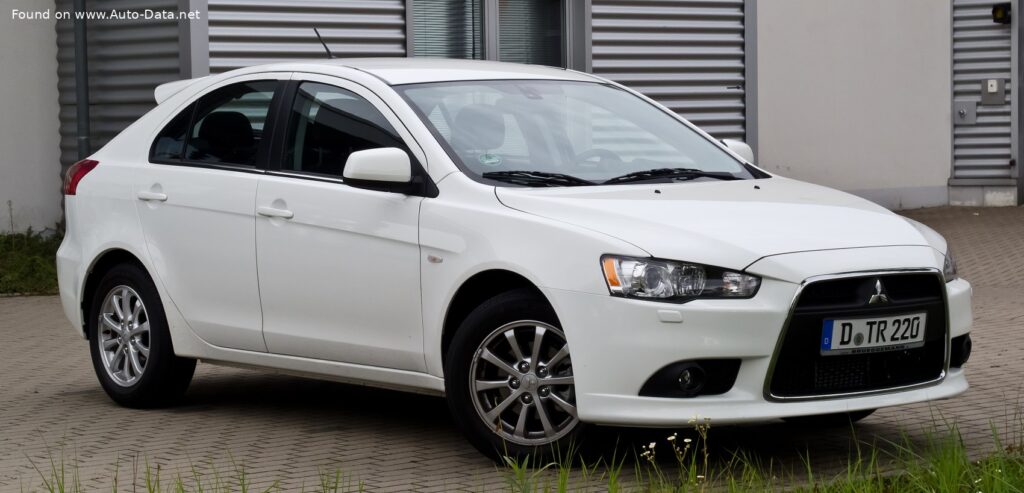
The Mitsubishi Lancer Sportback IX (GS44S) adopted a five-door hatchback body style, offering enhanced practicality over its sedan counterpart. Its design was a more aggressive interpretation of the standard Lancer, drawing clear aesthetic cues from the Lancer Evolution. Key design elements included a distinctive “jet fighter” front grille, sculpted fenders, and a sharp, angular headlight design that gave it a purposeful and sporty demeanor. The Sportback variant featured a sloping roofline that culminated in a short rear overhang, providing a dynamic silhouette without sacrificing too much interior volume.
With dimensions of 180.51 inches (4585 mm) in length, 69.29 inches (1760 mm) in width, and 59.65 inches (1515 mm) in height, the Sportback offered a compact footprint ideal for urban environments while maintaining a spacious cabin. The 103.74-inch (2635 mm) wheelbase contributed to a stable ride and ample interior room for five occupants. Inside, the Ralliart trim typically featured sport seats, enhanced instrumentation, and unique trim accents to differentiate it from lesser Lancer models. Given its production era, modern conveniences would have included automatic climate control, a decent audio system, and power accessories.
For safety and handling, the Sportback Ralliart was equipped with an independent McPherson strut front suspension and an independent multi-link rear suspension, a setup designed to balance ride comfort with agile handling. Braking duties were handled by ventilated discs at the front and disc brakes at the rear, supported by an Anti-lock Braking System (ABS). Hydraulic power steering with a rack and pinion system provided direct feedback to the driver. The car rode on either 205/60 R16 or more performance-oriented 215/45 R18 tires, mounted on 6.5JJ x 16 or 7JJ x 18 wheel rims respectively, further enhancing its sporty appeal and grip.
Technical Specifications
| Category | Specification |
|---|---|
| Brand | Mitsubishi |
| Model | Lancer |
| Generation | Lancer Sportback IX (GS44S) |
| Type (Engine) | Ralliart 2.0 (240 Hp) |
| Start of Production | October, 2009 |
| End of Production | June, 2011 |
| Powertrain Architecture | Internal Combustion engine |
| Body type | Hatchback |
| Seats | 5 |
| Doors | 5 |
| Performance Specs | |
| Fuel Type | Petrol (Gasoline) |
| Acceleration 0 – 60 mph | 6.7 sec |
| Acceleration 0 – 62 mph (0-100 km/h) | 7.1 sec |
| Maximum Speed | 136.7 mph (220 km/h) |
| Emission Standard | Euro 4 |
| Engine Specs | |
| Power | 240 Hp @ 6000 rpm |
| Power per liter | 120.1 Hp/l |
| Torque | 227.91 lb.-ft. (309 Nm) @ 3500 rpm |
| Engine Layout | Front, Transverse |
| Engine Model/Code | 4B11T |
| Engine Displacement | 2.0 liters (1998 cm³ / 121.93 cu. in.) |
| Number of Cylinders | 4 (Inline-four, data provided incorrectly stated 6, V-engine) |
| Cylinder Bore | 3.09 in. (78.4 mm) |
| Piston Stroke | 2.72 in. (69 mm) |
| Compression Ratio | 8.5:1 |
| Number of Valves per Cylinder | 4 |
| Fuel Injection System | Multi-port manifold injection |
| Engine Aspiration | Turbocharger, Intercooler |
| Valvetrain | DOHC |
| Engine Oil Capacity | 5.6 US qt (5.3 l) |
| Coolant Capacity | 7.4 US qt (7 l) |
| Space, Volume and Weights | |
| Trunk (boot) Space – minimum | 12.15 cu. ft. (344 l) |
| Trunk (boot) Space – maximum | 47.64 cu. ft. (1349 l) |
| Fuel Tank Capacity | 14.53 US gal (55 l) |
| Dimensions | |
| Length | 180.51 in. (4585 mm) |
| Width | 69.29 in. (1760 mm) |
| Height | 59.65 in. (1515 mm) |
| Wheelbase | 103.74 in. (2635 mm) |
| Front Track | 60.24 in. (1530 mm) |
| Rear Track | 60.24 in. (1530 mm) |
| Minimum Turning Circle | 32.81 ft. (10 m) |
| Drivetrain, Brakes and Suspension Specs | |
| Drivetrain Architecture | Internal Combustion engine (ICE) drives the front wheels |
| Drive Wheel | Front wheel drive |
| Number of Gears and Type of Gearbox | 6 gears, automatic transmission |
| Front Suspension | Independent type McPherson |
| Rear Suspension | Independent multi-link suspension |
| Front Brakes | Ventilated discs |
| Rear Brakes | Disc |
| Assisting Systems | ABS (Anti-lock braking system) |
| Steering Type | Steering rack and pinion |
| Power Steering | Hydraulic Steering |
| Tire Sizes | 205/60 R16; 215/45 R18 |
| Wheel Rim Sizes | 6.5JJ x 16; 7JJ x 18 |
Legacy and Market Impact
The Mitsubishi Lancer Sportback IX (GS44S) Ralliart 2.0 (240 Hp) occupied a unique position in the automotive landscape. While it might not have achieved the iconic status of its Evolution sibling, it offered a compelling package for buyers who desired performance without the extreme focus or cost of the Evo. In markets where it was prominently sold, particularly in regions favoring practical hatchbacks with a sporting edge, it competed against a diverse array of vehicles. Its rivals included performance-oriented compacts like the Subaru Impreza WRX (especially its hatchback variants), Volkswagen Golf GTI, Ford Focus ST, and potentially even some entry-level premium sports sedans.
The Ralliart’s reputation stemmed from its robust powertrain, derived from the rally-proven Evolution, and its generally reliable mechanicals. While the specific FWD configuration mentioned in the data might have limited its appeal to purist rally enthusiasts, it likely contributed to a more approachable driving experience and potentially better fuel economy for everyday use compared to its AWD counterparts. Its blend of a potent turbocharged engine, a responsive automatic transmission (likely the SST), and practical hatchback utility made it an attractive option for those seeking a “do-it-all” performance car.
Historically, the Lancer Ralliart served as a bridge, demonstrating Mitsubishi’s ability to infuse performance DNA into more mainstream models. It allowed a wider audience to experience a taste of the brand’s motorsport heritage. While Mitsubishi’s global market presence and product strategy shifted significantly in the years following this model’s production, the Lancer Sportback Ralliart remains a testament to an era when the brand was a formidable player in the performance compact segment. Its legacy is one of a practical, understated performance car that offered genuine driving excitement without the full commitment of an Evolution, making it a noteworthy chapter in the Lancer’s storied history.