
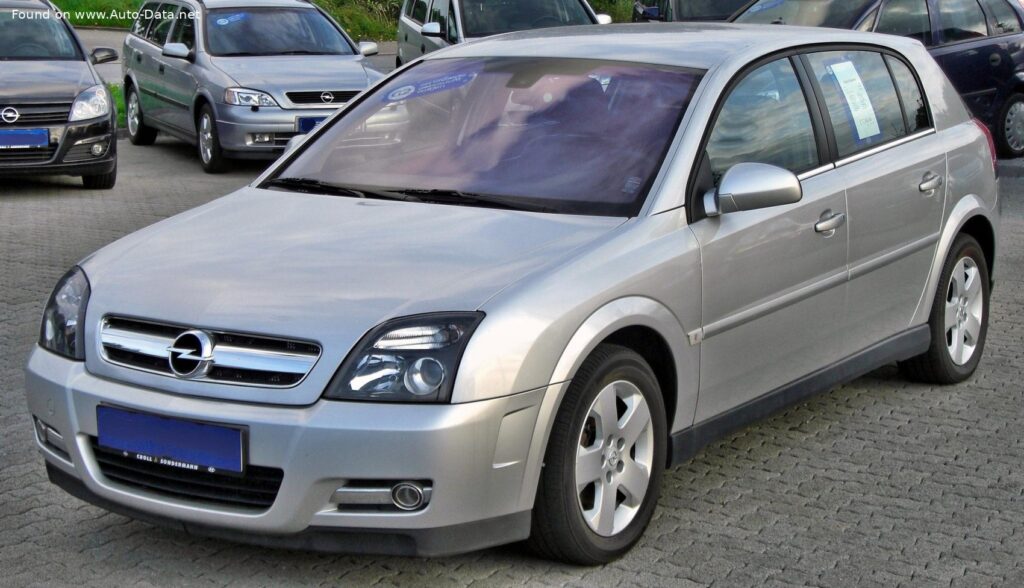
Opel Signum 3.0 V6 CDTI (177 Hp): An Executive Hatchback for Europe
The Opel Signum 3.0 V6 CDTI, produced between July 2003 and June 2005, represented a distinctive and ambitious venture by the German automaker Opel into the executive car segment. Positioned above the conventional Vectra C sedan and wagon, the Signum was conceived as a premium-oriented, five-door hatchback or “liftback” designed specifically for the European market. It aimed to offer enhanced versatility, comfort, and interior space, targeting customers who desired more flexibility than a traditional sedan but sought a more upscale experience than a standard station wagon. While never officially imported to the United States, the Signum showcased Opel’s engineering capabilities and its interpretation of a modern, practical executive vehicle for the continental European consumer. The 3.0 V6 CDTI variant, with its robust diesel powertrain, stood out as a particularly potent and efficient offering within the Signum lineup, blending strong performance with respectable fuel economy.
Engine and Performance of the Opel Signum 3.0 V6 CDTI
At the heart of this particular Opel Signum was a sophisticated 3.0-liter V6 CDTI (Common Rail Diesel Injection) engine, designated by the code Y30DT. This powertrain was a testament to the growing prowess of diesel technology in Europe during the early 2000s, combining a compact V-engine configuration with advanced fuel injection and forced induction. The engine produced a healthy 177 horsepower at 4000 rpm, delivering a smooth yet authoritative power delivery. More impressively for a diesel of its era, the torque output was a substantial 272.9 lb.-ft. (370 Nm), available from a low 1900 rpm. This broad torque band was crucial for effortless acceleration and strong in-gear flexibility, making the Signum 3.0 V6 CDTI a capable long-distance cruiser and an adept performer in varied driving conditions.
Power was transmitted to the front wheels via a precise 6-speed manual transmission, offering drivers engaging control over the engine’s output. This combination allowed the Signum to accelerate from 0 to 60 mph in a swift 8.9 seconds, with a top speed reaching 137.32 mph (221 km/h). These figures were competitive for its class and body style, underscoring its executive aspirations. Despite its performance capabilities, the 3.0 V6 CDTI also boasted commendable fuel efficiency for a vehicle of its size and power. The combined fuel economy was rated at 31.8 US mpg (7.4 l/100 km), with extra-urban driving yielding an even more impressive 40.6 US mpg (5.8 l/100 km). This blend of power, torque, and efficiency made the Opel Signum 3.0 V6 CDTI a compelling choice for European drivers seeking a refined yet economical executive car.
Design and Features: The Unique Opel Signum Approach
The Opel Signum’s design was perhaps its most distinguishing characteristic. While sharing its extended platform with the Opel Vectra C, the Signum adopted a unique five-door hatchback body type, often referred to as a “liftback” due to its sloping rear roofline that culminated in a large tailgate. This design choice was deliberate, aiming to fuse the elegant profile of a sedan with the practicality of a wagon. Measuring 182.52 inches (4636 mm) in length, 70.79 inches (1798 mm) in width, and 57.72 inches (1466 mm) in height, the Signum possessed a substantial road presence. Its extended wheelbase of 111.42 inches (2830 mm), significantly longer than the standard Vectra sedan, was instrumental in creating an exceptionally spacious and versatile interior.
Interior flexibility was a cornerstone of the Signum’s appeal. Unlike most conventional cars, the Signum featured individual rear seats that could slide, recline, and fold independently, offering unparalleled adjustability for rear passengers. This “FlexSpace” system, as Opel called it, allowed owners to tailor the rear compartment for maximum legroom, cargo capacity, or a balance of both. Minimum trunk space was a respectable 12.89 cubic feet (365 liters), expanding to an impressive 49.79 cubic feet (1410 liters) with the rear seats folded, rivaling many station wagons.
From a safety and convenience standpoint, the Signum was well-equipped for its time. Standard features included an Anti-lock Braking System (ABS) and hydraulic power steering with a rack and pinion setup. The suspension comprised coil springs at both the front and rear, providing a comfortable and composed ride characteristic of an executive tourer. Braking was handled by ventilated discs at the front and solid discs at the rear, ensuring confident stopping power. The vehicle rode on 215/55 R16 tires mounted on 6.5J x 16 wheel rims, providing a good balance of grip and ride comfort. The overall design philosophy emphasized comfort, practicality, and a somewhat understated elegance, typical of German automotive engineering of the period.
Technical Specifications
| Opel Signum 3.0 V6 CDTI (177 Hp) – Technical Specifications | |
|---|---|
| General Information | |
| Brand | Opel |
| Model | Signum |
| Generation | Signum |
| Type (Engine) | 3.0 V6 CDTI (177 Hp) |
| Start of Production | July, 2003 |
| End of Production | June, 2005 |
| Powertrain Architecture | Internal Combustion engine |
| Body Type | Hatchback |
| Seats | 5 |
| Doors | 5 |
| Performance Specs | |
| Fuel Consumption (Urban) | 23.1 US mpg (10.2 l/100 km) |
| Fuel Consumption (Extra Urban) | 40.6 US mpg (5.8 l/100 km) |
| Fuel Consumption (Combined) | 31.8 US mpg (7.4 l/100 km) |
| Fuel Type | Diesel |
| Acceleration 0 – 60 mph | 8.9 sec |
| Maximum Speed | 137.32 mph (221 km/h) |
| Weight-to-Power Ratio | 9.4 kg/Hp, 106 Hp/tonne |
| Weight-to-Torque Ratio | 4.5 kg/Nm, 221.6 Nm/tonne |
| Engine Specs | |
| Power | 177 Hp @ 4000 rpm |
| Power per Liter | 59.8 Hp/l |
| Torque | 272.9 lb.-ft. (370 Nm) @ 1900 rpm |
| Engine Layout | Front, Transverse |
| Engine Model/Code | Y30DT |
| Engine Displacement | 180.51 cu. in. (2958 cm3) |
| Number of Cylinders | 6 |
| Engine Configuration | V-engine |
| Cylinder Bore | 3.44 in. (87.5 mm) |
| Piston Stroke | 3.23 in. (82 mm) |
| Compression Ratio | 18.5:1 |
| Number of Valves per Cylinder | 4 |
| Fuel Injection System | Diesel Commonrail |
| Engine Aspiration | Turbocharger, Intercooler |
| Valvetrain | DOHC |
| Engine Oil Capacity | 7.66 US qt (7.25 l) |
| Coolant Capacity | 8.77 US qt (8.3 l) |
| Space, Volume and Weights | |
| Kerb Weight | 3681.72 lbs. (1670 kg) |
| Max. Weight | 4817.1 lbs. (2185 kg) |
| Max Load | 1135.38 lbs. (515 kg) |
| Trunk (boot) Space – Minimum | 12.89 cu. ft. (365 l) |
| Trunk (boot) Space – Maximum | 49.79 cu. ft. (1410 l) |
| Fuel Tank Capacity | 15.85 US gal (60 l) |
| Dimensions | |
| Length | 182.52 in. (4636 mm) |
| Width | 70.79 in. (1798 mm) |
| Height | 57.72 in. (1466 mm) |
| Wheelbase | 111.42 in. (2830 mm) |
| Front Track | 60 in. (1524 mm) |
| Rear (Back) Track | 59.53 in. (1512 mm) |
| Drag Coefficient (Cd) | 0.33 |
| Drivetrain, Brakes and Suspension Specs | |
| Drivetrain Architecture | Front-wheel drive, Internal Combustion engine |
| Drive Wheel | Front wheel drive |
| Number of Gears and Type of Gearbox | 6 gears, manual transmission |
| Front Suspension | Coil spring |
| Rear Suspension | Coil spring |
| Front Brakes | Ventilated discs |
| Rear Brakes | Disc |
| Assisting Systems | ABS (Anti-lock braking system) |
| Steering Type | Steering rack and pinion |
| Power Steering | Hydraulic Steering |
| Tires Size | 215/55 R16 |
| Wheel Rims Size | 6.5J x 16 |
Legacy and Market Impact of the Opel Signum
The Opel Signum, particularly in its 3.0 V6 CDTI guise, holds a rather unique place in Opel’s history and the broader European automotive landscape. It was an ambitious attempt by Opel to carve out a niche in the executive segment, offering a more practical and versatile alternative to traditional sedans, without fully committing to the station wagon format. Its “FlexSpace” interior concept was genuinely innovative, providing a level of adaptability that few direct competitors could match. This focus on interior space and modularity was a direct response to the perceived needs of European executive buyers who might use their vehicle for both business and family duties.
Despite its innovative features and solid engineering, the Signum never achieved the sales success Opel had hoped for. Its distinctive styling, which blended elements of a sedan, hatchback, and even a minivan, proved to be somewhat polarizing. Consumers in the executive segment were often drawn to more traditional three-box sedans or the growing appeal of premium German brands like BMW, Mercedes-Benz, and Audi, which offered more established brand prestige. Mainstream competitors such as the Ford Mondeo and Volkswagen Passat, while perhaps less distinctive, offered more conventional and often more affordable packages.
The Opel Signum 3.0 V6 CDTI ultimately struggled to define its identity clearly enough to capture a significant market share. It was arguably ahead of its time in anticipating the demand for highly versatile, comfortable, and efficient executive vehicles that blurred traditional body style lines. However, the market wasn’t entirely ready for such a departure from convention in that segment. Its production run was relatively short, ending in 2005, and it was eventually replaced by more conventional offerings within Opel’s lineup. Nevertheless, the Signum remains an interesting case study in automotive design and market strategy, remembered for its clever interior packaging and its attempt to redefine the executive car for a new era of European drivers. For those who appreciated its unique blend of practicality, comfort, and diesel performance, the Signum 3.0 V6 CDTI offered a compelling, albeit unconventional, proposition.
