Introduction: The Volkswagen Transporter (T5) Panel Van
The Volkswagen Transporter, known globally as a quintessential light commercial vehicle, has a storied history spanning many decades and generations. The Transporter (T5) represents the fifth iteration of this iconic lineage, produced by the German automotive giant Volkswagen Commercial Vehicles. Launched in 2003, the T5 generation continued the legacy of its predecessors, evolving to meet the demands of modern commerce and transportation. The specific variant under examination, the Volkswagen Transporter (T5) Panel Van 2.5 TDI (130 Hp) 4MOTION L2H3, epitomizes the blend of practicality, robust engineering, and all-weather capability that made the T5 a cornerstone of the European light commercial vehicle market.
While the Transporter series, particularly in its passenger-van configurations like the Multivan or California, has garnered a cult following and some limited presence in North America through grey market imports or specialized conversions, the Panel Van variant was primarily engineered for and sold in European and other international markets where such dedicated commercial vans are prevalent. This particular model, produced between 2003 and 2006, was designed as a workhorse, offering significant cargo capacity, a powerful and efficient diesel engine, and the added traction of Volkswagen’s advanced 4MOTION all-wheel-drive system. The “L2H3” designation signifies its long wheelbase (L2) and extra-high roof (H3), making it a formidable choice for businesses requiring substantial volumetric cargo space and the ability to navigate diverse terrains and challenging weather conditions.
Engine and Performance: The 2.5 TDI and 4MOTION Drivetrain
Powertrain Details of the Volkswagen Transporter (T5) Panel Van
At the heart of this particular Volkswagen Transporter (T5) Panel Van lies a robust 2.5-liter (2460 cm3 or 150.12 cu. in.) inline five-cylinder TDI (Turbocharged Direct Injection) diesel engine, designated with the code EA153 / AXD. This powerplant was a hallmark of Volkswagen’s commercial and larger passenger vehicles during its era, known for its strong torque delivery and durability. The engine produces a respectable 130 horsepower at 3500 rpm, which for a commercial vehicle of this size, provides ample power for hauling heavy loads and maintaining highway speeds.
More crucial for a utility vehicle is its torque output, and the 2.5 TDI excels here, delivering a substantial 340 Nm (250.77 lb.-ft.) of torque across a broad and usable rev range, specifically between 2000 and 2300 rpm. This low-end torque is vital for strong acceleration from a standstill, especially when fully loaded, and for effortless climbing on inclines. The engine benefits from a turbocharger and an intercooler, optimizing air intake and combustion efficiency, which contributes to both power and fuel economy. Fuel is delivered via a sophisticated pump-nozzle (unit injector) system, a technology that was cutting-edge for diesel engines in the early 2000s, ensuring precise fuel metering and efficient combustion. The engine features a SOHC (Single Overhead Camshaft) valvetrain with two valves per cylinder, and a high compression ratio of 18.5:1, typical for a direct-injection diesel.
Power is transmitted to the wheels through a durable 6-speed manual transmission, offering drivers precise control over gear selection and allowing for optimal engine performance across various driving scenarios, from urban delivery routes to highway cruising. A standout feature of this Transporter variant is its 4MOTION all-wheel-drive system. The drivetrain architecture is designed to drive the front wheels permanently, with the rear wheels engaging through an electrically or mechanically operated clutch when additional traction is needed. This intelligent system provides enhanced grip and stability on slippery surfaces, unpaved roads, or during adverse weather conditions, significantly broadening the operational capabilities of the panel van for businesses that operate off the beaten path or in regions with challenging climates.
Performance figures for this commercial vehicle are practical rather than sporty. It can accelerate from 0 to 60 mph in approximately 15.8 seconds (0-100 km/h in 16.6 seconds) and reach a maximum speed of 96.31 mph (155 km/h). Fuel consumption, while not the primary concern for a work vehicle, is efficient for its class, rated at 7.7 liters per 100 km (30.5 US mpg) in extra-urban conditions. The vehicle also met the Euro 3 emission standard, reflecting the environmental regulations of its time.
Design and Features: The L2H3 Configuration
Exterior and Interior Practicality
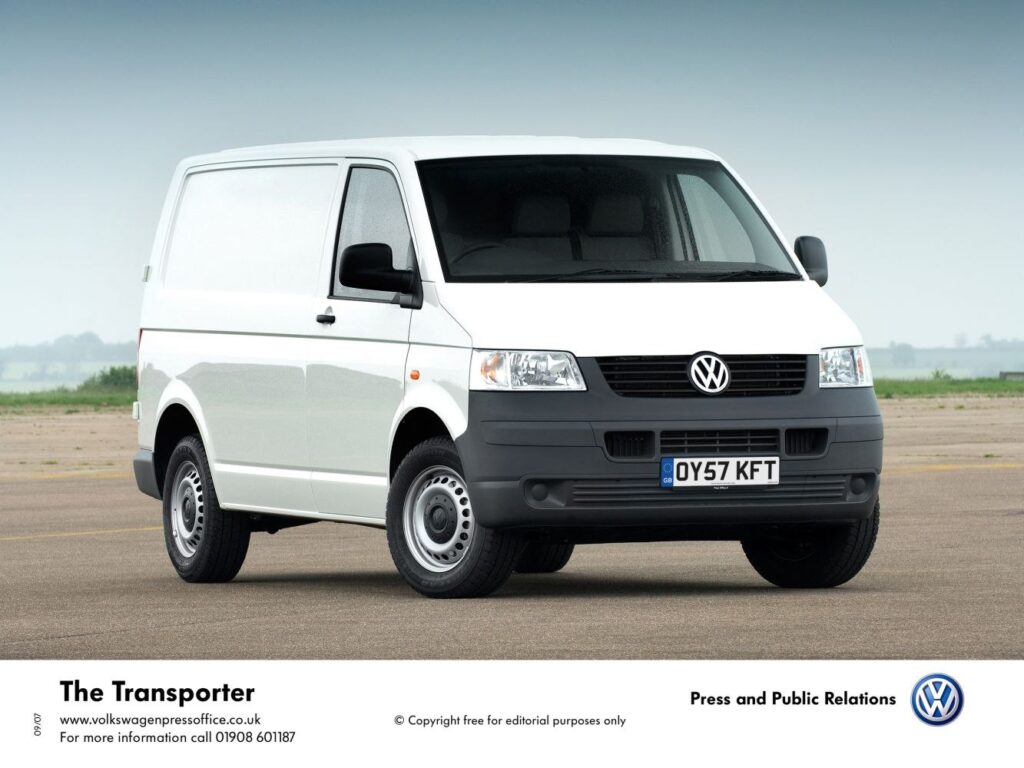
The Volkswagen Transporter (T5) Panel Van 2.5 TDI (130 Hp) 4MOTION L2H3 is a testament to functional design, prioritizing utility and ruggedness over mere aesthetics. As a panel van, its primary purpose is cargo transport, and the L2H3 designation underscores this capability. “L2” denotes the long wheelbase, measuring 3400 mm (133.86 inches), which contributes to improved stability and, crucially, a longer cargo area. “H3” refers to the extra-high roof, giving the van an impressive overall height of 2460 mm (96.85 inches). This combination results in a cavernous maximum trunk (boot) space of 9300 liters (328.43 cu. ft.), allowing for the transport of exceptionally large or numerous items, making it ideal for tradespeople, logistics companies, and various commercial applications.
The van features a practical 4-5 door configuration, typically comprising two front doors for the driver and passenger, a sliding door on one side (often the right, for curb-side loading/unloading), and rear barn doors for wide access to the cargo bay. The interior is designed for durability and ease of cleaning, with hard-wearing materials suitable for commercial use. Seating capacity is typically 2-3 occupants, with a single driver’s seat and a bench for one or two passengers, depending on the specific configuration.
Dimensions of the L2H3 model are substantial: 5290 mm (208.27 inches) in length and 1904 mm (74.96 inches) in width (2242 mm or 88.27 inches including mirrors). Despite its size, careful engineering ensures a minimum turning circle of 13.2 meters (43.31 feet), aiding maneuverability in urban environments and tight loading docks. The ground clearance of 165 mm (6.5 inches), combined with approach and departure angles of 22° and 16° respectively, and a wading depth of 300 mm (11.81 inches), further highlights its capability for challenging terrain, especially when coupled with the 4MOTION system.
In terms of chassis and safety, the Transporter T5 was equipped with an independent McPherson-type front suspension with coil springs and an anti-roll bar, paired with an independent coil spring rear suspension featuring a transverse stabilizer and trailing arms. This setup provides a balance of ride comfort for occupants and stability under load. Braking is handled by ventilated discs both front (308×29.5 mm) and rear (294×22 mm), complemented by an Anti-lock Braking System (ABS), a crucial safety feature for maintaining control during emergency braking, especially with a heavy load. The hydraulic power steering, a rack and pinion system, provides reliable and predictable handling. The van rides on 215/65 R16 tires mounted on 6.5J x 16 steel wheels, a common and robust setup for commercial vehicles.
Technical Specifications: Volkswagen Transporter (T5) Panel Van 2.5 TDI (130 Hp) 4MOTION L2H3
| Category | Specification |
|---|---|
| Brand | Volkswagen |
| Model | Transporter |
| Generation | Transporter (T5) Panel Van |
| Type (Engine) | 2.5 TDI (130 Hp) 4MOTION L2H3 |
| Production Start | 2003 year |
| Production End | 2006 year |
| Powertrain Architecture | Internal Combustion engine |
| Body type | Van |
| Seats | 2-3 |
| Doors | 4-5 |
| Performance Specifications | |
| Fuel Consumption (Extra Urban) | 7.7 l/100 km (30.5 US mpg) |
| Fuel Type | Diesel |
| Acceleration 0-60 mph | 15.8 sec |
| Acceleration 0-100 km/h | 16.6 sec |
| Maximum Speed | 155 km/h (96.31 mph) |
| Emission Standard | Euro 3 |
| Weight-to-Power Ratio | 15.8 kg/Hp (63.3 Hp/tonne) |
| Weight-to-Torque Ratio | 6 kg/Nm (165.5 Nm/tonne) |
| Engine Specifications | |
| Power | 130 Hp @ 3500 rpm |
| Power per liter | 52.8 Hp/l |
| Torque | 340 Nm @ 2000-2300 rpm (250.77 lb.-ft.) |
| Engine Layout | Front, Transverse |
| Engine Model/Code | EA153 / AXD |
| Engine Displacement | 2460 cm3 (150.12 cu. in.) |
| Number of Cylinders | 5 |
| Engine Configuration | Inline |
| Cylinder Bore | 81 mm (3.19 in.) |
| Piston Stroke | 95.5 mm (3.76 in.) |
| Compression Ratio | 18.5:1 |
| Valves per Cylinder | 2 |
| Fuel Injection System | Pump-nozzle (Unit Injector) |
| Engine Aspiration | Turbocharger, Intercooler |
| Valvetrain | SOHC |
| Engine Oil Capacity | 7.4 l (7.82 US qt) |
| Coolant Capacity | 7.1 l (7.5 US qt) |
| Dimensions, Volume, and Weights | |
| Kerb Weight | 2055-2258 kg (4530.5 – 4978.04 lbs.) |
| Max. Weight | 2800-3000 kg (6172.94 – 6613.87 lbs.) |
| Max Load | 742-745 kg (1635.83 – 1642.44 lbs.) |
| Trunk (Boot) Space – Maximum | 9300 l (328.43 cu. ft.) |
| Fuel Tank Capacity | 80 l (21.13 US gal) |
| Permitted Trailer Load with Brakes (8%) | 2500 kg (5511.56 lbs.) |
| Permitted Trailer Load with Brakes (12%) | 2500 kg (5511.56 lbs.) |
| Permitted Trailer Load without Brakes | 750 kg (1653.47 lbs.) |
| Permitted Towbar Download | 100 kg (220.46 lbs.) |
| Length | 5290 mm (208.27 in.) |
| Width | 1904 mm (74.96 in.) |
| Width including Mirrors | 2242 mm (88.27 in.) |
| Height | 2460 mm (96.85 in.) |
| Wheelbase | 3400 mm (133.86 in.) |
| Front Track | 1628 mm (64.09 in.) |
| Rear (Back) Track | 1628 mm (64.09 in.) |
| Front Overhang | 894 mm (35.2 in.) |
| Rear Overhang | 996 mm (39.21 in.) |
| Ride Height (Ground Clearance) | 165 mm (6.5 in.) |
| Minimum Turning Circle | 13.2 m (43.31 ft.) |
| Approach Angle | 22° |
| Departure Angle | 16° |
| Wading Depth | 300 mm (11.81 in.) |
| Drivetrain, Brakes, and Suspension | |
| Drivetrain Architecture | ICE drives front wheels permanently; rear wheels driven via electrically/mechanically operated clutch if necessary. |
| Drive Wheel | All-wheel drive (4×4) |
| Gearbox Type / Gears | 6 gears, manual transmission |
| Front Suspension | Independent, McPherson type with coil spring and anti-roll bar |
| Rear Suspension | Independent coil spring, Transverse stabilizer, Trailing arm |
| Front Brakes | Ventilated discs, 308×29.5 mm |
| Rear Brakes | Ventilated discs, 294×22 mm |
| Assisting Systems | ABS (Anti-lock braking system) |
| Steering Type | Steering rack and pinion |
| Power Steering | Hydraulic Steering |
| Tires Size | 215/65 R16 |
| Wheel Rims Size | 6.5J x 16 |
Legacy and Market Impact of the Volkswagen Transporter (T5) Panel Van
The Volkswagen Transporter (T5) Panel Van, particularly in its 2.5 TDI 4MOTION L2H3 configuration, cemented its position as a highly respected and influential vehicle in the European light commercial vehicle segment during its production run from 2003 to 2006, and well beyond. It inherited a legacy stretching back to the original Type 2 “Bus,” and each generation of Transporter has consistently set benchmarks for versatility, durability, and practicality. The T5 continued this tradition, evolving with more refined engines, improved ergonomics, and enhanced safety features compared to its T4 predecessor.
In its primary markets, the T5 Panel Van was a direct competitor to other established players like the Mercedes-Benz Vito, Ford Transit, Renault Trafic, and Fiat Ducato. What set the Transporter apart was often its robust build quality, strong residual values, and the breadth of its variant offerings. The 2.5 TDI engine, with its inline five-cylinder configuration, was particularly well-regarded for its torquey characteristics, making it an excellent choice for businesses that needed to carry heavy loads or tow trailers. Its reputation for reliability also meant lower downtime for commercial operators, a critical factor for profitability.
The 4MOTION all-wheel-drive system was a significant differentiator for the Transporter. While many commercial vans were exclusively front- or rear-wheel drive, the T5 4MOTION provided an invaluable advantage for specific niches. Construction companies, utility providers, forestry services, and delivery services operating in rural or mountainous regions found the enhanced traction indispensable for navigating challenging job sites, muddy tracks, or snow-covered roads. This capability expanded the operational envelope of the Transporter, allowing it to serve a wider range of industries and applications where other vans might struggle. The L2H3 configuration, with its generous cargo volume, further enhanced its appeal for businesses requiring maximum space for equipment, tools, or goods.
Beyond its commercial success, the Transporter T5 also gained a reputation for being a highly adaptable platform. While the Panel Van was designed for pure utility, its underlying architecture allowed for numerous conversions, from mobile workshops to camper vans, showcasing its inherent flexibility. The T5’s blend of German engineering, practical design, and robust performance ensured its enduring popularity. Even after the introduction of the T6 generation, T5 models, especially well-maintained 4MOTION variants, continued to be sought after in the used vehicle market, a testament to their lasting quality and functional appeal. The Volkswagen Transporter (T5) Panel Van 2.5 TDI 4MOTION L2H3 stands as a significant chapter in the history of commercial vehicles, embodying the workhorse spirit of the Transporter lineage.