
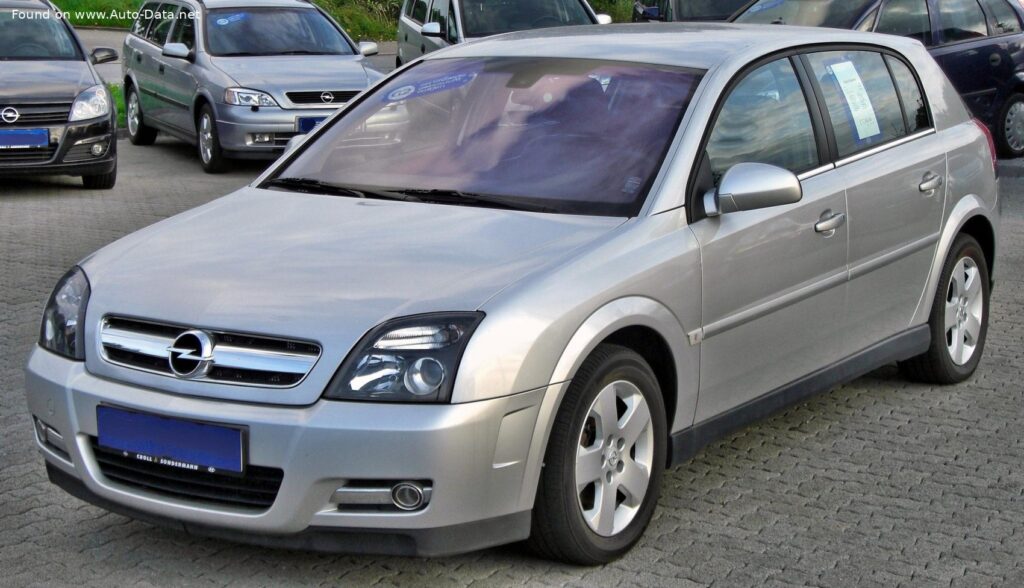
The Opel Signum: An Unconventional European Executive Hatchback
The Opel Signum, produced from July 2003 to June 2005, represented a distinctive and ambitious venture by German automaker Opel, a subsidiary of General Motors at the time. Positioned as a large executive hatchback, the Signum was based on the longer platform of the Opel Vectra C, sharing its architecture but carving out a unique niche in the European market. Unlike many of its contemporaries, the Signum was specifically designed to offer enhanced rear passenger comfort and cargo versatility, blending the practicality of a station wagon with the sleek lines of a large hatchback. This particular variant, the 3.0 V6 CDTI (177 Hp) Automatic, was a testament to Opel’s commitment to offering robust diesel powertrains, providing a compelling blend of performance, fuel efficiency, and refinement for the discerning European buyer. It was never officially sold in the United States, making it a lesser-known model across the Atlantic, but it played a notable role in Opel’s strategy to compete in the executive segment against more traditional sedans and wagons.
Engine and Performance: Powering the Opel Signum
Under the hood, the Opel Signum 3.0 V6 CDTI (177 Hp) Automatic featured a transversely mounted 3.0-liter V6 common rail diesel engine, designated with the internal code Y30DT. This sophisticated powerplant was engineered to deliver a strong balance of power and torque, making it well-suited for long-distance highway cruising and effortless overtaking. The engine generated a respectable 177 horsepower at 4000 rpm, translating to a power output of 59.8 horsepower per liter. More significantly, it produced a substantial 272.9 lb.-ft. of torque available from a low 1900 rpm, a characteristic hallmark of diesel engines that provided excellent low-end grunt and flexibility.
Power was delivered to the front wheels via a smooth-shifting 5-speed automatic transmission. This combination allowed the Signum to accelerate from 0 to 60 mph in a brisk 9.4 seconds, with a top speed of 135.46 mph. While not a performance car, these figures were competitive for its class and intended purpose as a comfortable, capable executive cruiser. The engine’s aspiration system included a turbocharger and an intercooler, optimizing air intake for improved combustion and efficiency. The DOHC valvetrain with 4 valves per cylinder further contributed to the engine’s responsiveness and refined operation.
Fuel efficiency was a key selling point for diesel engines in Europe, and the Signum 3.0 V6 CDTI did not disappoint. It achieved an impressive combined fuel economy of 29.8 US mpg (7.9 l/100 km). Urban driving saw figures around 21 US mpg (11.2 l/100 km), while extra-urban (highway) cruising could yield up to 39.2 US mpg (6 l/100 km). These figures, combined with a 15.85 US gallon fuel tank, provided a significant cruising range, a crucial factor for European drivers.
Design and Features: Innovation in Form and Function
The Opel Signum’s design was a departure from conventional sedan styling, embracing a five-door hatchback body type with an extended wheelbase of 111.42 inches. This stretched platform, shared with the long-wheelbase Vectra C, allowed for exceptional rear passenger legroom, a primary focus of the Signum’s design brief. The exterior featured a sleek, aerodynamic profile with a drag coefficient (Cd) of 0.33, contributing to both fuel efficiency and reduced wind noise at higher speeds. Its length of 182.52 inches and width of 70.79 inches gave it a substantial road presence.
Inside, the Signum truly differentiated itself. While it offered seating for five, the rear cabin was particularly innovative. Instead of a traditional bench seat, the Signum often featured two individual rear seats that could slide fore and aft, recline, and even be folded flat, much like the front seats. This “FlexSpace” system provided unparalleled versatility, allowing owners to prioritize either legroom or cargo space. The trunk space was generous for a hatchback, ranging from 12.89 cu. ft. with all seats in place to a cavernous 49.79 cu. ft. with the rear seats folded down. This flexibility made it a strong contender for those who needed both executive comfort and practical utility without opting for a full-sized wagon or minivan.
Standard features for a vehicle of its class in the early 2000s included power steering (hydraulic rack and pinion), ventilated disc brakes at the front, and disc brakes at the rear, complemented by an Anti-lock Braking System (ABS) for enhanced safety. The suspension system utilized coil springs at both the front and rear, tuned for a comfortable yet composed ride characteristic of European executive cars. The car rode on 215/55 R16 tires mounted on 6.5J x 16-inch wheel rims.
Technical Specifications
General Information |
|
| Brand | Opel |
| Model | Signum |
| Generation | Signum |
| Type (Engine) | 3.0 V6 CDTI (177 Hp) Automatic |
| Start of Production | July, 2003 |
| End of Production | June, 2005 |
| Powertrain Architecture | Internal Combustion Engine |
| Body Type | Hatchback |
| Seats | 5 |
| Doors | 5 |
Performance Specifications |
|
| Fuel Consumption (Economy) – Urban | 21 US mpg (11.2 l/100 km) |
| Fuel Consumption (Economy) – Extra Urban | 39.2 US mpg (6 l/100 km) |
| Fuel Consumption (Economy) – Combined | 29.8 US mpg (7.9 l/100 km) |
| Fuel Type | Diesel |
| Acceleration 0 – 60 mph | 9.4 sec |
| Maximum Speed | 135.46 mph (218 km/h) |
| Weight-to-Power Ratio | 9.4 kg/Hp, 106 Hp/tonne |
| Weight-to-Torque Ratio | 4.5 kg/Nm, 221.6 Nm/tonne |
Engine Specifications |
|
| Power | 177 Hp @ 4000 rpm |
| Power per Liter | 59.8 Hp/l |
| Torque | 272.9 lb.-ft. @ 1900 rpm (370 Nm @ 1900 rpm) |
| Engine Layout | Front, Transverse |
| Engine Model/Code | Y30DT |
| Engine Displacement | 180.51 cu. in. (2958 cm3) |
| Number of Cylinders | 6 |
| Engine Configuration | V-engine |
| Cylinder Bore | 3.44 in. (87.5 mm) |
| Piston Stroke | 3.23 in. (82 mm) |
| Compression Ratio | 18.5:1 |
| Number of Valves per Cylinder | 4 |
| Fuel Injection System | Diesel Commonrail |
| Engine Aspiration | Turbocharger, Intercooler |
| Valvetrain | DOHC |
| Engine Oil Capacity | 7.66 US qt (7.25 l) |
| Coolant Capacity | 8.77 US qt (8.3 l) |
Space, Volume and Weights |
|
| Kerb Weight | 3681.72 lbs. (1670 kg) |
| Max. Weight | 4817.1 lbs. (2185 kg) |
| Max Load | 1135.38 lbs. (515 kg) |
| Trunk (Boot) Space – Minimum | 12.89 cu. ft. (365 l) |
| Trunk (Boot) Space – Maximum | 49.79 cu. ft. (1410 l) |
| Fuel Tank Capacity | 15.85 US gal (60 l) |
Dimensions |
|
| Length | 182.52 in. (4636 mm) |
| Width | 70.79 in. (1798 mm) |
| Height | 57.72 in. (1466 mm) |
| Wheelbase | 111.42 in. (2830 mm) |
| Front Track | 60 in. (1524 mm) |
| Rear (Back) Track | 59.53 in. (1512 mm) |
| Drag Coefficient (Cd) | 0.33 |
Drivetrain, Brakes and Suspension Specifications |
|
| Drivetrain Architecture | Front-wheel drive with Internal Combustion Engine (ICE) |
| Drive Wheel | Front wheel drive |
| Number of Gears and Type of Gearbox | 5 gears, automatic transmission |
| Front Suspension | Coil spring |
| Rear Suspension | Coil spring |
| Front Brakes | Ventilated discs |
| Rear Brakes | Disc |
| Assisting Systems | ABS (Anti-lock braking system) |
| Steering Type | Steering rack and pinion |
| Power Steering | Hydraulic Steering |
| Tires Size | 215/55 R16 |
| Wheel Rims Size | 6.5J x 16 |
Legacy and Market Impact
The Opel Signum, particularly the 3.0 V6 CDTI variant, was an intriguing proposition in the European automotive landscape of the early 2000s. It attempted to bridge the gap between traditional D-segment (mid-size) sedans and wagons, and the emerging popularity of MPVs (minivans) and SUVs. Its primary competitors in Europe included models like the Renault Vel Satis, which shared a similar philosophy of offering a more unconventional, comfort-oriented executive experience, as well as more traditional executive cars such as the Ford Mondeo, Volkswagen Passat, and even entry-level premium offerings from Audi, BMW, and Mercedes-Benz.
Despite its innovative FlexSpace interior and powerful, efficient diesel engine, the Signum struggled to find widespread market acceptance. Its unique styling, which some found polarizing, and its positioning in a segment dominated by more conventional body styles, meant it never achieved the sales volumes Opel had hoped for. Many buyers in the executive class preferred the established prestige and styling of traditional sedans or the outright utility of wagons. The Signum’s emphasis on rear passenger comfort and adaptability, while technically impressive, was perhaps too niche for the mainstream European market.
Nonetheless, the Opel Signum 3.0 V6 CDTI (177 Hp) Automatic represented a bold move by Opel to innovate within the executive segment. It showcased advanced diesel technology for its time and demonstrated a forward-thinking approach to interior design and versatility. While its production run was relatively short (2003-2005 for this specific engine variant, with the overall model ending in 2008), the Signum remains a testament to Opel’s willingness to experiment with design and packaging to meet evolving consumer needs, even if those needs were not universally embraced. Today, it stands as a unique chapter in Opel’s history, appreciated by enthusiasts who value its comfort, space, and the robust performance of its V6 CDTI engine.
