Seat Ibiza V 1.0 EcoTSI (115 Hp) Start&Stop: A Detailed Overview
The Seat Ibiza V 1.0 EcoTSI (115 Hp) Start&Stop represents the fifth generation of the popular subcompact car produced by the Spanish automaker SEAT, a subsidiary of the Volkswagen Group. Introduced in 2017 and produced in this specific configuration until 2018, this iteration of the Ibiza marked a significant evolution in design, technology, and efficiency for the brand. Primarily designed for the highly competitive European market, where small, fuel-efficient hatchbacks are a staple, the Ibiza V was built on the Volkswagen Group’s MQB A0 platform, sharing its underpinnings with siblings like the Volkswagen Polo and Skoda Fabia. This allowed for improved interior space, enhanced driving dynamics, and the integration of advanced technologies previously reserved for larger vehicles.
Positioned as a youthful and sporty contender in the B-segment, the Ibiza V aimed to attract buyers seeking a blend of practicality, style, and engaging performance, all while maintaining excellent fuel economy. The 1.0 EcoTSI engine variant, with its 115 horsepower output and integrated Start&Stop system, was a key offering, demonstrating SEAT’s commitment to modern, downsized, turbocharged powertrains that deliver respectable power and torque without compromising efficiency. While never officially sold in the United States, the Seat Ibiza V is a prime example of the European automotive landscape, where compact dimensions, sophisticated small-displacement engines, and versatile hatchback designs dominate urban and highway driving alike.
Engine & Performance of the Seat Ibiza V
At the heart of the Seat Ibiza V 1.0 EcoTSI (115 Hp) Start&Stop lies a thoroughly modern and efficient powertrain. This variant features a 1.0-liter (999 cm³ or 60.96 cu. in.) inline three-cylinder engine, designated by codes like CHZJ or DKJA. Despite its small displacement, the engine benefits significantly from direct fuel injection, a turbocharger, and an intercooler, allowing it to produce a robust 115 horsepower at 5000-5500 rpm. This power output, impressive for a one-liter unit, translates to a power-per-liter ratio of 115.1 Hp/l, showcasing its advanced engineering.
Equally important is the torque delivery, which stands at 200 Newton-meters (147.51 lb.-ft.) available across a wide and accessible band from 2000 to 3500 rpm. This broad torque curve ensures responsive acceleration in everyday driving scenarios, making the car feel livelier than its displacement might suggest. Paired with a precise 6-speed manual transmission driving the front wheels, the Ibiza V 1.0 EcoTSI can accelerate from 0 to 60 mph in a brisk 8.8 seconds (0-100 km/h in 9.3 seconds) and reach a maximum speed of 121.17 mph (195 km/h). The engine’s DOHC valvetrain, with four valves per cylinder, further optimizes combustion efficiency and performance.
Fuel efficiency is a cornerstone of this powertrain. The integrated Start&Stop system automatically shuts off the engine when the vehicle is stationary, reducing fuel consumption and emissions in urban traffic. This contributes to an impressive combined fuel economy rating of 50 US mpg (4.7 l/100 km). Urban consumption is rated at 40.6 US mpg (5.8 l/100 km), while extra-urban driving yields an exceptional 57.4 US mpg (4.1 l/100 km). With CO2 emissions of just 108 g/km, the Ibiza V meets stringent Euro 6 emission standards, underscoring its environmental consciousness. The vehicle’s lightweight construction, with a curb weight of 2347.92 lbs (1065 kg), also plays a crucial role in its agile performance and efficiency, resulting in a favorable weight-to-power ratio of 9.3 kg/Hp.
Design & Features
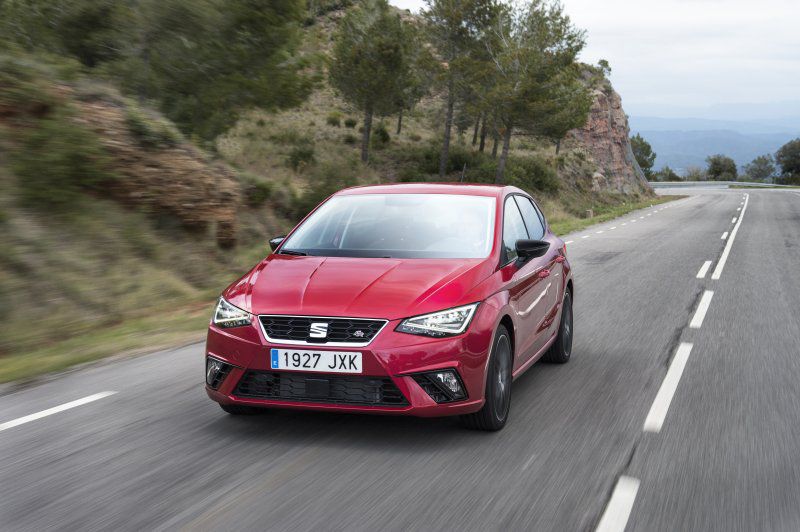
The Seat Ibiza V adopted a sharper, more angular design language compared to its predecessors, aligning it with SEAT’s contemporary aesthetic, characterized by crisp lines and dynamic proportions. As a 5-door hatchback, it offered a practical and versatile body style, appealing to a wide demographic from young professionals to small families. The exterior featured a bold front grille, distinctive LED daytime running lights, and sculpted body panels that conveyed a sense of sportiness and sophistication. Its compact dimensions – a length of 159.8 inches, width of 70.08 inches, and height of 56.85 inches – made it ideal for navigating crowded European city streets, while a wheelbase of 100.94 inches contributed to a stable ride and maximized interior volume.
Inside, the Ibiza V offered a surprisingly spacious and well-appointed cabin for its segment. Designed to accommodate five occupants, it featured comfortable seating and a driver-focused dashboard layout. Standard features for the era included power steering with electric assistance, ensuring effortless maneuverability. Safety was addressed with an Anti-lock Braking System (ABS) and disc brakes all around, with ventilated discs at the front for enhanced stopping power. The suspension system, comprising an independent McPherson strut setup with coil springs and an anti-roll bar at the front, and a semi-independent coil spring arrangement at the rear, provided a balanced ride quality, blending comfort with responsive handling.
Practicality was a strong suit, with a minimum trunk (boot) space of 12.54 cubic feet (355 liters), expandable to a generous 41.14 cubic feet (1165 liters) with the rear seats folded down. This made the Ibiza V capable of handling everything from weekly groceries to weekend luggage. The fuel tank capacity of 10.57 US gallons (40 liters) combined with its excellent fuel economy offered a substantial driving range. The car also offered a range of tire sizes, from 185/65 R15 up to 215/40 R18, allowing buyers to customize the look and handling characteristics to their preference.
Technical Specifications
| Attribute | Value |
|---|---|
| General Information | |
| Brand | Seat |
| Model | Ibiza |
| Generation | Ibiza V |
| Type (Engine) | 1.0 EcoTSI (115 Hp) Start&Stop |
| Start of Production | 2017 year |
| End of Production | 2018 year |
| Powertrain Architecture | Internal Combustion Engine |
| Body Type | Hatchback |
| Seats | 5 |
| Doors | 5 |
| Performance Specs | |
| Fuel Consumption (Urban) | 5.8 l/100 km (40.6 US mpg) |
| Fuel Consumption (Extra Urban) | 4.1 l/100 km (57.4 US mpg) |
| Fuel Consumption (Combined) | 4.7 l/100 km (50 US mpg) |
| CO2 Emissions | 108 g/km |
| Fuel Type | Petrol (Gasoline) |
| Acceleration 0 – 60 mph | 8.8 sec |
| Acceleration 0 – 100 km/h | 9.3 sec |
| Maximum Speed | 195 km/h (121.17 mph) |
| Emission Standard | Euro 6 |
| Weight-to-Power Ratio | 9.3 kg/Hp (108 Hp/tonne) |
| Weight-to-Torque Ratio | 5.3 kg/Nm (187.8 Nm/tonne) |
| Engine Specs | |
| Power | 115 Hp @ 5000-5500 rpm |
| Power per Liter | 115.1 Hp/l |
| Torque | 200 Nm (147.51 lb.-ft.) @ 2000-3500 rpm |
| Engine Layout | Front, Transverse |
| Engine Model/Code | CHZJ, DKJA |
| Engine Displacement | 999 cm³ (1.0 L / 60.96 cu. in.) |
| Number of Cylinders | 3 |
| Engine Configuration | Inline |
| Cylinder Bore | 74.5 mm (2.93 in.) |
| Piston Stroke | 76.4 mm (3.01 in.) |
| Compression Ratio | 10.5:1 |
| Valves per Cylinder | 4 |
| Fuel Injection System | Direct Injection |
| Engine Aspiration | Turbocharger, Intercooler |
| Valvetrain | DOHC |
| Engine Oil Capacity | 4 l (4.23 US qt) |
| Coolant Capacity | 10 l (10.57 US qt) |
| Engine Systems | Start & Stop System |
| Space, Volume and Weights | |
| Kerb Weight | 1065 kg (2347.92 lbs) |
| Max. Weight | 1660 kg (3659.67 lbs) |
| Max Load | 595 kg (1311.75 lbs) |
| Trunk (Boot) Space – Minimum | 355 l (12.54 cu. ft.) |
| Trunk (Boot) Space – Maximum | 1165 l (41.14 cu. ft.) |
| Fuel Tank Capacity | 40 l (10.57 US gal) |
| Max. Roof Load | 75 kg (165.35 lbs) |
| Permitted Trailer Load with Brakes (8%) | 1200 kg (2645.55 lbs) |
| Permitted Trailer Load with Brakes (12%) | 1100 kg (2425.08 lbs) |
| Permitted Trailer Load without Brakes | 570 kg (1256.63 lbs) |
| Dimensions | |
| Length | 4059 mm (159.8 in.) |
| Width | 1780 mm (70.08 in.) |
| Width Including Mirrors | 1942 mm (76.46 in.) |
| Height | 1444 mm (56.85 in.) |
| Wheelbase | 2564 mm (100.94 in.) |
| Front Track | 1525 mm (60.04 in.) |
| Rear (Back) Track | 1505 mm (59.25 in.) |
| Front Overhang | 796 mm (31.34 in.) |
| Rear Overhang | 699 mm (27.52 in.) |
| Minimum Turning Circle (Diameter) | 10.6 m (34.78 ft.) |
| Drivetrain, Brakes and Suspension Specs | |
| Drivetrain Architecture | Front-wheel drive, Internal Combustion Engine |
| Drive Wheel | Front wheel drive |
| Number of Gears and Type of Gearbox | 6 gears, manual transmission |
| Front Suspension | Independent, type McPherson with coil spring and anti-roll bar |
| Rear Suspension | Semi-independent, coil spring |
| Front Brakes | Ventilated discs |
| Rear Brakes | Disc |
| Assisting Systems | ABS (Anti-lock braking system) |
| Steering Type | Steering rack and pinion |
| Power Steering | Electric Steering |
| Tires Size | 185/65 R15; 195/55 R16; 215/45 R17; 215/40 R18 |
| Wheel Rims Size | 5.5J x 15; 6.5J x 16; 7J x 17; 7J x 18 |
Legacy & Market Impact
The fifth-generation Seat Ibiza, particularly the 1.0 EcoTSI (115 Hp) Start&Stop variant, carved out a significant niche in the intensely competitive European subcompact segment. Its introduction in 2017 was met with positive reception, largely due to its striking design, improved interior quality, and the benefits of the new MQB A0 platform. This platform, shared with the Volkswagen Polo, allowed the Ibiza to shed its previous generation’s more budget-oriented image and present itself as a more sophisticated and dynamically capable vehicle.
In Europe, the Ibiza faced formidable rivals such as the Ford Fiesta, Renault Clio, Peugeot 208, Opel Corsa, and its platform-mate, the Volkswagen Polo. Against these competitors, the Ibiza V distinguished itself with its distinctly sporty styling, a hallmark of the SEAT brand’s “auto emoción” philosophy. Its sharper handling characteristics and youthful appeal often made it a preferred choice for drivers seeking a more engaging experience than some of its more conservative rivals.
The 1.0 EcoTSI engine, with its balance of power and exceptional fuel economy, was particularly impactful. It perfectly aligned with European market demands for efficient, low-emission vehicles that could still offer sufficient performance for both urban commutes and longer highway journeys. The Start&Stop system further cemented its reputation as an environmentally conscious and cost-effective option for daily driving. This engine variant became a popular choice, showcasing the viability and effectiveness of modern three-cylinder turbocharged powertrains.
While the Seat Ibiza V was never exported to the North American market, its success in Europe highlighted a different automotive paradigm. It demonstrated how compact dimensions, advanced small-displacement engines, and clever packaging could create a highly desirable and practical vehicle. The Ibiza’s reputation as a stylish, reliable, and fun-to-drive subcompact cemented SEAT’s position as a key player in the European automotive landscape. Its legacy continues as a benchmark for what a modern, efficient, and engaging B-segment hatchback can be, influencing subsequent designs and technological advancements within the segment.